

Pros And Cons Of EV Vs. Internal Combustion Off-Road SUVs
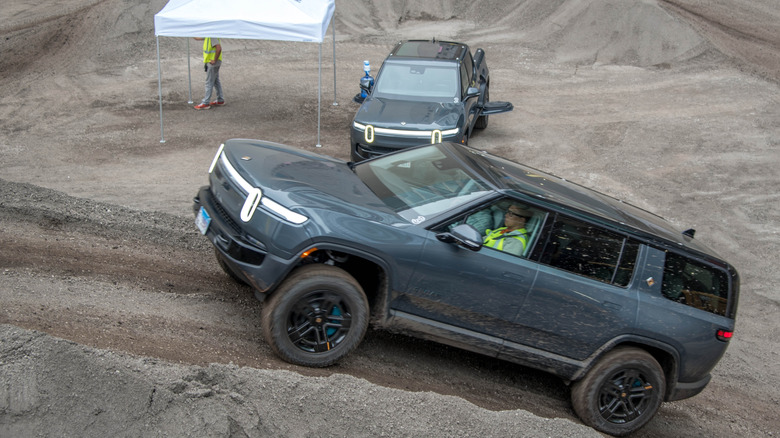
For decades, one of the biggest debates among off-road enthusiasts has been whether gas or diesel trucks make for the better off-roader. There are plenty of good reasons to run both types of vehicles on your favorite trails, but gas and diesel enjoyers alike have a new issue to worry about. That would be the new kid on the block: electric SUVs with purported off-road chops for days. While it might've once been inconceivable that an electric vehicle could even come close to matching the performance of off-road all-stars like the Toyota Tundra, the Subaru Forester Wilderness, and even the Mercedes-Benz C-Class, the introduction of the Rivian R1S and R1T in 2021 turned the off-roading world upside down.
As it turns out, modern EVs aren't just highly capable on pavement; they can also be tuned for seriously impressive rock crawling, and they even have some significant benefits over their competitors with traditional internal combustion engines. For one, many EVs have excellent ground clearance, and they need fewer pieces of specialized gear to excel on even the most challenging wilderness trails.
That's not to say that gas- and diesel-powered SUVs are now completely obsolete. Far from it. There are plenty of downsides, with the issue of range at the forefront of the discussion. It's just no longer so easy for non-electric off-road vehicles to claim superiority over the outdoors. And as EVs get better and battery technology improves, the dominance of gas and diesel rigs is sure to wane.
Pro: EV drivetrains are a game changer
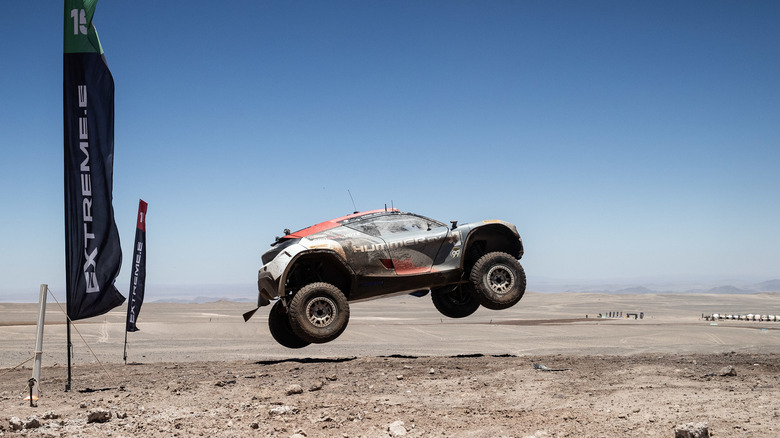
When navigating stretches of trail with treacherous ruts, massive boulders, and loose dirt, you don't normally get through the rough just by slamming the gas pedal and hoping for the best. Successfully navigating tough trails involves care, patience, and, most importantly, torque — the force your car uses to turn its wheels.
In non-EVs, a big part of the off-roading experience is carefully managing your gears to keep the engine's RPMs at a level ideal for achieving maximum torque. This isn't easy, and doing it incorrectly can mean getting stuck or even breaking something. But EVs don't require any careful RPM management, switch flipping, or finely honed instincts to unlock constant maximum torque. That's because it's always there, on demand, the moment you press the accelerator. Electric motors don't need any time to rev to the ideal speed and can instead deliver max torque directly from a stop. That's what gives them such thrilling acceleration and what makes EVs like the Rivian R1 such monstrous off-roaders.
So, what takes tons of bells and whistles on an SUV with an internal combustion engine — such as four-wheel low, four-wheel high, transfer cases, and locking differentials — is accomplished with electric motors. For example, the GMC Hummer EV has a tri-motor drivetrain, and the Rivian R1 has a quad-motor setup. This allows the SUVs to deliver torque to individual wheels exactly when it's needed most, unlocking massive crawling capability with relatively little gear. The end result is that EVs have all the power they need even from a dead stop, and they can navigate complicated terrain easily.
Con: Hard range limits could ruin your day
A sticking point with EVs since the very beginning has been range. Automakers are constantly in pursuit of ever-more-efficient batteries and ever-longer all-electric ranges. In daily driving, this hurdle isn't very hard to overcome. If you drive less than a couple hundred miles a day and have access to a Level 2 charger, you may literally never think about running out of juice. But the fact is that once you're out on a trail, there's no reliable way to top up, and if you run your battery to 0% in the middle of nowhere, well, you're out of luck.
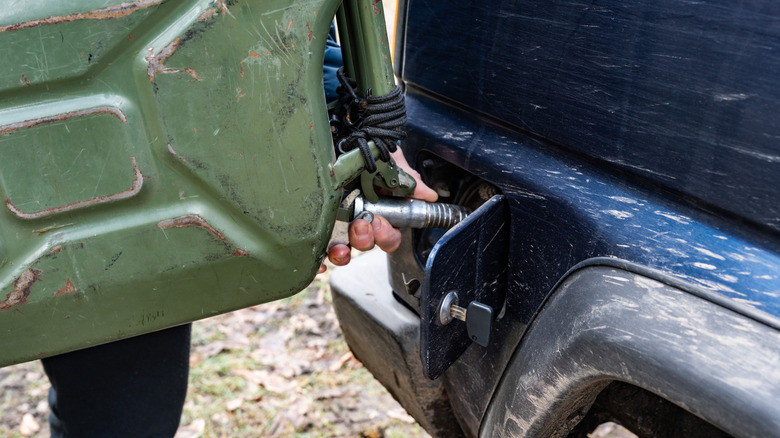
With a diesel- or gas-powered SUV, it's a pretty simple affair to carry a gas can or two for spare fuel. This lets you fill up on the go and push past the limits you'd normally be able to reach on a single tank of gas. It also means that, if you push yourself a little too far, you can always dig the spare out of the back, hopefully giving you enough juice to reach civilization and refuel or find someone who can drive you to the nearest gas station. With EVs, there's no such option. Hot-swapping batteries on the fly isn't really a thing, even for on-road EVs, and there's no guarantee that you'll find yourself in range of appropriate charging infrastructure after a big day on the trails.
That puts a hard ceiling on how many miles you can cover on a trail if you're driving an EV. Additionally, you're none too likely to even start the trail with a full charge, especially if you like to get out deep into the wilderness. This isn't an insurmountable problem, but it can't be ignored.
Pro: There's just not much to break
Even though many of the most popular off-roaders started out as military vehicles that eventually made it into civilian life, they're far from indestructible. In fact, gas-powered off-road vehicles require a lot more specialized equipment to perform at their best, and these systems are prone to breaking after a while. It's not like off-roading is super easy on your ride, after all. When it comes to EVs, there's just less there to break.
For one, EVs require exceedingly few fluids. There's no gasoline, no engine oil, no transmission fluid, no power steering fluid, and so on. That means no losing your oil pan on a stray boulder, no fuel lines breaking from debris, and no coolant leaks leading to an overheated engine. It's actually kind of peaceful to think about. You just get to drive out onto your favorite trail and not stress over keeping all your fluids topped up, and you never have to stop to add coolant in the middle of an exciting stretch.
The same is true for gear such as locking differentials and transfer cases. For EV drivers out on the trails, catching your differential on a rock and destroying it are experiences of the past. The smooth underbelly of an EV gives it more ground clearance than an equivalent gas-powered SUV with sensitive gear strapped to the underbelly. Of course, ground clearance isn't everything.
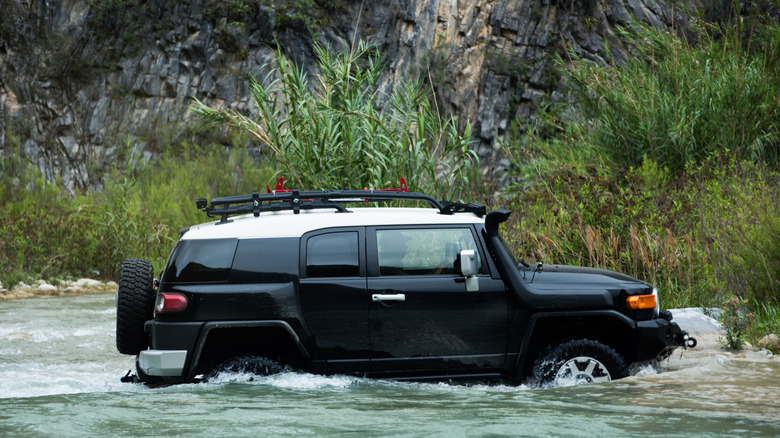
Dust and water intrusion are also less serious issues due to the lack of an engine and other complex moving parts. You don't have to worry about clogging your intake with dust or hydrolocking your engine because there's no intake moving air into the vehicle's machinery, and there's no engine. You can easily ford streams with many EVs, but, uh, not the Cybertruck.
Con: When EVs break, they break big
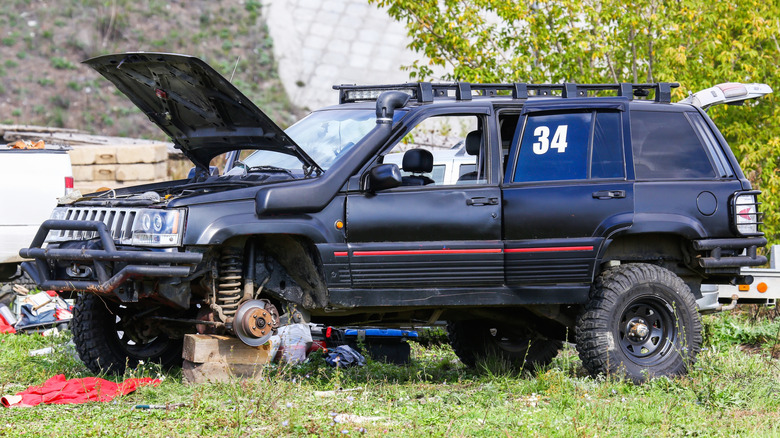
Yes, it's true that you're less likely to have a critical failure in your drivetrain because it has fewer complex, moving parts. However, EVs aren't invincible either, and when something goes wrong, it tends to go really wrong. Whereas fixing an issue on the go is part of the everyday experience for off-road enthusiasts driving gas-powered SUVs, EVs are a bit more — let's say — esoteric. If you drive an off-road legend like the Jeep Wrangler Rubicon, you might know how to patch up a broken fuel line or perform a basic trail repair with no issues. It'll take some time and the right tools, and maybe the foresight to carry some spare parts with you, but it's doable.
That's not always the case with EVs. These complicated machines often require proprietary systems just to diagnose issues, and many common EV repairs take much longer for licensed technicians to perform than the equivalent repair on a gas-powered vehicle. Not to mention that you need a degree to fully understand the complex electrical systems. This is all to say: EVs are complicated machines, and off-roaders don't have decades of experience solving problems with them on the fly.
Another major concern is the battery. Scraping the underbelly of your EV on rocks isn't going to destroy your non-existent transfer case, but it does risk damaging the car's battery. Not only are these batteries prohibitively costly to replace, but they're also capable of igniting and causing massive, catastrophic fires. Now, EVs don't burn to the ground very often, but the risk is always there, and it might make you think twice about taking your spiffy new EV out on challenging trails.
Pro: EVs are fun as hell
There's a reality about electric cars that driving enthusiasts of all stripes simply can't afford to deny: EVs are really, really, really fun. Sure, lots of them might have numb steering, and charging still takes (and may always take) longer than filling up a gas tank, but the draw toward instantaneous torque and lightning-fast acceleration isn't diminished by such minor flaws. And, like it or not, EVs on the trail are just as charismatic and inspiring as their on-road counterparts would suggest.
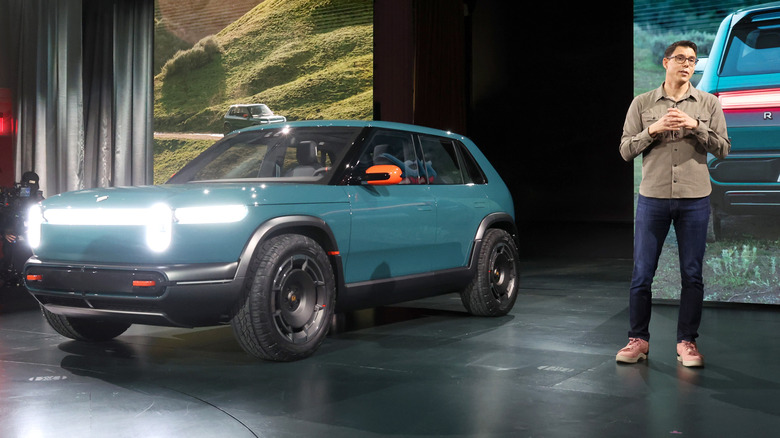
Rivian really started something special here, because before the R1, EV off-roading seemed like a dream. And now the 2026 Rivian R1's 1,000-horsepower quad-motor setup is less stunning than its incredible off-road capabilities. With the R2 looking even better than anyone had hoped, Rivian might just be introducing yet another off-road all-star to the world.
Off-road-focused electric SUVs are going to be easier for beginners to get a handle on, and even old heads might be glad for the break from the cognitive load that is managing gears to maximize torque. The power delivery just feels so good, and the lack of forward creep makes managing low-speed stretches of trail all the smoother. Once the world's EV charging infrastructure gets a bit more robust — it's already gotten leaps and bounds better in the last few years — you might see EVs tackling even the most remote of trails.
Con: EVs are haunted by high prices

Yes, it's one of the main talking points surrounding EV accessibility these days, but it's worth harping on for a bit longer. EVs have long been, and continue to be, significantly more expensive than their gas-powered counterparts. Mercifully, that price gap has shrunk somewhat in recent years, but the Trump administration's axing of the EV tax credit and subsequent loosening of critical CAFE standards may cause EV prices to start climbing again. Yay for looser fuel economy standards in the face of an accelerating climate crisis!
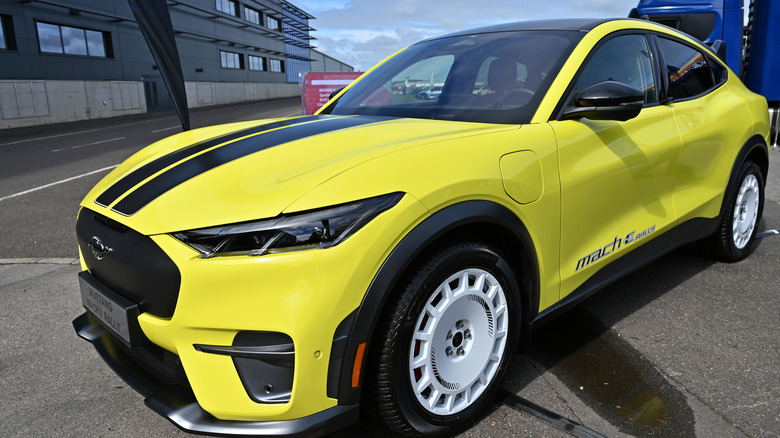
Regardless of what the future holds, the reality today is that EVs aren't exactly an accessible mode of transportation for the average person, and that's doubly true for those looking for off-road rides — especially when America is getting gems like Hyundai's new Tucson XRT Pro with actual mechanical upgrades. For reference, a 2026 Subaru Forester Wilderness starts at $36,995, while a Ford Mustang Mach-E Rally is one of the most affordable EVs with real off-road chops and starts at $58,930. If you want a tri-motor Rivian R1S — not even the top-of-the-line quad-motor — you'll find yourself paying nearly double that before any options. The R1 is a veritable powerhouse and might even be worth every penny you pay for it, but that doesn't mean everyone can actually afford it, no matter how cool it is.
Of course, China is still winning the cool award for its off-roader with a waterproof engine and propellers. Not to mention sonar. And it's way cheaper than a Rivian, too. Why can't we have nice things?
Are EV off-roaders worth it?
At the end of the day, it's hard to deny the capabilities that electric SUVs have in off-road spaces, and while they certainly aren't going to replace our beloved gas-guzzling rock crawlers entirely any time soon, they're sure to be a fixture in the culture for a long time to come. For as long as torque has a chokehold on every enthusiast's fantasies, electric SUVs are going to keep showing up on the trails and maybe even occasionally showing up everyone else there.
If you can convince your rich friend to let you take their R1 or their completely over-the-top Hummer EV out to the trails and crawl around for a while, you should take the opportunity and get a feel for what these beasts can really do. You may just find yourself salivating and feeling inspired to save up for an EV off-roader of your own. Or maybe you'll miss the rumble of your precious V6 and the thrill of the hunt for ideal torque output.