

2026 Honda Prelude Is Enjoyable To Drive But Feels Underbaked
Since its reveal in prototype form a few years ago, I've been on the record as being on the new Honda Prelude's side. The idea of an efficient liftback with engaging dynamics is very appealing to me, especially when presented in a well-designed wrapper. I don't think an enthusiast car needs tons of power to be compelling, and the Civic Hybrid's setup is widely lauded, so I thought combining that with simulated shifts and other performance upgrades should be a recipe for success.
Unfortunately, after driving the Prelude on some of the amazing roads near Palomar Mountain in Southern California, I'm left more than a little perplexed. There are some fantastic aspects of this car — it looks awesome, it's fun to drive and handles really well, and it's still a pretty nice package even at its Trump-inflated current price. But while the Prelude's hybrid powertrain does get great fuel economy, it simply isn't exciting or good enough for this car, and Honda's hyped-up S+ Shift system is mostly pointless. As it is now, the 2026 Honda Prelude is an enjoyable but strange car that feels mismatched and underbaked.
Full disclosure: Honda invited me to drive down to Oceanside, California, and put me up in a hotel that has the "Top Gun" house on its grounds so I could drive the new Prelude, the facelifted Pilot, and every prior generation of Prelude. They fed me good meals and also invited an Olympian to teach us how to curl.
The good
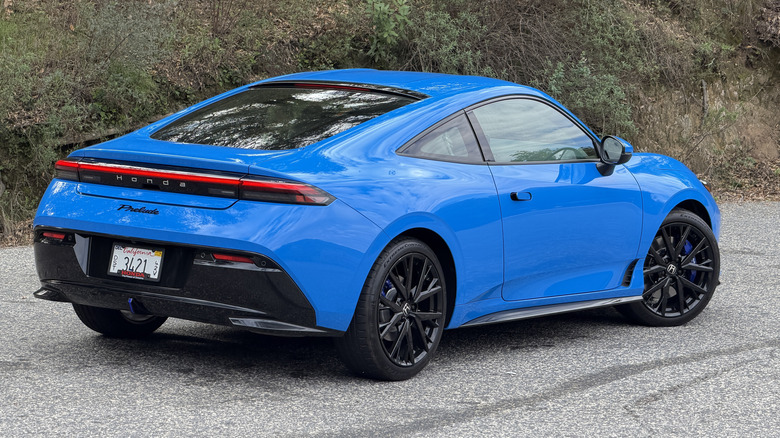
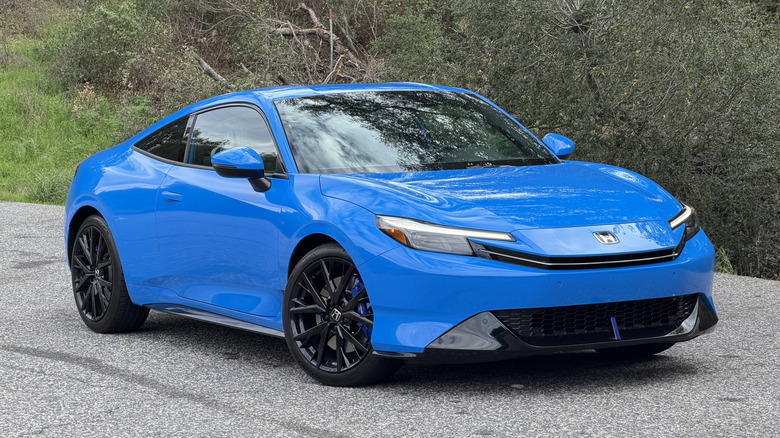
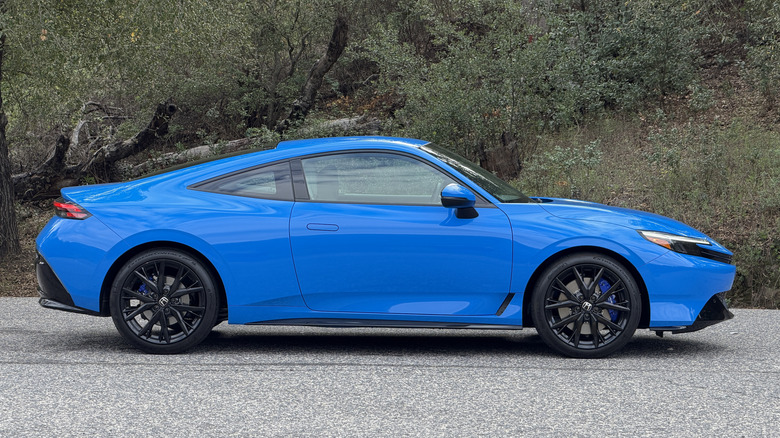
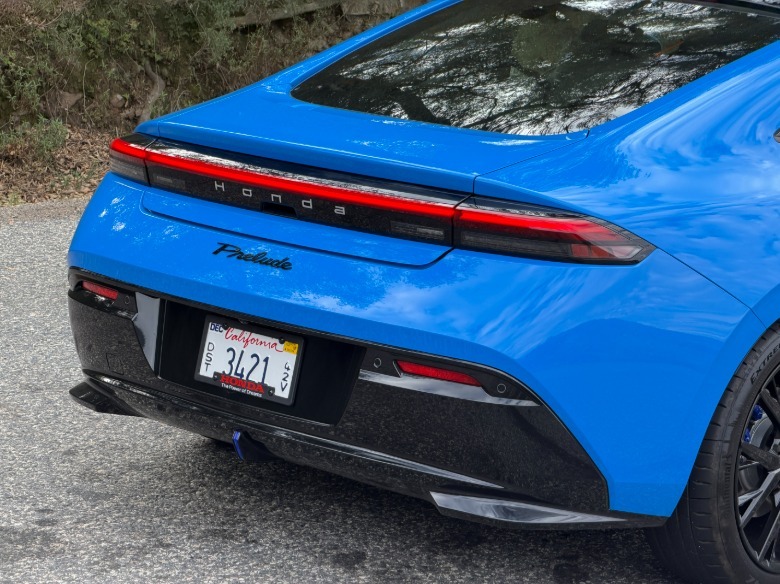
I'll start out with the styling, one of the most positive aspects of the Prelude. It really does look good from every angle, I think, especially in one of the bright colors like the Boost Blue you see here. Sure, you'll probably get some annoying people saying that your car looks like a Prius, but aside from the upper nose treatment I really don't think they're similar, and who cares, anyway? The Prelude has some really nice details, like the way the corners of the front bumper inform the shape of the vents behind the front wheels, and the surfacing of the rear haunches. Following a group of other journalists in Preludes, it looks properly sporty from behind. The stance rules, and we already know the car will take well to modification.
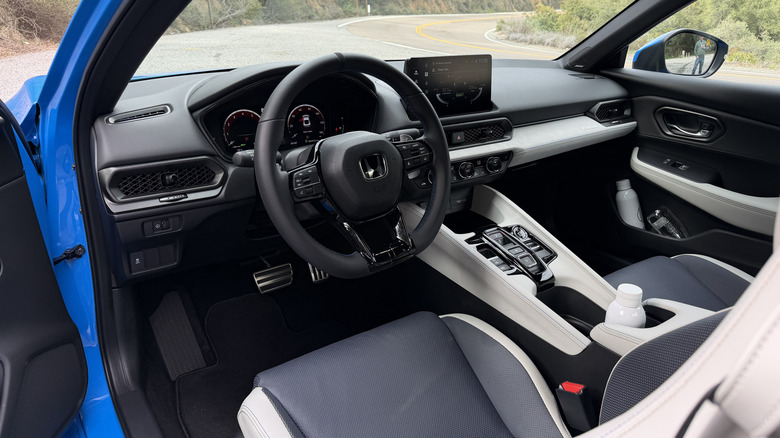
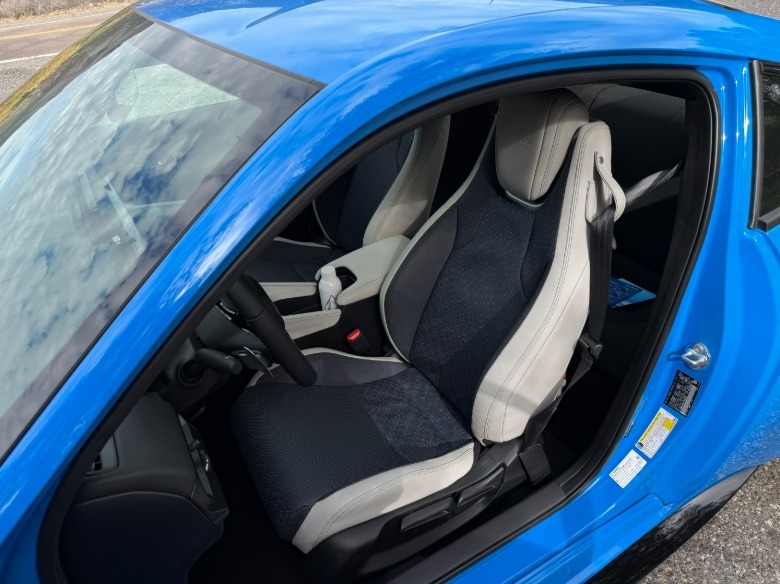
The interior is nice, too. While a lot of the components are the same, it isn't just the Civic's interior ported over. You definitely have to get the two-tone white and blue color scheme, though annoyingly it's only offered with blue or white paint. (The other paint options are bright red, black or gray.) There are more leather-covered and padded surfaces than in a Civic, and the finish on the dashboard, center console and door panels is nice. Even with black leather you get blue stitching, and the seats have an awesome perforated houndstooth pattern.
 Daniel Golson / Jalopnik
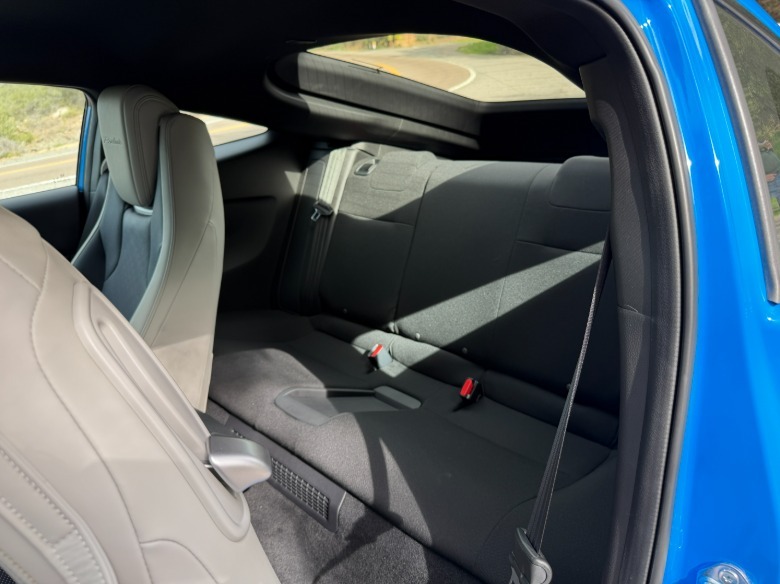
Those seats are great, seemingly a bit more well-bolstered than what's in the Civic Si and with integrated headrests. The passenger seat is apparently wider for more comfort, though I honestly couldn't tell a difference. While I can technically fit in the sparse cloth-upholstered back seats behind my 5'9" driving position, the C-pillar is extremely thick and large, partially because of the design of the liftback. I certainly would not feel safe with my head resting right against it, even if the panel was a softer material instead of hard plastic. While the rear window is big, that thick C-pillar and small quarter window makes rearward visibility pretty bad, but the A-pillars are super thin like the Civic's, and the view out the windshield is fantastic.
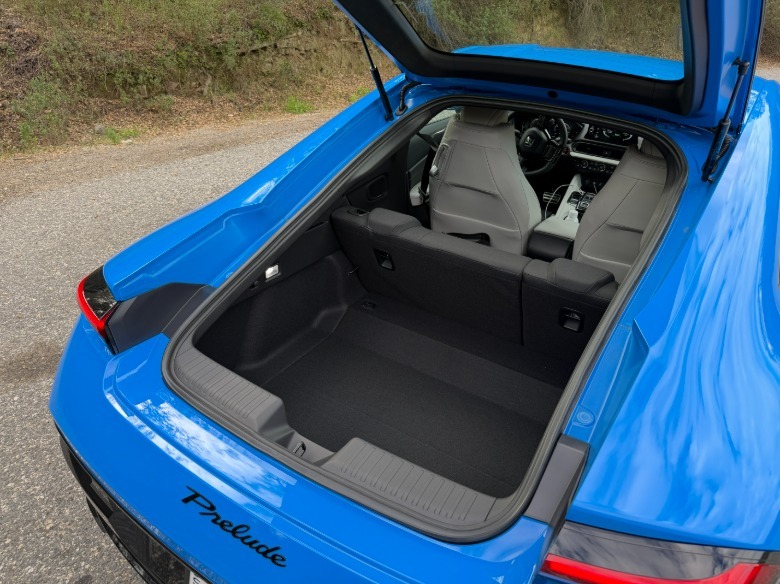
Despite really being sized for children or pets, those extra seats do give the Prelude a leg up on other strictly two-seat coupes like the Nissan Z. Its cargo area is seriously big, too. Honda only quotes cargo volume with the rear seats up, which at 15.1 cubic feet is already more than twice that of the Toyota GR86 and almost as much as a BMW 4 Series Gran Coupe, and the seats fold with a 60/40 split to create an almost-flat floor. The company says there's enough room for golf bags, and you might be able to fit a bicycle in there. The sill is pretty tall, but the Prelude is low and small enough it won't be too much of a pain to load in suitcases or other gear.
The really good
Within seconds of driving the Prelude you'll experience its best attribute: how it handles. Honda fitted the Prelude with the wider tracks and dual-axis MacPherson strut front suspension from the Civic Type R, along with a multi-link rear axle and adaptive dampers. Its steering rack is also taken from the Type R, albeit modified for more of a grand-touring feel. There are four different drive modes on offer — Comfort, GT and Sport, plus a configurable Individual — that change up powertrain response, suspension damping, steering tuning and engine sound. The car defaults to GT, which is a fine middle ground, though I'd probably just always keep it in Sport as differences between the three aren't hugely noticeable.
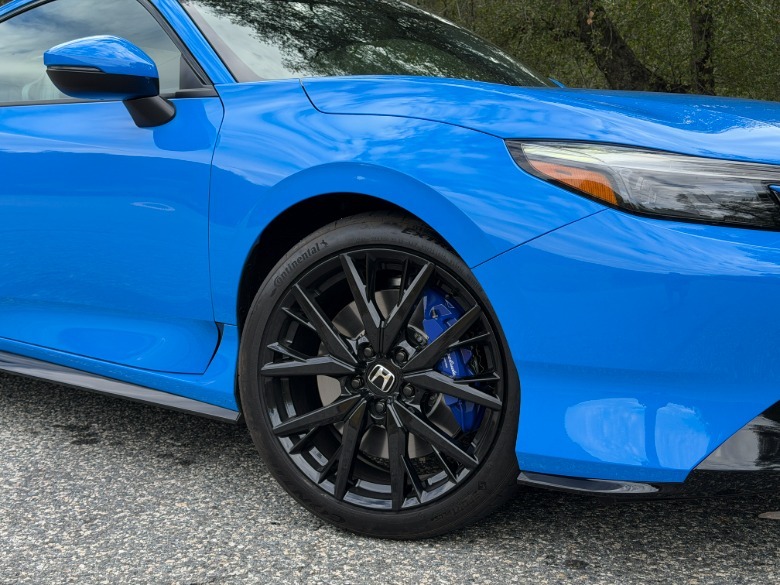
Good news is, the Prelude's dynamics are every bit as excellent as its sporty siblings. The flat-bottomed steering wheel provides tons of feedback, with a sharpness and precision that make small corrections easy. All-season tires are standard, but the Prelude I drive is fitted with Continental ExtremeContact Sport 02 summer tires that offer more grip than a Prelude driver will probably ever need. (Honda has yet to say how much this option costs, and it's not shown on the configurator.) Even in Sport mode the ride is pretty comfortable, nicely absorbing surface transitions and pockmarked tarmac, but the tires do contribute to a lot of road noise that makes its way into the cabin.
 Daniel Golson / Jalopnik
Because its powertrain isn't particularly powerful, the Prelude is more of a momentum car, as my drive partner (and friend of Jalopnik), MotorTrend's Scott Evans, accurately described it. It's all about quickly cruising through corners, maintaining speed using momentum and steering inputs more than the throttle and brakes. The Prelude's development manager Tomoyuki Yamagami told us he loves the movie "Top Gun," but instead of wanting to make the Prelude like a fighter jet, he wanted it to be like a glider. The Prelude only weighs 3,261 pounds, according to Honda, so it does feel very light on its feet. I can carry a lot of speed into corners without the balance getting thrown off, and it rotates well with little body roll. The Prelude is well suited to long sweepers, where it still feels engaging and fun, but it's really at home when attacking tight, technical routes, where you'll easily enter a flow state. It's definitely a car that will make you smile on a good road, which I think matters more than anything else.
Honda also gave the Prelude the same Brembo brakes as the Type R, which use four-piston calipers and 13.8-inch rotors up front and 12-inch rotors in the rear. The setup is almost certainly overkill for this car given the amount of power it has, but brake pedal feel is extremely good. In normal driving, you can use the steering wheel paddles to select between half a dozen levels of regenerative braking, the most extreme of which is nice and strong, able to bring the car fairly close to a stop. But in order to force the regen to stay at a specific level you need to hold down the left paddle once you've selected it, otherwise it will reset to the default no-regen state the second you hit either of the pedals, and even then the setting doesn't stay for very long.
The not-so-good
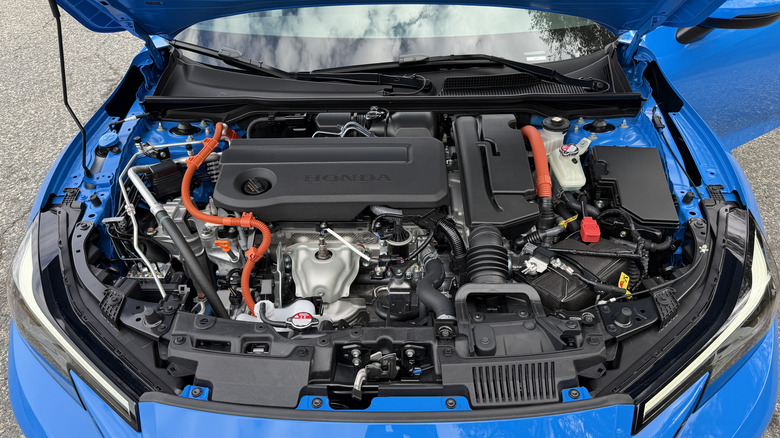
But with the Prelude's handling excellence comes powertrain meh-ness. Its setup is identical to the Civic Hybrid, combining a naturally aspirated 2.0-liter inline-4 with a pair of electric motors; one is attached to the engine as a motor/generator to produce energy for the battery and to the other electric motor, which is a drive unit directly powering the front wheels. A traditional transmission or CVT isn't needed, and most of the time the electric motor is doing all the acceleration work, but there is a clutch lock up that allows the gas engine to send torque to the wheels at freeway speeds. The engine makes 141 horsepower and 134 pound-feet of torque on its own, the electric motor makes 181 hp and 232 lb-ft on its own, and total system horsepower comes in at 200.
There's been a big brouhaha about how quick the Prelude actually is in the real world, partly because Honda hasn't given any sort of estimate, and because YouTubers who got their hands on early production units made videos showing off how seemingly slow the acceleration times are, in some cases recording 0-to-60-mph times of more than 9 seconds. And in real life it does feel quite slow, at least from a stoplight. In Sport mode, regardless of whether or not S+ Shift is turned on, flooring it from a stop results in way too much hesitation for a performance car, with the Prelude taking multiple beats before it starts to accelerate with any urgency. Honda says the electric motor's maximum torque is available from 0 to 2,000 rpm, but it really doesn't feel that way. Doing a rolling start from 5-10 mph does seem to result in quicker acceleration, though it's still not very impressive. There is adequate power when going to pass a car on a back road, merging onto the freeway or accelerative out of a corner, but the Prelude is no speed demon.
 Daniel Golson / Jalopnik
Now, I didn't try brake-torquing it, which is how Car and Driver got a Civic Hybrid to 60 mph in 6.2 seconds, so that could be the key to getting similar numbers out of the Prelude. (C/D's number also includes a 0.3-second, 1-foot rollout, and the publication said that without brake-torquing it the Civic was about a second slower.)
It definitely is efficient, though, which helps make up for its lack of shove. The EPA estimates the Prelude at 44 mpg combined, 46 mpg city and 41 mpg highway; all three figures are only 4 mpg less than what a Civic hybrid hatchback will do. That's better than most economy cars will get, let alone other sports cars — an automatic GR86 can only manage 21 mpg city and 30 mpg highway. After about 150 miles of driving, much of which was aggressive and with S+ turned on, the Prelude said we had gotten 35 mpg.
The strange
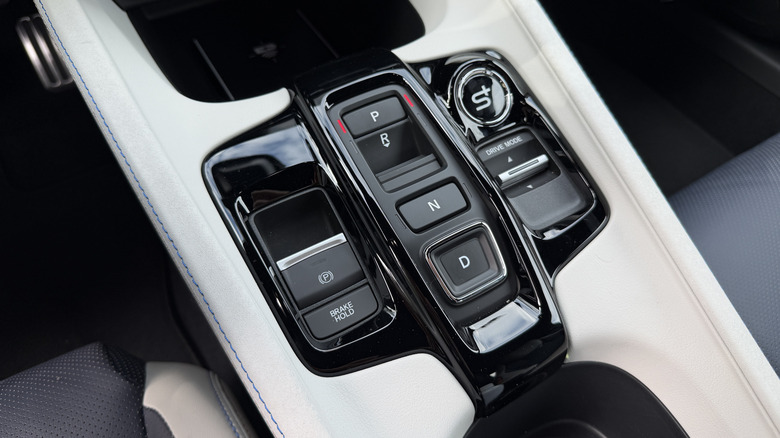
Activated by a big button in the center console is the S+ Shift system, which aims to mimic the feel and operation of a dual-clutch transmission with eight gears. You can either leave the system to its own devices where it shifts like a normal automatic, or use the nice metal paddle shifters to do it yourself. S+ Shift can be turned on in any of the different drive modes, and it's tuned to match the vibe of each one, though I don't really know why you would use it outside of Sport mode. Honda says that in Sport the system "delivers the exhilaration of a high-revving naturally aspirated engine, complete with deliberately increased gear-shift shock, vibrations, engine sounds and active downshifting during deceleration." I'm not so sure about any of that.
The system does an alright job of knowing when to downshift in normal driving, but there are many instances where it keeps me in a higher "gear" as I'm braking for a corner and doesn't downshift quickly enough. It also doesn't react quickly enough when I get back on the power, and unless I have my foot absolutely pinned to the floor, it automatically upshifts well before the engine's redline. Using the paddles is the way to go, as the system at least reacts quickly when either one is pulled, but even then it certainly doesn't make the Prelude feel like it has an eager, high-revving powertrain. Part of this problem could be due to the number of simulated gears. Eight feels like overkill, and I can't imagine there would be any downsides to going with six instead — maybe Honda didn't so that the car would still be efficient if you want to do a long highway stint with S+ on, but I don't know why anyone would do that.
 Daniel Golson / Jalopnik
As for extra vibrations and gear shift shock? I experience none of that, either as a driver or passenger. Upshifting or downshifting using the paddles results in essentially zero physical feedback aside from the sounds of the engine, the obvious change in revs and the visual of the gear indicator changing numbers in the gauge cluster. A normal automatic transmission in a more boring car provides a more noticeable kick in your back when downshifting. When S+ Shift is turned off, in Sport mode the Prelude still mimics the actions of a transmission instead of a direct-drive setup or CVT, modulating the engine rpm as if it's shifting. There's basically no perceptible difference in how that feels versus the shifts with S+ on, and in neither situation does it feel like real shifts are actually happening.
The S+ Shift system isn't totally useless, as it is nice to be able to control the shifts when on a canyon road, but at the same time it's not exciting enough to make me actually want to do so. I have just as much fun driving the car with the system off as I do with it on, and I don't think that should be the case. (Making matters worse, S+ doesn't keep the car in manual mode, as it'll still shift for you even if you've just been using the paddles.) It's a far cry from a car like the Genesis GV60 Magma, which is so viscerally engaging that it could fool even a blindfolded race car driver into thinking they were in something with a real DCT.
The verdict
Though the Prelude's interior is nicer than a Civic's, it's definitely not perfect. I don't understand why the seats aren't power-adjustable, and why they aren't ventilated. The 9-inch touchscreen is fine, with improved software and more Google-based features than Hondas of the past few years, and you do get USB-C ports and wireless Apple CarPlay and Android Auto. The backup camera is horrible, and there's no option for a 360-degree system, though at least it has front and rear parking sensors. Again, the 10.2-inch digital gauge cluster is nice, but its graphics are old and nothing special. You get a 8-speaker Bose sound system that's pretty good, but it's disappointing when put against the 12-speaker system of the Civic Sport Touring. Spend more time in the cabin, and you'll notice more cheapness like a lack of headliner-mounted grab handles, unappealing grain patterns on surfaces, and not a lot of storage space.
While I absolutely think the Prelude would be an easier sell if it were cheaper than its $43,195 (including destination) base price, which it would be if it weren't for Trump's tariffs, I don't think it's terribly egregious. A Civic Sport Touring Hybrid hatchback is $8,405 less to start, and the Prelude's chassis upgrades and unique body style are worth a lot of that difference. There's really nothing else like it on sale, and I'm sure Honda will be able to find the 5,000-ish yearly buyers it's anticipating to nab in the U.S. — that would work out to every Honda dealer in the country selling about four of them per year. There are definitely people out there who want a coupe that's fun to drive, but still need some amount of practicality and good fuel economy, and Honda says the car has already been successful with enthusiast buyers in Japan.
 Daniel Golson / Jalopnik
I've purposefully not weighed into the discourse on whether or not the new Prelude deserves to have its name until the end here. Yamagami said the intent wasn't to look to the past but to the future, pointing to the actual meaning of the word Prelude — this is a car that looks to the future of performance and technology, not the past. Having also driven all five previous generations of Prelude at the event, I think it's totally fine and mostly fitting that this new model uses the name. It's a cool, kinda strange car with unique market positioning and weird technology choices, and the same could be said for the old Preludes, too.
Yamagami also said Honda considered canceling development of the Prelude partway through. I'm glad it didn't, but I definitely think it could do with some additional development now. I don't think the solution is to just throw the Civic Si or Type R powertrain in and call it a day, like online commenters say they want (though I wouldn't say no to the latter). Using a hybrid setup makes sense for this car, but the one currently in it isn't the right one. Boosting the electric motor and/or engine's output would certainly help, and if the S+ Shift system actually felt like it did anything, it wouldn't be nearly as disappointing. Maybe Honda could add another electric motor to the rear axle, but then the Prelude would surely be even pricier. I think Andy's Frankenstein Si hybrid idea would be great for this car.
At the end of the day, the 2026 Honda Prelude is a cool car that's great to drive despite all of its shortcomings. Even if Honda calls it a day and lets the Prelude linger on the vine with no changes, I'm still gonna be on this coupe's side. But I'll still be confused, too.