

GM Is Locking In A $1 Billion Contract With The Army As Truck Business Flourishes Under Trump

Good morning! It's Wednesday, July 22, 2026, and this is The Morning Shift, your daily roundup of the top automotive headlines from around the world, in one place. This is where you'll find the most important stories that are shaping the way Americans drive and get around.
In this morning's edition, big trucks and bigger defense contracts are the way forward at General Motors under the Trump administration, Toyota is extending the lifecycles of some models as it deals with tariff and competitive pressures, Acura is working on a crossover that'll sit above the MDX and Aston Martin's creditors are getting tired of the British automaker's shenanigans.
Oh, and if you want a recap of the latest auto news delivered to your inbox each weekday morning because life is busy and you can't always head to our website, you can sign up for Jalopnik's free The Morning Shift newsletter right here.
1st Gear: Life is good for GM under Trump
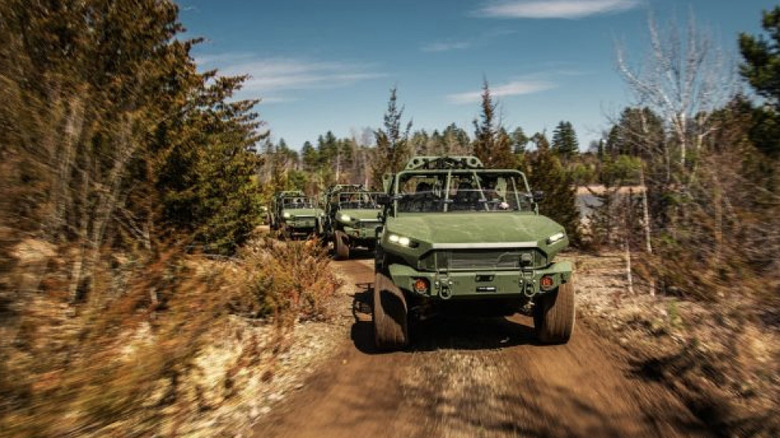
Since Donald Trump re-entered the White House, General Motors has been hard at work pivoting its business practices to capitalize on the policy changes he has ushered in by pouring billions into expanding U.S. production of GM's biggest vehicles, rolling out new pickup trucks, high-dollar, gas-powered Cadillacs and military vehicles. Thus far, it has paid off in a big way.
The General has taken advantage of regulatory rollbacks pushed through by Trump that have allowed it to throw in the towel on its money-burning electric vehicle projects while also doubling down on money-making pickups and SUVs. At the same time, the automaker has been getting ready to finalize a deal worth more than $1 billion that'll supply 10,000 trucks to the U.S. Army. It's a far cry from where things once were between Trump and GM. From The Wall Street Journal:
Even Trump administration moves that initially boded poorly for GM—costly automotive tariffs and attacks on Iran that drove up gas prices and at first rattled its stock price—have left the automaker largely unscathed or hobbled its rivals more.
"We haven't made excuses, we've just continued to perform," GM Chief Executive Mary Barra said in a Tuesday call with analysts. GM shares are up more than 50% since Trump returned to office, with Wall Street's enthusiasm over deregulation outweighing tariff fears.
Barra drew a barrage of presidential insults during Trump's first term, angering him with workforce cuts and supporting California's ability to set its own tailpipe standards. He attacked GM's plans to invest heavily in EVs, said a move that would slash U.S. jobs was "nasty" and slammed the company for shutting a factory.
This time around, the bad blood has eased and the relationship has improved both through GM's public positions as well as back-room bargaining. Barra, who meets directly with Trump and his top lieutenants, has been quick to get on board with his initiatives.
She praised tariffs last spring as a tool to level the playing field when the auto industry lobbied against them, and backed off plans to do away with gas-powered cars in favor of EVs within the next decade. GM still sells a lineup of EVs and is developing new ones but has shifted those plans due to weaker demand and regulatory changes.
GM, meanwhile, has spent more on federal lobbying this year than any single company.
Following Trump's tariffs, GM said it would spend billions on expanding U.S. production on gas-powered trucks and SUVs. So far, it has paid off in a big way. Even though GM sold 4% fewer vehicles year-over-year in Q2 of 2026, its revenue was up 2%.
It has also been all-in on the administration's push to get the automotive industry involved in weapons production.
The company has talked with Lockheed Martin about making parts for the defense contractor's weapons and, last month, announced a general agreement between the companies to work together to bolster munitions production.
GM's defense subsidiary is a leading contender to build a large infantry squad vehicle for the U.S. Army that would replace the Humvee. It also builds a lightweight infantry squad vehicle based on the Chevrolet Colorado pickup.
[...]
Defense initiatives account for only a fraction of the automaker's revenue and total production capacity, but they represent a growing business line. On Tuesday, Barra touted the division's potential in more detail than she has on many previous calls; she said she expects $700 million in defense revenue this year, while producing double-digit margins.
[...]
In addition to EV relief and defense work, GM scored a win with a Trump administration trade deal that kept tariffs low enough to allow the automaker to continue importing vehicles from South Korea.
Barra said GM's upward trajectory is expected to continue in 2027 because of "multiple engines of margin expansion and growth."
Listen, I'm not saying GM is going to get burned at some point, but just about every single entity that has made a deal with Trump has gotten burned at the end of the day; I hardly think GM will be the first to come out unscathed.
2nd Gear: Toyota is stretching vehicle lifecycles
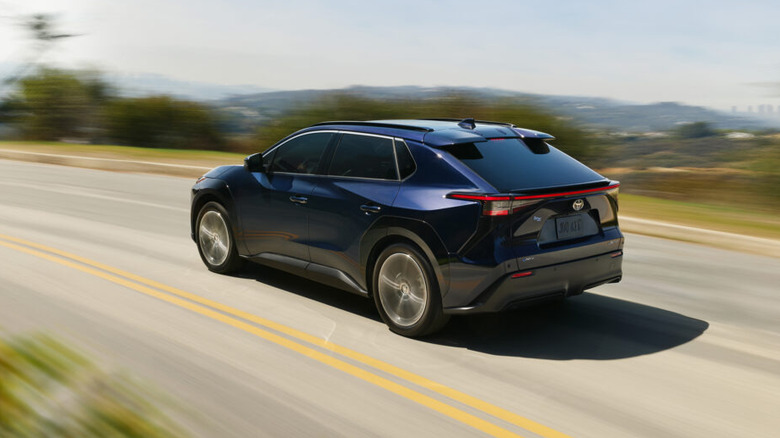
Toyota is planning to stretch out its already-long product development cycles as unprecedented trade pressures and strong competition turn the automotive market on its head. Now, planned sheet metal or interior mid-cycle refreshes on some less-popular models that would have occurred every other year have been extended or modified to focus on less dramatic, and crucially — less costly — changes, such as software upgrades. From Automotive News:
The next four years will see major refreshes or redesigns of some of Toyota's core models such as the Corolla, Corolla Cross, Prius and RAV4, which has just been redesigned. And the lineup could grow to include a new compact pickup — if Toyota can find the development, engineering and production bandwidth to develop it.
Unlike many competitors in the U.S., the Japanese brand, with the broadest light-vehicle portfolio in the U.S., continues to invest in electrification, including the introduction of new nameplates this year such as the upcoming electric three-row Highlander.
It's also upgrading its formidable gasoline-electric hybrid lineup to a new, more efficient fifth-generation hybrid system, and continuing improvements to its standard Toyota Safety Sense suite of driver assistance technologies, as well as upgrading audio, multimedia and infotainment systems.
It seems enshitification of everything will continue until morale improves.
No, I'm not saying that these Toyotas are bad cars, but in a world where upgrades came every year, it's a bummer to see that go away. It's not like Toyota is exactly hurting right now, either.
3rd Gear: Acura is working on a larger three-row crossover
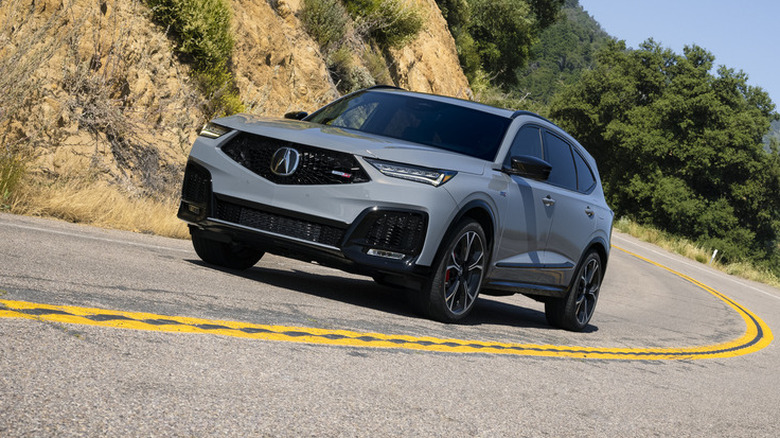
Acura wants a new flagship in the form of a three-row utility vehicle that would slot in above the mid-size MDX. The decades-old ambition is scheduled to enter production at the automaker's plant in Lincoln, Alabama, in September 2029, so it's still a ways away, to say the least. According to folks with knowledge of Honda's plans, the "Acura XL" is expected to sell up to 40,000 units per year and feature the automaker's new large-vehicle hybrid powertrain — something I got an up-close look at on a trip to Japan last year. From Automotive News:
Acura jumped ahead of Cadillac and Audi in the first half of the year to become the fourth-largest luxury brand in the U.S.
U.S. sales of large premium crossovers have risen three consecutive years, to a record 194,910 in 2025, according to the Automotive News Research & Data Center. The segment, led by the Lexus TX, was 51 percent larger last year than in 2020.
[...]
A larger three-row Acura would directly compete with the TX and provide a more attainable alternative to large but pricey European flagships such as the Mercedes-Benz GLS, BMW X7 and upcoming Audi Q9.
[...]
The new flagship would finally bring to life the spacious luxury family hauler that Acura teased more than a decade ago.
In the mid-to-late 2000s, Acura pursued a more ambitious strategy to become a true top-tier luxury player.
Plans included V-8 engines, rear-wheel-drive platforms and higher-end models that could directly take on BMW, Mercedes-Benz and even more exotic rivals.
A larger crossover or flagship SUV reportedly was part of that plan, but the global financial crisis scuttled it.
A larger three-row from Acura would definitely be a welcome addition to its lineup. Not only do I think Honda would do a good job with it, but Acura just sort of desperately needs another car. With the RDX soon leaving production, the company is about to sell just three vehicles: the Integra, ADX and MDX. That's just not enough to stay afloat for very long.
4th Gear: Creditors would really like Aston Martin to get it together
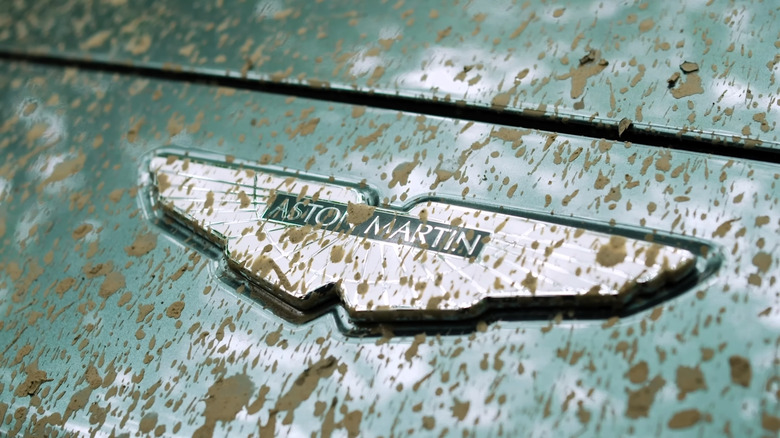
It seems like every week Aston Martin's creditors try to turn up the heat on the struggling automaker just a little bit more. A group of them just sent a letter to the British marque in an effort to stop a debt deal that would erode their standing.
Aston has reportedly been in talks with funds like BlackRock-owned HPS Investment Partners to raise additional funds that would be backed by the automaker's assets and placed beyond the reach of existing creditors — a maneuver known as a drop-down to the more financially savvy folks among us. From Bloomberg:
The creditor letter argues that a deal of this kind, which could strip the bondholders' collateral including intellectual property, would violate the bond documents, according to people familiar with the matter. The bond documents were drafted under New York law, said the people, who asked not to be identified because the details are private.
The letter — which was sent on Monday and drawn up with specialists at law firm Quinn Emanuel Urquhart & Sullivan LLP — gives Aston Martin a 48-hour window to confirm they won't push ahead with this type of transaction, the people said.
It states that if the company and the board choose to carry out such a transaction without considering an alternative proposal put forward by existing creditors, there could be risks under English law, the people familiar said.
The letter also emphasizes that a deal with HPS, which is a shareholder in Aston Martin's Formula One team, would come with related-party risks and that creditors will be looking very closely into it, they said.
[...]
The creditors' decision to ramp up the pressure comes after a broader group of bondholders sent a letter to the company offering to provide fresh financing if needed. They proposed broader discussions about the firm's capital structure, but Aston Martin didn't engage, the people said.
Aston has been struggling with production delays, quality issues, weak demand in China and, of course, U.S. tariffs. Previously, the automaker has relied on equity injections to deal with liquidity gaps; it said in April that some of its shareholders provided $66.9 million of debt to bolster its cash buffers. This, in turn, made creditors get together, fearing the company could seek more funding using provisions in its relatively loose bond documentation.
That could leave them subordinated or otherwise disadvantaged, also known as up poop creek without a paddle.
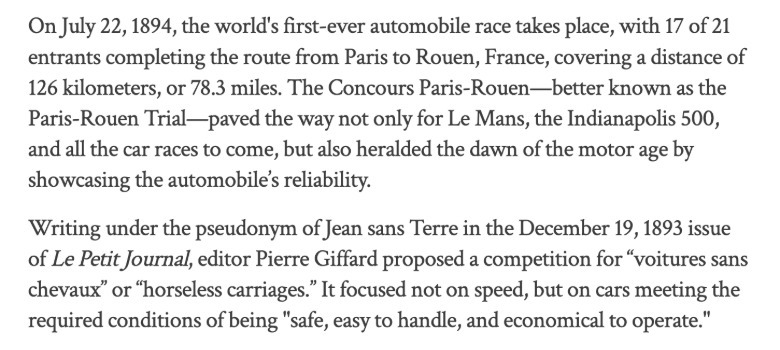
Reverse: The race that started it all
 History.com
Leave it to the French to come up with something as fun and silly as auto racing. Does it serve a purpose? Absolutely not. Is it one of the greatest things on our green earth? You're damn right. Who would have known that this would be the first domino to fall in what would culminate in a season-long humiliation situation for George Russell 132 years later? If you want to learn more about this first race, head over to History.com.
The Fuel Up
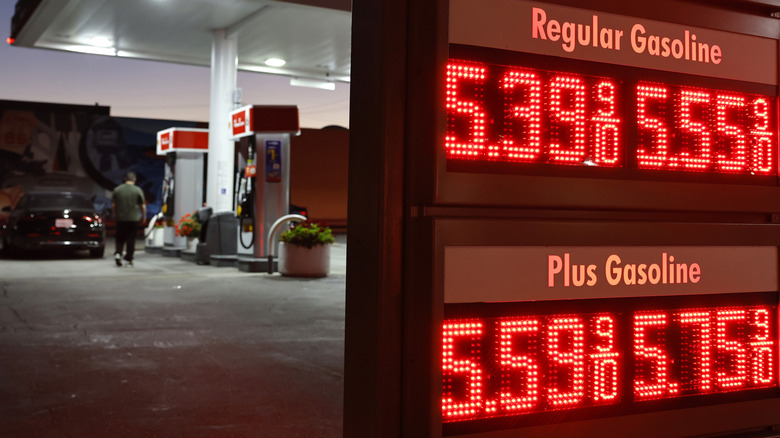
Bad news, big dawgs. Gas prices don't look like they'll be retreating anytime soon. Instead, they're only going to continue to rise as the U.S. and Israel's war with Iran intensifies as Secretary of War and Beer Pete Hegseth asks for another $70 billion and the Strait of Hormuz remains closed to traffic. WTI Crude Oil futures and Brent Crude prices remain elevated as well, sitting at $87 and $94, respectively, at the time of publication.
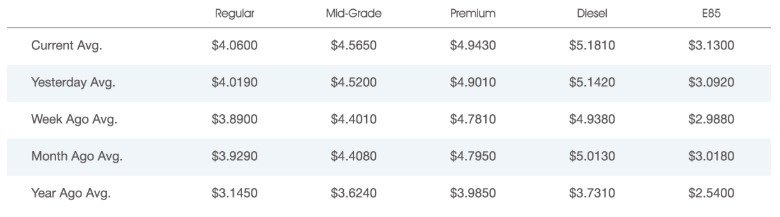
Here's where national average prices stand right now, according to AAA:
 AAA
AAA
This all shakes out to the average price of a gallon of regular gas jumping another 4 cents overnight to $4.06, according to AAA. At the very least, we're still a good ways off from the 2026 high of $4.56 we saw back in May.
On the radio: ROLE MODEL - Joy
Role Model is such a strange guy. I love him. If you're not already in on him, I promise that his music is worth his time — and not just his "Sally" song.