

If You Must Buy A 2026 Toyota Corolla Cross, Do Yourself A Favor And Get The Hybrid
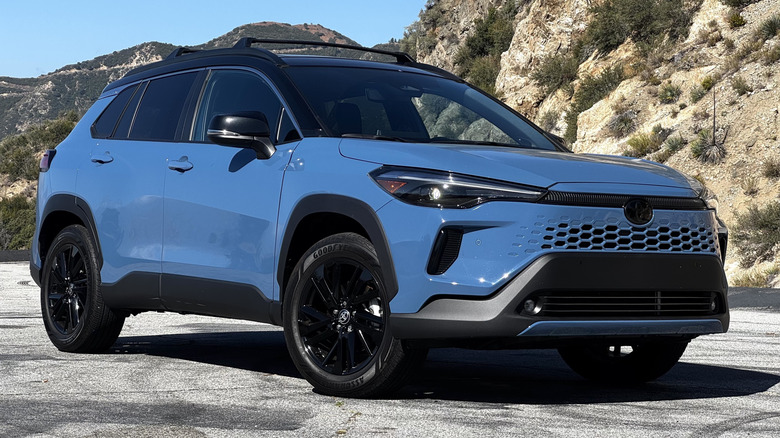
The Toyota Corolla is the ubiquitous small car. Over the course of its 58 years on sale in the United States, it has earned itself a widespread reputation for being supremely dependable, efficient, and affordable, but typically devoid of engaging driving dynamics or any other exciting qualities. (Unless, of course, there are a few extra letters tacked on like GR, and the old AE86 is another story too.)
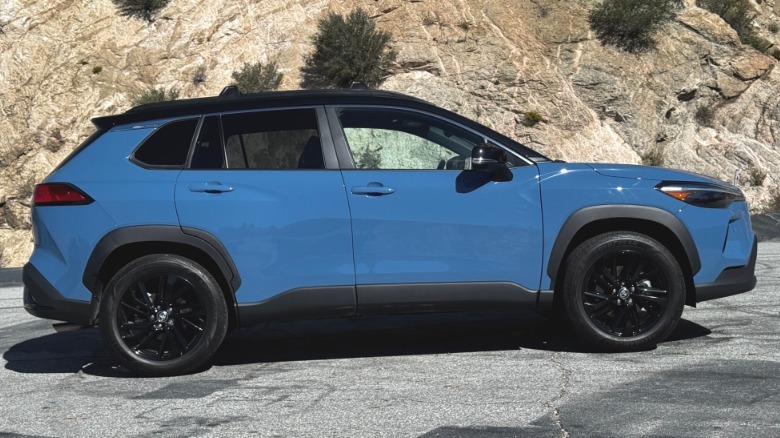
Toyota has sold more than 50 million Corollas worldwide, but it wasn't until a few years ago that it introduced the Corolla Cross, a taller, all-wheel-drive crossover model. Like its shorter sedan and hatchback siblings, the Corolla Cross does a great job of being a no-nonsense commuter, but it similarly lacks spunk. If you must get a Corolla Cross, do yourself a favor and opt for the hybrid powertrain since it provides a few smiles with its instant torque and good gas mileage.
 Logan K. Carter/ Jalopnik
Full disclosure: Toyota loaned me a Corolla Cross and a Corolla Cross Hybrid, each for week-long loans, and I lived with them as my daily drivers. I've chosen to combine the two into one review because they are vastly the same cars, just with different drivetrains.
The gas-only car is underpowered and lackluster
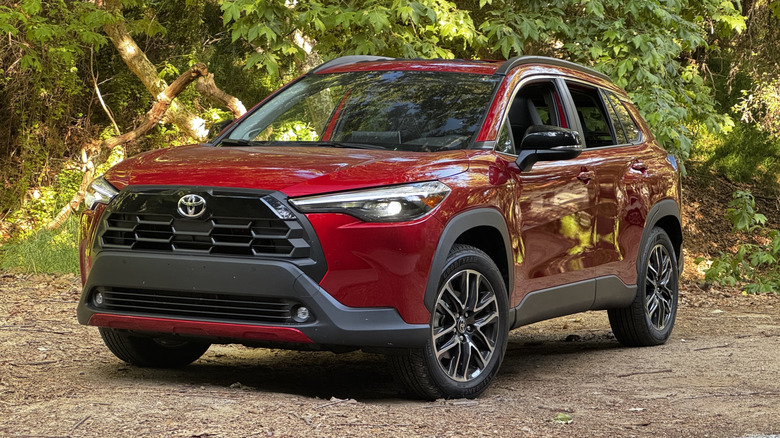
Let me get one thing straight right away: The Corolla Cross is not a bad car. It just happens to compete with a lot of other subcompact crossovers, some of which possess more character like the Chevrolet Trax, or off-road chops like the Subaru Crosstrek, fun driving dynamics like the Mazda CX-30, or near-luxury features like the Hyundai Kona. The Corolla Cross delivers none of those, but it does make car ownership and operation a total breeze if you're the type who wants your car to disappear into the white noise of your life.
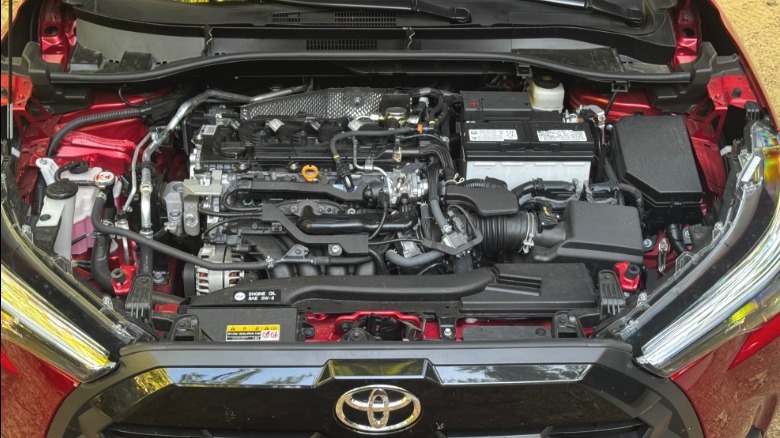
The gas-only Corolla Cross is especially forgettable, powered by a naturally aspirated 2.0-liter inline-4 that sends 169 horsepower and 151 lb-ft of torque to either the front or all four wheels through a continuously variable automatic transmission. This combination is EPA rated for between 31 mpg city, 33 mpg highway, and 32 mpg combined for the most efficient front-wheel-drive Corolla Cross L, and 29 mpg city, 31 mpg highway, and 30 mpg combined for top XLE AWD cars, which is a bit underwhelming.
 Logan K. Carter/ Jalopnik
On top of that, my test Corolla Cross XLE AWD felt underpowered in a lot of settings, which caused me to push the engine harder and thus achieve even worse results closer to 25 mpg. When I asked the little two-liter to hustle the 3,500-ish pounds the Cross weighed with my butt in the driver's seat, it grew quite loud and thrashy. Passing maneuvers required great long-distance vision and plenty of patience and the lack of power became even more apparent when I drove above sea level.
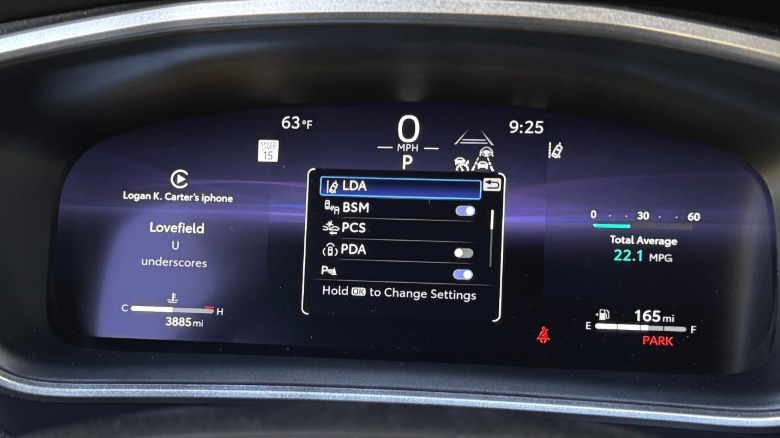
Beyond the car's weak engine, its steering is dead but at least light for easy parking lot maneuvering, and the brakes do their job just fine. Toyota's Safety Sense 3.0 suite of active safety features are standard on the Corolla Cross, though you have to step up from base L to LE grade in order to get blind-spot monitoring, and you have to get an XLE for front and rear parking assist with automated braking. The adaptive cruise control worked great during my week with the car, and it's easy to operate using the steering wheel controls.
 Logan K. Carter/ Jalopnik
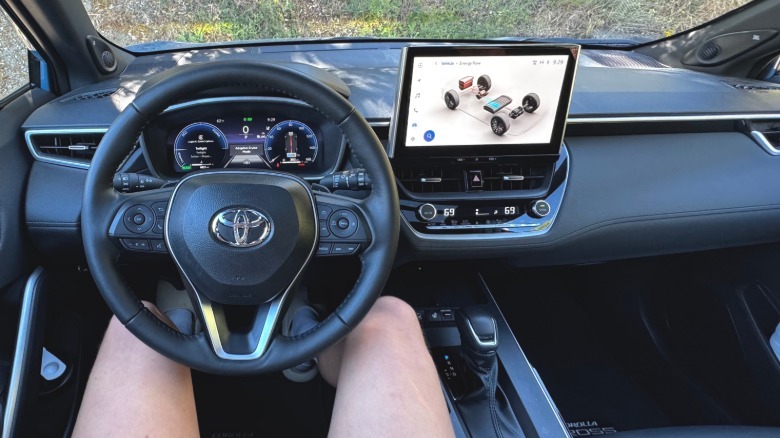
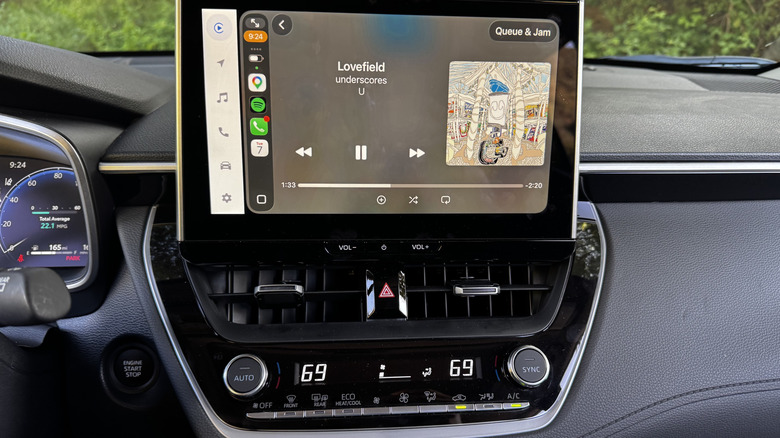
The top XLE trim gets an upgraded 12.3-inch digital gauge cluster, which is clear and easy to see without causing fatigue at night, but navigating through the menus on the cluster is needlessly overcomplicated. The standard 8-inch touchscreen infotainment system, however, is very clear and easy to navigate, but it lacks a home screen. Wireless Apple CarPlay and Android Auto come standard on all Corolla Crosses, and I had no issues with connecting my iPhone 15 to the car at any point during my loans.
At least it can be relatively cheap, with a starting price of $26,485 including destination for the base Corolla Cross L FWD, but my loaded Corolla Cross XLE AWD had a sticker price of $33,954. At that price point, the Corolla Cross's value proposition feels weak.
The hybrid costs more but it's worthwhile
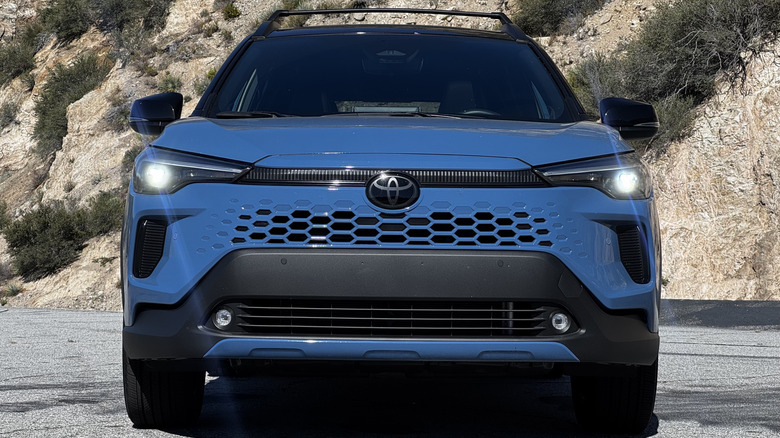
The Corolla Cross Hybrid brings at least a little bit of excitement with a 2.0-liter four-cylinder engine paired with a permanent magnet synchronous electric motor and a 4.08 Amp-hour lithium-ion battery. In total it produces 196 horsepower, and all Corolla Cross Hybrids come with all-wheel drive as standard. The Hybrid gets exceptional gas mileage at 46 mpg in the city, 39 mpg on the highway, and 42 mpg combined.
Opting for the hybrid powertrain — which I strongly recommend for anyone considering a Corolla Cross — does bump that price up a bit. The cheapest Corolla Cross Hybrid S starts at $30,845. My loaded Hybrid XLE press car had an MSRP of $37,449 thanks to extra-cost options like the $1,250 Convenience package that includes a small moonroof and power trunk lid, an $800 JBL Premium Audio package that is actually quite good, a two-tone paint scheme for $500, and a few little additions like floor mats for $309.
 Logan K. Carter/ Jalopnik
Sadly, Toyota reserves a lot of desirable features for the most expensive trim level, like my test car's 60/40 folding rear seats, rear arm rest with cupholders, 10-way power driver's seat with adjustable lumbar, and dual-zone automatic climate control. If you can do without those features, the $32,165 SE trim seems like the Corolla Cross Hybrid's sweet spot, since it comes with wireless charging, single-zone automatic climate control, privacy glass, and blind-spot monitoring with rear cross-traffic alert.
But the $37,449 MSRP of my tester is an awful lot of money for a Corolla Cross, especially when you remember that the excellent RAV4 is redesigned for this year, now only offered as a hybrid that gets better gas mileage than the Corolla Cross, and it starts out at $33,350. The RAV4 is 9inches longer overall than the 172-inch Corolla Cross, so the only reason I'd recommend the Corolla over the RAV4 is if you need a smaller vehicle.
Cheap cars can be fun and interesting, just not this one
Driving the Corolla Cross felt like operating any other household appliance like a dishwasher or a washing machine. At no point did I ever feel endeared to it, regardless of the powertrain. There were two instances where I had something close to fun in the Corolla Cross, and only in the hybrid: the immediate torque at low speeds made for smile-inducing zippy stop sign pull-aways, and I liked seeing how long I could keep the car in electric-only mode, which is harder than it sounds thanks to the tiny hybrid battery.
Once I got moving and passed the hybrid's very brief wave of electric torque, the gasoline engine wailed to life, and the Corolla Cross Hybrid's allure faded. Pressing the accelerator pedal in either car returned a classic CVT rubber band-like response, where you push the pedal, the gas engine gradually works its way up to its power band, and then it finally gives you what little acceleration it can offer. I might forgive this if the Corolla Cross was in any way engaging to drive, or if it had refinement, comfort, or a spacious interior as consolation, but it offers none of those things especially well.
 Logan K. Carter/ Jalopnik
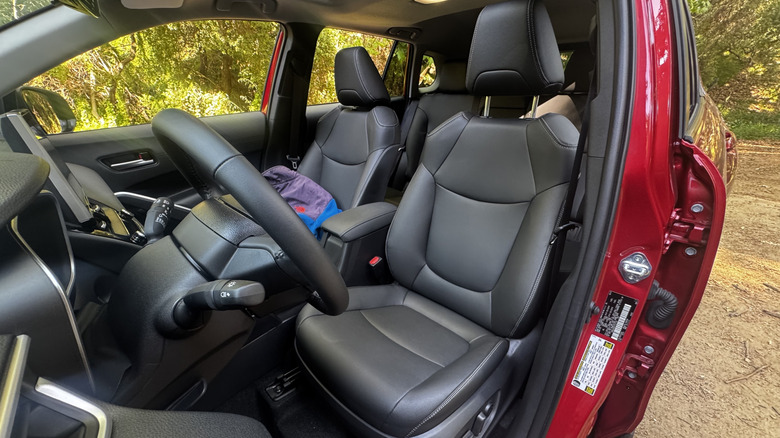
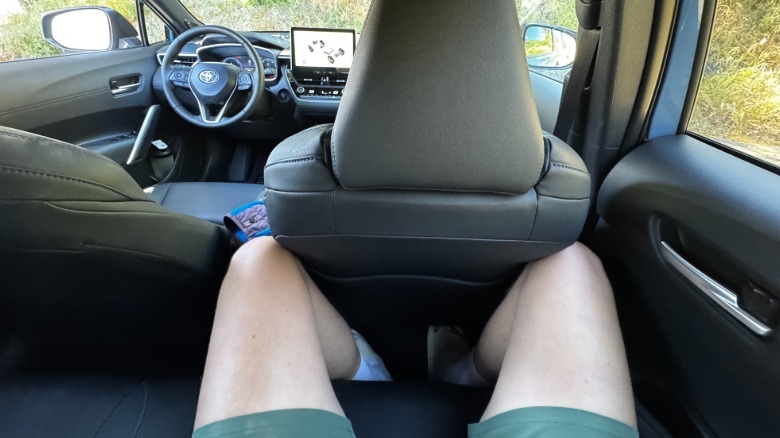
The car's ride was fine, but the front seats gave me butt-and-back ache after a two-ish-hour drive from LA to San Diego. I'm 6-foot-8 so I was not expecting to find acres of room in the subcompact Corolla Cross, but it still felt cramped. The front seat footwells were narrow and the seats didn't go back as far as I'd prefer, so my right leg kept hitting the hard plastic center console despite a claimed 42.9 inches of legroom. And the front seat head room with the moonroof felt tight, too, measuring in at 39.5 inches. Even for this class, the Corolla Cross's rear seats felt tight on legroom with just 32 inches, and head room at 39.1 inches. For reference, the Subaru Crosstrek has 4.5 inches more rear seat leg room, and the Honda HR-V has 5.7 inches more legroom in its back seats.
Its interior feels cheap and let a lot of noise in at highway speed, especially compared to the Mazda CX-30 I recently drove. The absolute worst thing about the Corolla Cross, though, was its flagrantly unpadded armrests. Both the door-mounted armrest and the center console armrest felt as though they were made of diamond — not because they were fancy and expensive, but because they were harder than rocks. It's possible that the extreme discomfort I experienced was due to my 99.9th-percentile height, but be sure you can handle rock-hard armrests before you buy a Corolla Cross.
It's perfect for you if you want basic transportation and not much else
The Corolla Cross is a perfectly sensible little crossover, but it possesses one of my absolute least favorite traits: it's forgettable. As a 6-foot-8-inch queer person, I've had to learn how to embrace being different. Now that's one of my absolute favorite things about myself, and one of my favorite things about all of the people and objects I choose to bring into my life, like my 2017 Mini Cooper S. Thus, the Corolla Cross wouldn't be the subcompact crossover I would buy.
Here's a little anecdote for you. My uncle is an Elder in the Jehovah's Witness church, so he was never around to celebrate holidays, birthdays, or anything we really did as a family. There's genuinely nothing wrong with that; he's one of the kindest, most gentle, and most genuine people I know. He plays a significant role in his community, and I have a lot of respect for him. Yes this is a bit strange, but I think these traits are mirrored in the Corolla Cross. It's a sensible, honest, dependable car, but it's not much for celebration or big moments of excitement. If the Corolla Cross could be religious, I think it would be a Jehovah's Witness.
 Logan K. Carter/ Jalopnik
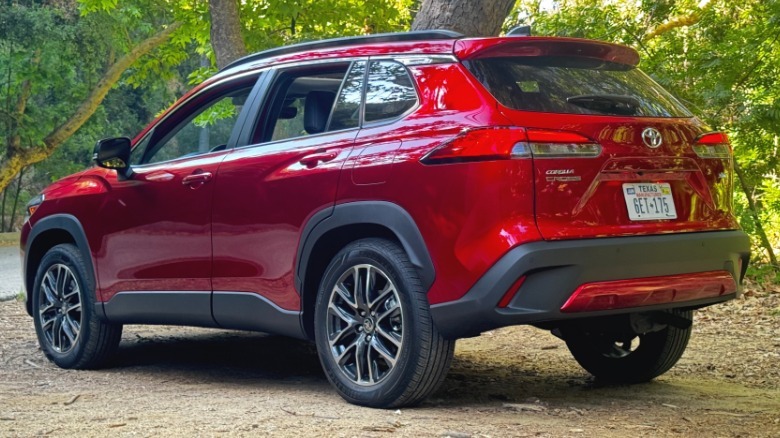
The best things about the Corolla Cross are its exceptional predicted reliability, low operating costs, and high resale value. For a lot of folks, that's the recipe for a perfect car, and if that's what you're saying to yourself in your head right now, dear reader, then get your booty to a Toyota dealer.