

2026 Toyota RAV4 Hybrid And PHEV Don't Innovate But Should Continue To Dominate
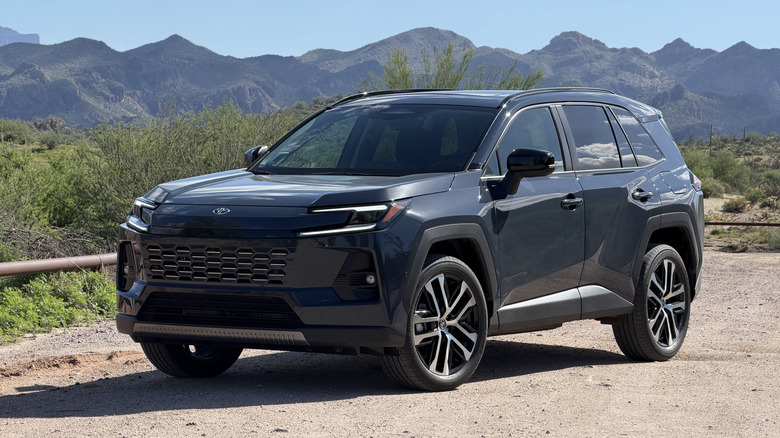
If you take pickup trucks out of the equation, the Toyota RAV4 is the best-selling car in the U.S., moving 475,192 units in 2024 and 358,134 through the third quarter of this year. Its closest competitor, the Honda CR-V, lags behind the RAV4 by tens of thousands of units, and the RAV4 absolutely crushes every other Toyota in sales, pickups included. Toyota says it sells the RAV4 in more than 180 countries — so almost all of them — and it's inarguably the company's most important model.
For 2026 the RAV4 enters its sixth generation, and while Toyota calls it "all-new" as automakers love to do, it isn't really. The new RAV4 rides on the same TNGA platform as the fifth-gen car, and its powertrains (now only either a hybrid or plug-in hybrid) are just evolutions as well, albeit with legit upgrades. And despite competitors like the CR-V, Kia Sportage and Mazda CX-50 having a few years' head start on Toyota, which should've come out swinging, the new RAV4's interior is just not nice enough, and it doesn't feel as refined overall as those other compact SUVs.
But the 2026 RAV4 looks awesome from the outside, has much-improved tech on the inside, and Toyota's hybrid powertrains continue to be some of the best on the market. Toyota offers more variety than ever now, too, with the return of the rugged Woodland model and a new GR Sport trim, the latter of which I'm covering in a separate review — it's genuinely fun and feels substantially different. Even though Toyota didn't take a lot of risks, and it might not become the class leader, the 2026 RAV4 is a definite improvement over its predecessor, and should retain its sales crown for years to come.
Full disclosure: Toyota flew me out to Phoenix and put me up in a casino resort for two days so I could sample almost every version of the new RAV4.
Toyota's hybrids still rule
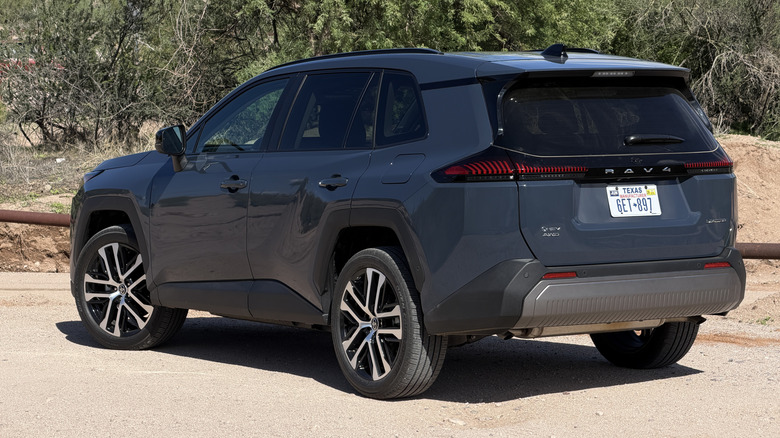
This is the latest Toyota to only be offered with hybrid powertrains, and like with the latest-gen Camry, I don't really know what took Toyota this long — it seems like such a no-brainer for such a popular model, especially when more than half of all RAV4 sales last year were of electrified models. This fifth-generation hybrid system has seen improvements to the battery, power control unit, transaxle and other components, and fuel economy increased by a not-insignificant amount. The hybrid's operation is even better than before, with a transition between electric power and dino juice that's more a lot more smooth than in other much more expensive hybrids. The engine is mighty loud and grating, though, especially when you have to really get on it.
New RAV4 hybrids use the same naturally aspirated 2.5-liter inline-4 as last year's RAV4 hybrid, but the Atkinson cycle engine's output has been increased from 176 horsepower to 183 hp, with the same 163 pound-feet of torque. Factor in the two electric motor-generators (the primary one of which makes 134 hp and 153 lb-ft) and the 2026 RAV4 has a total of 226 hp in front-wheel-drive form. Previously the hybrid was only sold with all-wheel-drive; those models get a third electric motor independently sending 89 lb-ft to the rear axle for a 236-hp total output, up from 219 hp combined before. Toyota doesn't divulge acceleration figures for the RAV4, but it feels more than quick enough for everyday driving — MotorTrend got a 2023 RAV4 XSE Hybrid AWD to 60 mph in 7.3 seconds, and the new model should be a tad brisker.
 Daniel Golson / Jalopnik
Front-wheel-drive RAV4 hybrids have Toyota-estimated fuel-economy ratings of 48 mpg city, 42 mpg highway and 44 mpg combined. Going for all-wheel drive doesn't bring a huge penalty; most AWD trims are rated at 45/39/42 city/highway/combined by Toyota, which is a welcome improvement from the 41/38/39 ratings of the 2025 model with AWD. The Honda CR-V hybrid, meanwhile, has EPA ratings of 40/34/37 with all-wheel drive, and 43/36/40 with front-wheel drive. In fact, the RAV4 hybrid's estimates handily beat all of its competitors, including also-new models like the Subaru Forester hybrid.
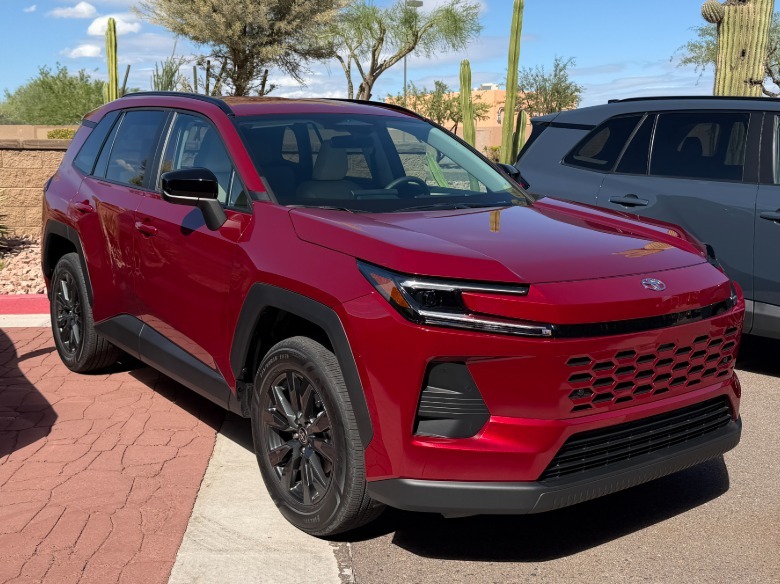
Toyota says it increased the chassis rigidity, retuned the suspension, and made a host of other minor hardware tweaks compared to the outgoing model. The electronic power steering doesn't offer much feedback, but it reacts to inputs well and isn't too sloppy or numb. 20-inch wheels are standard on the XSE and optional on the Limited, and ride quality is better than you'd expect, and there's not an egregious amount of body roll, though it can get bouncy. I briefly ride in an XLE with 18-inch wheels (that red one above), which most RAV4s will probably have, and the thicker sidewall does make it a more plush experience. A lot of road noise enters the cabin regardless, though. Bumps or broken pavement may feel dampened through your butt, but your ears will definitely hear the knocks and chatters.
You want the PHEV
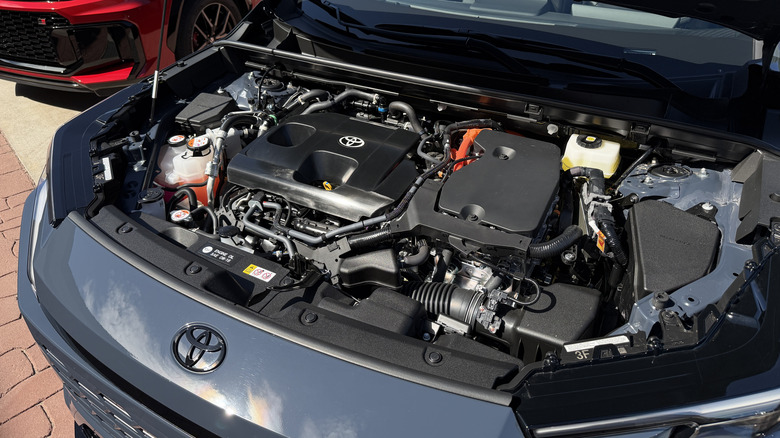
The standard hybrid might be good, but the optional plug-in-hybrid powertrain is what you really want. It has the same four-cylinder engine under the hood, but with slightly more power and torque (186 hp and 172 lb-ft) and a newly developed PHEV system that also features three motor-generators. The lithium-ion battery now has a 22.7-kWh capacity, 4.6 kilowatt-hours greater than the outgoing generation, and the primary front motor makes 203 hp while the independent rear motor is quoted at 91 lb-ft. Total output is 324 horsepower, 22 hp more than the old PHEV. That's a heck of a lot — the Mitsubishi Outlander PHEV only has 248 hp, and the Koreans make do with 268 hp.
There's the same surge of torque and linear acceleration that you'd expect from an EV, feeling plenty brisk when under just electric power as you can now floor it without the engine turning on. But in hybrid mode when the engine is running, the GR Sport feels very quick, enough to make me giggle every time I punch it, and the PHEV definitely rides, handles and steers better than the standard hybrid. The engine doesn't sound as coarse or strained as in the hybrid, either, and the integration of electric and gas power is pretty seamless. Unlike in the hybrid, where the EV Mode button is basically pointless, the PHEV will be able to drive up to a Toyota-estimated 52 miles on electricity alone, and it can do over 80 mph. You can also force the car to run the engine, or put it in auto mode, which does a nice job prioritizing electric-only operation without totally draining the battery. The electronically controlled continuously variable transmission has a mode for simulated shifts, with paddle shifters available on the XSE, and while it doesn't really add much to the driving experience, it is useful to use in lieu of adjustable levels of regenerative braking, which the RAV4 still lacks. It does have a new electronically controlled brake system that better integrates the regenerative braking with the friction brakes, and pedal feel is good.
There is one bit of strangeness. More plug-in hybrids are starting to have DC fast-charging capability, which is genuinely useful when you've got a range as long as the RAV4 does. Only some of the RAV4 PHEV trim levels are able to fast-charge, though. The Woodland and XSE have a CCS charging port on the driver's side front fender, with the ability to go from 10% to 80% in 35 minutes, and an 11-kW onboard charger that can recharge the battery in two and a half hours using a 240-volt outlet. But the SE and GR Sport only have a J1772 port, located on the passenger side, with no fast-charging capability and a 7-kW onboard charger that takes three and a half hours.
Looks good, but doesn't feel it
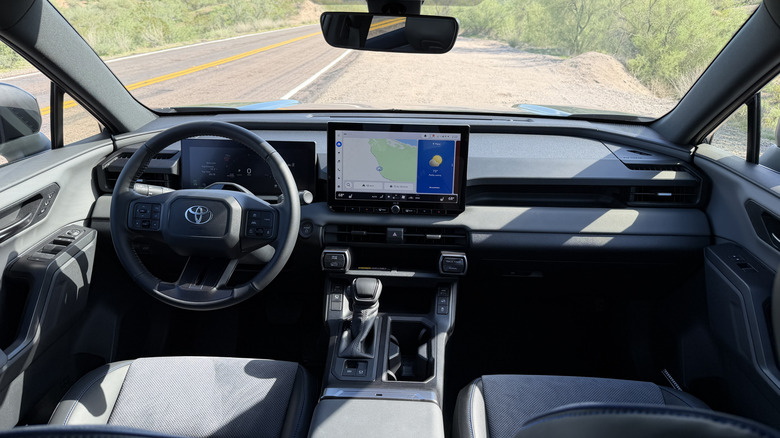
It's just too bad the RAV4's interior isn't a totally great place to be while you're enjoying that great powertrain. The door panels have a soft-touch material on them, but there's almost zero padding behind that material, so the armrests are quite uncomfortable. The center console armrest is even worse — Toyota designed it to flip around and become a tray, which is finicky to do, and it's just a hard, flat surface. The whole center console is hard plastic, and my knee is constantly knocking against a slightly protruding panel. All but the base LE apparently have leather-wrapped steering wheels, but said leather feels nasty (a problem across most of Toyota's lineup these days), and Toyota's SofTex upholstery that's used on the seats, door panels and other places isn't as nice as the synthetic materials from other brands. There are some little fit and finish issues across all the RAV4s I drive, like the trim piece that wraps around the top of the dash, but I'll give Toyota the benefit of the doubt here as these cars are all pre-production units, so hopefully the RAV4s that people actually buy will be a bit better.
 Daniel Golson / Jalopnik
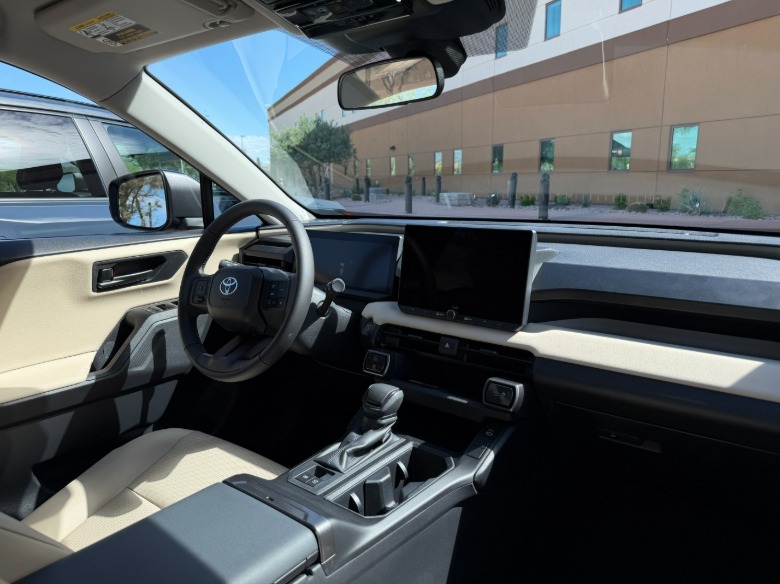
I will give Toyota praise for there being no shiny black plastic; parts like the center console instead have a smooth texture and a sparkly colored fleck to the finish, which is refreshing. The interior design overall is really good, and the layout of all the controls feels logical from behind the wheel. I like that the dashboard has a shelf for the wireless charging pads (most trims have one, but the Limited gets two) and a separate open cubby below it, plus cupholders that are on their own and further back — too often, many of these things are combined together, and thus not as usable. Under each center air vent is a cool little pod with buttons for the various drive modes, and the switchgear and buttons throughout the interior have a satisfying feel. It looks good in a color scheme other than just black, like the beige in the XLE Premium above.
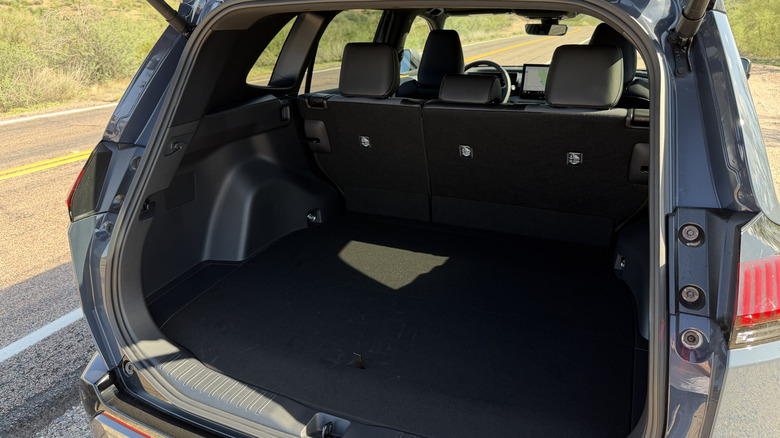
Aside from the thick D-pillar the RAV4 has great visibility, especially out the front where the hood sculpting is akin to the Lexus GX. The RAV4 is nearly identical in exterior dimensions to the outgoing model, and the same is true about passenger and cargo space. My 5-foot-9 self easily fits and finds a good seating position, both up front and in the rear bench. Depending on the trim level, you can either get a standard-size sunroof or a large panoramic unit, both of which tilt and slide, and neither of which seem to impact headroom, even for rear-seat passengers.
Three distinct styling themes
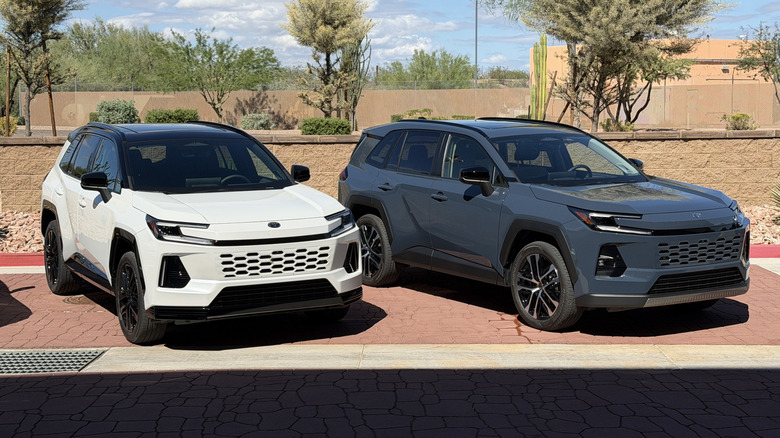
I do think the new RAV4 looks awesome from the outside, even if it's more evolution than revolution. There are three main "grades" — Core, Woodland, and GR Sport — all with their own styling treatments and unique front end styling. Recent Toyotas like the Camry and facelifted Corolla Cross hybrid have a color-keyed grille, a motif that the Core grade RAV4 uses as well, with dozens of hexagonal inlets cut out of the bumper. Clamp-shaped headlights have LED running lights, low beams and high beams as standard, and every RAV4 has LED taillights. The SE and XSE's basic styling are the same as the LE and XLE Premium, but with dark chrome bits in the grille and black exterior accents, wheels and badging. The XSE also gets vertical LEDs in the bumper.
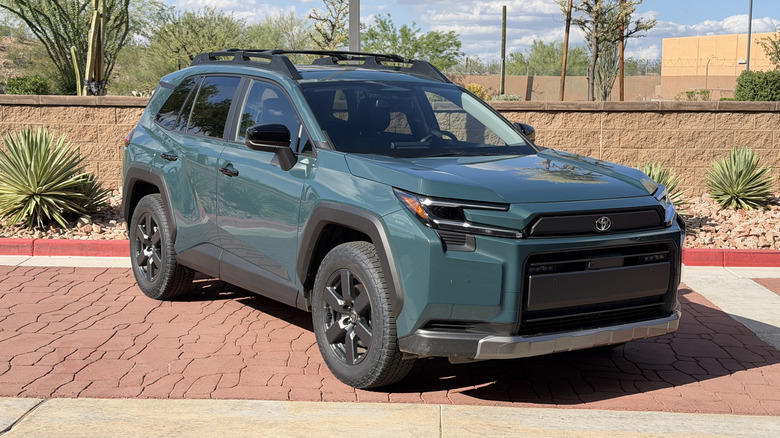
It can be hard to give a compact crossover genuinely muscular styling, but Toyota has achieved that with the RAV4's rear doors and fenders. A line starts at the back edge of the front wheel arch, kicking up at the rear door and creating a dramatic crease that gives the rear haunches a ton of dimension. Not only is it reminiscent of the '80s box-style flares that everyone loves, but it reminds of the 2001 Toyota RSC, one of my favorite concept cars. In fact, in GR Sport guise the new RAV4 gives me total RSC vibes. I've also got to give it up for Toyota offering some real colors on the RAV4, like a bright red and a couple of nice blues, and there's a great Woodland-exclusive green.
Off the beaten path
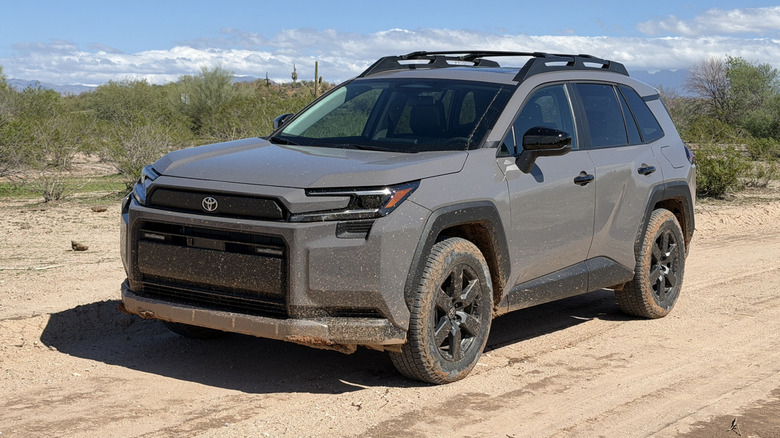
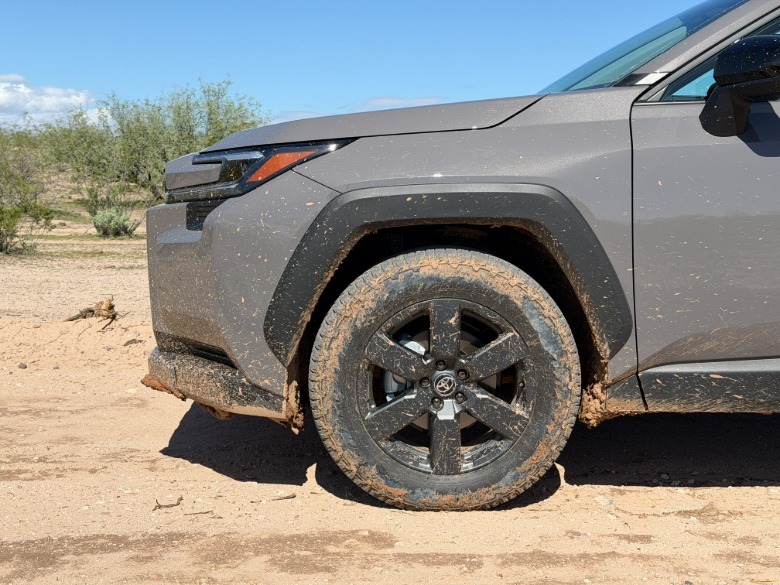
Off-road trim levels of crossovers are all the rage these days, so Toyota brought back the RAV4 Woodland model, now available in both hybrid and plug-in hybrid forms (I only take a drive in the one without a plug). Dunlop Grandtrek all-terrain tires wrapped around 18-inch wheels are the only real mechanical change, adding half an inch of ride height, but the Woodland also gets wider fender flares, roof rails with crossbars, and Rigid Industries LED fog lights. The whole front bumper and black "grille" is unique to the Woodland, giving it a totally different face from the Core RAV4 trims that's a bit more traditionally SUV-like.
On pavement the Woodland has a bit of a softer ride, but at the expense of more road noise. Fuel economy also takes a hit, with the Woodland hybrid being 4 mpg behind the XLE AWD in both city and highway, and 3 mpg worse combined. Still, 39 mpg combined is pretty dang good for a crossover on all-terrains. The plug-in Woodland takes less of a mpg hit compared to the other RAV4 PHEVs, and it gets 49 miles of electric range as estimated by Toyota, so it's still one of the longest-range PHEVs on the market. It's also the only PHEV to come equipped from the factory with all-terrains aside from the Jeep Wrangler 4xe and Grand Cherokee 4xe, which have less than half the electric-only range.
 Daniel Golson / Jalopnik
Toyota set up a course for us at Fort Mcdowell Adventures, which starts off with an easy dirt trail with some muddy ruts and washboard sections. The Woodland makes light work of it, but really any crossover on all-terrains would, and its Trail drive mode has the same tuning as other RAV4. We do drive up a fairly steep hill covered in sharp rocks that could quickly humble a normal crossover, and the Woodland bounds right up it like a mountain goat. The hill-descent control system is well-tuned and makes going back down a breeze.
Finally, we're in 2025
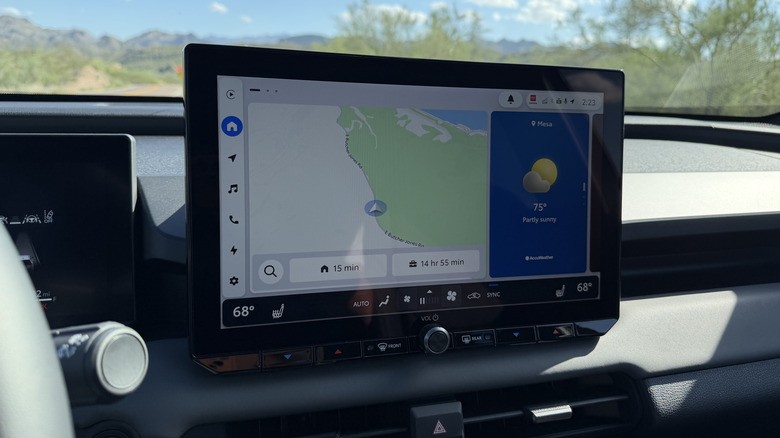
Regardless of what model you get, the 2026 RAV4 has major upgrades in the technology department. It's the first Toyota with a new, much cleaner infotainment system that really brings the brand up to date — fingers crossed it quickly spreads across the brand's lineup. Most trim levels have a 10.5-inch touchscreen that is fine, but the XSE, Limited and GR Sport have a great 12.9-inch unit, shown above. The new multimedia system has a customizable home screen with a widget tile design that is very intuitive, bright graphics, clean animations, and simple menus.
An always-there bar on the left side of the screen has shortcuts to things like navigation, media and settings, and an always-there bar at the bottom has climate control functions. But don't worry, there's also physical buttons for temperature and front and rear defrosters, plus a volume knob. A new virtual assistant, activated by saying "Hey, Toyota," is able to do things like turn on your wipers, adjust the climate control, or find restaurant recommendations or sports results using an AT&T 5G connection. Wireless Apple CarPlay and Android Auto are standard across the board, but the new cloud-based native navigation system is very good, especially with how it's integrated in the gauge cluster and uses Google data. But most of you will probably be mad because it'll require a subscription after a one-year trial.
 Daniel Golson / Jalopnik
Every RAV4 has a 12.3-inch digital gauge cluster with a much nicer look and more customization than basically any other recent Toyota, and you can get a color head-up display on the very top trims. There's a USB-C port on each side of the lower dash, which are 15w on the LE, SE, and weirdly the GR Sport, but 45w on the XLE Premium, Woodland, XSE and Limited. All but the base model have two USB-C ports for the back seat, too. The available 9-speaker JBL sound system is not bad for this class of car, and you can get a digital rear-view mirror and a built-in dash cam.
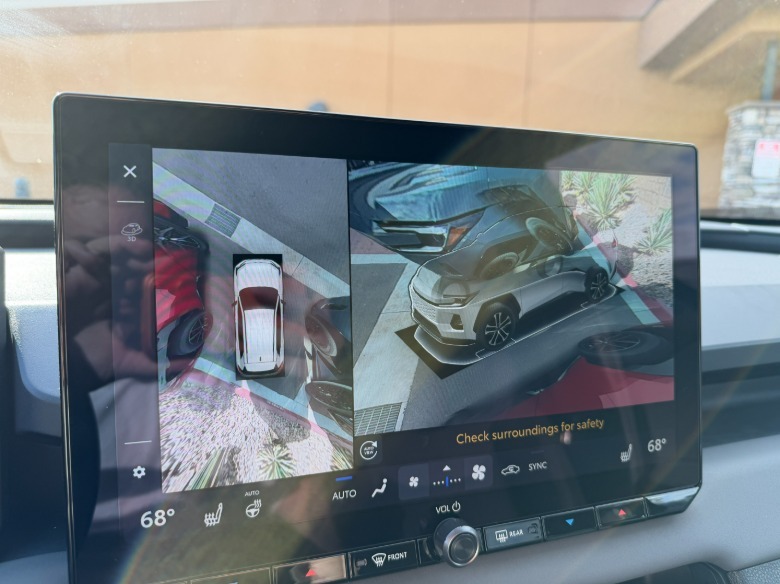
What might annoy me the most, though, is the backup camera. These things have been mandated in all new cars since 2018, and some of the most value-oriented brands have super high-resolution backup cameras. The new RAV4's backup camera is plain bad, even if you get the optional 360-degree camera setup that has a 3D view. It's too low-res, and the 3D view looks wonky. You do get an over-the-wheels view that's helpful when off-roading in the Woodland, though the camera views automatically turn off once you've reached about 12 mph.
You want stuff? It's got stuff
Beyond just the tech item, you can get a bunch of niceties in the RAV4. The base LE has dual-zone automatic climate control, keyless entry and pushbutton start, auto up/down for all the windows, and a power-adjustable driver's seat. Also included in every 2026 RAV4 is Toyota Safety Sense 4.0, consisting of adaptive cruise control, automated emergency braking with pedestrian detection, lane-departure warning with steering assist, lane-keeping assist, road sign recognition and automatic high beams. Blind-spot monitoring with rear cross traffic alert is standard, too.
Depending on the trim level, your RAV4 can have heated and ventilated front seats, heated rear seats, heated side mirrors, a heated steering wheel, rain-sensing wipers with a de-icer, a power tailgate (with hands-free operation as an additional option), a smaller shift-by-wire shifter, front and rear parking sensors, LED fog lights, and traffic jam assist for the adaptive cruise control. Another reason you want to get an SE or XSE? Blue stitching and interior accents.
Coming soon to 180 countries near you
Toyota has yet to tell us how much the 2026 RAV4 will cost beyond that it will start "in the low $30,000 range" thanks to the newly available FWD hybrid. The 2025 RAV4 LE AWD hybrid starts at $34,300 while the range-topping Limited is $42,605; the PHEV SE comes in a few grand more than that, and the XSE is $50,560. Yes, that's a lot for a RAV4, but it's also the average price of a new car, and yes, that also sucks. Toyota says the most popular version of the new RAV4, at least for the standard hybrid, will be the XLE Premium, which should come in under $40,000. Even if prices rise by a grand or two across the board, which I doubt will be the case, I don't think that is going to stop buyers from racing to their closest dealer, where the 2026 RAV4 hybrids will start appearing in December, with the PHEV following in Q1 of 2026.
I said at the top of this story that the RAV4 is the best-selling car in the U.S. if you take pickups out of the equation, but you don't even need to do that for a mega achievement. Ford lumps all of its F-Series trucks together in sales reporting; if you look at the F-150 alone, the RAV4 beat it last year. The RAV4 has also been the best-selling SUV in the U.S. for eight years straight, and Toyota says it outsold 14 other entire car brands in 2024. Toyota could've kept selling the outgoing one for another couple of years, and it would probably still top the sales charts.
This sixth-generation RAV4 looks better on the outside and the inside, it's nicer to drive, it has seriously improved technology and more desirable features, and its hybrid-only powertrains are better than ever. Having even more choice with the three distinct grades can only be a good thing as well, and I really do hope Toyota starts a trend of actually sporty (relatively) affordable crossovers with the GR Sport. Sure, I might be disappointed by the new RAV4's interior and lack of really meaningful change and improvement compared to the previous generation, but I think it will continue to dominate the market and be the right choice for leagues of customers in those 180-plus countries.