

Automakers Expect $2.3 Billion In Tariff Refunds Whether Trump Likes It Or Not
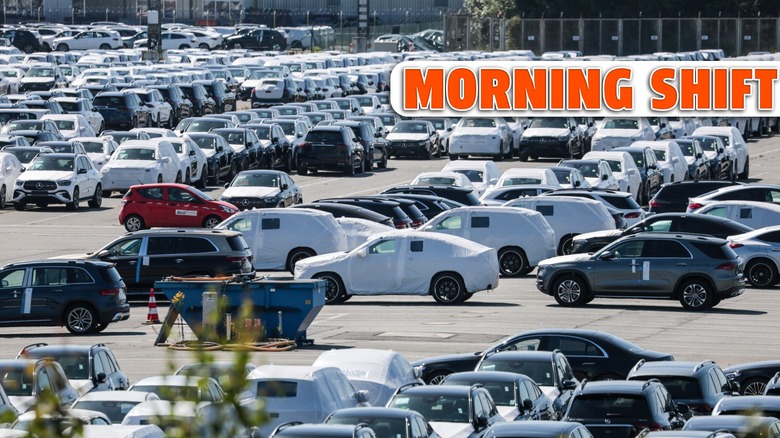
Good morning! It's Thursday, April 30, 2026, and this is The Morning Shift, your daily roundup of the top automotive headlines from around the world, in one place. This is where you'll find the most important stories that are shaping the way Americans drive and get around.
In this morning's edition, automakers around the world are expecting big pay days in the form of tariff refunds, Volkswagen says more cuts are coming as profits continue to slide, General Motors is set to invest over a billion dollars in gas engine output, and Aston Martin's ride on the struggle bus continues with no end in sight.
1st Gear: Automakers want their tariff refunds, Trump be damned
A handful of automakers are reporting some very solid first-quarter profit boosts, but it's not because they magically started selling more cars at a time when the industry is slowing. Instead, they're projecting what they're expecting to get from future refunds of tariff payments they made to the U.S. government that were declared illegal by the Supreme Court. Of course, by taking these refunds, they risk angering President Donald Trump, but it's a risk many are apparently willing to deal with.
Last week, companies that were hit with import duties began applying for refunds following a Supreme Court ruling back in February that struck down some of Trump's tariffs. In total, up to $166 billion is set to be reimbursed to importers who paid tariffs, and the auto industry was one of the hardest hit. In total, automaker are expected to ask for about $2.3 billion in refunds. The process is expected to take several months. From Reuters:
Ford Motor told investors it is due to be reimbursed $1.3 billion that it paid under a 1977 law called the International Emergency Economic Powers Act, or IEEPA. General Motors anticipates recovering $500 million it paid in import taxes under that law. Mercedes-Benz also said it recorded an expected refund onto its first-quarter books.
The companies logged the estimated refunds for accounting purposes, which increased their quarterly bottom lines. They acknowledged, though, that they did not know when they would be refunded, given the uncertainty around the government's process for doling out payments.
GM and Ford both said that because the money has not been received yet, they did not record the payments as free cash flow, and would only do so once it comes through the door.
On Thursday, Jeep-maker Stellantis booked a positive first-quarter impact of around 400 million euros ($467 million), based on expected refunds.
[...]
Accounting firm Ernst & Young said in an advisory paper last month it was acceptable to book projected refunds when companies can assert their intent to recover payments and reasonably estimate the amount.
There's a real risk that Trump, a notoriously vindictive man, could — in one way or another — punish automakers that apply to get their money back. In an interview last week with CNBC, he reportedly said he would "remember" companies that opted not to seek refunds. However, he didn't go so far as to say how they may benefit.
Ford CFO Sherry House said on Wednesday that the company had a fiduciary duty to file a lawsuit to get reimbursed, "really just for purposes of protecting our shareholders and getting in line to be able to receive the reimbursement."
[...]
Meanwhile, Trump's tariffs are still inflicting pain. The levies charged under IEEPA were only a slice of the overall tariff regime affecting carmakers, which still face import taxes on steel and aluminium, cars and parts shipped from Mexico and Canada, and other levies.
[...]
GM said this week that tariffs would reduce its profits by $2.5 billion to $3.5 billion this year. Ford pegged its net tariff cost at $1 billion.
Back in February, Trump imposed a 10% tariff for 150 days under Section 122 of the Trade Act of 1974. He also launched investigations into excess industrial capacity in major trading partners and into forced labour.
It's not totally clear how Trump will react to the government losing out on $166 billion, but I cannot imagine it will go over well.
2nd Gear: Volkswagen says more cuts are coming
Not every automaker is feeling the joy of tariff refunds. Volkswagen says it must fundamentally overhaul its business as new tariffs, geopolitical issues and weak car demand ravage its sales — causing it to suffer a sharp first-quarter profit drop.
Finance chief Arno Antlitz said that the cost-cutting measures currently in place "are not enough," while the automaker revealed its 2026 Q1 results. They were, uh, bleak: a 14% fall in operating profit to $2.9 billion. Analysts had apparently expected profits to be broadly flat. From Reuters:
The group, which includes Porsche and Audi, has been hit by steep U.S. tariffs expected to cost about 4 billion euros a year, and is battling to arrest sliding sales in China and the U.S.
[...]
The Wolfsburg-based company posted quarterly revenue of 75.7 billion euros, down 2.5% and below analysts' estimate for 77.6 billion euros.
That translated into an operating margin of 3.3%. Volkswagen forecasts a rise in operating margin to between 4% and 5.5% in 2026 from 2.8% in 2025.
[...]
It was also forced to adjust its strategy In China, where the German automaker has invested billions to develop and produce cars to serve the local market and for exports.
Since 2023, Volkswagen has reduced capacity by around 1.5 million cars in China and scaled back long-term sales targets. Volkswagen deliveries in the world's largest automotive market dropped by 15% at the start of the year.
Volkswagen CEO Oliver Blue has said the automaker would "turn over every stone" in its quest for future savings. Those "stones" include 50,000 already-planned job cuts in Germany by 2030 to evaluate whether or not under-utilized plants are worth keeping going. Hell, it's even taking a look at its myriad of brands and models. Just a few days ago, we saw Porsche drop its 45% stake in Bugatti.
It's a spooky time for Das Auto.
3rd Gear: GM earmarks $1.4 billion for engine, transmission and casting prodution
General Motors is investing around $1.4 billion in three factories in the U.S. and one in Canada that'll produce gas engines, transmissions and metal castings — showing a clear sign that it's serious about internal combustion power once again as demand for electric vehicles falls off. The new investment comes on top of another $6 billion GM has already invested in U.S. factories over the past year at the behest of President Trump. From Reuters:
The investments will support the launch of GM's next-generation trucks and full-size SUVs, such as the Chevrolet Silverado and Cadillac Escalade.
GM is investing $300 million at a plant in Romulus, Michigan, to increase transmission production.
The automaker is investing $150 million in a casting plant in Saginaw, Michigan, to increase the output of engine parts.
Another $40 million is going to a plant in Toledo, Ohio, to increase transmission production.
In Canada, GM said it's investing 691 million Canadian dollars ($504.9 million U.S. dollars) for production of the next generation of its V-8 engine at a plant in Ontario.
While it's certainly good to see automakers investing rather than contracting, I do think it's a bit of a shame that we seem to be going backwards. Just a few years ago, the future seemed electric. Now, we're all in on gas V8s once again. What's going to happen when the next President comes in and wants stricter emissions rules?
4th Gear: Aston Martin can't stop losing
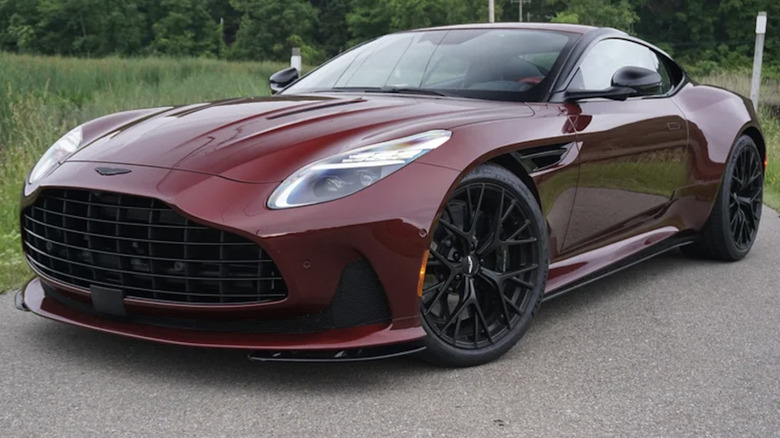
Aston Martin is feeling the heat, but it's gotta be used to that at this point, no? The British automaker reported yet another quarterly loss, as Lawrence Stroll's company put up another £50 million ($68 million) in an effort to ease the pressure its been feeling. Its pretax loss narrowed ever-so-slightly to £65.5 million ($88.5 million) in the first quarter of 2026 from the same time a year earlier, but its net debt ballooned to £1.46 billion ($1.97 billion). From Bloomberg:
Aston Martin has been struggling to become self-sufficient, relying on capital raises led by Stroll's consortium. The former textiles tycoon, who is the luxury automaker's executive chairman, rescued the company in 2020 but his plan to launch more models, such as the Valiant, hasn't paid off so far because of product delays and quality problems. US tariffs and a slowdown in China have provided further setbacks.
In an effort to stem the losses, Chief Executive Officer Adrian Hallmark has been reining in spending, including by cutting jobs and putting new models under review. It's also been more creative in raising cash, such as a £50 million deal with Stroll's Formula One team for future Aston Martin naming rights.
There were few details about the new facility, but it accrues interest when drawn upon, is secured against some assets and involves "a small commitment fee," Chief Financial Officer Doug Lafferty said on a call with analysts.
[...]
Earlier this year, the company said it only expects free cash outflow to improve, not turn positive in 2026 as it had previously targeted. Outflows in the first quarter were £117 million.
In an ever-so-slight bit of good news, first-quarter revenue rose 16% to £270.4 million ($365.5 million), thanks to new vehicles like the $1 million Valhalla hypercar. It helped Aston stick to its guidance for the year, but Hallmark did flag the U.S. and Israel's war with Iran as a possible issue for the automaker going forward.
Lets just hope Lance Stroll and Fernando Alonso have better weekends than Lawrence in Miami. They won't, but I'm sure they could use some sort of win (read: not finishing behind Cadillac).
Reverse: You like the internet? I love it.
 History.com
It's hard to think of anything in the latter half of the 20th century that has meant more to the world than the establishment of the World Wide Web. Sure, the internet is a far bleaker place than it was even a few years ago, but dammit, I love it. Regardless of the fact that I wouldn't have a job without it, it's a place that has brought the world together, providing everyone with a connection with endless amounts of both entertainment and information.
I wish there weren't so many evil people on it, but that seems more like a symptom of the world, rather than a symptom of the internet itself. Anyway, I'm going to celebrate WWW Day by upping my screen time to 18 hours. It's only fitting. If you want to learn more about the internet as we know it going live, head over to History.com.
The Fuel Up
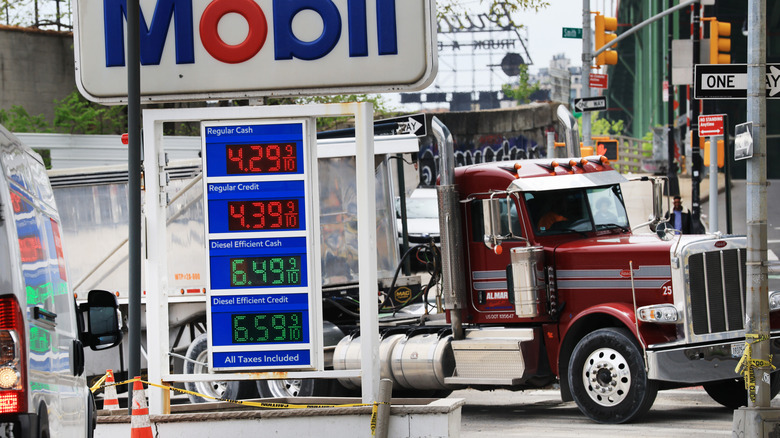
I've got some bad news, folks. The meteoric rise of gas prices is showing no signs of slowing down, as we've blown straight past the previous high of $4.17 per gallon that we saw on April 9. There are now fears that the U.S.'s blockade of the Strait of Hormuz could end up lasting months, and oil prices have jumped again overnight. At the time of publication, WTI Crude Oil futures are around $104 and Brent Crude is about $108.
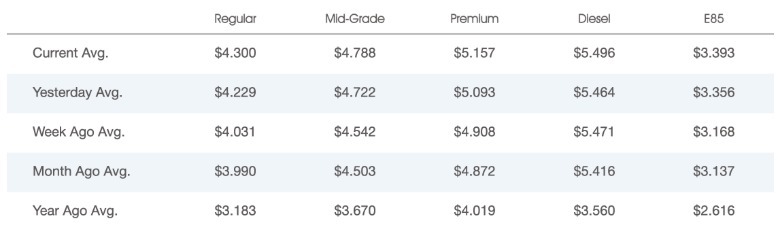
Now, we're dealing with a new 2026 record for the average price of a gallon of gas since prices shot up another 7 cents overnight to $4.30, according to AAA. Keep in mind, just one week ago, gas was 27 cents cheaper because of a brief respite in price increases we saw after April 9.
Here's where national average prices stand right now, according to AAA:
 AAA
AAA
The last time we saw prices this high was back in July of 2022, when the average price of a gallon of gas hit $4.67, according to the Energy Information Administration. Hopefully we don't get there again, but who the hell knows at this point? In any case, the average price of a gallon of gas is now up $1.32 — or about 44.3% — since the war first broke out on February 28, when it was $2.98.
On the radio: Black Eyed Peas - Meet Me Halfway
Everybody remembers "I Gotta Feeling" from this album, but if you were to ask me back in 2008 (when I was 12), I'd have said "Meet Me Halfway" was the best song on The E.N.D. 18 years later, and I've still gotta agree with that opinion. The song is just so satisfying to listen to. It also rips me right back to middle school.
I'm very sorry to all the old-heads who are annoyed by how young I am.