

Ultra-Luxury Automakers Are The Real Victims Of The U.S.-Israeli War With Iran
Good morning! It's Monday, March 30, 2026, and this is The Morning Shift, your daily roundup of the top automotive headlines from around the world, in one place. This is where you'll find the most important stories that are shaping the way Americans drive and get around.
In this morning's edition, won't someone please think about what is really being hurt by the U.S. and Israeli's war with Iran? The profits of ultra-luxury automakers, of course! But don't worry, we're getting to the bottom of this travesty. We're also talking about Ford CEO Jim Farley's generous pay package for 2025, a Jeep Cherokee production halt and a hit for BYD's profitability.
1st Gear: Keep ultra-lux OEMs in your thoughts and prayers
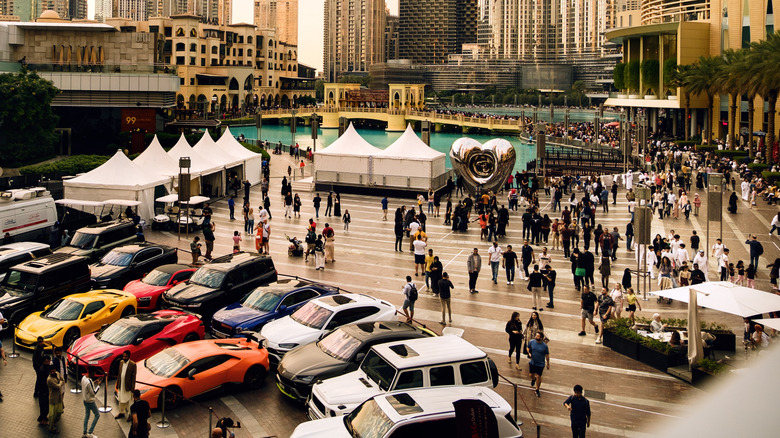
A lot has been said about the victims caught up in the middle of the U.S. and Israel's war with Iran, but there's one group that I've hardly heard anything about. It's a group that, arguably, has suffered even more than the untold hundreds (if not thousands) who have lost their lives, home, friends and family in this conflict. Its ultra-luxury automakers that are going to take profit hits because their profitability and upselling cash cow — the Middle Eastern market — isn't going to be spending like it once was.
While the region may only account for less than 10% of sales volume at most luxury automakers, profit share is far higher since customers in the region are willing to pay for high-dollar extras and customization. Alas, demand is now weakening because of that pesky war and all of the, you now, death and destruction of civilization. It's a real shame. Perhaps we should start a GoFundMe. From Reuters:
A standard Rolls-Royce Phantom starts at about 430,000 pounds ($572,416), but the addition of bespoke features for wealthy Gulf buyers can push prices far above that – for some models bespoke additions can double or triple the price tag.
Rolls-Royce Motor Cars, owned by Germany's BMW, revealed the Arabesque just a week after opening its second Dubai showroom, before U.S.-Israeli strikes on Iran followed by Iran's strikes on the Gulf sent shockwaves across the region.
"It's the best market in the world," Bentley CEO Frank-Steffen Walliser said earlier this month of the Middle East.
But many luxury dealerships in the Gulf closed temporarily after war broke out on February 28. Ferrari and Stellantis unit Maserati paused deliveries this month, although both say showrooms have since reopened.
In an emailed response to questions, Rolls-Royce said it was "closely monitoring" the situation in the Middle East.
[...]
Meanwhile, F1rst Motors in Dubai, which sells all the top luxury car brands, shut its doors for the first few days after the war started, but has since reopened.
Director Chris Bull said the showroom is best known for its selection of Ferraris and Bugattis and sells vehicles ranging from about $250,000 all the way up to $14 million.
Bull said since F1rst Motors reopened, business is down about 30%, although sales of cars priced at more than $1.4 million have stabilised and its sales outside the United Arab Emirates remain robust.
"Obviously, there are fewer people walking in the front door ... But we're still managing to maintain a good level of business," Bull said, adding some buyers will pay up to 30,000 euros ($34,512) to fly a $7 million car out of the country.
During a media briefing, Volkswagen Group CEO Oliver Blume said Middle East sales were "very high margin" and the company expects to see "an impact."
It's not just off-the-shelf supercars either! Bespoke models from these automakers are also seeing tough headwinds as missiles rain down on civilians below.
Rather unreasonably, an unnamed industry executive told Reuters that that aspect of the business has dried up, and Bentley's CEO said that folks "in the Middle East have other thoughts than looking for a new Bentley at the moment." Yeah, man. I'd say so.
2nd Gear: Jim Farley is the $27 million man
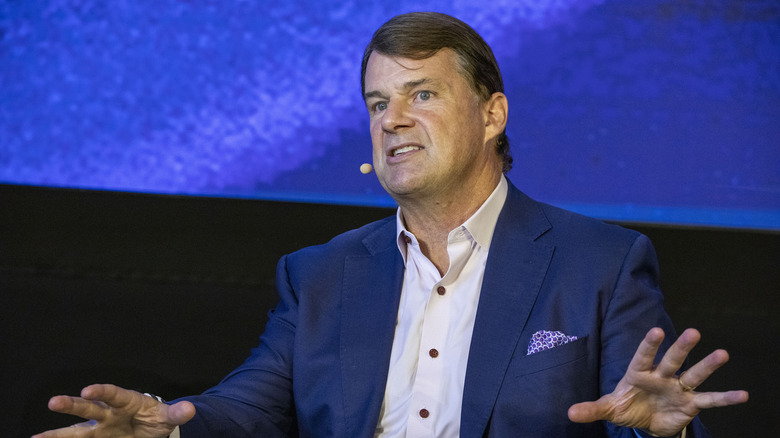
Do you own a new Ford? How's it treating you? Do you think the guy responsible for it should have gotten $27,519,558 last year? Well, too bad, because that's exactly what happened. CEO Jim Farley's total compensation jumped nearly 11% to his highest total since becoming CEO in late 2020. It's also equal to 295 times the medium annual pay for all other employees ($93,397), which is a rough look. His massive payday came on the heels of the company exceeding initial quality targets.
Of course, the automaker also issued a record number of recalls in 2025 — 153 cover 12,930,717 vehicles, to be exact. Ford argues that initial quality is a more reliable metric to measure progress since many of the recalls included older models that pre-date Farley and his executive team. That means Farley made about $2.13 for every car Ford recalled last year. From Automotive News:
Farley's base salary was unchanged at $1.7 million, while his stock awards fell by nearly $2 million to $18.8 million, according to the automaker's annual proxy statement released March 27.
Farley's nonequity incentives jumped 255 percent after the company hit 130 percent of its overall bonus targets.
While it reached just 64 percent of earnings targets, the company reached the maximum 200 percent of quality goals related to vehicles with zero and three months in service. It also hit 200 percent of its integrated services revenue target and 121 percent of a global electric vehicle volume target, excluding China.
Farley earned just under $25 million last year after the company fell short of quality and EV targets.
Farley wasn't the only Ford executive who made out in 2025. Executive Chair Bill Ford made $20.3 million (down slightly from $20.4 million in 2024). Vice Chair John Lawler, who was CFO until February of 2025 made $11.8 million (up from $9.4 million). The company's current CFO, Sherry House, made $8.4 million (down from $12.1 million because of a hiring bonus). Ford's chief EV, digital and design officer, Doug Field, made $15.3 million (down from $15.5 million). Finally, Alicia Boler Davis, who was hired in July to run Ford's Pro commercial business, made nearly $19 million.
Keep in mind, all of these massive paydays came despite the fact Ford lost $8.2 billion in 2025 — its third-worst performance ever. Of course, that's largely due to EV write-downs and $2 billion in tariffs, but that's sort of on Ford for whiffing on its EV strategy, and it's not like the company hasn't been sucking up to Trump.
3rd Gear: Jeep Cherokee production stopped over supplier dispute
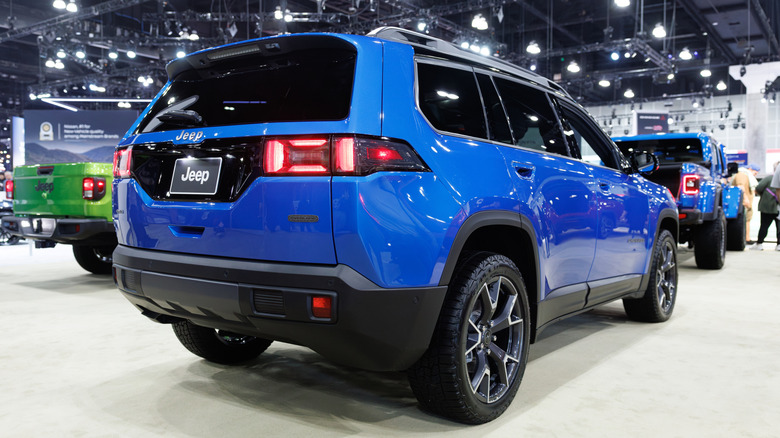
Stellantis is in a fight with one of its suppliers, and production of its incredibly important Jeep Cherokee crossover is suffering because of it. Now, there's a lawsuit saying that its factory in Toluca, Mexico has been shut down since March 14 because of a payment issue with ZF Foxconn Chassis Modules, the supplier that builds suspension modules for the vehicle.
It apparently stopped shipping parts to the Mexican plant after trying to get additional price increases on contracts, according to the lawsuit, but Stellantis is confident that a court order in Mexico should restart operations in the next few days. There's an issue, though: this isn't the only beef Stellantis and ZF Foxconn currently have. From The Wall Street Journal:
The supplier also threatened to stop shipping crucial parts to a Stellantis factory in Canada unless the carmaker agrees to pay tens of millions of dollars in price increases, the lawsuit said.
The Windsor, Ontario factory, which makes the Chrysler Pacifica minivan and Dodge Charger, faced an imminent shutdown as a result of the dispute. But a temporary restraining order issued Wednesday by a Michigan judge ordered the supplier to resume shipments. That factory hasn't experienced any downtime, Stellantis said.
Payment disputes between automakers and suppliers aren't unusual in the industry, but rarely spill over into court and result in parts shipments being halted.
The interruption in production for Jeep and Chrysler also presents a potentially significant headache for Stellantis, which has been trying to engineer a turnaround after a dismal 2025 performance that ended with $26 billion in charges amid a reset on its electric-vehicle strategy.
"While turning to the courts is never our preferred approach for resolving supplier matters, Stellantis will take appropriate steps to protect the integrity of our manufacturing operations and ensure fair business practices," the company said.
This issue between the two companies apparently dates back to December. At that time, Stellantis' U.S. affiliate paid over $26 million and granted substantial price increases to avoid parts not being shipped. The automaker claims this "emboldened" the supplier to ask for another $70 billion in cash payments and price increases.
4th Gear: BYD sees profit drop for first time in a long time
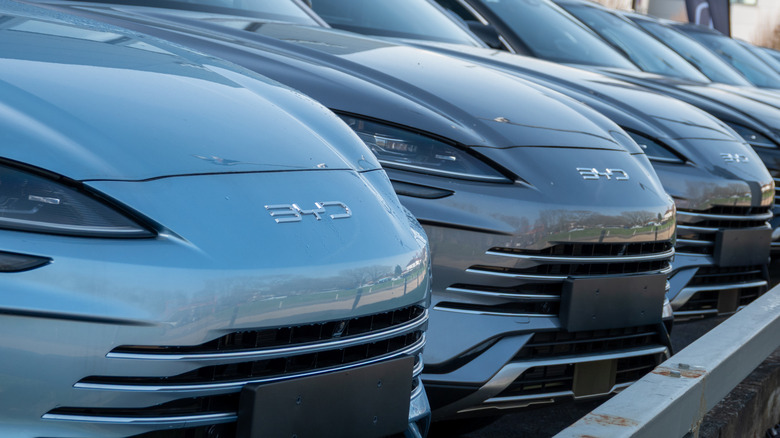
BYD may be China's biggest electric automaker by sales, but that doesn't mean its impervious to issues. The company just posted a bigger-than-expected profit drop and disclosed a not-ideal headcount fall for the first time thanks to weakening sales in its home market.
The automaker's net profit fell 19% to $4.72 billion, which represents its first annual profit drop in four years. It's also quite a bit more severe than the average 12.1% fall expected by analysts. Things aren't exactly looking up for 2026, either. From Reuters:
BYD could face a tougher earnings backdrop in 2026, as intense competition and softer domestic demand are likely to keep pressure on profit, even as overseas growth continues, analysts said.
The automaker was once propelled by its affordable Dynasty and Ocean series, but has been losing ground as rivals such as Leapmotor and Geely narrow its technological lead.
It was China's biggest automaker in 2025 but fell to fourth place over the January to February period as its overall sales dropped by the most since the COVID-19 pandemic.
[...]
For the three months through December, profit slumped 38.2% to 9.3 billion yuan from a year ago, its third straight quarter of decline.
Gross profit margin from autos and related products, which contributed 80.7% to operating revenue, slipped to 20.5% last year, down 1.8 percentage points from a year ago.
[...]
Sales were also impacted this year by revised subsidies favouring models priced higher than those in BYD's core budget segment.
Cars going for under 150,000 yuan ($21,699) accounted more than 61% of BYD's domestic sales in November, based on a Reuters analysis of the company's filings and sales data from Chinese auto analytics platform DATADIC.
To revive sales, BYD unveiled 11 models with a faster-charging battery and pledged to grow its flash charging network. Still, the higher-priced lineup is unlikely to be enough to boost sales as consumers seek affordable options, analysts said.
BYD said it would expand sales abroad. Revenue of vehicle and related products increased by 5% last year, thanks to strong sales growth in overseas markets, which posted a better profitability.
Revenue did grow by 3.5% during 2025, but it was its weakest pace in 6 years. Not helping matters is the fact the company cut its workforce by 10.2% to 869,622, as of the end of 2025.
Clearly, it is a bit of a BYD issue, and not something Chinese automakers are struggling with as a whole. Geely reported a 36% core net profit rise in 2025, and Xpeng booked its first ever quarterly profit.
Reverse: Thanks, Obama
 History.com
It's hard to imagine how bad the Great Recession could have gotten if the government let General Motors and Chrysler fail. It's equally hard to imagine how much of an auto industry the country would even have left outside of Ford, which wasn't doing too hot itself at the time. In any case, good job, Barry. If you want to learn more about the auto industry bailout and Obama's stipulations, head over to History.com.
The Fuel Up
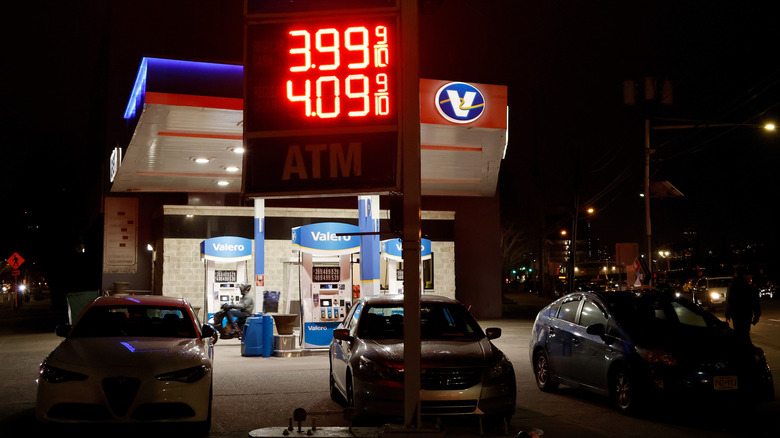
Gas prices have, for the most part, stabilized in the high $3.90s, as the prospect of widespread $4 per gallon gas is just too much for the universe to handle right now. Still, we're getting awfully close, with both WTI oil futures and Brent Crude over $100 per barrel.
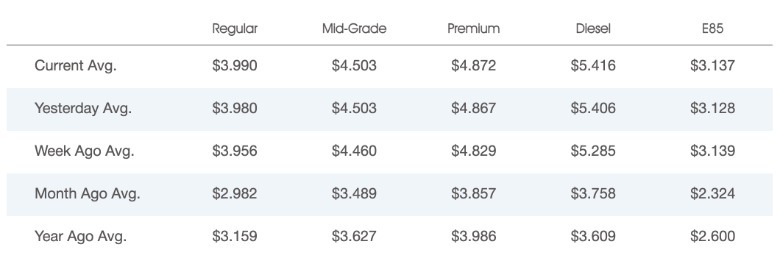
We inched ever so slightly closer to $4 overnight, as the average price of a gallon of gas rose from $3.98 to $3.99, according to AAA. I'd be shocked if it didn't happen at some point this week, since there haven't really been many signs of the U.S.-Israeli war with Iran slowing down or the Strait of Hormuz reopening in any meaningful way.
If you were wondering, the last time gas was over $3.98 was back in August of 2022, according to data from the Energy Information Administration, and, the average price of a gallon of gas is now up $1.01 — or about 29% — since the war first broke out on February 28, when it was $2.98.
 AAA
AAA
Here's where national average prices stand right now, according to AAA:
On the radio: Ace Frehley - New York Groove
Folks, it's New York International Auto Show week. Do you know what that means? It means all the automakers and journalists I'd usually have to get on a plane to go interact with have to come and see me on my home turf — in da greatest city in da world, baby. What a treat that is. They should be so lucky.
Be on the lookout for our full coverage of the show. Los Angels' very own Daniel Golson and I will be at the Javits Center with the very latest.