

MapQuest Includes Flock Camera Locations Now
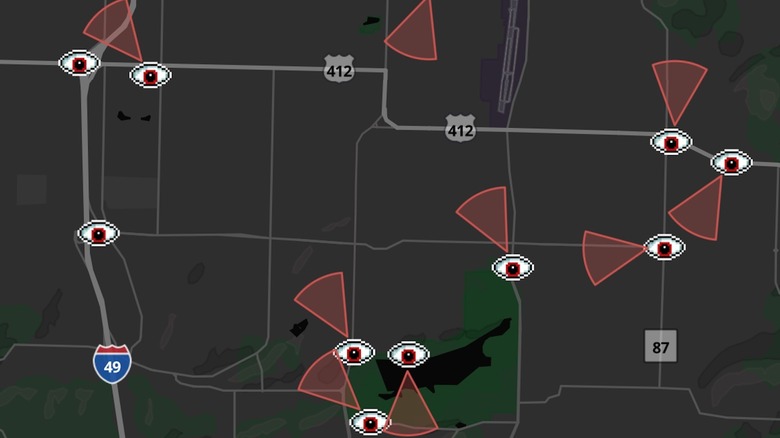
MapQuest has seen a resurgence in popularity after refusing to obey President Trump's executive order to change the name of Lake Ontario to Lake America. Now the company is striking back on more than just principle. Engadget reports that a new map layer displays the locations of surveillance cameras and automated license plate readers, handy for those of us who value our privacy.
The feature currently appears to only be available in the MapQuest app, not on the website. Turning it on is as simple as opening the map settings, then turning on the "Surveillance" layer. Then, once you zoom in to an area closely enough, animated eyeballs appear on the map to mark camera locations. Where available, a red cone also shows you what direction the cameras are pointed. You can also tap on any location to see what type of camera it is (license plate reader, dome, fixed, etc.), its location coordinates, and what direction it's facing.
MapQuest's surveillance layer comes as a result of user requests, reports Business Insider:
MapQuest's General Manager Doug Berger said drivers using the service inspired the company to add the feature.
"We build around what drivers ask for, and showing surveillance camera locations is one of our users' top three requests," Berger told Business Insider in a statement.
The staggering number of cops caught abusing the system, as well as innocent people getting stopped for crimes they didn't commit, has led to a significant backlash against Flock cameras. More and more communities are ending their Flock contracts in response. In the meantime, MapQuest has given us an easy way to track the cameras that are still out there.
Welcome to the resistance
MapQuest's announcement of this feature (set to "Somebody's Watching Me" by Rockwell) says this isn't just for Flock cameras, but also for Axon, Motorola Solutions, and many others. It isn't clear exactly where MapQuest is getting this data, but Gizmodo reports that it bears a striking resemblance to the information available from DeFlock, the open-source project documenting over 143,000 camera locations.
One could accuse MapQuest of simply copying DeFlock's homework for good publicity against Google Maps and Apple Maps, both of whom also caved to President Trump's nonsensical name changes. On the other hand, people have to actively seek out and search DeFlock to find cameras, while MapQuest now delivers this data to all of its users in the palms of their hands. Making this information more easily accessible may lead more people to look at it, decide they don't want these cameras in their backyard, and get them taken down the right way, or at least put trash bags over them.
Companies that provide these services may be unhappy about this development. Flock, in particular, filed a lawsuit to shut down FlockSurveillance.org, though that website is now back up. It would be much more difficult to sue MapQuest than a single security researcher's personal project. It's the OG of mapping websites that first went online in 1996, decades before these ALPR and surveillance systems even existed. It's come a long way from having us print out directions on paper, back before smartphones gave everyone a GPS in their pockets. Now, MapQuest has joined the resistance, positioning itself as a spunky upstart among the giants like Google and Apple that pushed it out of the spotlight in the first place.