

The Staggering Number Of Flock Cameras That Dot US Highways
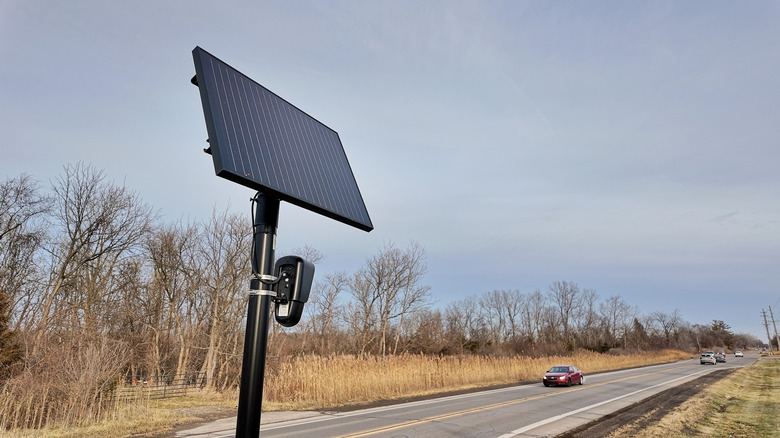
Unless you've been living under a rock on the far side of the moon, you've likely heard some of the controversy surrounding Automated License Plate Readers (ALPRs). These cameras capture, analyze, and save license plate information so law enforcement can use it to track specific vehicles suspected in crimes. Of the popular license plate readers, none are more contentious than the oft-reviled Flock cameras. They're the stick-mounted, solar panel-wearing boogeyman making headlines by tracking cars using advanced license plate-reading technology. In fact, Flock's cameras can find your car even without a license plate – and there's a bunch of them.
Just how many? Some states have over 10,000 of the things watching traffic at any given time so far. Altogether, there are well over 100,000 cameras associated with Flock Safety across 49 of these 50 states –- more than any other license plate reader brand out there. The common sight of these cameras has even concerned citizens asking questions along the lines of whether Flock cameras can tell how fast they're driving. Beyond asking questions, some less-than-enthusiastic residents have taken to protesting, obscuring, or even obliterating the Orwellian devices. It's gotten so crazy that some cities have straight-up dropped their contracts with Flock Safety, yet the cameras remain after removal deadlines.
Over a hundred thousand Flock cameras watch U.S. highways, roads, and cities
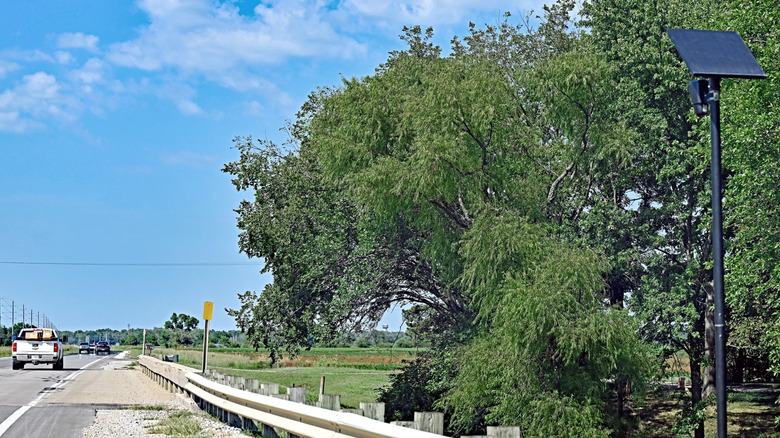
Flock Safety got its start in the license plate reading camera business back in 2017. Two years later, a law enforcement agency in Jersey Village, Texas, became the brand's first official police customer. Now, nearly a decade later, you don't have to drive very far to find Flock cameras. As of this year, the OpenStreetMap ALPR dataset counts at least 127,344 license plate reading cameras in the United States. Of those cameras, at least 82% (around 104,883 cameras) are tagged as Flock Safety devices. The company itself has characterized its camera network as having over 120,000 devices, a figure that accounts for the vast majority of license plate readers watching American roads.
In addition to the nosy little cameras in urban environments, there are around 24,000 readers sitting outside American cities and towns. So, hitting the highway between big cities or taking back roads won't necessarily mean a journey free from Flock's gaze. As far as individual states go, California and Texas lead the country, with 15,334 and 14,341 Flock Safety-tagged cameras, respectively. That said, more readers in the Lone Star State reside outside city and town boundaries than those in California – around 2,957 readers compared to California's 1,145. Now that's a Flock-load of camera coverage.
Ditching Flock cameras doesn't mean an end to plate readers
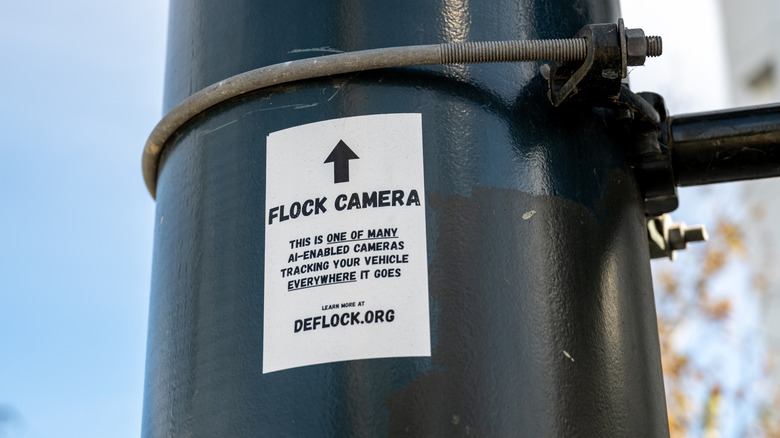
So, what's all the Flock fuss really about? The brand is quick to remind Americans that the cameras are a useful tool for law enforcement. Critics, however, maintain that the cameras are a violation of privacy. After all, the argument can be made that Flock cameras violate safety standards and the Fourth Amendment. Yikes. Still, not every city wants the little black cameras around. Tempe, Arizona, and Stow, Massachusetts, recently made the decision to deactivate their cameras and cancel their Flock Safety contracts. Troublingly, canceling a contract doesn't always mean disappearing cameras. In some instances, deactivated Flock cameras were left up so long after their contract ended that cities resorted to covering them with trash bags.
Of course, Flock Safety isn't the only name in the game; ALPR cameras from Axon, Genetec, Axis, and Motorola Solutions (yes, that Motorola) also dot highways and streets across the country — over 22,500 of them in America. In fact, as some jurisdictions ditch Flock cameras, Axon has stepped in to fill the plate reader vacuum. Earlier this year, the Denver City Council decided to scrap its relationship with Flock Safety and instead commit to a $150,000, 50-camera contract with Axon. In Syracuse, New York, lawmakers also decided to make the switch from Flock Safety to Axon. Even with cities severing their ties to Flock Safety, plate readers remain.