

Chinese Car Sales Are Surging In Europe And U.S. Senators Want To Make Sure That Can't Happen Here
Good morning! It's Thursday, September 24, 2026, and this is The Morning Shift, your daily roundup of the top automotive headlines from around the world, in one place. This is where you'll find the most important stories that are shaping the way Americans drive and get around.
In this morning's edition, Chinese car companies are already seeing their sales surge in Europe, and U.S. Senators are begging President Trump not to let that happen Stateside; Mercedes-Benz wants to cut over $900 million worth of labor costs in Germany, and Honda is looking to Ohio for a $2.5 billion assembly plant.
If you'd like a recap of the latest auto news sent to your inbox each weekday, you can sign up for Jalopnik's free Morning Shift newsletter here.
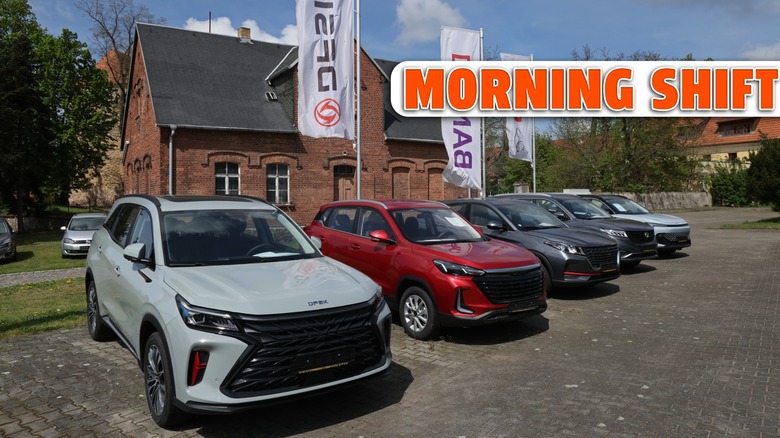
1st Gear: Chinese automakers are already killing it in Europe...
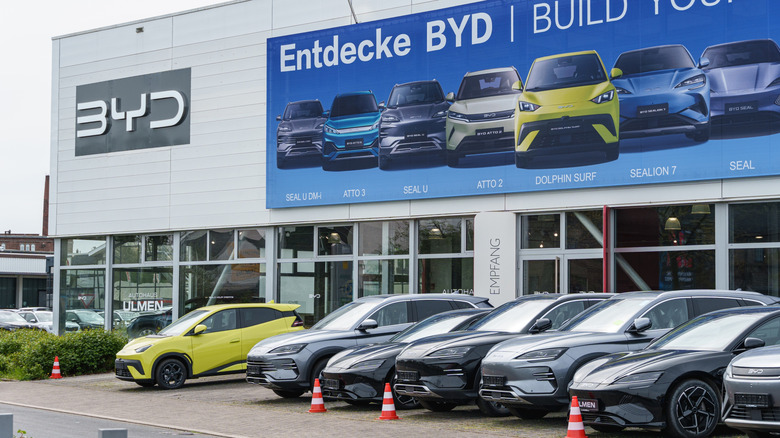
Chinese automakers may be fairly new to the European market, but they've come out swinging. Last month, they logged strong growth once again, making strides and winning over drivers on the continent as domestic companies find it harder and harder to stay competitive.
BYD led the way, with new-vehicle registrations more than doubling year-over-year in August to 26,007 units across the European Union, the UK, Iceland, Liechtenstein, Norway and Switzerland. It's not just BYD, though. SAIC's registrations were up 32% to 21,214 units, and Leapmotor's registrations leapt threefold to 7,630 vehicles. At the same time, Volkswagen saw sales drop 3.6% to 201,818 vehicles, and Renault's followed a similar trend, falling 4.4% to 71,906 registrations. Obviously, they cleared these Chinese companies on pure volume, but these trends are certainly worrying for the Europeans. From The Wall Street Journal:
While August tends to be a slow month for car registrations in Europe since many dealerships close for the summer holidays, the schism in the registration rate for Chinese and domestic carmakers shows that BYD and its peers keep gaining ground even though European auto groups sold many more vehicles in absolute numbers.
Many European carmakers have had to review their lineups and take hefty impairment charges in recent years, with Chinese competition often featuring as one of the main reasons.
Last week, Volkswagen slashed a key profitability target for the year after flagging roughly $11.5 billion of impairment charges linked to its stake in Porsche AG, tough trading conditions and restructuring efforts.
The guidance cut came weeks after Volkswagen's supervisory board approved a plan to double job cuts to 100,000 in a bid to remain competitive at a time when the auto sector struggles with U.S. tariffs, rising manufacturing costs and stiff competition from Chinese rivals.
Porsche AG also said at the end of July that it would cut 5,000 jobs. The sports-car maker was hit by a collapse in sales in China, U.S. tariffs and a premature bet on electric vehicles. Several EV makers have had to scale back production in recent years as they struggled to convince drivers to transition to electric.
The data comes from the European Automobile Manufacturers' Association, which says monthly passenger-car registrations increased 5.3% in Europe as a whole and 4.5% in the EU. Meanwhile, they were up 2.6% in Germany, 7.4% in France and 3.2% in Italy. That's not bad, considering August is supposed to be slow.
2nd Gear: ...and U.S. Senators are trying to stop that from happening here
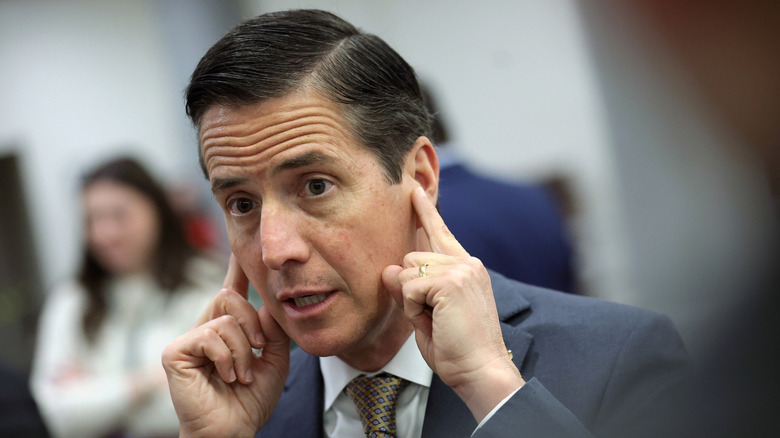
Clearly, U.S. Senators are seeing what's going on in the EU, and it's making them go peepee and their pants. There's a new effort by Michigan Democratic Senator Elissa Slotkin and Ohio Republican Senator Bernie Moreno to quickly win Senate approval of a permanent ban on Chinese vehicles. It comes just as President Trump meets with China's President, Xi Jinping.
The bill, which is — if you think about it — anti-American in nature since it's anti-consumer choice and thus, anti-capitalist, has a lot of momentum. A House version now has over 100 cosponsors while automakers and legislative aides hope to win passage this year. Slotkin and Moreno aim to win unanimous Senate approval for it this week. From Reuters:
"Whether you are a Democrat or Republican, no one wants Chinese cars in America," she said at a Capitol Hill press conference, adding the measure's authors are trying to identify any opponents and address their concerns.
A couple of Republican senators have already raised some concerns, a congressional aide told Reuters, adding that it was not yet clear whether they will object.
A notice sent to offices of Democratic senators said Moreno intended to seek unanimous consent for the bill this week.
[...]
China has strongly opposed the US vehicle ban and efforts to make it permanent.
Earlier this month, Trump told Fox News he would accept Chinese car companies building cars in the United States, sparking alarm among automakers.
Slotkin said allowing this would mark "the beginning of the end of auto manufacturing in the United States."
Last week, automakers, suppliers and dealers urged Trump "to maintain policies that keep the door firmly shut to Chinese automakers seeking to sell, import or manufacture vehicles inside the US"
A regulation imposed by former President Joe Biden's administration in early 2025 effectively banned all Chinese automakers from selling or building passenger vehicles in the US because they could send sensitive driver data to China. Washington also maintains more than 100% tariffs on Chinese electric vehicles.
The bill, which has 51 Senate supporters, would make the ban into law and prevent the White House from issuing waivers to Chinese vehicles to sell vehicles in the United States.
A letter from industry big-timers like Ford, General Motors, Hyundai, Stellantis, Tesla, Toyota, Volkswagen and a slew of others argued that Chinese investment wouldn't create new American jobs. Instead, it would "shift jobs away from manufacturers that have made generational investments in the US and toward companies owned and operated by the Chinese government." Bluetooth, Wifi, cellular connectivity, and some satellite communications technologies are covered under the rules based on national security concerns based on the idea that these vehicles could collect sensitive data on American owners. Of course, I'm writing this on my Chinese-made laptop, and you're reading this on your Chinese-made phone.
3rd Gear: Mercedes-Benz plants to cut $911 million in German labor costs
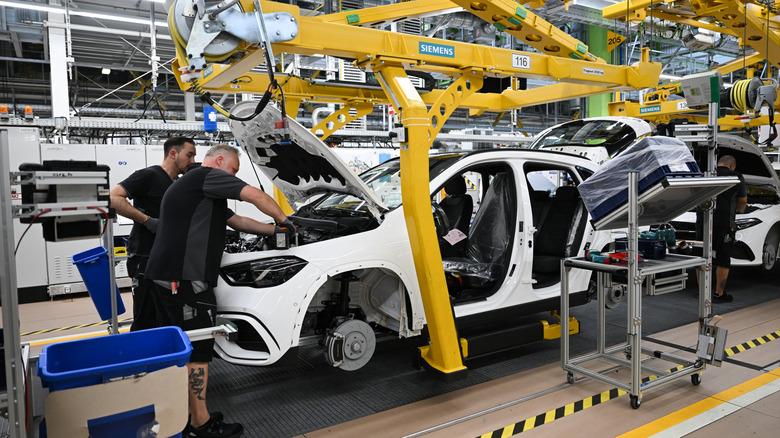
Mercedes-Benz is planning to cut about $911 million in German labor costs, according to three anonymous sources familiar with the matter. Options under consideration include increasing working hours without increasing pay (bad), adjusting holiday and Christmas bonuses (bad) or eliminating special payments (bad). From Reuters:
Management has told workers that producing in Germany has become too expensive, calling on them to work more and commit to cost-cutting targets. Otherwise, two German plants could be closed.
Volkswagen is pursuing the most far-reaching overhaul in the company's history and BMW is also cutting thousands of jobs, as Germany's storied auto sector faces a growing threat from low-cost Chinese competitors while navigating tariffs and EV costs.
This news comes as Mercedes must also contend with crappy sales in China and the idea that it could potentially be barred from operating in the U.S. because of Slotkin and Moreno's Chinese vehicle ban. Since MB is more than 15% owned by a Chinese company, it would technically not be allowed to sell vehicles in the U.S. as the bill is currently laid out. Not great!
4th Gear: Honda is looking to Ohio for a $2.5 billion assembly plant
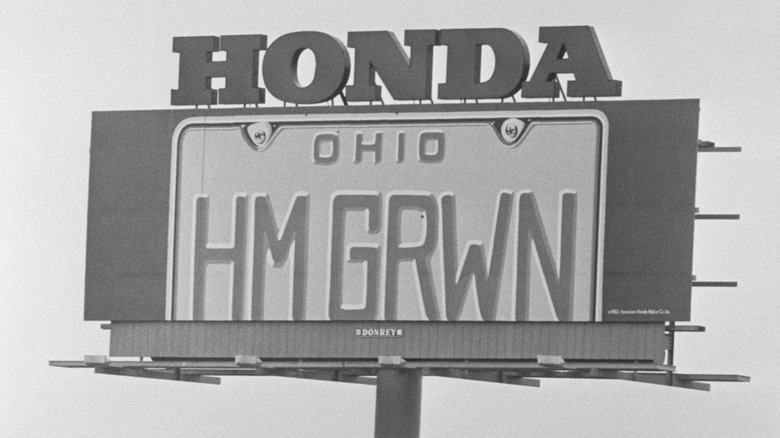
Honda is in the end stages of talks to build a massive $2.5 billion hybrid vehicle assembly plant in the U.S., and it's looking like Ohio is currently the front-runner to land the lucrative deal. If negotiations with the state go through, the automaker plans to start operations in 2030, and it'll produce a pair of large flagship crossovers for Honda and Acura.
It would mark Honda's eighth assembly plant in North America and highlight how far the Japanese automaker has moved away from its electric vehicle plans. We first told you about the idea of Honda adding an eighth assembly plant back in July. Well, here it is. From Automotive News:
Honda is targeting the launch of 15 next-generation hybrid models globally by the end of March 2030, with the majority aimed at North America.
North America — Honda's largest and most profitable market — accounted for about 40 percent of the company's global sales last year. Its factories in the U.S., Mexico and Canada are running nearly at maximum capacity.
[...]
An additional plant would deliver breathing room critical for supply chain resilience and sales growth.
"I want to increase the number of sales in North America a lot," [Honda CEO Toshihiro] Mibe said at the time. "The basic idea is to produce in a place where there is demand."
Trade tensions also are amplifying the need for more U.S. production. Automakers are racing to build more vehicles in the U.S. to avoid steep import tariffs. Toyota is investing $3.6 billion to add a second assembly line in Texas, shifting 150,000 Tacoma pickups from Mexico starting in 2030.
Ohio certainly makes sense as a spot for Honda to set up another shop. It has a very well-established footprint in the Buckeye State with assembly plants in Marysville and East Liberty. It's also converting portions of a joint-venture battery plant in Ohio that it originally built with LG Energy Solutions. It's now going to produce hybrid batteries and energy-storage systems.
Reverse: Thanks for all the cool stuff
 History.com
Today, the Honda Motor Company turns 78 years old, and it's almost impossible to count all of the sick cars it has built over the years. Who knows where the automotive industry would be without it? I sure don't want to think about that scenario, because it would certainly be a hell of a lot less interesting. Anyway, if you want to learn more about the early days of Honda, head over to History.com.
The Fuel Up
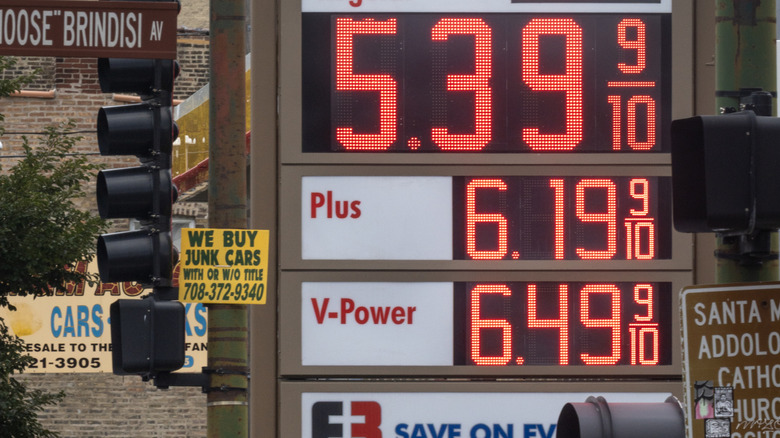
We've reached a sort of holding pattern plateau when it comes to fuel prices. While they're not going down, they haven't really gone up, either, over the past few days, which I guess is a good thing. Fairly flat WTI Crude Oil futures and Brent Crude prices, which were sitting at $94 and $105, respectively, at the time of publication, certainly have something to do with it.
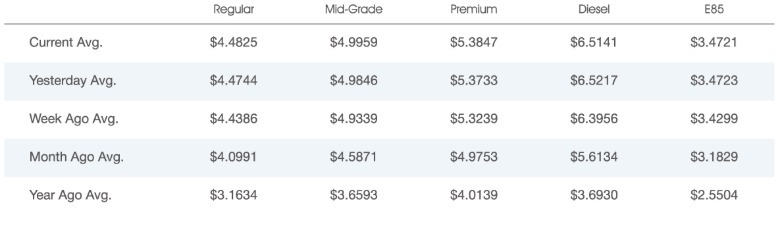
Here's where national average prices stand right now, according to AAA:
 History.com
All of this is to say that the average price of a gallon of regular gas was up another cent overnight to $4.48, according to AAA. We're getting ever-so-close to the 2026-high of $4.56 that we saw back in May, folks. Diesel was actually down ever-so-slightly to $6.51 — down 2 entire cents from its all-time high set two days ago.
On the radio: Steely Dan - 'Reelin' in the Years'
Friends, it's ThrusDan. Act accordingly.