

BMW, Mercedes And Audi Can't Stop Their Doom Spirals In China
Good morning! It's Tuesday, August 11, 2026, and this is The Morning Shift, your daily roundup of the top automotive headlines from around the world, in one place. This is where you'll find the most important stories that are shaping the way Americans drive and get around.
In this morning's edition, Germany's three big automakers cannot seem to reverse their fortunes in China, General Motors takes another step away from the EV space by selling its stake in an Indiana battery venture, Unifor and GM are set to begin contract talks in Canada and Tesla is recalling over 20,000 vehicles for headlights that are too bright.
If you'd like a recap of the latest auto news sent to your inbox each weekday, you can sign up for Jalopnik's free Morning Shift newsletter here.
1st Gear: BMW, Audi and Mercedes flounder in China
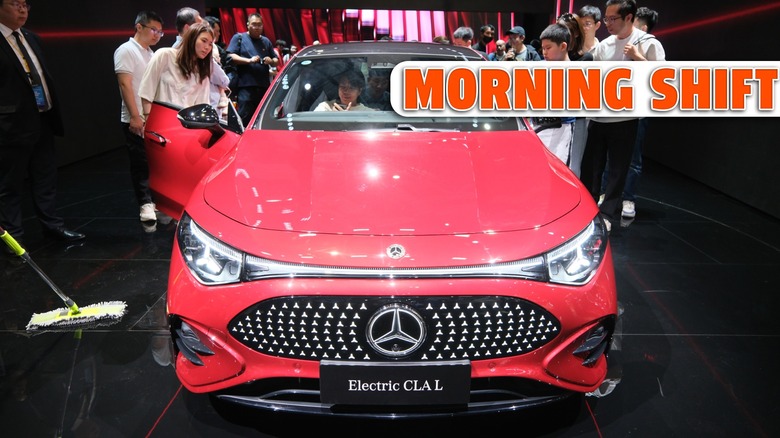
German automakers are doing everything they can to win over young Chinese buyers, and not a single thing has worked so far. Take Mercedes' latest effort — a team-up with McDonald's to create the "So McBenz" marketing campaign that allowed a cheeseburger figurine to take the place of its traditional three-pointed star on the all-electric CLA. It was supposed to appeal to those very buyers, but instead it was flop city. In the first half of the year, MB sold just 1,153 CLAs in China, and at the same time Xiaomi sold over 80,000 of the similarly priced SU7. It's a damn shame, too, because the CLA is a great car.
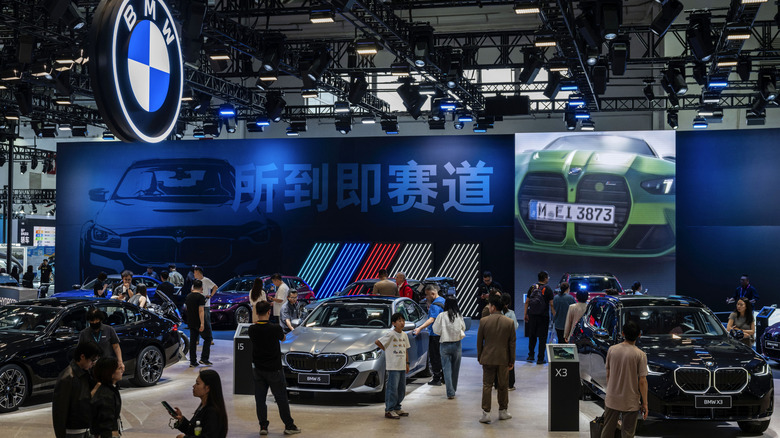
It's not just Mercedes, either. BMW, Volkswagen and Porsche are also dealing with their own mini China Syndromes. All four were dealt second-quarter sales declines of at least 30% — worse than the market's overall drop. Meanwhile, Xiaomi and BYD are swiping their customers away. No one has figured out how to reverse course, and it's not for lack of trying. From Bloomberg:
Most of them have partnered with Chinese companies to gain access to the latest EV technology and better understand what local drivers want. Mercedes built a long-wheelbase version of the CLA to appeal to Chinese tastes for a roomier back seat. It packed the car with software including AI-powered voice control and priced it from just 229,000 yuan ($33,943), roughly 40% cheaper than the European version.
Instead of winning clients, Mercedes had to concede that competing in China would require even further price cuts that would see it lose money on almost every electric CLA sold, according to people familiar with the matter. The company is limiting its push for the car until economics improve, the people said, asking not to be identified discussing internal commercial decisions
[...]
BMW slashed its margin outlook due to the China slump, putting it on course to be the least profitable major European automaker this year. Managers including Mercedes Chief Executive Officer Ola Källenius expect the market to remain brutally competitive for years to come.
The problem isn't only price. In many cases, German carmakers still operate on the development-to-market schedule of the gasoline era, refreshing products every four years or longer, and teasing snippets of new cars long before drivers can buy them. But in China, the EV market has come to resemble the frenzied pace of consumer electronics, with brands rejuvenating cars as fast as 18 months and having a new model ready for mass purchase right off the bat.
[...]
That's fueling a fundamental shift in brand perception in China, where Mercedes, Audi and BMW are losing their luxury edge because they're perceived as trailing local manufacturers on software and EV technology.
Part of why the electric CLA is flopping is because rivals led by Xiaomi's SU7 dominate the segment at that price point with more advanced automated-driving functionality, a mobile-phone first entertainment system and hipper branding, said Li Yanwei, who advises the China Automobile Dealers Association. The CLA's sporty design tries to cater to a younger crowd, ignoring Mercedes' traditional middle-aged customers who tend to have families and prefer bigger interiors, he added. The CLA "is in an awkward place where it's not the most affordable and not the most luxurious," Li said.
[...]
The shift, which has accelerated since the start of this year, is starving the German carmakers of returns that help keep costly car production going in their home country. Blume in June said Volkswagen's business model was essentially broken. The comments paved the way for his plan to cut 100,000 jobs and shutter German factories, triggering staunch opposition from powerful labor leaders.
In China, Blume is betting on partnerships with Xpeng Inc. and state-owned SAIC to rejuvenate the VW and Audi brands. The first of the new VW-Xpeng models, the ID.Unyx 08, went on sale only recently, meaning there's little data to judge its success. Deliveries of the Chinese AUDI sub-brand's E5 Sportback, which has been out for roughly a year, have been underwhelming despite the car garnering critical acclaim.
For BMW, which in June slashed its projected carmaking margin to as low as 1% because of the decline in China, the main test is around the corner. The company is about to embark on its most ambitious push in the country in years with the first two of its revamped Neue Klasse models, the electric i3 sedan and the iX3 SUV. The latter will open for pre-sales in China on Aug. 21. Both are long-wheelbase models catering to local drivers.
BMW has spent over $11.5 billion on the Neue Klasse, saying that the tech it revealed last September would serve as a benchmark. While I personally think it's going to be very good, I am not Chinese, so I've got no way of knowing if it'll actually work to turn the automaker's fortunes around over there.
There's no word on the price of the Chinese iX3 just yet, but to be competitive it would have to be priced similarly to the Chinese Tesla Model Y, which starts around $39,125. That's just about half what BMW charges for the iX3 in Germany.
I'm not sure where this market ends up for Western automakers, but I feel like we're starting to reach a point of "throwing good money after bad." It's becoming evident that shoppers are only interested in cars built in China for the Chinese market, not global/Western cars that just so happen to be sold there.
2nd Gear: GM sells stake in battery venture as it unwinds EV tie-ups
General Motors can see what the slowdown of electric vehicle adoption, so it's selling half of a planned $3.5 billion EV joint venture in Indiana to Samsung SDI Co — the company it was tied up with in the first place. Samsung SDI will buy GM's 49.99% stake in the venture and operate it as a wholly owned entity.
Updated Tuesday August 11, 2026 3:00 p.m. EST - GM sent Jalopnik the following statement:
GM has not cancelled or indefinitely delayed any electric trucks. EVs remain the end game for GM, and we are firmly committed to our award-winning electric truck and SUV portfolio, along with our advanced technology roadmap.
We apologize for the error.
The 680-acre property in beautiful New Carlisle, Indiana, will be Samsung SDI's first standalone manufacturing hub in North America. It'll produce energy storage cells to cater to surging demand. From Bloomberg:
Separately, both companies have clinched an agreement to jointly develop next-generation prismatic EV batteries featuring high energy density and fast-charging capabilities for GM's future lineup, Samsung SDI said.
"This decision reflects changing market conditions while preserving our strategic relationship with GM," Samsung SDI said in the statement. "At this plant, we will sustain our joint efforts with GM for the future EV era while actively addressing US ESS demand."
[...]
GM's move away from battery production is the latest in a long pullback by the automaker, which had hoped to be selling 1 million EVs a year in the US by now. Despite a huge push by GM and other companies, EV demand has fallen short of expectations as American consumers demurred on plug-ins and the Trump administration removed federal sales incentives that could have helped demand.
As a result, GM has taken $11 billion in writedowns for its EV programs, sold back its share of one planned battery plant to another South Korean partner, LG Energy Solution, and converted an assembly plant in suburban Detroit to make large trucks and SUVs that burn gasoline.
The Ultium Cells LLC venture jointly owned by GM and LG Energy Solution in Tennessee has also started making cells for stationary energy storage.
GM has spent about $300 million on developing the site, which was announced just two years ago. Some buildings have been completed at the facility, but there isn't any production equipment in place just yet. When it does spin up, Samsung SDI will employee 1,600 people.
3rd Gear: Unifor, GM begin contract talks
Just a short while after striking a deal with Ford, Canada's Unifor auto workers union has turned its attention to General Motors. It represents over 4,600 workers at the company's facilities in Ontario. A spokesperson for the automaker in Canada says the company is "committed to working collaboratively" with the union to reach a new labor agreement. From Automotive News:
Unifor national president Lana Payne said in an interview at the time that the agreement with Ford marked a precedent with key gains around wage increases and job security.
"I have confidence in what we've negotiated here because history shows us if we do hit a rough patch, that there's a way to work our way through that," Payne said in July.
"Obviously, I don't have a crystal ball here, but we have done everything we can to show that this auto industry is incredibly important and that our union is going to continue to fight for it."
However, she did acknowledge differences between Ford and its other automotive counterparts — General Motors and Stellantis — that could make upcoming talks more complicated.
Namely, General Motors' Ingersoll assembly plant and Stellantis' Brampton assembly plant both currently sit idle with thousands of workers laid off.
"The difference is that they have taken decisions that were different than Ford Motor Co. throughout the last 18 months," said Payne, referring to the period of trade uncertainty that Canada has faced since the introduction of auto tariffs.
"There's no doubt in my mind that those contract talks will also be tough and quite frustrating. But we have to fight for this industry here, and this is one of the ways that we can do it."
The current edition of bargaining between Unifor and the remaining Detroit Three automakers also comes alongside headwinds for the sector.
Unifor has previously highlighted challenges like tariffs in the U.S., President Trump's decision to upend the Canada-U.S.-Mexico Agreement and the introduction of Chinese EVs into the Canadian market.
Solidarity forever, Canadian workers. Go get yours, ya hosers.
4th Gear: Over 20,000 Tesla Model 3s, Model Ys recalls for headlights that work too well
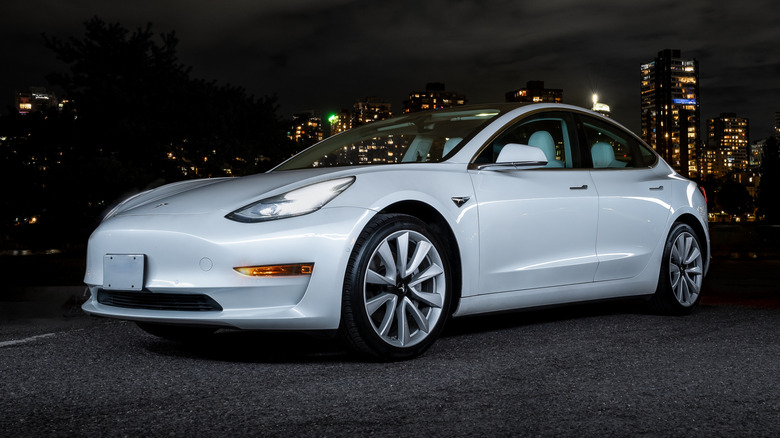
Tesla is recalling 18,735 2020-2023 Model Y crossovers and 1,614 2017-2023 Model 3 sedans because the goddamn headlights are too bright. They're making the lives of oncoming drivers miserable and putting them in danger. From the National Highway Traffic Safety Administration:
The headlight low beams may be to be too bright and exceed the maximum light output. As such, these vehicles fail to comply with the requirements of Federal Motor Vehicle Safety Standard (FMVSS) number 108, "Lamps, Reflective Devices, and Associated Equipment."
Right now, a remedy is still under development, but owners of these blinding machines should expect a letter to be mailed out by September 15 of this year.
Reverse: A real hero of mine
 History.com
We should all be so lucky to quit the crappy jobs we've had in such a chic way. Steven Slater, you are my hero, and I hope your little slide down onto the runway was as magical as it seems. If you want to read more about Slater, the events leading up to his cool-ass decision and the trouble he got in because it was, uh, illegal, head over to History.com.
.
The Fuel Up
Folks, we were ever-so-close to the average price of a gallon of regular gas dipping back below $4, but yet another stalemate between the U.S., Israel and Iran over the Strait of Hormuz has killed that dream. It has also caused oil to rise, with WTI Crude Oil futures and Brent Crude prices gaining this morning. They were sitting at $82 and $87, respectively, at the time of publication.
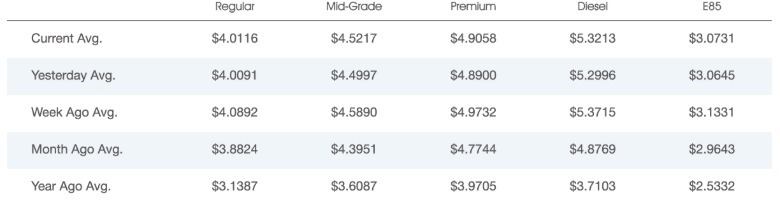
Here's where national average prices stand right now, according to AAA:
 AAA
AAA
What all this means is the average price of a gallon of regular gas was flat overnight, maintaining the $4.01 level it was at yesterday, according to AAA. Technically, it was us a few fractions of a penny, which shows that we're not moving in the right direction. At the very least, we're still a good bit off from the 2026 high of $4.56 that we saw back in May, but I wouldn't be surprised if we got there soon.
On the radio: Toploader - Dancing in the Moonlight
I know everybody loves the King Harvest version of this song, but since that's really just a cover as well, I've really got no issue saying the Toploader version of "Dancing in the Moonlight" will always have a special place in my heart. It's such a magical song, and this version especially brings me back to such a fun time and place in my life.