

Driving The 2027 Infiniti QX65 Had Me Thinking 'Oh, For FX's Sake!'
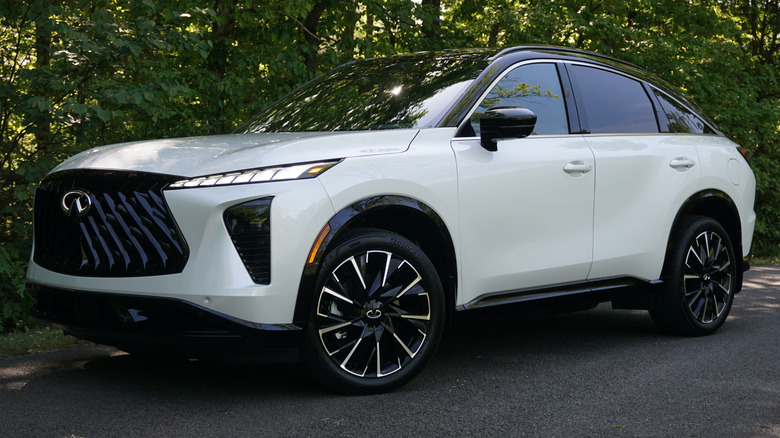
There's nothing inherently wrong with an automaker using design cues from well-known models of its past on a new car. It happens all the time, and usually it's not much of a big deal. The only concern when pulling a stunt like that, though, is that the new car needs to have a real connection to what came before it. Unfortunately, in the case of the 2027 Infiniti QX65, other than a sloping roofline and some other minor design touches, there's not much that links it back to the iconic Infiniti FX of the early 2000s, no matter how much Infiniti tries to play up that connection.
Sure, the QX65 is a good-looking crossover (minus the clear fact it's based on a front-wheel-drive platform), but despite what Nissan might call its best efforts, the QX65 is severely lacking in the powertrain, driving dynamics and overall luxury departments when it comes to really matching up with what the FX brought to the table over 20 years ago. I know it's harsh to compare a new car to one from a different time and place in the industry, but if that's what Infiniti is doing, then that's what I'm going to do too.
Full Disclosure: Infiniti flew me down to Nashville, Tennessee, fed me some very yummy food and put me up in a lovely hotel, all so I could test out the 2027 QX65 Autograph.
Looks, maxxed
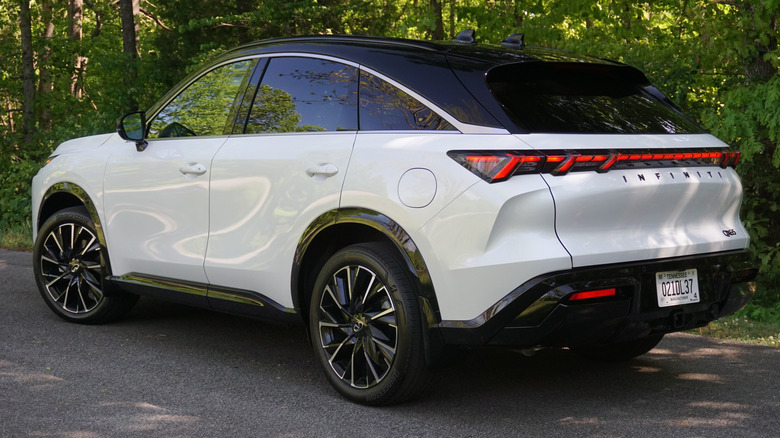
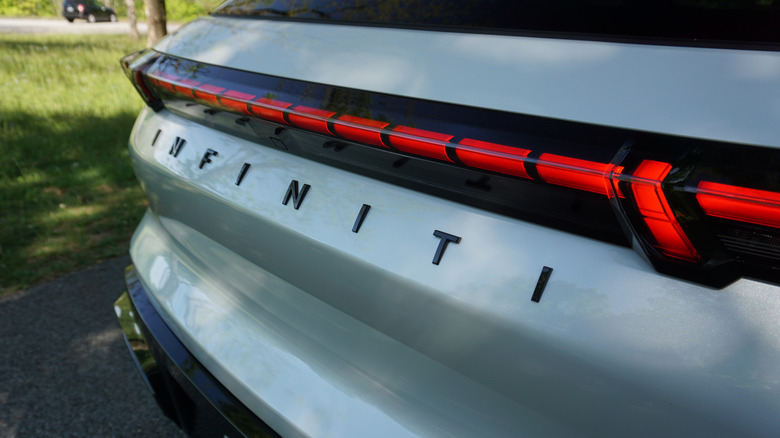
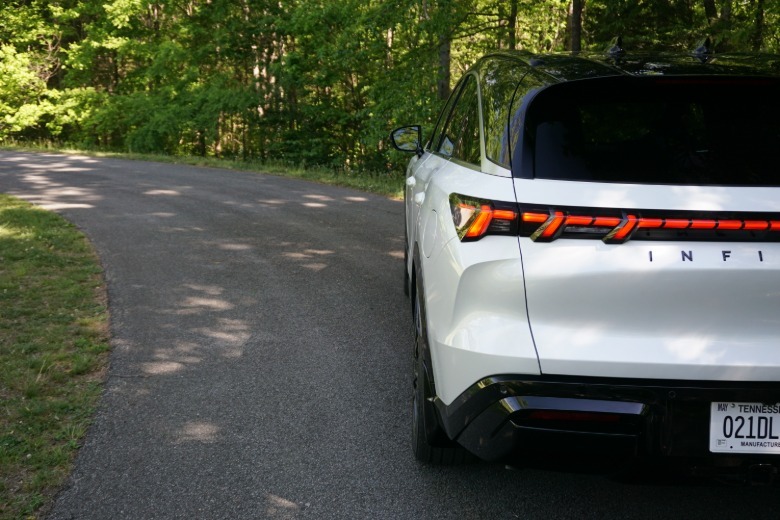
Since I'm a good news first type of guy, let's start out with the QX65's styling. Admittedly, it's pretty damn strong if you're into an in-your-face design language and the whole crossover coupe ethos. This area is also where it reminds me the most of the FX it's trying to emulate, especially the sloping roofline that tapers quickly to the rear bumper — though looking at a current Nissan Murano, I noticed some striking similarities. Still, it looks good back there, with a large roof spoiler and diffuser-like bumper, as well as the 3D-look taillight bar. Infiniti designers lopped a lot of the rear end off a three-row QX60 to create the QX65, but it only loses 5.8 cubic feet of cargo space, dropping to 35.8 behind the second row. That number shows just how big this thing is, and it feels as wide as it looks.
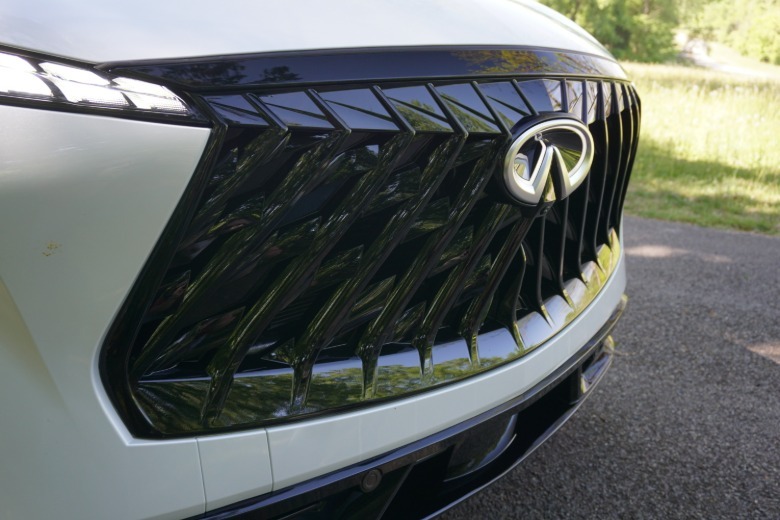
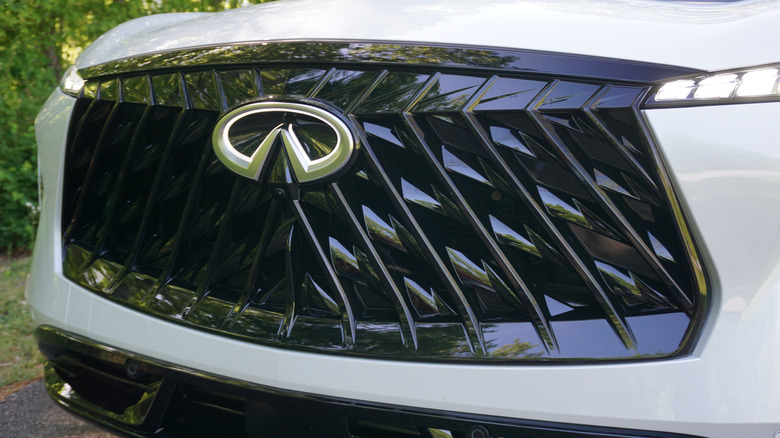
For big face enjoyers, the QX65 will certainly please with its massive grille. Infiniti designers say it was inspired by Japan's bamboo forests, and I love the layered effect they've gone with that almost makes the Infiniti logo look like it's floating. The rest of the front fascia is also quite nice to look at. It gets the sort of split headlight treatment we're oh so used to seeing these days, with the main headlights "hidden" below the automaker's signature "piano key" running lights coming off the grille.
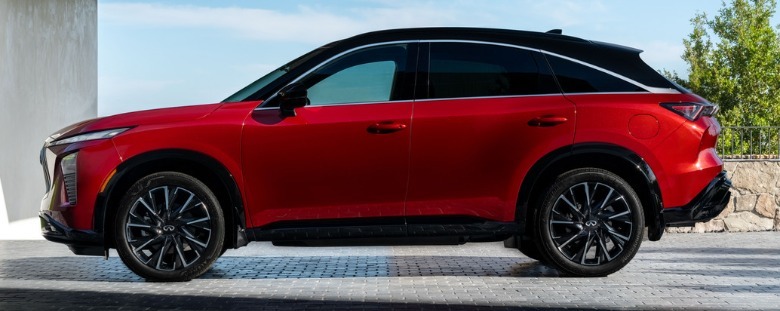
Another highlight is the car's Sunfire Red paint, which has real gold-coated glass flakes in it that give a wonderful sparkly look. It's really up there with Mazda's Soul Red. You will have no doubt noticed that most of the photos I've taken are of a Radiant White car. They were randomly assigned at the launch, and I was obviously a loser that day. What can ya do? It's still a nice color.
 Infiniti
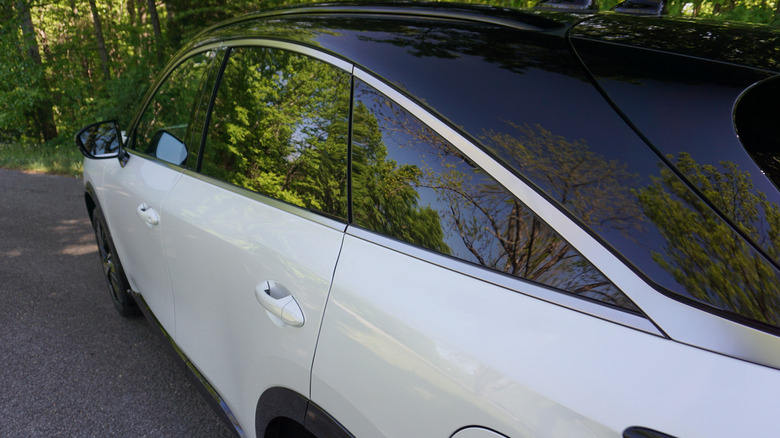
The side profile is a bit of a mixed bag, unfortunately. While I like the overall shape — including that roofline — this is where the true nature of the QX65 really comes into play. Unlike the original FX, which was based on the same rear-wheel-drive platform as the G35 and Nissan 350Z, the QX65 runs on Nissan's front-wheel-drive D-Platform. That means only so much can be done to cover up the tiny dash-to-axle ratio between the front doors and the wheels. It's a shame, to be honest. I'm sure most people who buy a QX65 won't notice, but freaks like you and me will, and we're who really count.
Showroom showstopper
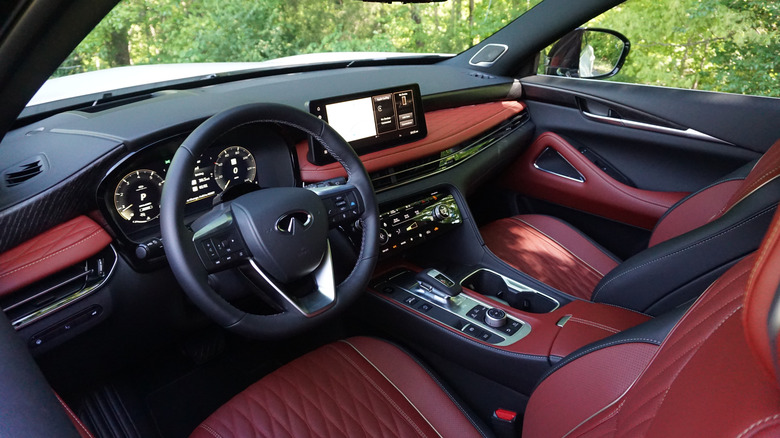
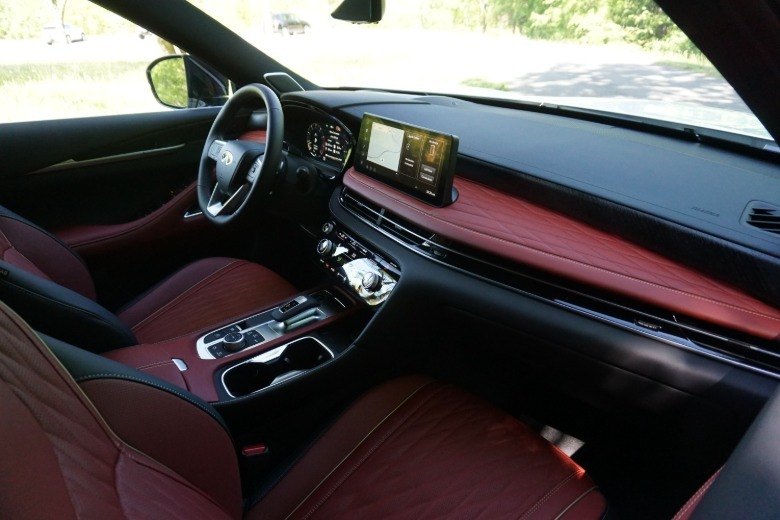
The interior of the QX65 is a fairly nice place to be, especially in top-level Autograph trim, but I get the overwhelming feeling that it was created more from the perspective of what would impress buyers at a dealership rather than what is going to look good, be functional and stand the test of time.
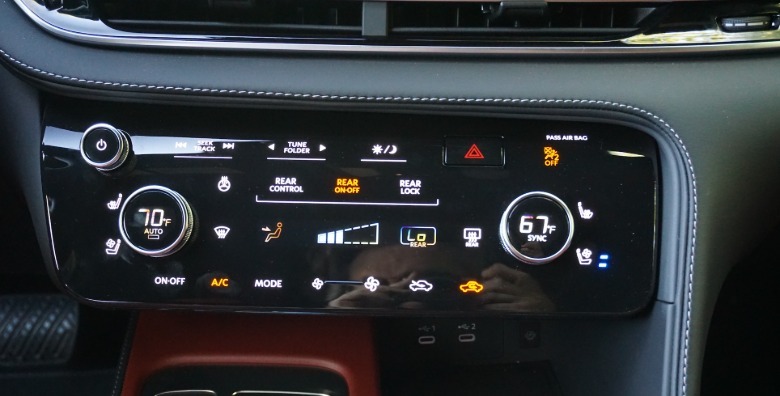
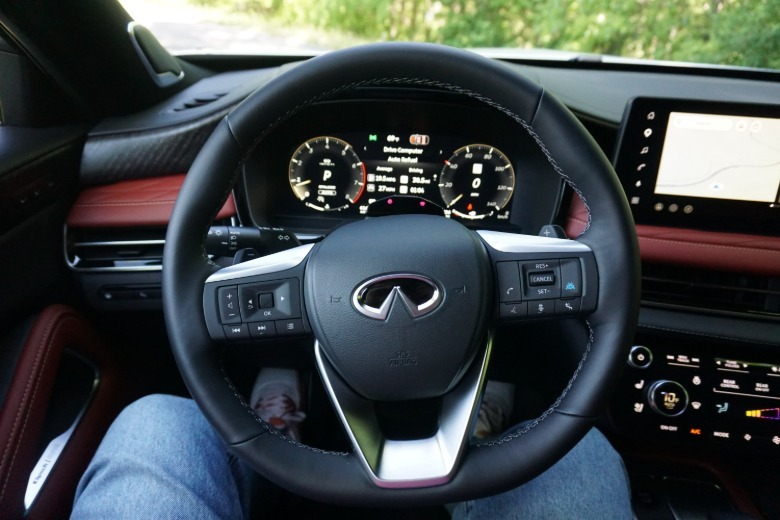
Yes, it's got all of the things we look for in a luxury car interior: quilted leather, real wood, actual metal, a 20-speaker audio system and a pair of large screens. But none of it feels particularly forward-thinking or quality-focused. There's an air of cheapness to this $71,000-plus crossover. So much of the switchgear, whether it's on the steering wheel, the physical HVAC controls or the screens themselves, is plucked right out of Nissan products that cost less than half the price of this thing.
 Andy Kalmowitz / Jalopnik
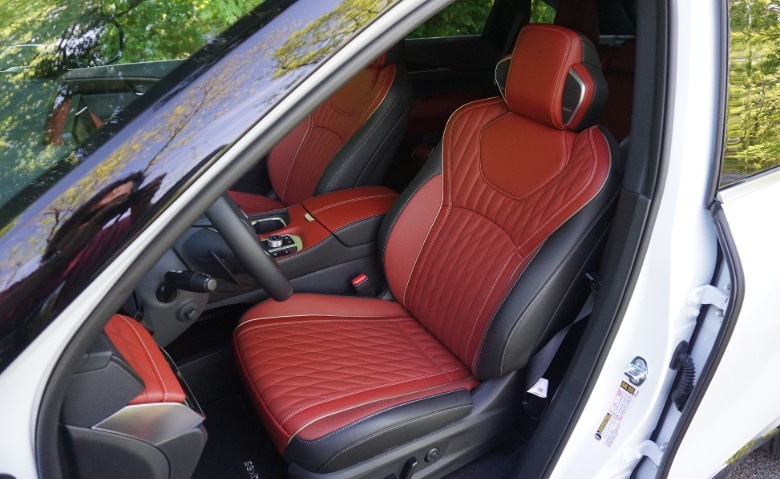
Yet, on a showroom floor, buyers probably won't notice that. They also aren't going to notice the slippery leather, fingerprint-loving piano black plastic, touchscreen graphics from the early 2010s, and very plasticky-feeling door handles. Hell, they probably won't even notice that the 1,200-watt, 20-speaker Klipsch audio system doesn't sound all that great. I mean, it's fine, but I expected more out of a car with headrests that look like Dr. Earman.
 Andy Kalmowitz / Jalopnik
At the very least, the heated and cooled seats those headrests are connected to are pretty damn comfortable, and they've even got a massage function on the top trim. Though even this is a bit more showroom showstopper than anything, because it doesn't feel like it's doing much other than inflating and deflating the lumbar support, but someone at a dealer will read a brochure saying it has massaging seats and not think anything more than that.
The two screens, both 12.3 inches, do a fairly good job of telling you all the information you need to know, but graphics are a bit, well, lacking. I will say the gauge cluster is incredibly customizable, and you can put pretty much whatever info you can dream of into it — other than a full-screen map. That's just a bridge too far, apparently. The center infotainment display, on the other hand, looks and feels old. Its graphics remind me of the late Obama administration, and its operation reminds me of the first Trump administration. It's a rough combination.
 Andy Kalmowitz / Jalopnik
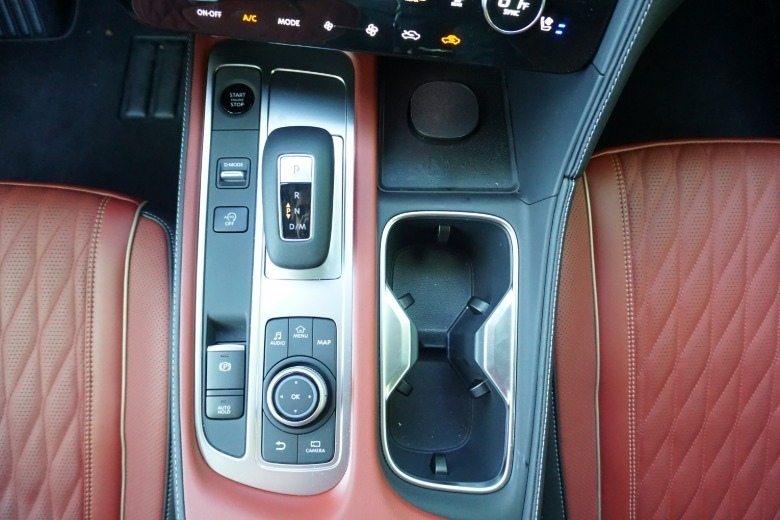
This can be fixed by hooking up wireless Apple CarPlay or Android Auto, as well as using the standard Google built-in features. Usually, even with a wireless connection I still plug my iPhone in because CarPlay is such a battery drain. Not this time, though, because the QX65 has one amazing thing on the inside: a 15-watt Qi2 wireless charger with a fan and magnet built in. Basically, it operates like a MagSafe charger in the car, making sure the phone doesn't overheat or flop around when accelerating or cornering. It's amazing, and I need this to show up everywhere.
 Andy Kalmowitz / Jalopnik
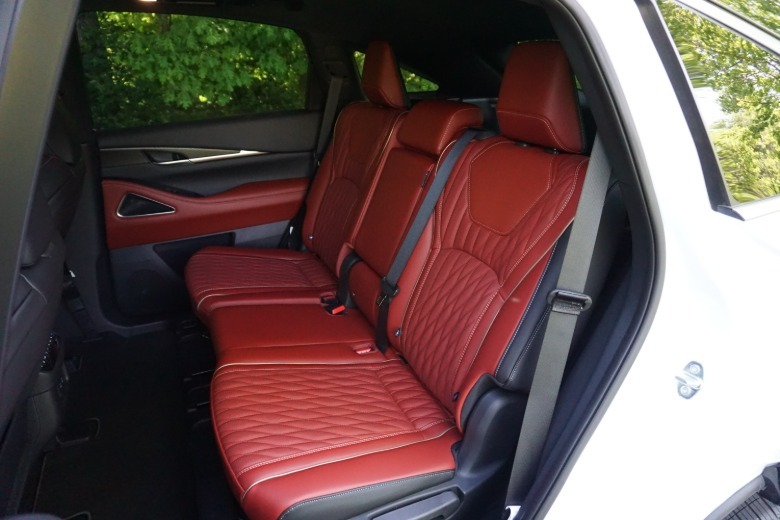
Something else the QX65 does exceedingly well is provide you with space. I've already mentioned how big the cargo area is, but because this SUV is so massive, nearly every interior dimension is gargantuan (other than rear headroom at 36.9 inches). At 6-foot-1 — which I need to remind you all that I am every time I can — I can easily fit behind my own seating position in the second row with room to spare, though my head does brush up against the ceiling. Up front, there's plenty of space as well. My co-driver and I actually remarked that it felt almost like a full-size SUV with how far apart we were sitting, which makes sense. If space is what you're looking for, this is going to be hard to beat.
Tribute band performance
The QX65 is not a fun car to drive. Usually, that wouldn't be an issue. No one in their right mind would care if a 4,715-pound luxury crossover is fun to drive. The issue is that the two generations of FX were notably very good (and fun!) to drive, and Infiniti's designers, engineers and spokespeople have all made sure to drive home the point that the QX65 was "designed to feel composed, dynamic and refined," and how it'll give drivers a "responsive, rewarding drive." Dawg, none of that is true, and it made me focus on the bad parts of its driving experience rather than paying attention to what the QX65 did well: highway cruising.
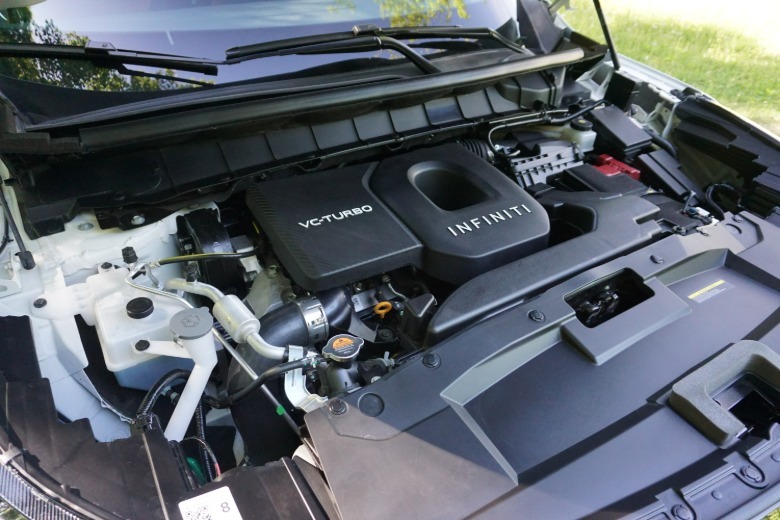
The problems start with the automaker's turbocharged variable-compression 2.0-liter inline-four engine. The tech is undoubtedly cool. I mean, it's sick that Nissan was able to get variable compression to actually work in an everyday car, I'm just not sure that it was worth it. The engine groans its way to a 6,000-rpm redline while producing a fairly average 268 horsepower and 286 pound-feet of torque. That power is routed through a 9-speed automatic transmission to a standard all-wheel-drive system.
 Andy Kalmowitz / Jalopnik
Infiniti hasn't quoted a 0-to-60-mph time, but it's probably somewhere in the 6.5-second area, and the QX65 is able to tow up to 6,000 pounds. But this engine doesn't really encourage you to push the car, even with the Active Sound Enhancement — which can't be turned off — doing its best VQ impression. Not even the fact that engineers retuned the throttle pedal and shift schedule to be more aggressive is enough to overcome the simple fact that it doesn't feel fun to push. This could be forgiven if it returned good gas mileage, but it doesn't even come close. The best the EPA says you're going to manage is 20 mpg city, 26 mpg highway and 22 mpg combined.
It's also hard to forget the fact that the FX made a whole lot more power over 20 years ago. When it debuted for the 2003 model year, the FX could be had with either a 3.5-liter V6 or 4.5-liter V8, which made 280 hp and 315 hp, respectively. Hell, at its peak, the second-generation FX50 (later renamed QX70) had a 5.0-liter V8 with a whopping 390 horsepower. Oh, how the mighty have fallen. What the FX, Infiniti?
 Andy Kalmowitz / Jalopnik
In any case, what is mighty is the amount of force you'll need to turn the steering wheel. I've got no idea why the steering is so goddamn heavy even in its chillest "Auto" mode. I mean, it's damn near Bentley levels of beefy, but without any annoying things like precision or feedback. Combine that with a floaty chassis and massive dimensions, and the QX65 feels downright ponderous on a tight backroad. It rolls, it leans, it flops all over the place. Really, it's just unpleasant on a good back road, and I wouldn't recommend driving enthusiastically to any QX65 buyers.
 Andy Kalmowitz / Jalopnik
The car is far more at home on an open highway, where the nine-speed auto can drop the revs below 2,000 rpm. There, you can crank the Klipsch audio system and maybe find a song that highlights its capabilities, turn on the adaptive cruise control and eat up the miles. The soft suspension that wreaked havoc on a back road now does a wonderful job of soaking up bumps in uneven pavement. The "massaging seats" are doing their job, and you're drifting home in a middle manager's idea of luxury.
But even this comes with a caveat. A big part of its wonderful highway driving prowess is Nissan's solid ProPilot Assist 2.1 hands-off driving system. The issue is that it's not standard, even on the top-of-the-line QX65 Autograph. I'm sorry, but if I'm paying nearly 65 grand for a bigger Infiniti, it better have everything. As you're about to find out, that's not the case at all.
You'll pay
If you've read all this and decided I'm an asshat who doesn't know what they're talking about, first of all, fair, and second of all, there are some things you've gotta know about the QX65's pricing. It's sort of odd, because the QX65 looks and is sized like a competitor for cars like the BMW X6, Mercedes-Benz GLE Coupe and Genesis GV80 Coupe, but its pricing tells a different story. It's far closer to the entry-level luxury world than those cars are, at least when it comes to starting price.
Prices open at $55,535, including destination, for the QX65 Luxe. It comes standard with 20-inch wheels, those dual 12.3-inch screens with wireless CarPlay and Android Auto, some no-name 11-speaker audio system, a panoramic sunroof, eight-way power heated front seats, three-zone climate control, LED lights all around and ProPilot assist. That's not a bad amount of kit for the price, I'll be honest.
 Andy Kalmowitz / Jalopnik
Next up is the QX65 Sport, which starts at $57,290. It gets everything from the Luxe, plus some extra sporty options like 20-inch black wheels, a "sport" grille mesh insert, and black chrome touches on the outside. On the inside, buyers are treated to a 16-speaker Klipsch audio system, ventilated front seats and a 3D surround view monitor with a front wide view and invisible hood view. Buyers can also add the Premium Package, which gives you a rearview mirror camera, head-up display and towing setup.
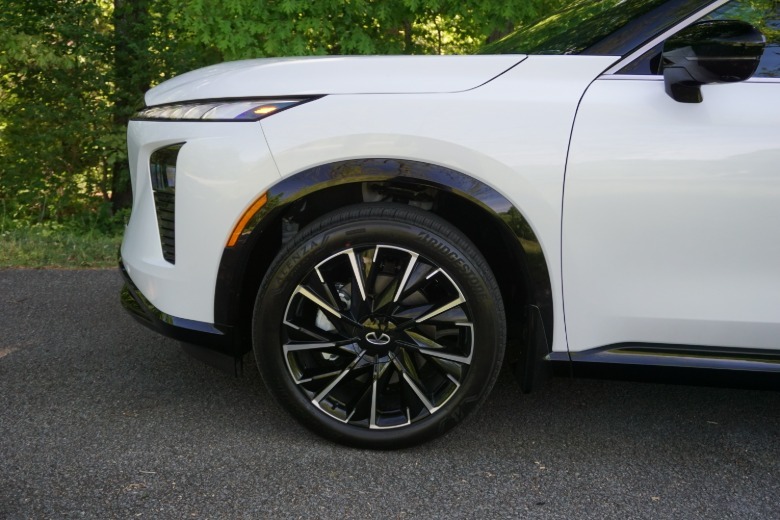
Finally, there's the Mack Daddy of them all, the QX65 Autograph, with prices that start at $64,135. It represents a pretty significant jump over the rest of the lineup, but it does add a lot of kit, like 21-inch wheels, chrome window surrounds, open-pore wood, aluminum scuff plates, semi-aniline leather with quilting and massage, heated rear seats, a digital rearview mirror, a head-up display and the aforementioned 20-speaker Klipsch audio system.
 Andy Kalmowitz / Jalopnik
Buyers can also option a tow package and the tech package I mentioned earlier. That adds in ProPilot Assist 2.1, the 360 camera, a driver monitor system and a front-center supplemental airbag mounted in the driver's seat. If this were my world, all of these things would be included in the Autograph's price; alas, they are not.
My tester was fitted with the Tech Package ($3,700), Dark Illuminated Cargo Scuff Plates ($450), Black Roof Rail Crossbars ($490), a Cargo Package ($365), Splash Guards ($220), the USB Charging Cable Set ($95, oh my f*cking God), and, finally, Premium Paint ($1,900). All in all, its as-tested price was a whopping $71,355. I know. I agree with what you're thinking right now.
Not Infiniti's future
Look, the QX65 isn't terrible. It's a fine car, and it'll probably make people who get really good lease and finance deals really happy. Hell, it's going to make the guy who got upgraded to "Presidential" at the Hertz rental desk ecstatic. But this isn't the FX reborn. Maybe a car like that will be coming out in a few years. It's hard to say right now.
During the product briefing before our drive, something that happens at every first drive event, I was struck by how much time was spent talking about the future of Nissan and Infiniti. Sure, a lot is going on at the company right now — it's got plans for a high-performance QX80 variant, a V6 performance sedan with a manual, a hybrid mid-size crossover, and two different body-on-frame SUVs. But I couldn't help but think that the QX65 is a vestige of the old Infiniti, and not just because it's supposed to look like a popular crossover from 20 years ago. No, it feels like old Infiniti because it's an uninspired product left over from a time before the company decided to get serious again.
This SUV is meant to remind you of something great that came before it, but it does a better job of reminding you how far the company has fallen since that high watermark. Because of that, I've got the sneaking suspicion that the QX65 is an inflection point, and better things are on the horizon for this once-great brand.