

2027 Audi Q9 And SQ9 Go Straight To The Top Of Their Class
Purpose-built three-row European luxury SUVs thrust themselves into the American car market in the 2000s with the likes of the Volvo XC90, Land Rover LR3, and Mercedes-Benz GL, but one stood out from the crowd as the most stylish and car-like three-row SUV of all: Audi's svelte Q7. Though it was never known for being the roomiest or most off-road capable vehicle in its segment, its posh looks and sporting approach to the three-row SUV recipe was well received by car reviewers and buyers alike.
Fast forward 20 years, though, and the Audi Q7 has only been redesigned one time since its 2007 introduction. That second-generation model is now a decade old and falls squarely on the smaller end of its class. Audi is changing that for 2027, yes with a larger Q7 that I'll be reviewing soon, but it's also unleashing an new, even larger SUV that becomes Audi's new flagship: the 2027 Q9.
 Logan K. Carter/ Jalopnik
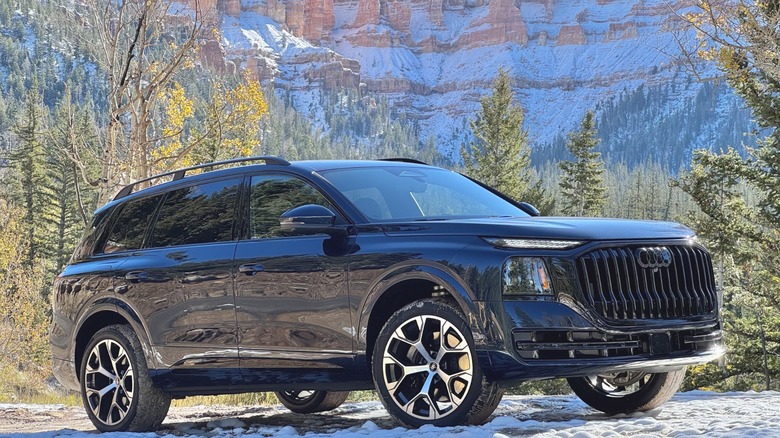
The properly big Audi Q9 and its performance-minded SQ9 sibling are here to offer true three-row comfort for up to seven occupants and all their stuff, designed with the American market in mind. From a quick first impression, I think Audi has a big winner on its hands, which is a good thing because the automaker and its profit-starved Volkswagen AG corporate overlords could really use a win right now.
Full disclosure: Audi wanted me to get some seat time with its new Q9 and SQ9 so badly it flew me out to St. George, Utah, put me up in a swanky golf resort, and kept me fed and beveraged for a few days.
Size matters
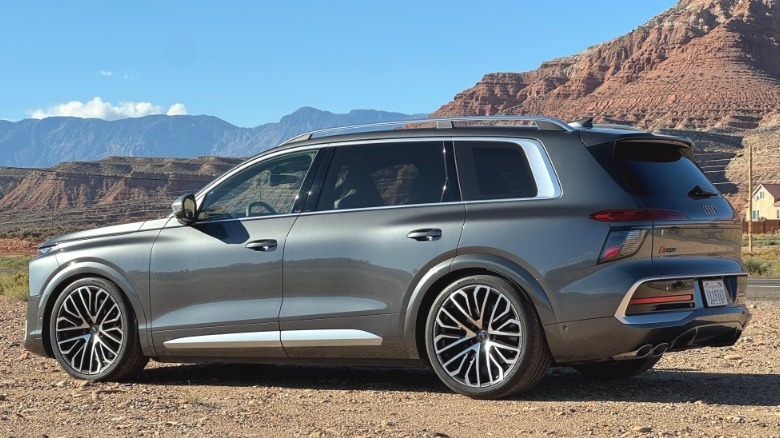
Audi flew my colleague Andy out to Germany this summer to preview the finally redesigned third-generation Audi Q7 as well as the new Q9, and he did a great job of covering the minutiae of the new platform and its offerings, but I'll give a surface-level overview here for you. Compared to the 2027 Audi Q7, the Q9 is, well, bigger. The Q9 is 9.9 inches longer at an overall length of 209 inches, it has a 5.6-inch-longer wheelbase at a limo-like 123.5 inches, and it sits 0.2 inches taller at 71.4 inches. The SQ9's body is 1.2-inches wider than the standard Q9, though its overall width is the same 86.8 inches including side mirrors.
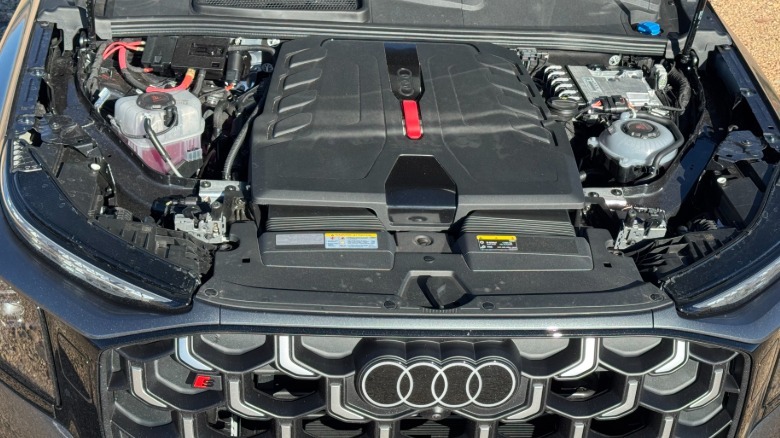
The Q9 may be bigger, but it shares its drivetrains with the new Q7. That means the standard engine is a twin-turbocharged 2.9-liter V6 that sends 429 horsepower and 442 lb-ft of torque through an 8-speed automatic transmission to all four wheels via a standard Quattro system. If you're a sick and demented person who thinks that's not enough power for your three-row SUV, we should be friends, but more to the point, the SQ9 abides. It's hiding a twin-turbocharged 4.0-liter V8 under its hood that sends 591 hp and 590 lb-ft of torque through the same transmission to a new Quattro system that has an electronically controlled all-wheel-drive clutch and rear differential lock that's designed to enable higher angles of oversteer, since that's what matters most in a three-row SUV.
Its tech was intuitive overall
Audi hosted the Q9 first drive event in St. George, Utah, which sits just outside the boundaries of what we call Zion National Park, though Indigenous tribes knew the region as a sacred place called Mukuntuweap for thousands of years before Mormon colonizers arrived and renamed it Zion. This was my first time in Utah, and the nature nut in me has always wanted to visit the region to explore it and take in its distinctive geography, so I was stoked to do just that on this trip — I even touched a couple buttes. I felt infinitely privileged to witness and explore the region's striking sights and its towering triumphs of nature, even when that involved sitting stationary in an hour-long traffic jam in the park.
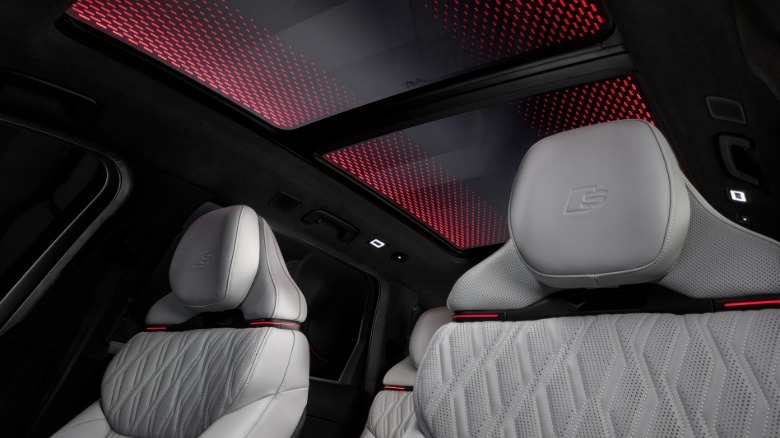
At least while we were stuck in traffic my test Q9 was a particularly posh chariot for me and my co-driver, from the extensive adjustments and excellent massage function of the front sports seats to the utterly gigantic electrochromic sunroof that in my car had an ambient light design integrated into it. (That last feature will be delayed on production cars, but don't fret, as I found it to be totally excessive and unnecessary anyway.) The fourth D in the 4D Bang & Olufsen audio system came courtesy of subtle seat bottom vibrations that mirrored the bass line of whatever was playing on the stereo, and again, I found it totally excessive and unnecessary. The sound quality was great, though!
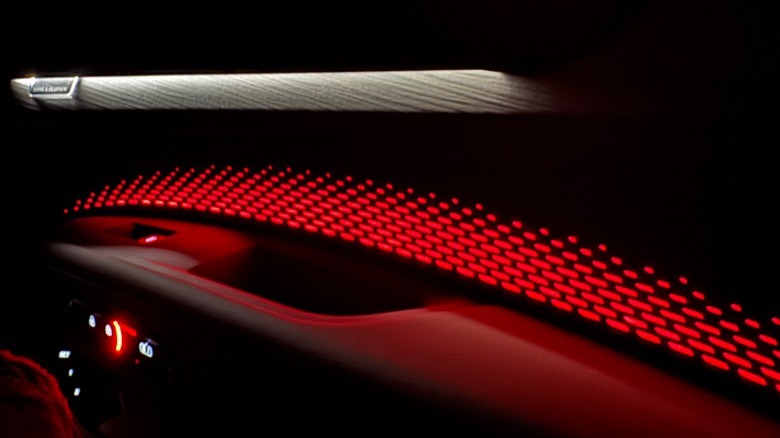 Logan K. Carter/ Jalopnik
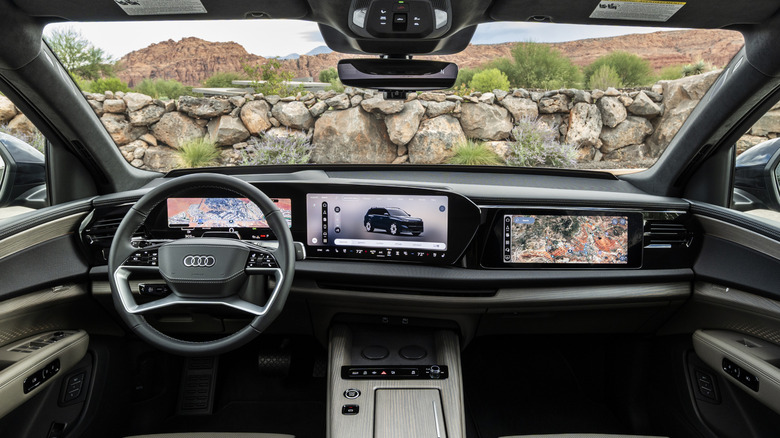
During that traffic jam my co-driver and I were able to flip through nearly every single menu in the Q9's nicely sized 14.5-inch center touchscreen and 12.3-inch passenger screen. Audi's latest MMI infotainment system is easy to navigate and logically organized, but the passenger screen, like all passenger screens, felt totally extraneous. At least I was able to flip through my seat massage settings on the passenger screen, unlike the Mercedes-AMG GLS63 I drove a few weeks ago.
Infuriatingly, the passenger seat's side bolsters and thigh bolster could only be adjusted through the center touchscreen, which is aggressively angled toward the driver, making it a long reach and hard to see what I was doing. What's the point of a passenger screen if you still have to briefly hijack the entire infotainment screen just to extend your thigh support? Okay, rant over. As a whole, I found the tech in the Q9 to be intuitive, cleanly laid out, and mostly useful.
The Q9 drove like a much smaller vehicle
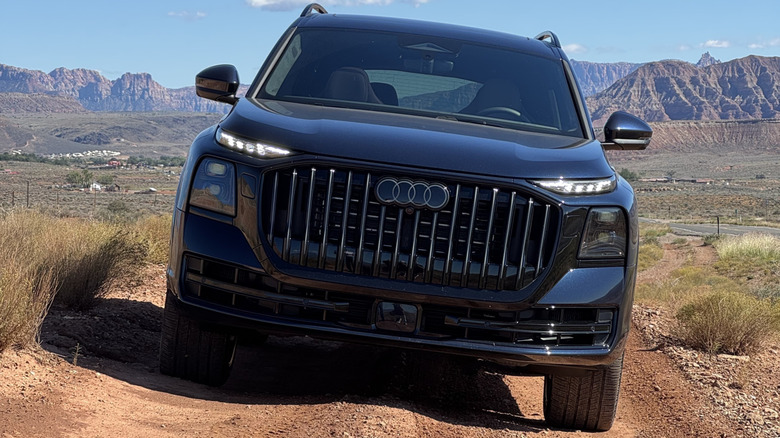
The Q9 was great to drive, and felt much smaller and less SUV-like than the GLS I drove a few weeks prior, despite being 3.6 inches longer and 1.6 inches wider than the Mercedes. That was likely due in part to the four-wheel steering that came with the Audi's Prestige package, which can steer the rear wheels up to five degrees to tighten the turning circle at low speeds (let me tell you, it's tight) and improve stability at higher speeds. If you're intimidated by the thought of driving such a big brute, the Q9's rear-wheel steering made this behemoth feel like a compact crossover in parking lots, and it's something not offered on the GLS.
At higher speeds on more demanding roads, the Q9 continued to belie its heft, feeling downright nimble at times. Its steering was direct and communicative, and at 5,302 pounds is no lightweight, but it's light for its class. The Q9 felt remarkably more like driving a big wagon than a big SUV, and it took to twisty roads like a duck to water.
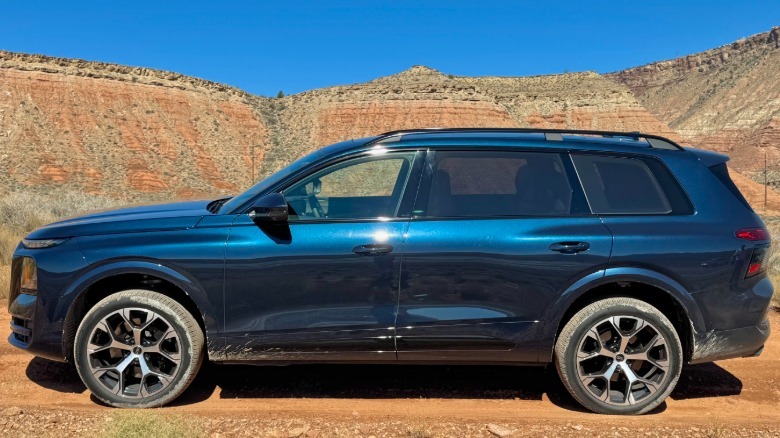 Logan K. Carter/ Jalopnik
The twin-turbo V6 contributed to the car-like feel, as it provided effortless power even when going uphill at 10,000-feet altitude. Audi fitted this big hauler with some sufficiently big brakes, with even the Q9 sporting six-piston front brake calipers that clamped down mightily on the 15.7-inch rotors, hucking any loose items toward the front of the cabin. The only time I thought about the Q9's heft was at lower engine speeds, where the rev-happy engine exhibited a fair amount of turbo lag, but once on boil its RS5-related V6 smoothly pressed me into the seat as speeds rose. I saw no need for stepping up to the SQ9 — until I drove it, that is.
The SQ9 goes straight to the top of its class
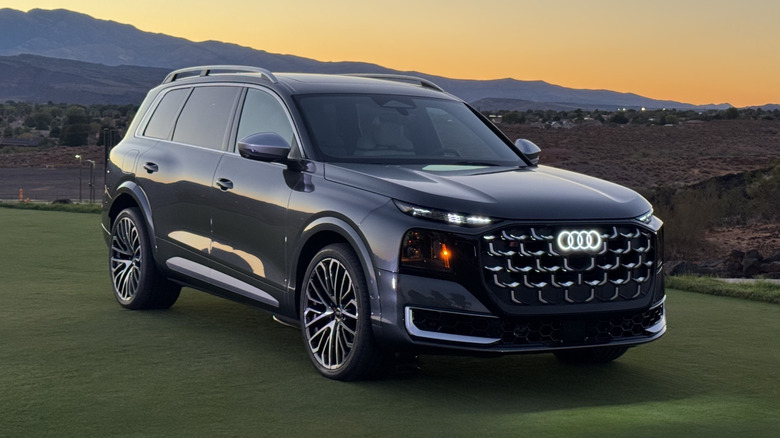
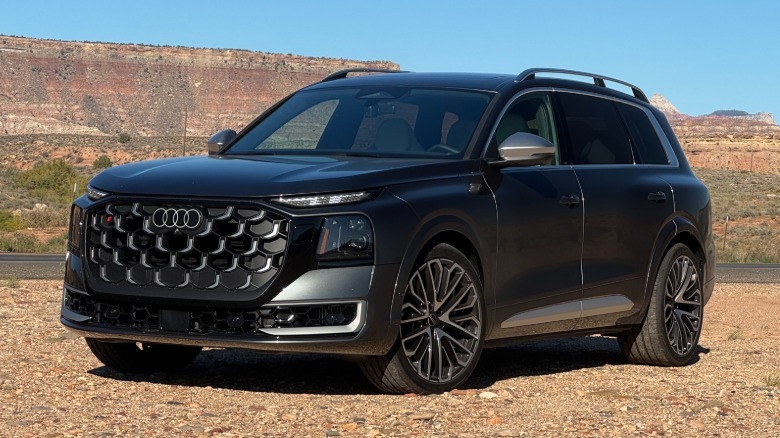
Other than the Q9's vertical, Jaecoo-esque grille and the SQ9's more traditionally Audi mesh grille, visual differences between the two models are slim, and the same could be said for their interiors. What really sets the two SUVs apart is under their shapely upright bodies. The extra 162 hp and 148 lb-ft from the SQ9's fire-breathing twin-turbocharged V8 didn't immediately make themselves too obviously known, but then I engaged launch control.
Don't make the same mistake I made, you have to be in Dynamic mode and push the traction control button once to enter Sport Traction mode before flooring both pedals. The first time I attempted a launch, I didn't change the traction mode and was deeply underwhelmed by the launch, but that made the first real launch all the more mind-boggling.
 Logan K. Carter/ Jalopnik
With launch control actually active, the 5,556-pound SQ9 damn near popped a wheelie as it ripped through gears on its way to 60 mph, which Audi says it can do in a hardly believable 3.8 seconds. I do this for a living, and I immediately burst into a fit of giggles when I released the brake pedal. I felt like I personally shook hands (hooves?) with every single one of the 591 horses under the SQ9's hood. I cannot imagine how a car full of kids would react to the wicked experience of launch control in an SQ9, but they would undoubtedly give the parent at the helm the "coolest parent" crown.
The Q9 was plenty competent on two-lane mountain roads, so I expected more of the same from the SQ9, but man, the SQ9 clung to the road like a limpet. I didn't get to put the Quattro system's rear LSD and increased oversteer angle claim to the test, but I did get to push it around some delightfully deserted winding roads with tight switchbacks, and there was not even a slight tendency to understeer. Its standard four-wheel steering came into play again, as well as the sport-tuned adaptive air suspension that effectively eliminated body lean and any sense of topheaviness and somehow made this nearly 17.5-foot-long family hauler dance like a sports sedan.
 Logan K. Carter/ Jalopnik
I drove the facelifted 2027 Mercedes-AMG GLS63 in Colorado a few weeks before driving the SQ9, and the SQ9's driving dynamics blew the GLS63 out of the water. Yes, I understand how pointless it sounds comparing the high-speed driving dynamics of two three-row luxury SUVs, but this is extremely important consumer advice for a handful of wealthy people who are in the market for one of these bruisers. The Q9 drove great, but the SQ9 was impossibly good. Its six-piston calipers and 16.5-inch front disc brakes were hooked up to a firm pedal with virtually no pre-engagement squish, which made stopping the performance variant a satisfying, if almost violently effective experience.
The suspension is not supposed to offer a magic carpet ride
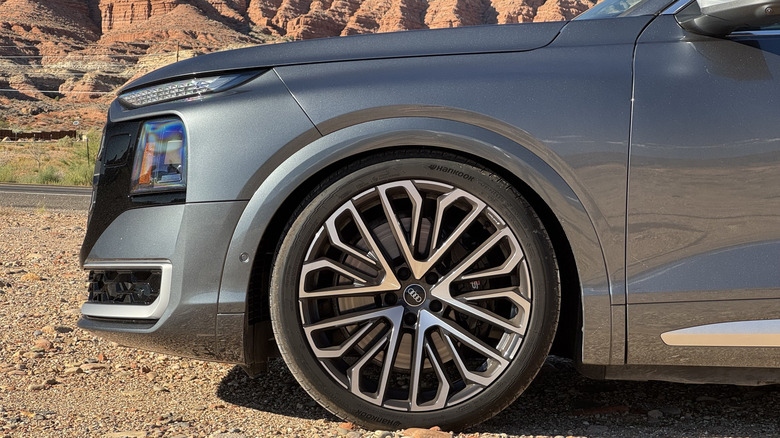
During our pre-drive briefing, the Q9's Quattro development specialist Dieter Weidemann said, "we did not want a flying carpet ride," so I was worried the Q9 would not offer an especially luxurious driving experience, but that worry quickly faded away once I got behind the wheel. Though the Q9 definitely did not offer a magic carpet ride, its suspension embodied the characteristically Audi trait of being taut and athletic without being harsh or jiggly – again, more like a car than a big SUV. Considering that my test car was riding on 22-inch wheels, I found the firm ride to be inoffensive, especially once I started hustling it a bit.
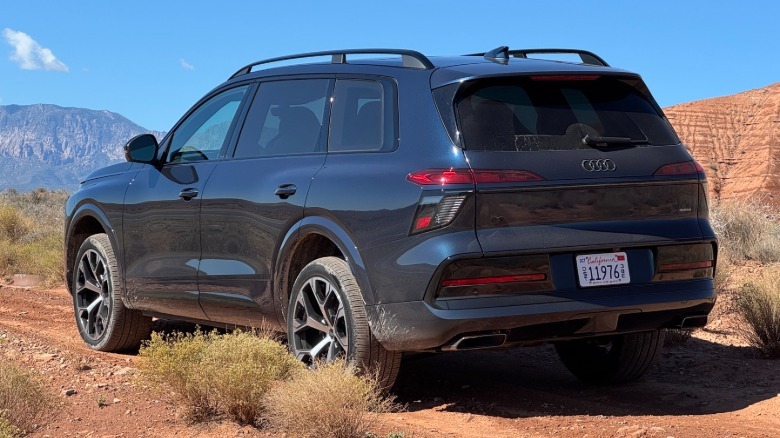
The SQ9's sport air suspension has a wider spread between Comfort and Dynamic mode, so it rode about the same as the Q9, which is to say firm and taut, but not harsh or in any way uncivilized or uncomfortable when in Comfort mode. Dynamic mode in the SQ9 was noticeably firmer than the Q9's Dynamic mode, so it made the ride feel a bit busy over broken pavement, but it never felt overly harsh, and it kept the big SUV flatter and more composed through corners.
 Logan K. Carter/ Jalopnik
On open highways, the Q9's interior was well-insulated from wind noise, but some pavement types produced more road noise than I would've hoped. Again, those big wheels probably contributed to this sensation. Fortunately, I could crank up the excellent stereo and drown out that hum, and activate the supremely effective massaging seat function.
It features Audi's first hands-free driving function
Available on Premium Plus and Prestige trims is Audi's new hands-free Adaptive Cruise Assist Plus system, which functions basically the same as all the other hands-free highway driving systems like Super Cruise and Blue Cruise, but I found its engagement procedure to be a bit unclear. The system became available on divided highways, and it indicated that by displaying two flashing white lights at the bottom of the gauge cluster and a pop-up window that said, "assisted hands-free driving available." What I found weird was how you engage the system — you just let go of the steering wheel, and those white lights turn green to let you know the system is active.
Usually these systems require some sort of button press to confirm their activation, but here you just let go of the wheel, which on one hand was convenient, but on the other hand made it difficult to not engage the system. For example, I wanted to drive the car because I was approaching a construction zone on the highway, but since the system was signalling it was ready to engage, it automatically did so the instant I readjusted my grip on the steering wheel.
The system worked pretty well during my drive, though it got flummoxed by some recently made lane deviations and construction zones. Like all other driver assistance systems on American roads it's still just a Level 2 system, so the driver is always 100% responsible for what their car does. At first, it felt too easy to unintentionally engage the system, but for much of the drive I appreciated how intuitively I could let the computers take over for a bit, so I had mixed feelings about it.
The interior felt up to old Audi standards
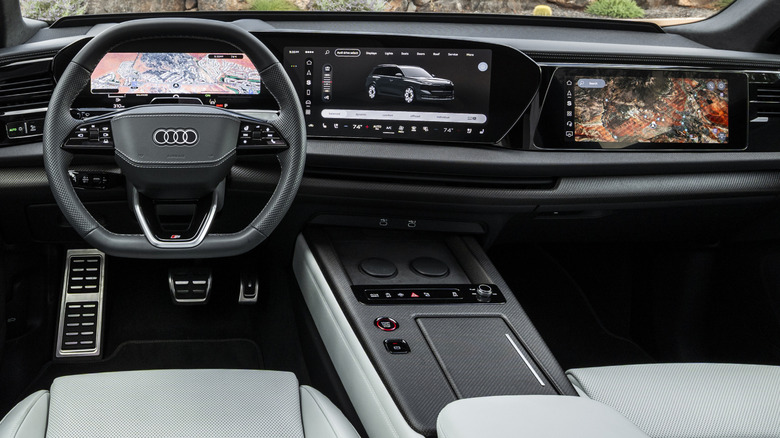
Audis from a few generations ago were known for their impeccably styled and assembled interiors, where nearly everything you touched felt expensive. Some of the newer Audis I've experienced fell short in their interior material quality, which has felt blasphemous. I'm happy to report that the interior in the Q9 and SQ9 lived up to the high standards set by Audis of yore, save for one thing.
Naturally, the Q9 has Audi's current MMI panoramic display that incorporates three screens, and I was grateful to see that the design incorporated a shelf to stabilize a hand on while you poke at the touchscreen, but that shelf was covered in a padded fabric that felt like it came off a Temu office chair. Otherwise, though, literally everything inside the Q9 felt great, and the SQ9's fascinating carbon basalt structure inlay trim offered a new take on carbon fiber, with a matte finish and an exceedingly unique texture that felt great to the touch, and it didn't show finger prints!
 Audi
Having said that, both of my test cars were equipped with the Luxury package, which includes a suede-like Dinamica headliner and an extended leather package that adds leather to the dash, upper doors, center console, and armrests, according to the price sheet. I cannot vouch for the interior of lesser Q9s, but I sure hope they don't rely too heavily on the hard plastics found in some other Audis.
Beyond upscale materials, they offer American-sized interiors
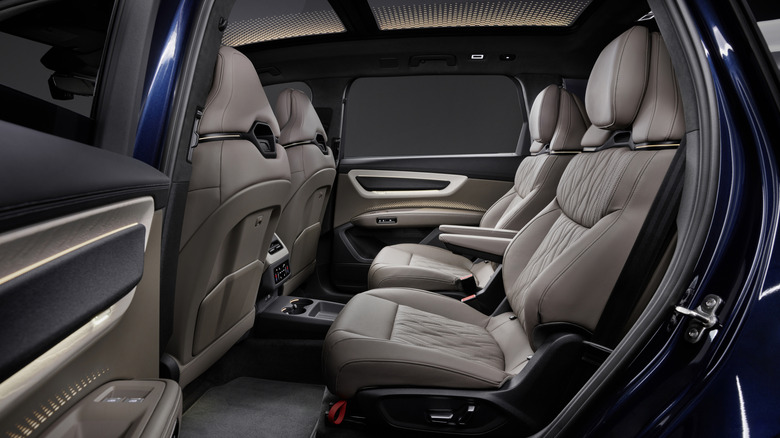
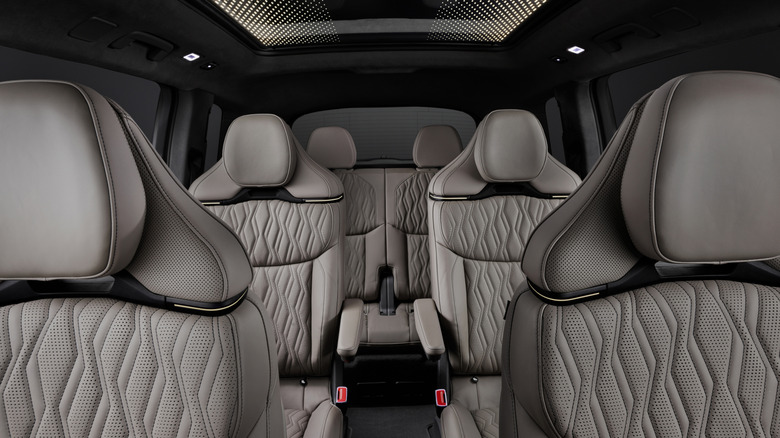
The Q9's front row seats don't offer additional space when compared to the Q7, which isn't an issue since they had ample room for my 6-foot-8-inch tall leggy frame. Second-row occupants benefit most from the Q9's extended length, with 2.3 inches more legroom than the new Q7, but strangely the Q9's third row doesn't offer any additional legroom over the smaller Q7 with just 29.1 inches of legroom, though it does offer 1.5 inches more headroom. An Audi spokesperson said, "The Q9 offers a more accommodating third row than the Q7, thanks primarily to 1.5 inches of additional headroom and improved knee room." Audi said the published third-row legroom measurement is required to be taken with the second row in its rearmost position, and since the Q9's second-row seats have two inches more rearward travel than the Q7, the third-row measurement is the same. So as long as second-row occupants scoot up a bit, the third row does offer more legroom than the smaller Q7.
I found the Q9's second row of seats to offer fantastic legroom, even behind my own driving position, but the third row sat almost on the floor, practically forcing me into a fetal position. Headroom wasn't bad, though. I wouldn't want to be back there for too long as a 99.9th percentile 30-year-old, but for folks with smaller frames and younger knees it should be acceptable.
 Logan K. Carter/ Jalopnik
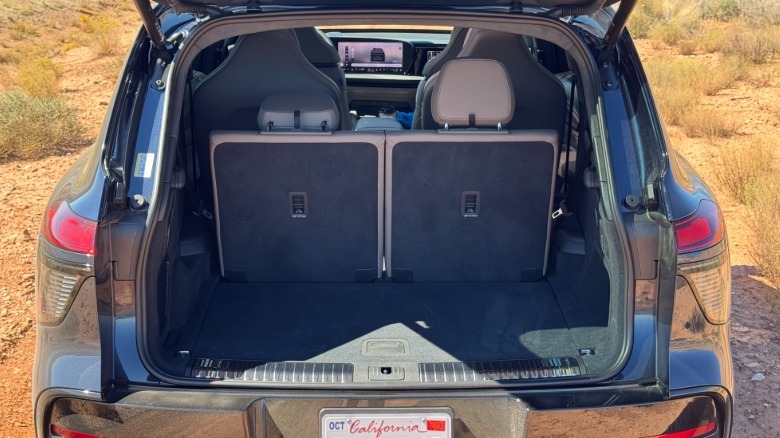
Behind all those seats, the Q9 has 4.2 cubic feet more cargo space than the Q7 at 19.3 cubes, which is good for its class, as well as 6.1 cubic feet more space behind the second row (up to 50 cubes depending on seating configuration) and 9.1 more with both rear rows folded at a big 87.1 cubic feet of space.
Expensive, but not the most expensive in this class
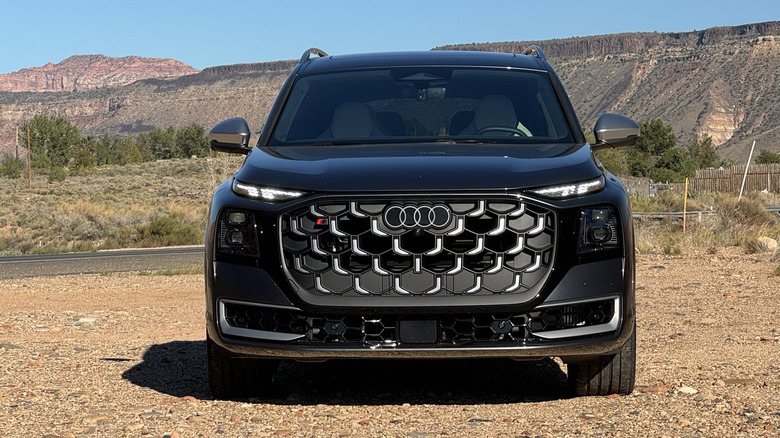
Both the Q9 and SQ9 I drove were kitted out with as many options as possible, which means I got to experience all the features. The base Q9 Premium is already quite well-equipped, with digital gauges, a passenger screen, adaptive air suspension, surround-view camera system, adaptive cruise control with lane departure warning, automatic parking with acoustic parking sensors, interior ambient lighting, navigation, and a Bang & Olufsen stereo. It also has four-zone climate control, a head-up display, heated steering wheel and front seats, leather upholstery, a panoramic sunroof, a power tailgate and power-folding third row, and customizable exterior light signatures. As with all new Audis, you get complementary scheduled maintenance for three years or 30,000 miles, all at the base price of $89,095 including destination.
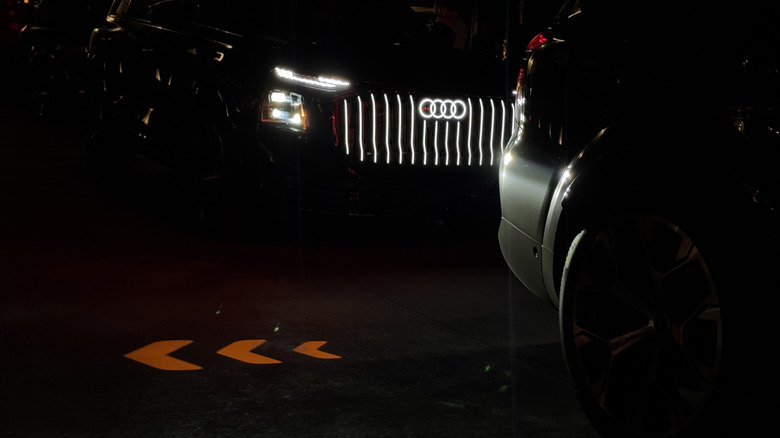
My Q9 tester was loaded to the gills at a rather dear price of $111,895, which includes the $14,700 Prestige package, the $2,800 Black Optic styling package that I'd personally skip, the $4,000 Luxury package that includes trick automatic doors, an $850 trailer hitch with 7,700-lb towing capacity, and the comfortable but bulky $450 second-row captain's chairs that do not fold flat and limit maximum cargo capacity. The pricey Prestige package really cranks up the luxury quotient with brilliant all-wheel steering, a 4D Bang & Olufsen stereo, curved digital OLED taillights, massaging Nappa leather sport seats, an electrochromic panoramic sunroof, an illuminated grille, and extended interior ambient lighting.
One major piece of new technology offered on the Q9 is its digital matrix LED headlights, which are available in the U.S. for the first time. In addition to having fancy glare-free automatic high beams, the lights are capable of doing projections, like orange arrows on the ground to show which direction the car is turning.
All about the Prestige and Luxury packages
My Luxury Package-equipped test car touted another example of tech that felt awfully lavish, the new-to-Audi automatic doors. I didn't entirely see the draw of these admittedly entertaining electronically operated doors until I spoke with a colleague who has a few of those screamy, kicky, and all-too-often sticky things called kids.
I see how a busy parent who has their hands full, whether their hands are full of children or other child-related paraphernalia, would find an automatically opening door mighty handy. The Q9's automatic doors worked well during my time interacting with them, even successfully using their ultrasonic sensors to avoid smacking any surrounding obstacles or people. They were a bit awkward to operate in some scenarios though, since I often found it necessary to stand in the path of the opening door to use the handle, but I'm sure that would become a non-issue if I spent more time getting used to it. This can also be mitigated by opening the doors via the myAudi smartphone app.
Concerningly, though, there is no mechanical interior door release on Q9s fitted with powered doors. Instead, Audi has included an integrated capacitor that "has been durability tested for a 15-year service life and is designed to notify the driver if service is required." After a series of Tesla Cybertruck "death trap" door lawsuits that caused the deaths of several people, I'd be concerned about the lack of a mechanical interior door release, but Audi feels its electronically actuated door latches are safe, which is good I guess.
The Q9 and SQ9 are fantastic luxury three-row SUVs
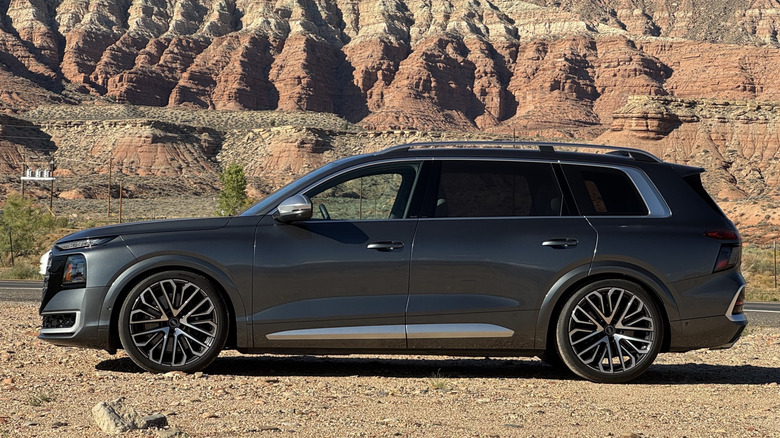
In case you couldn't tell from the few thousand words above, I was heartily impressed with the Q9 and SQ9. My top-trim test cars were exquisitely finished inside and out, the Q9 provided ample power and handling prowess, and the SQ9 took that to the nth degree. I think they're both fully qualified for the role of Audi's new flagship model, offering wealthy families a sleek, luxurious kid-hauling chariot that should handily inspire envy among lowly onlookers, especially when the electric doors magically pop open.
Compared to rivals like the Mercedes-Benz GLS, BMW X7, Land Rover Defender 130, and Lexus TX, I think Audi has produced a distinctive option for buyers who want a piece of that classic Audi chicness that's lacking in some of the brand's other recent offerings. It's not as in-your-face as the star-spangled GLS, not as weird-looking as the X7, and not as square as the Defender. The Q9 and SQ9 are a return to form for Audi, yet in a segment it's never competed in before, and I think it's the three-row luxury SUV to get right now. The redesigned X7 is just around the corner though, so we'll see how long that lasts.