

These 5 Inline-6 Engines Might Not Roar Like V8s, But They Make More Power
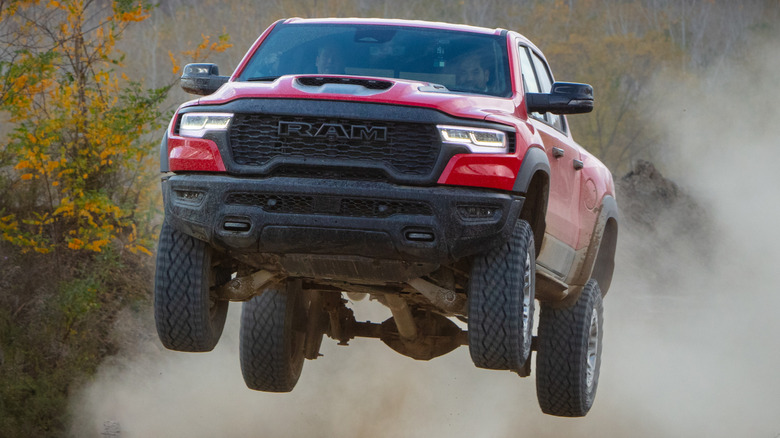
Opinions will no doubt vary over the synthesized V8 sounds in the new Mercedes-AMG GT, but there's nothing quite like the inimitable roar of the real thing. The V8's power output, though? Now, that has been a lot easier to replace ever since the advent of turbocharged inline-sixes, such as those from BMW, Ford, Stellantis, and TVR. In fact, there are even four-cylinder engines that can out-muscle V8s nowadays, but that's another story.
Now, we do have to set out some ground rules before we get into the details. First off, we're only talking about factory inline-six engines featured in production cars. So tuning the iconic Toyota 2JZ-GTE to make 1,000 hp doesn't really count. We're also going to steer clear of all the V8s with surprisingly low horsepower for this comparison. After all, plenty of six-cylinder engines can now harness more power than a V8 like the 1975 5.7-liter L48, which was limited to 165 ponies in some of the laziest malaise-era Corvettes. That's why, we've made sure all the inline-sixes below pack more horsepower than a proper modern V8: The 5.7-liter Hemi, recently revived in the 2026 RAM 1500, which sets our output floor at a respectable 395 hp.
BMW's 3.0-liter B58 and S58
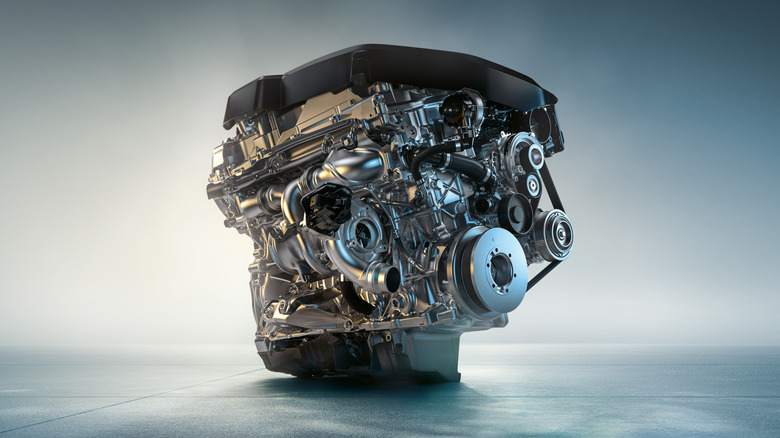
BMW didn't invent the inline-six engine, but it seems to have just about perfected it. Indeed, some fans consider the B58 to be one of the best mass-market engines the brand has ever produced. This twin-scroll, single-turbo 3.0-liter unit has appeared in more than 40 different vehicles, and not all of them have been BMWs. For example, the engine belts out 382 hp in the new Toyota GR Supra. Sure, that falls below the 395-hp Hemi benchmark, but a variant of the B58 featured in the Morgan Supersport 400 — the brand's most powerful vintage-look roadster yet — makes the cut with 402 hp. This stunning retro-styled Morgan also races to 62 mph in a brisk 3.6 seconds.
The B58 serves as the basis for the twin-turbocharged S58, upgraded with the help of BMW's M high-performance division. Debuting in the 2020 X3 M and X4 M SUVs, the setup features a lighter, forged crankshaft that handles higher combustion pressure and raises the redline to 7,200 rpm, rewarding drivers with 473 hp and 442 lb-ft of torque in its early variants. Of course, BMW never stopped developing the engine, and it eventually reached 543 hp in models such as the 2023 M4 CSL and later in the 2024 M3 CS and 2025 M4 CS. BMW evolved its inline-six power even further with the race-spec P58 that can deliver 590 hp in the track-only M4 GT3 racecar.
Stellantis' 3.0-liter Hurricane
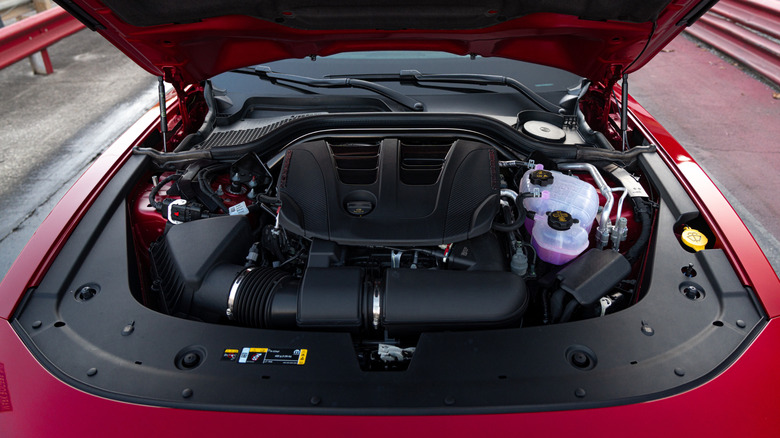
Despite Stellantis' refocus on Hemi V8s, the engine that was supposed to replace them remains in play. The automaker's Hurricane is a twin-turbocharged 3.0-liter inline-six that premiered in 2023 as an option for the Grand Wagoneer and became standard when Jeep dropped V8s from the Wagoneer lineup in 2024. And despite customer complaints, the Hurricane brings key benefits over the 6.4-liter Hemi that used to power the Wagoneer/Grand Wagoneer family. For example, it has more power: 510 hp and 500 lb-ft of torque in the 510 version, compared to 471 hp/455 lb-ft from the 6.4-liter Hemi V8 that Jeep offered alongside it.
The Hurricane's EPA ratings of 14 mpg city, 20 mpg highway, and 18 mpg combined also compare favorably against the Hemi's 13/18/15 mpg, respectively. Both engines allow owners to tow up to 10,000 pounds, but be aware that the Hurricane models have retreated to the standard output (SO) versions pushing 420 hp and 468 lb-ft of torque in 2026 model year Jeeps. Instead, the new range-topping motivator is a 647-horsepower plug-in-hybrid powertrain leveraging a 3.6-liter V6 to drive its 130-kW onboard generator.
The Hurricane is also available in two categories in the Ram 1500 and the Dodge Challenger. Both are available with standard output (SO) versions making the same power as in the Jeep, with Stellantis providing separate high output (HO) tuning on top of that. In the Ram, that means 540 hp and 521 lb-ft of torque, while Dodge owners get 550 hp and 531 lb-ft of torque in the Charger Scat Pack — the most powerful production Hurricane yet. No wonder the Charger was proclaimed the North American Car of the Year for 2026.
Ford's 4.0-liter Barra
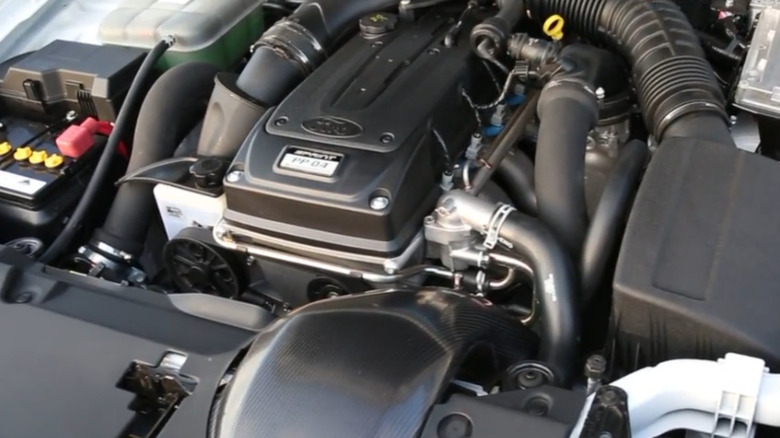
A legendary Australian engine that's finally available to purchase in America, Ford's 4.0-liter Barra inline-six – nicknamed for a local sport fish called the Barramundi — was the crown jewel of Ford's operations Down Under in the early 2000s. While it traces its roots to the 1960 Ford Falcon, with many updates along the way, it launched as a naturally aspirated unit in the 2002 Ford Falcon, where it was good for roughly 244 hp. As time went on, it would eventually be used in Australian Blue Oval cars such as the Fairlane and LTD sedans and the Territory SUV.
The 2002 mill featured double overhead cams, 24 valves, and electronic fuel-injection. But the ultimate expression of the Barra inline-six didn't come until 2016 when Ford launched a limited-edition Falcon XR6 Turbo Sprint with a turbocharged version of the engine capable of 435 hp and 425 lb-ft of torque. This Falcon could fly to 60 mph in approximately 4.5 seconds.
That's no doubt an impressive number for a production six-pot, yet it was just the tip of the iceberg for the Barra's aftermarket power potential. Tuners have been pulling more than 1,000 hp out of Barra blocks, with the effort from Monsta Torque being a mighty case in point. According to Garret, modifications including a larger turbocharger, a new turbo-back exhaust system, and a new intercooler raised the bar to 1,033.9 horsepower at the rear wheels.
TVR's 4.0-liter Speed Six
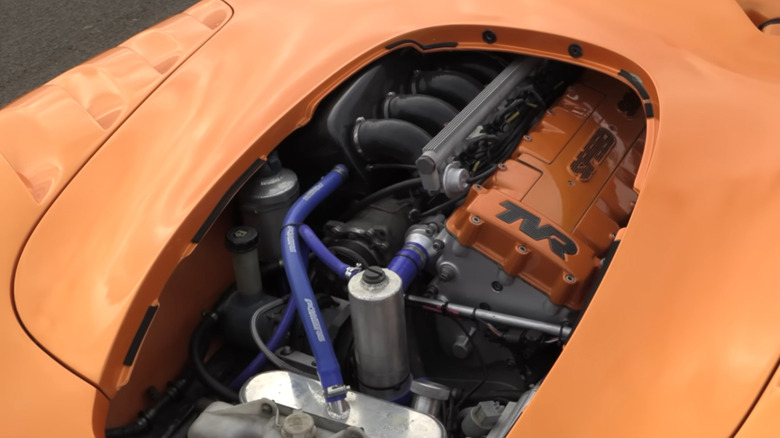
TVR proves that even a tiny boutique automaker can get in on the big-horsepower inline-six action. The UK brand was named after — and by — Trevor Wilkinson, who put together his first car in 1947. The thing is, due to the state of manufacturing in England after World War II, this early Wilkinson machine, and those that first followed, were mostly pieced together from off-the-shelf components made before the war. More than a decade would pass before the 1958 Mark I/Grantura would become the first official production TVR — with a four-cylinder engine serving up 79 horsepower in its slightly later Mark II configuration, according to the TVR Car Club.
By the early 2000s, a TVR could take to the streets with a naturally aspirated 4.0-liter inline-six that could unleash 440 horsepower. Technically, however, the engine making all those horses was limited to the only TVR T440R in the world. Yet a 406-hp version of the TVR's Speed Six engine was the motivator of choice for the TVR Sagaris, which went into production in 2005. Only 200 or so seem to have been made, weighing less than 2,400 pounds and reaching 60 mph in 3.7 seconds. Keep the pedal to the metal, and the car can achieve a top speed north of 185 mph.
TVR has had its financial ups and downs since then, and is now owned by a company called Charge Holdings. It's hard to know what the future holds for the rebooted brand, but the brand announced an all-electric model based on the V8 Griffith in 2025.