

Here's Every V12 Car You Can Still Buy
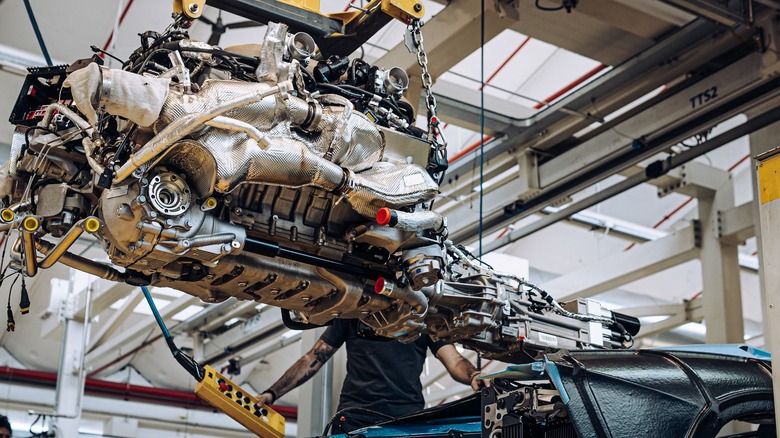
There's nothing quite like the high-revving, smooth-running performance of a V12 engine, and for a lot of folks, there's no replacing the soundtrack, either. Unfortunately, their expense and complexity meant they were almost always going to be rare beasts, most often reserved for the upper echelons of the auto world. (Although GM once built a V12 engine for heavy-duty trucks.)
The only new vehicles available for sale today with V12 engines are from the likes of Ferrari (Purosange and, duh, the 12Cilindri), Lamborghini (Revuelto), Aston Martin (Vanquish), Rolls-Royce (Phantom, Ghost, and Cullinan), and Mercedes-Maybach (S 680 4Matic). And it's really been that way from the beginning.
The first V12 used in a mass-produced automobile came in 1915, when a 424-cubic-inch mill was mounted in the Packard Twin Six, where it delivered 88 horsepower at just 3,000 rpm. The thing is, the starting price for the Twin Six was $2,600, and a premium model like the Imperial Landaulet upped the ante by $2,000 for a cost that translates to over $150,000 today. Meanwhile, the 70-horsepower Cadillac Type 51, introduced the same year as the Packard and known as the industry's first volume car with a V8, opened at just $1,975.
(If you're wondering about Ferrari and Lamborghini, two brands famous for V12 machines, the former used one on its very first car, the 1947 125 S. The latter then hired one of the former's master engineers, Giotto Bizzarini, to craft its own new V12 for the 1964 350 GT.)
Aston Martin
Aston Martin is a relative latecomer to the V12 scene, introducing the DB7 V12 Vantage in 1999 as its first production model with that engine setup. The company had experimented with a 4.5-liter V12 back in 1954, trying it in the DP115 prototype race car, but the concept seems to have been abandoned soon after. As for the V12 Vanquish, it came with a 6.0-liter unit kicking out 420 horses and 400 pound-feet of torque — and a surprising backstory.
No, Aston Martin's V12 wasn't 2 Ford V6s glued together, but it does trace its conception back to the Blue Oval. Remember, Ford owned Aston Martin for about 20 years, from 1987 to 2007, and engineers from the former made many contributions to the V12 engine for the latter. (Ford and Lincoln did show V12 concept cars around this time, but they never made it into production.)
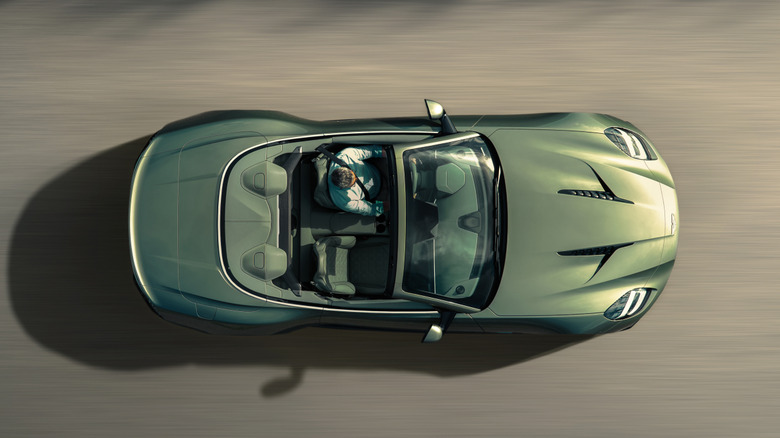
Clocking in with the current Aston Martin lineup shows the Vantage has been vanquished by, well, the Vanquish. Rocking a twin-turbocharged 5.2-liter V12 — the present-day Vantage makes do a with a twin-turbo V8, albeit one with 670 horsepower and 590 pound-feet of torque — the Vanquish raises the output bar to 824 horses and 738 pound-feet of twisting strength. At the same time, it lowers its 0-60 sprint time below 3.3 seconds. Keep the pedal to the metal after that, and you can see the speedometer get all the way up to 214 mph. You can also drop the top in the beautiful 2026 Aston Martin Vanquish Volante for a better chance to hear the V12's unique roar.
Ferrari
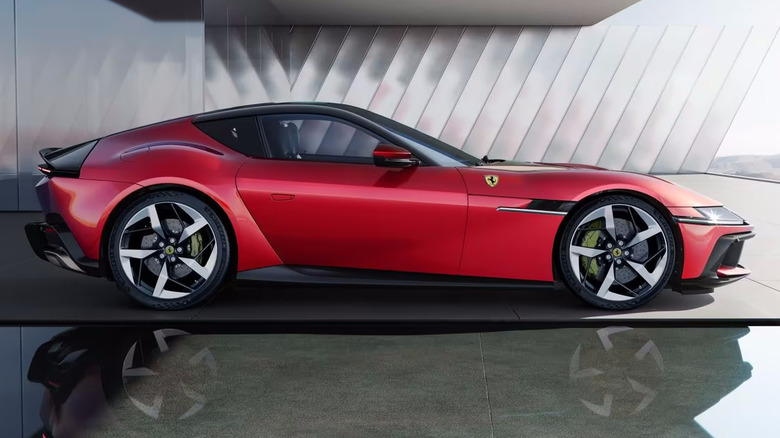
The Ferrari 12Cilindri taps right into the automaker's long history of V12-powered GT cars, leveraging a 6.5-liter engine that delivers about 820 horsepower and 500 pound-feet of torque. Plus, it takes full advantage of the high-revving nature of V12s for a sky-high redline of 9,500 rpm.
Think of it this way: If you compare V12 and V8 engines with the same amount of displacement, those cubic inches are divided among 12 cylinders in the former and among 8 in the latter. As a result, each individual piston can be smaller in the V12 than in the V8 and rely on smaller, lighter pistons (and associated components). Then, with the engine moving less piston weight, it can rev those pistons faster. In fact, peak ponies for the 12Cilindri arrive at 9,250 rpm while maximum torque is available at 7,250 rpm. It's enough for the 12Cilindri to reach 60 mph in fewer than 2.9 seconds on its way to a maximum velocity north of 211 mph.
Of course, the car is hardly perfect. Ferrari had to recall 80 12Cilindris for illegally dark window tint. Which was at least a better recall outcome than for the automaker's other current V12 ride, the Purosangue SUV. Ferrari had to recall 541 of them for possible loss of braking ability.
That could be especially worrying if you're trying to slow your Purosangue from its top speed of nearly 193 mph, or after a brisk 0-60 run of less than 3.3 seconds. True, those numbers are down slightly from the 12Cilindri, but remember the SUV weighs more and has a slightly older version of the 6.5-liter V12. The mill for the 12Cylindri has been updated with new exhaust, oil-pump, and fuel-injection systems.
Lamborghini
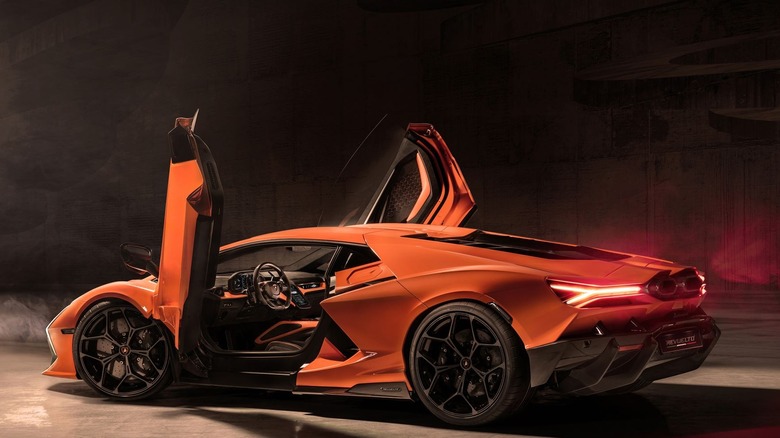
Ferrari's arch-nemesis likewise built on tradition when it introduced the Lamborghini Revuelto with V12 motivation. Lamborghini, however, gave a nod to modern power trains by adding a plug-in hybrid system into the mix. You won't get very far using electricity alone, since the car has an EV driving range of a mere five miles. Nor does hybridization help much when the juice runs out, as the Revuelto has a fuel-economy line of 12 mpg combined/10 mpg city/17 mpg highway at that stage. Not that many of its drivers will probably care.
Folks feeling the need for speed can look forward to 1,001 horsepower from a combination of the Revuelto's 6.5-liter V12, its 3.8-kWh battery pack, and three electric motors — each of the front wheels gets one, while a third has been built into the eight-speed dual-clutch automatic transmission. Launch this raging bull and you're rewarded with a max speed of approximately 217.5 mph. Acceleration-wise, the Revuelto rockets to 60 mph from a dead stop in under 2.5 seconds.
Lamborghini lovers should also be on the lookout for the automaker's "few-off" limited editions. These typically blend very limited production with unique details, with models released according to the brand's private schedule. One of the most recent was the Lamborghini Fenomeno, a super-exclusive monster backed by a tuned-up version of the Revuelto power train pushed to 1,065 horsepower. All sold out almost immediately, but you never know when the next limited-edition Lambo will drop.
Mercedes-Maybach
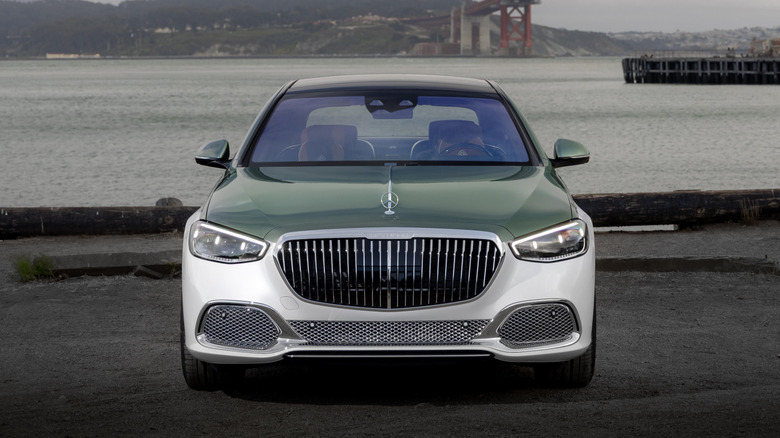
Back before the Italians got busy with their V12s, Wilhelm Maybach was doing the same in Germany: He rolled out that country's first V-12 series-production car in 1929, his aptly named Maybach Type 12. Maybach also earned patents for a belt-drive system, a jet-style carburetor, and a modern honeycomb-type radiator, and he designed the engines for many of Germany's zeppelins. Nowadays, though, he may be best remembered for his work with Mercedes-Benz, which the company honored by naming its ultra-luxe sub-brand — Mercedes-Maybach — after him.
All that comes together in the Mercedes-Maybach S 680 4Matic sedan, powered by a twin-turbocharged 6.0-liter V12 that gets the handcrafted treatment from Mercedes' engineers. Thanks to those efforts, this mighty motor can pour out 621 horsepower and 664 pound-feet of torque, allowing folks to pilot the 5,200-pound super sedan from 0 to 60 mph in 4.3 seconds. Moreover, while it may not outrun the V12 entries from Ferrari and Lamborghini, the Mercedes-Maybach can out-comfort them. A cabin offering a simulated hot-stone massage, aromatherapy, 31-speaker Burmester audio, Manufaktur leather, real wood accents, and a full range of bespoke options are all part of the picture.
You should further keep in mind that, for 2027, the Mercedes-Maybach S-Class sticks with the V12 and looks even flashier. The already imposing exterior, for example, is enhanced by an even bigger grille and bright touches including rose-gold headlight accents and available gold-accented 21-inch wheels. Mercedes' V12s will last longer than that, too, as the company has vowed to keep the engine alive into the 2030s — if not longer.
Rolls-Royce
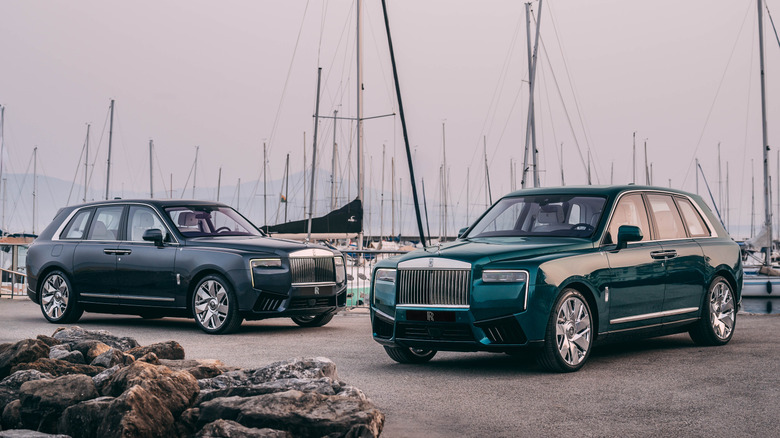
The story of Rolls-Royce's 12-cylinder engines goes back yet farther, to 1915, though the first application was in an airplane, not a car. More specifically, it was a massive mill designed for British military planes and boasted more than 20 liters of displacement and more than 200 horsepower on tap. After World War I — and a few decades of engine development — Rolls-Royce premiered its first V12-powered car, the 1936 Phantom III that leveraged 7.3 liters of displacement for 165 horses.
Rolls had its share of success with cars driven by its legendary, long-running 6.75-liter V8 — sometimes shared with Bentley during the engine's 60-plus years in production. But once BMW acquired the Rolls-Royce name in 1998, Rolls shifted to V12 motivation — though with the V8's traditional 6.75 liters of displacement.
Fast forward to 2026, and three Rolls-Royce models carry on that tradition with modern 6.75-liter twin-turbo V12s: the Phantom sedan, Ghost sedan, and Cullinan SUV, all of which can take advantage of 563 horsepower and more than 600 pound-feet of torque. Only the all-electric Spectre lacks a V12 — for now. There was actually a time when the company planned on giving up on gas engines entirely, but Rolls-Royce has walked back its all-electric plan at this point.
Here's where we'd normally spend some time telling you about all the fantastic non-engine content in these vehicles, but we don't really have space. After all, as Rolls-Royce's most jaw-dropping bespoke cars will show you, just about everything can be optional for its customers.