

Dealers Can Now Get In Trouble If They Advertise Cars That Aren't Actually Available
Good morning! It's Friday, March 27, 2026, and this is The Morning Shift, your daily roundup of the top automotive headlines from around the world, in one place. This is where you'll find the most important stories that are shaping the way Americans drive and get around.
In this morning's edition, the FTC is going after dealers that market unavailable vehicles, Jaguar-Land Rover is suspending production for at least two weeks in the UK, the Ford F-150 is in short supply and the UAW is unhappy with Stellantis over bonus payouts
1st Gear: FTC is coming for dealers that advertise unavailable vehicles
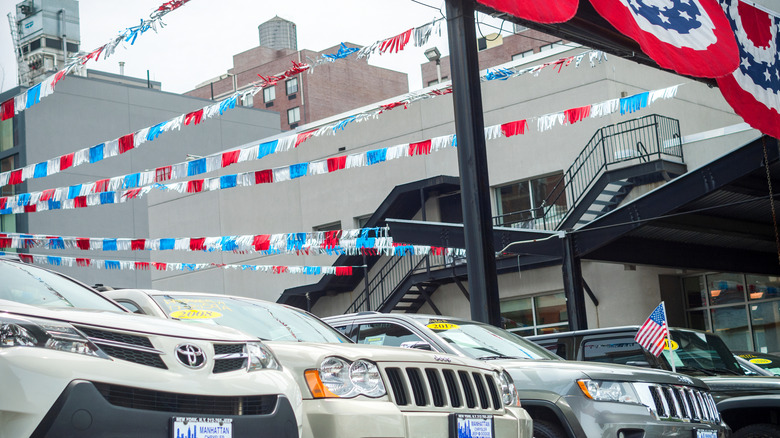
There are few things more frustrating than seeing a car advertised online, only to get to the dealership and find out it's gone. Now, the Federal Trade Commission is cracking down, saying its illegal to advertise unavailable vehicles. Oh, happy days. Earlier this month, Christopher Mufarrige, the director of the agency's Bureau of Consumer Protection, sent letters to 97 dealership groups on the suspicious they violated at least one of six "illegal" advertising practices. These practices could end with the dealer getting slapped with over $50,000 fines per offense as well as customer restitution.
Five of those practices involve advertising vehicles at lower prices than the actual out-the-door price, but the sixth is the one we're interested in today: "advertising unavailable or nonexistent vehicles." Oddly, the FTC won't give an exact time to dealers on exactly how quickly sold vehicles need to be removed from their websites and other online advertising, citing the desire not to give legal advise. Still, it's a step in the right direction. From Automotive News:
Dealers also should avoid generic disclaimer statements of, "'Oh yeah, the car may not be available,'" [ComplyAuto co-CEO Chris] Cleveland said on the webinar. Those were a "red flag" to a regulator, he said.
"You're basically admitting ... you're advertising cars that aren't available for sale," he said.
Jeffrey Greenbaum, managing partner of the Frankfurt Kurnit Klein & Selz law firm in New York City and a specialist in advertising law, thinks regulators will accept a "reasonable" gap in time to update a listing "as long as that dealer is acting properly, to then stop promoting the availability of that car once it's been sold."
Penalties for advertising unavailable vehicles can happen on a state level, as well. What a beautiful thing that is.
Swickard Auto Group agreed to pay a $800,000 penalty and accept a $200,000 suspended penalty to settle Alaska Department of Law's allegations of unfair or deceptive practices, the agency announced March 24.
"It is unfortunate that none of the settlement funds are going to customers," Swickard said in a statement. "We advocated for that outcome, but the State is keeping the funds for themselves. If this were truly about consumers, the outcome would have prioritized consumers."
[...]
Swickard Auto advertised unavailable models and refused to sell vehicles at the prices it had advertised, the agency alleged in a news release.
"Car dealers don't get to advertise one price and charge another — or advertise cars that aren't really there," Alaska Attorney General Stephen Cox said in a statement March 24. "That's a bait-and-switch, and it's unlawful."
Swickard Auto admitted no wrongdoing under terms of the settlement.
[...]
The group also addressed the advertising allegations.
"We disagree with the claim that customers couldn't buy vehicles at advertised prices," Swickard said. "During COVID, vehicles were often pre-sold due to shortages, so the facts don't support that narrative. And when they point to Facebook or social media posts, those formats don't allow for every detail of a transaction to be included. We offered to reimburse any customers who felt impacted by these issues. However, we are not aware of any such circumstances."
I really hope this sort of trend continues. I know just about every car enthusiast has a s story about driving to a dealer very far away just to find out the car they were prepared to buy "just sold." I still think about what my life would be like if I got that Miata instead of my old Z4. I'd probably have more money and a better outlook on life.
2nd Gear: Jaguar-Land Rover hit with another production pause in the UK
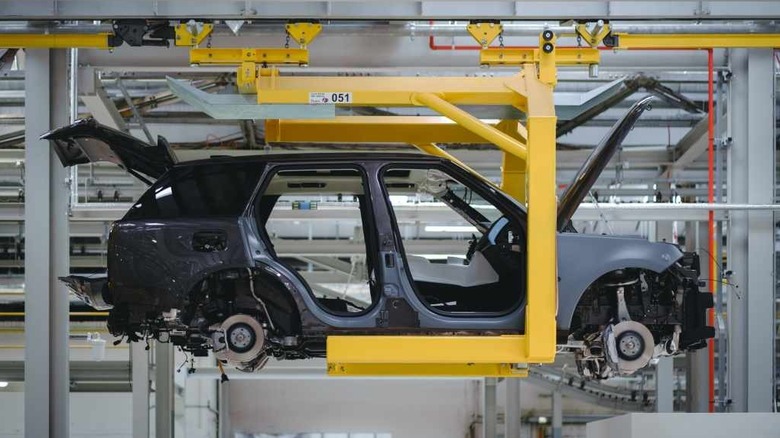
The hits just keep coming for Jaguar-Land Rover, man. The troubled Indian-British automaker has temporarily stopped production on its production lines at its plant in Solihull, England because of a parts issue with a supplier. While it's not expected to be a super-long-term issue, the pause will go on for about two weeks, with production resuming April 8. It'll be worked into an already-planned shutdown for the Easter holiday.
The automaker builds the Range Rover and Range Rover Sport models on this line. In other words, this is where its flagship vehicles are produced. From the BBC:
A JLR spokesperson said: "Due to a part supply challenge with a supplier, we are temporarily pausing production on certain vehicle lines at our Solihull manufacturing facility. We are working closely with that supplier to resolve the issue as quickly as possible and minimise any impact on our clients or our operations."
Colleagues will be attending site as usual.
It is the latest disruption to hit the West Midlands manufacturer, after a major cyber attack forced it to shut down its computer networks for several weeks last year.
The company previously said production had since returned to normal levels.
I know it's only going to last for a few weeks, but I can't think of anything JLR needs less right now than another production pause. Between the pauses and massive tariff bills, I wouldn't want to be a Jaguar-Land Rover accountant right now.
3rd Gear: Ford can't keep up with F-150 demand
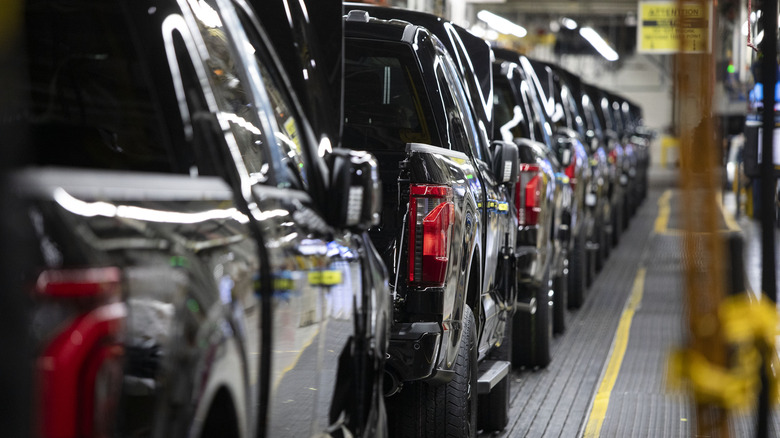
Everybody wants a Ford F-150, and its causing a headache for the Blue Oval. Despite adding a shift at its Dearborn Truck Plant to make up for lost production during last fall's fire at an aluminum supplier, Ford just cannot keep up. Now, that tight inventory means buyers may have to pay more if they want a new F-150.
The reason for this is simple: Ford is pushing out more high-end versions of the F-150, They're more profitable with an average list price of about $87,000 a pop, and it's building far fewer entry-level F-150s, which have an average list price of about $52,000. It makes sense from Ford's perspective. Aluminum is still in short supply — and President Trump's 50% aluminum tariff is certainly not helping things — so why not concentrate on the models that make you the most money? From the Detroit Free Press:
To offset higher costs, Ford also is increasing the delivery fees on the vehicles, Greene said, even as it lowered the manufacturer's suggested retail price on some 2026 F-150s.
[...]
Ford spokesman Said Deep said of the delivery fees: "These charges ... are reviewed and adjusted as necessary to keep consistent with the industry. We average the charge so no matter where a customer lives in America, the destination and delivery is the same."
Meanwhile, the war in Iran is not helping automakers because it's disrupting the global supply of aluminum, causing price volatility and making it more competitive to get. But Ford's leadership said it is working with its aluminum supplier Novelis to get it back online — though it could be later this year before F-150 inventory stabilizes.
[...]
[A]ccording to Cars.com data, F-150 supply at dealerships was down 34% in February compared with the year-ago period.
Since October of last year, inventories of the F-Series line have slid by 29% from 241,300 vehicles to 172,400 vehicles, and they're currently at their lowest level in two years. I guess if you really want an F-150, you're either going to have to wait or be willing to pay up for a more well-appointed model than you would have otherwise gotten. It's strange times we're living in.
4th Gear: UAW workers miss out on Stellantis bonuses
After telling its United Auto Worker union-represented employees last month that there wouldn't be any 2025 profit sharing checks for them since the automaker, well, didn't turn a profit, the automaker decided to give some of its salaried employees performance bonuses anyway. As you may imagine, the UAW's leadership and its rank and file members didn't take too kindly to that.
Now, a group that includes on-site managers, corporate staffers and salaried trade workers will be getting performance bonuses at the end of March despite the fact the company took a $26.5 billion loss in 2025, but there's no word on how many employees actually got bonuses The news was confirmed by a Stellantis spokesperson. From the Detroit Free Press:
A salaried, nonunionized employee at Stellantis can qualify for a performance bonus in three categories: company-wide, divisional and individual. No company-wide bonuses are going out for the automaker's poor performance in 2025, but the company confirmed that some divisions and individuals will receive bonuses for their performance last year.
"The compensation package for some non-bargaining unit employees includes a Stellantis Annual Incentive Plan (SAIP) payment, which is driven by three performance pillars — company, division and individual — with specific financial and non-financial annual targets as well as results from the divisions to which they are aligned and personal goals," Stellantis spokesperson Jodi Tinson said in a statement. "As Stellantis' overall 2025 performance results did not meet the established targets, the company component of SAIP will not be paid. Payment of the divisional and individual payments remain directly conditional on the results achieved."
[...]
Rich Boyer, United Auto Workers vice president who oversees the Stellantis department of the union, told the Detroit Free Press he was "disgusted" to hear that some managers would be getting bonuses.
"The UAW, as well as I personally, am disgusted that we were just informed that management employees will be receiving a bonus check while Stellantis UAW members did not receive a profit-sharing check," Boyer said. "Our members help drive this company's success each and every year and they deserve to share in its success."
UAW President Shawn Fain, too, called the news the "epitome of corporate greed" in a statement to the Free Press.
Bonuses for the non-bargaining unit employees at Stellantis are part of the yearly compensation package and paid out if an employee or department can meet certain goals. On the union side, however, profit-sharing checks rely on one key metric: adjusted operating income.
Even though Stellantis made headlines with a $26 billion loss, the union negotiated to pay out profit-sharing checks according to adjusted operating income, a term used to describe a special formula that exempts unique costs the company faced in a given year. The company's $26 billion write-down, lost as it pivoted away from electric vehicles, was deemed an extraordinary expense and is exempted from adjusted operating income, the bucket of cash UAW employees draw from.
Nonetheless, Stellantis' adjusted operating income — with the massive write-downs exempted — was still a loss of $2.2 billion.
At least CEO Antonio Filosa and Chairman John Elkann missed out on some big chunks of their multimillion-dollar paydays. Don't worry, though. They were still paid handsomely.
Filosa, who took over the company in June, made $6.3 million for his work in 2025 — a combination of his $1.6 million base salary, a $2.2 million relocation stipend, nearly a million dollars in benefits and a $1.7 million grant from the company. In total, Filosa came in shy of the nearly $12 million he could have made had the company hit all of its targets.
Filosa, as well as Stellantis Chairman John Elkann, missed out on multimillion-dollar paydays for missing their performance goals, according to Stellantis' filings. Filosa could have earned at most $6.4 million in bonuses atop his $1.6 million salary, and Elkann would have made $2.7 million if the company could have grown sales, increased quality, lowered warranty costs, and increased cash flow and income.
Warranty cost was the only metric in which the company exceeded goals, falling short of all others. Elkann and Filosa did not receive any bonus payouts.
Both Boyer and Fain called it a "massive slap in the face and the epitome of corporate greed."
Reverse: The most consequential day in history
Usually, I pick one historic event to highlight in "Reverse," but after looking through today's offerings, I was dumbfounded. There are no less than 14 major historical events and a smattering of celebrity birthdays that are worthy of highlighting. Because of that, I'm just going to list out every wild thing that happened today:
- 1775: Thomas Jefferson elected to the Continental Congress
- 1865: Lincoln, Sherman and Grant plan the final stages of the Civil War
- 1912: Japanese cherry trees planted along the Potomac in Washington, D.C.
- 1929: Herbert Hoover has first telephone installed in the Oval Office
- 1939: First Men's NCAA "March Madness" Champion crowned (my bracket was wrong)
- 1952: Kiichiro Toyota, Toyota founder, dies
- 1958: Nikita Khruschev becomes the Soviet premier
- 1963: Quentin Tarantino is born
- 1964: Strongest earthquake in U.S. history — a 9.2 — hits Alaska
- 1969: Mariah Carey is born
- 1973: Marlon Brando declines his Best Actor Oscar for "The Godfather"
- 1977: Two Boeing 747s crash into each other in Tenerife, killing 583 passengers and crew members
- 1979 Pattie Boyd and Eric Clapton get married (George Harrison needs a gun)
- 1980 123 Oil workers drown in the North Sea
- 1984 Hot Pockets trademarked
- 1998 FDA approves Viagra
What a Goddamn day this is. Who the hell knows what March 27, 2026 has in store? Nothing good, I'm sure. If you want to learn more about all these wild events, head over to History.com.
The Fuel Up
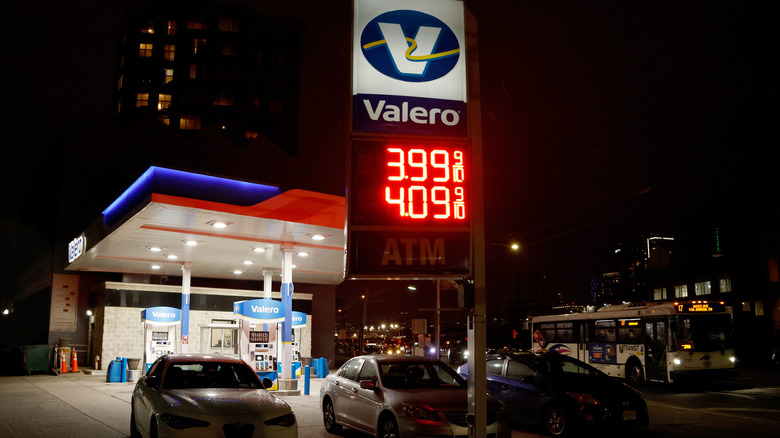
We're now on day three of gas prices stabilizing at and around $3.98 per gallon. It seems the $4 boogie man is just a bit too much for most gas stations to ask for. Still, Brent crude oil prices have cracked $110 per barrel, so I don't expect this plateau to last much longer.
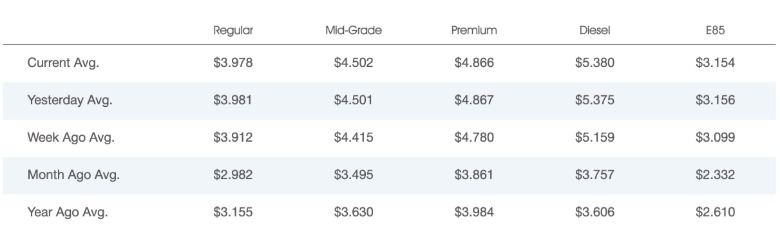
In any case, overnight we saw the average price of a gallon of gas once again retreat a fraction of a cent from $3.981 to $3.978, according to AAA. It won't mean much to normal folks like you and me, but I guess it's better than having them go up.
If you were wondering, the last time gas was over $3.98 was back in August of 2022, according to data from the Energy Information Administration, and, the average price of a gallon of gas is now up a full dollar — or about 28.7% — since the war first broke out on February 28, when it was $2.98.
Here's where national average prices stand right now, according to AAA:
 History.com
On the radio: Paramore - Ain't It Fun
Folks, it's Friday. The weather is relatively nice here in New York City. I'm feeling good, and there's no better way to celebrate than with a little Hayley Williams to kick off the day. Sure, things are pretty bad out there right now, but for the next four minutes and 56 seconds, they're going to be okay.