

Volkswagen May Shift German Plant Production From Cars To Components For Israel's Iron Dome Air Defense System
Good morning! It's Thursday, March 26, 2026, and this is The Morning Shift, your daily roundup of the top automotive headlines from around the world, in one place. This is where you'll find the most important stories that are shaping the way Americans drive and get around.
In this morning's edition, Volkswagen wants in on the war machine, new car price hikes are unavoidable if tariffs are going to stick around, even Honda's strong bike division is seeing cracks and Lyft is rolling out a driver-relief program amid high-ass gas prices.
1st Gear: The People's Iron Dome
Do you ever read a bit of news and say, "ah, yeah. That makes sense." Well, Volkswagen is apparently in talks with Israel's Rafael Advanced Defense Systems, working out a deal that would switch production at the automaker's Osnabrück plant in Germany from vehicles (what it should be making) to missile defense components for Israel's Iron Dome air defense system (what it should not be making), according to people who were familiar with the plan.
Under this scheme VW's Osnabrück factory would build various Iron Dome parts, including heavty-duty turcks that carry the system's missiles. It would also build launchers and electricity generators. However, in a bit of relief of peace-loving Volkswagen fans everywhere, the automaker wouldn't produce the projectiles itself. From the Financial Times:
The concept would require minimal new investment, according to the first person. "There is some money needed to transition to new production but this is pretty easy."
The idea, he added, was that "proven [defence] tech comes together with German manufacturing" to produce the system.
Production could be up-and-running within 12-18 months, the person said, as long as workers agreed to switch to weapons production.
Rafael plans to set up a separate production facility in Germany for the system's missiles, which must be handled on a specialist site.
The company hopes to sell the Iron Dome system to governments across Europe including Germany, as countries strengthen their air defences as part of a large-scale rearmament in response to Russia's full-scale invasion of Ukraine. Germany last year took delivery of the first of three batteries of the Israeli Arrow 3 air defence system, made by another Israeli company, Israel Aerospace Industries.
Rafael chose Germany for European production because of its status as one of the strongest supporters of Israel in Europe, according to a third person familiar with the plan.
Another of the people said the company had heeded pleas from senior German officials to harness excess capacity in the country's struggling industrial sector.
I suppose this tie-up does make some sense from VW's perspective. The German automotive industry is struggling right now, but do you know what isn't? War. It's very possible that this switchover could save 2,300 jobs at the plant, which has been under the threat of closure.
Still, even people within Volkswagen seem to understand that this may not be the most popular idea with folks who were in the plant, but I don't really think that's going to stop these plans from moving forward:
"The aim is to save everybody, maybe even to grow," said one of the people familiar with the plans. "The potential is so high. But it's also an individual decision for the workers if they want to be part of the idea."
The German government is actively supporting the proposal, according to a second person.
VW already makes military trucks in a joint venture between subsidiary MAN and German arms group Rheinmetall. But the partnership with Rafael would mark a major return to weaponry for VW, which produced military vehicles and the V1 flying bomb for Hitler's Wehrmacht during the second world war.
Maybe there's still hope for the Volkswagen lovers out there who aren't particularly fond of Zionism. A spokesperson for the automaker told the Financial Times that it was in discussions with "various market players," adding that there were "currently no concrete decisions or conclusions regarding the future direction" for the Osnabrück plant.
2nd Gear: New car price hikes are coming thanks to tariffs
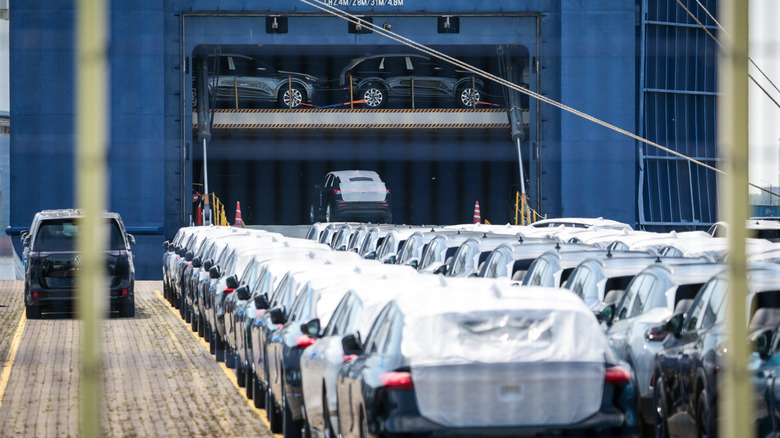
In a bit of a shocker, automakers have bore the brunt of President Trump's tariffs thus far, but that's not expected to last for much longer. More likely than not, car companies will start raising prices to offset tariff costs they can no longer afford. As it stands right now, there's a 25% tariff on imported cars and auto parts and a 50% tariff on steel and aluminum, and last year alone, similar tariffs costs automakers about $35 billion. From the Detroit Free Press:
"(Automakers) absorbed those tariff costs at launch to defend volume and protect market share, but that was never sustainable," Erin Keating, Cox Automotive executive analyst, said on March 25. "All the while, we saw destination and handling fees rise as automakers looked for ways to recoup some costs. The net takeaway: Vehicle prices are going up. The question is how much and how fast?"
That's just one conclusion drawn from the analysts at Cox Automotive, which held its first-quarter insights call with the news media and industry experts on March 25.
The automotive research firm said first-quarter data studied so far showed that U.S. retail car sales will likely be down 2.6% to 15.8 million this year compared with 2025, given many factors in the economy creating buyer hesitancy this year.
[...]
"We are sitting at a unique inflection point where overlapping policy actions, cost pressures, geopolitical uncertainty, and rapidly shifting consumer behavior are all colliding at once," said Keating. "The pace of change in the past 12 months has been extraordinary, and it's created a market environment that is genuinely difficult to navigate for automakers, for dealers and for consumers."
Keating says the absorption phase is "definitely over" and we're now moving into a "pass-through mode" where MSRP increase dramatically. She added that we're also seeing car companies rationalize features and push lower cost trims to balance out affordability against a higher cost base. Oh, and just for some added fun, incentives are falling by the wayside.
3rd Gear: Honda's bike division needs to make up for EV screw up
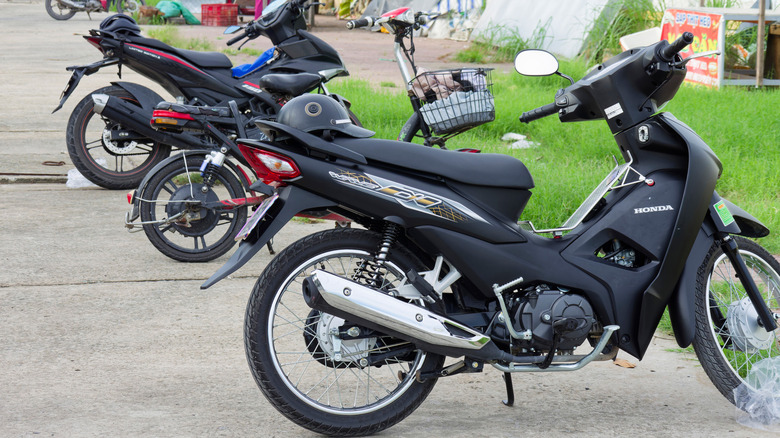
Honda screwed up big time with its electric vehicle strategy, and now it's gotta avoid doing the same thing in other parts of its business — namely its motorcycle and bike department. Nearly one-in-three motorcycles sold globally is a Honda, and they generate the majority of the company's operating profit despite accounting for less than a fifth of sales. Sounds good, right? Well, even they're starting to see issues as e-bikes from China proliferate. From Bloomberg:
Though cars will undoubtedly be the focus of Chief Executive Officer Toshihiro Mibe's turnaround plan in May, he will also face pressure to show investors he won't squander Honda's best-performing unit. How the company adapts to an electric future will be central to whether it can stabilize earnings and restore investor confidence.
"What's happening with automobiles is the most likely scenario for two-wheelers," said Hikaru Todoroki, principal auto consultant for KPMG. "Competition is intensifying."
[...]
Honda's motorcycle business is already encountering growing competition. The manufacturer began its global electric motorcycle rollout three years ago with two models each in Indonesia and India, but the South Asian debut struggled. Of the two introduced in India, one relied on battery swapping without home charging, limiting usability, while the other paired fast charging with a significantly higher price than rivals.
India, which accounts for roughly a third of the global motorcycle market, has drawn a wave of competitors racing to introduce new models, advance technology and secure battery supplies largely controlled by China and South Korea.
[...]
"Making an aggressive effort to approach the market – that's not what the Japanese are doing," Todoroki said.
Honda plans to invest ¥500 billion ($3.1 billion) in electric motorcycles by 2030, with aspirations to introduce 30 models and reach annual sales of 4 million units. Eventually, it aims for EVs to account for a fifth of its two-wheeler sales.
Drawn by the smartphone-like convenience of plug-and-play and low maintenance costs, consumers are projected to drive up electric bike and scooter adoption in the coming years, with BloombergNEF predicting that 87% of all motorcycle sales will be electric by 2040.
It's not just issues abroad, either. Honda is also facing challenges at home in Japan as it seeks to roll out electric bikes. China's Yadea entered Japan in November with an electric scooter that carried the same price tag as local gas-powered options, which meant it was roughly 30% cheaper than a comparable battery-powered model from Honda.
Honda has ambitious long-term goals of capturing 50% of the global market, with major growth concentrated in India, Indonesia and the Philippines, as well as Brazil and other parts of Latin America. However, those markets present massive hurdles for the company. Electric bikes usually offer less than 62 miles of range — whereas most gas bikes can go up to 186 miles between fill ups. Of course, batteries remain as costly and space-constrained as ever, which makes it difficult to match gas bikes when it comes to both performance and affordability.
4th Gear: Lyft gives drivers a break over gas prices
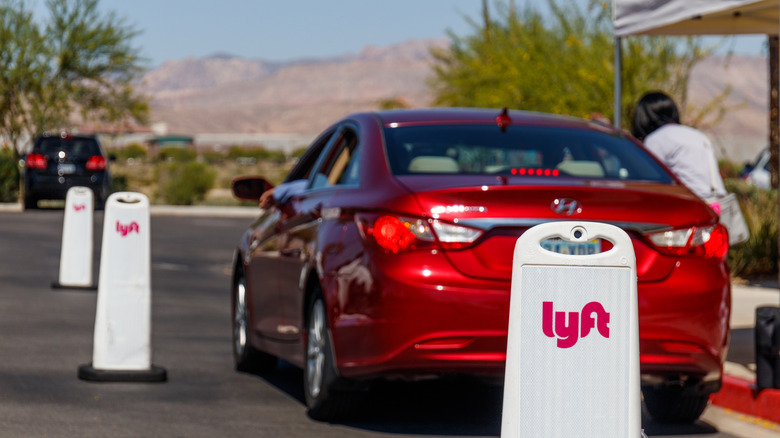
It's not often that companies do good things for the folks who work for them, but here we are. Ride-hailing service Lyft said it's rolling out a temporary driver-relief program in the U.S. to help its drivers deal with higher gas prices. The 60-day program, which will run March 27 through May 26, offers cash-back incentives and fuel saving for drivers using the Lyft Direct debut card and elegible gas stations. From Reuters:
Under the initiative, top-performing drivers will receive an extra 2% cash back on fuel purchases, while mid-level drivers will get an additional 1%, on top of existing rewards that range from 1% to 10% based on driver status.
The combined savings, including offers from Lyft partners, could reach as much as 94 cents per gallon for top-tier drivers, based on national average fuel prices of $3.97 per gallon, the company said.
Food delivery platform DoorDash said on Monday it was launching a similar program that would run through April 26.
Now, just imagine for a second if Lyft just paid its drivers better and treated them like the employees that they really are, rather than contractors. What a world that would be.
Reverse: Two years, just like that
 History.com
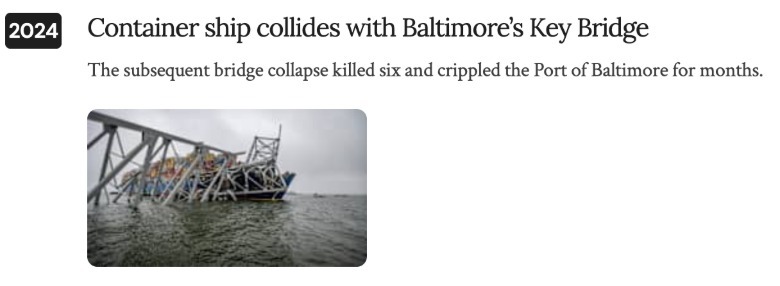
I can't believe it's already been two years since the Key Bridge disaster. Reconstruction of the crucial bridge is still nowhere near completed, as President Trump has publicly feuded with Maryland Governor Wes Moore. Back in 2025, he wrote on social media "I gave Wes Moore a lot of money to fix his demolished bridge. I will now have to rethink that decision???," according to Maryland Matters. We'll see how this goes. If you want to learn more about the bridge and the disaster, head over to History.com.
The Fuel Up
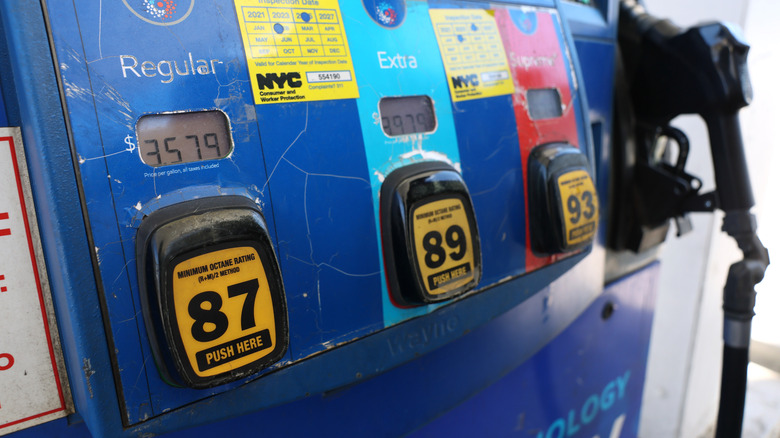
For the time being, gas prices seem to have somewhat plateaued. However, I don't expect that to last for very long, as Brent Crude prices have spiked back over $100, talks about a possible ceasefire in the the U.S.-Israeli war with Iran are muddy at best and the Strait of Hormuz is still virtually shut.
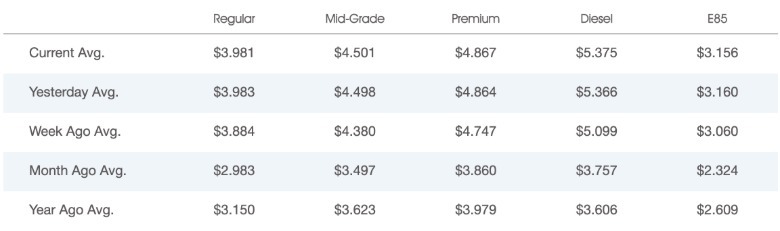
Still, overnight we saw the average price of a gallon of gas actually come down a fraction of a cent from $3.983 to $3.981, according to AAA. This means virtually nothing to normal folks like you and me, but I guess it's something. It's the first time gas prices have retreated at all since the war started on February 28.
If you were wondering, the last time gas was over $3.98 was back in August of 2022, according to data from the Energy Information Administration. In any case, the average price of a gallon of gas is now up a full dollar — or about 28.7% — since the war first broke out on February 28, when it was $2.98
Here's where national average prices stand right now, according to AAA:
 AAA
AAA
On the radio: Michelle Branch - Everywhere
I couldn't tell you why, but Michelle Branch's "Everywhere" has been stuck in my head for, like, two days now, and I've got to get it out. Maybe if I transfer it to you, I'll be free of this curse. Don't get me wrong, the song is fantastic. I've just had enough.