

10 Of The Coolest Classic Cars Almost Nobody Bothers To Import
Mainstream always wins in the automotive world. Take the Mk4 Supra as an example; it was a fine grand tourer of its era, but surely not a mainstream car when it adorned Toyota dealerships. Once that orange Supra appeared in "The Fast and the Furious", though, everything changed. Its nigh-indestructible 2JZ engine also played its role, but either way, the Mk4 Supra is etched into the mind of many automotive enthusiasts.
We can surely tell you about other classics that are almost too present in media, but hearing about another Supra or NSX is almost yawn-inducing at this point. Instead, in this piece, we'll uncover some cool classic cars that people are still sleeping on and don't bother to import. Of course, these models aren't absent in North America — just rare. But that should probably change, because each one has a distinct personality that most cars lack. Like, a suspension system that puts most modern cars to shame, or an awe-inspiring exterior design. Still, this is Jalopnik, so the list consists mostly of quirky fun-to-drive machines — and they can all be imported into the U.S. right now.
Citroën Xantia Activa V6 (1994 to 2002)
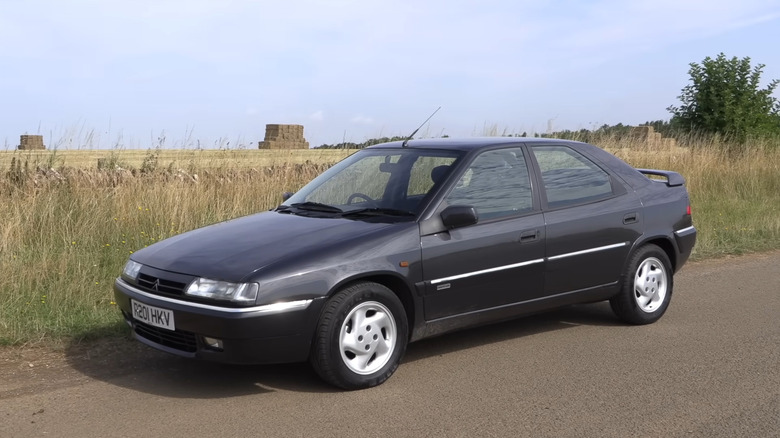
Porsche's fancy "Active Ride" suspension, which debuted on the 2024 Panamera, stole quite a few headlines with its body-roll-deleting abilities. But it also reminds us of the Citroën Xantia Activa V6, which debuted nearly 40 years earlier. Today, a clean example costs around $23,500 in Europe. Of course, we're under no illusion that Porsche's system is more sophisticated. But the fact that Citroën offered technology with similar abilities in the 1990s is just wild. Oh, and the Xantia wasn't a DS successor; the larger XM carried that burden while the Xantia was Citroën's mid-size offering. Basically, it was a French Camry competitor.
The magic behind the Activa's suspension could be found in the active anti-roll bars powered by hydropneumatic suspensions, which ensured that the Xantia remained level in the corners. Boy, did it work. A close friend of mine had this same car and we used it extensively for long road trips. It had a buttery-smooth ride yet remained level in the corners; body roll was only 0.5 degrees. On twisty roads, this means unparalleled comfort, even when compared to modern cars.
But the Xantia Activa V6 also out-cornered many supercars from its era, achieving lateral acceleration of 0.94 g. Alas, it never felt sporty to drive, even though it had a 2.9-liter V6 with 191 horsepower and a five-speed manual. As a long-distance transportation machine, however, it bettered 1990s Mercs. Plus, its Bertone-designed body is absolutely timeless.
Fiat Coupe 20V Turbo (1993 to 2000)
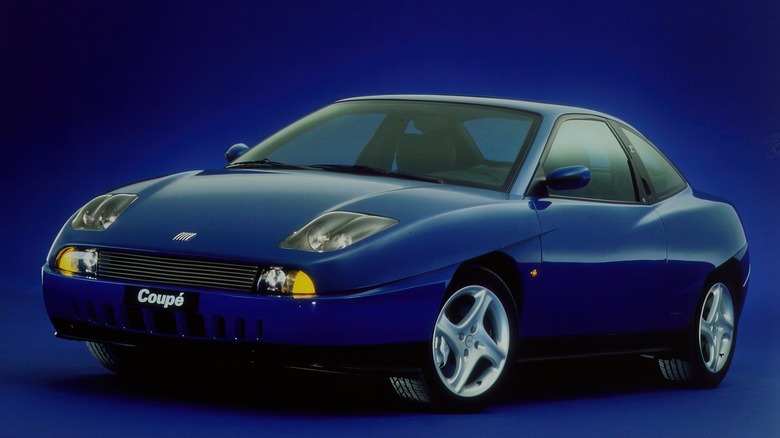
Dreaming of an Italian exotic, but only have the cash for an economy car? Fiat has the perfect four-wheel machine for you, and it first arrived back in 1993. Yes, it's no Ferrari — and, yes, it only comes with front-wheel drive. But the Fiat Coupe 20V Turbo still has more character than most modern sports cars, including an especially unique sound from one of the most famous inline-5 engines. The 2.0-liter turbocharged inline-five unit is plenty powerful, too, producing 217 horsepower and 228 pound-feet of torque, enough for a 0-62 mph sprint of 6.5 seconds and a top speed of 155 mph. It came standard with a five-speed manual, which Fiat replaced with a six-speed in 1998.
If you want to own one without drawing much attention, make no mistake — the Chris Bangle-designed exterior will turn heads. Yup, that's the same Chris Bangle that BMW enthusiasts love to hate. Some would say that his work on the Fiat Coupe is also questionable, but you can't deny its uniqueness. Of course, since you'll mostly be driving this car, you'll be staring at the fantastic Pininfarina-designed interior instead. The divided analog instruments and body-colored trim on the dashboard get you ever closer to the Ferrari experience you crave.
Also, don't let the FWD configuration fool you into thinking the Coupe 20V Turbo isn't ready for the canyons. Fiat equipped the funky-looking sports car with a Viscodrive limited-slip differential to handle torque steer, and it works well. The Coupe 20V Turbo has an all-independent suspension, too. If you want to check it out for yourself, you can snatch a low-mileage example in Europe for around $20,000.
Alfa Romeo 916 GTV V6 (1995 to 2005)
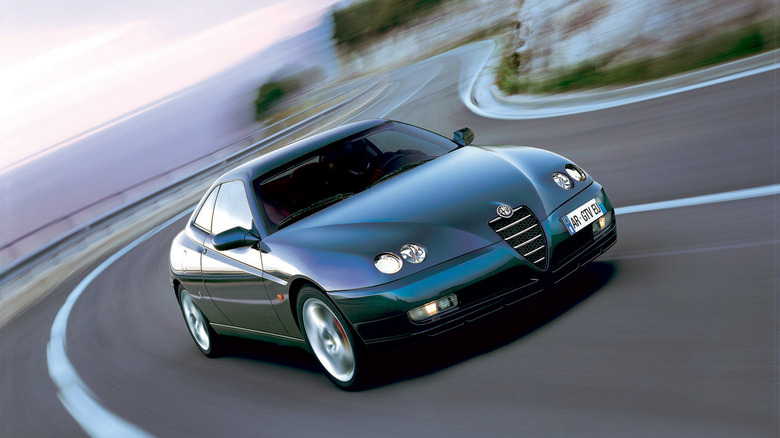
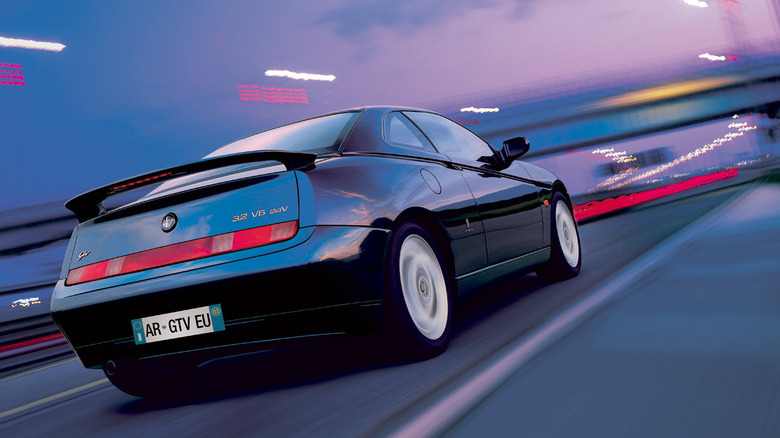
The Alfa Romeo GTV V6 is all but forgotten as a 1990s classic, yet it's able to impress on so many grounds — especially with its exterior. We bet you won't find its connection to the Fiat Coupe, despite both sharing the same underpinnings. Between the small round headlights and clamshell hood, the deep-cut line that runs diagonally front-to-back, and the sporty Kammback tail, it looks exquisite from any angle. Sadly, we can't say the same for its "Spider" convertible variant, which looks bloated.
Initially, the GTV got the looks — but not the means — to excite. Sure, there was a potent 2.0-liter turbocharged V6 that caused some stir, but it lacked the aural drama of Alfa Romeo's legendary Busso V6. In 1998, though, Alfa Romeo introduced a 3.0-liter, 24-valve V6 engine. That engine was based on the Busso, bringing its famous raspy soundtrack to the exotic-looking GTV. Moreover, with 217 horsepower on tap, it propelled the GTV to 62 mph in 6.7 seconds and reached a top speed of 149 mph. A five-speed manual was standard, which further enhanced the driving experience.
Unfortunately, the GTV V6 was front-wheel drive, just like the Fiat Coupe. And with such a heavy engine up front, it just isn't the precision tool you'd expect from an Alfa Romeo. Fortunately, that's nothing that can't be solved with a limited-slip differential and stiffer suspension. Currently, well-maintained GTV V6s go for around $20,000 in Europe.
Mitsubishi FTO GPX (1994 to 2000)
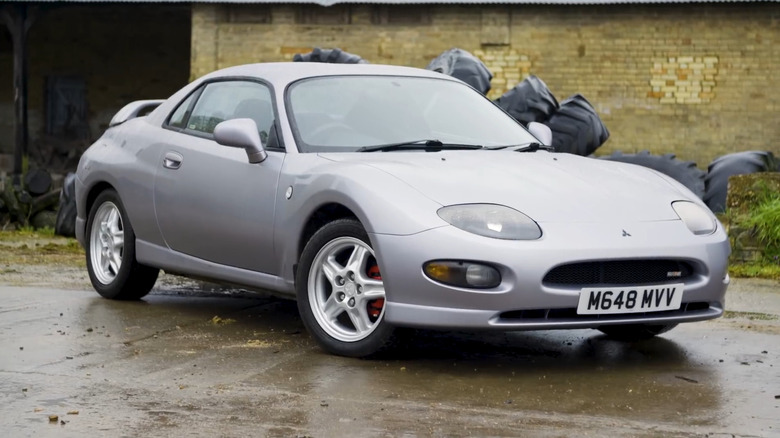
The Acura/Honda Integra Type R is rightfully etched as the finest front-wheel drive sports car in automotive history. But there is another Japanese classic that followed the same recipe quite successfully, although it never reached cult status. The FTO GPX had most of the same ingredients as its Honda rival, and it even won the 1994 Japan Car of the Year Award. Even so, because Mitsubishi offered it in right-hand drive only, it's a rarity on North American roads.
It's a shame, because under the svelte hood, the FTO GPX packs a high-revving 2.0-liter V6 that's good for 197 horsepower and 147 pound-feet of torque. The car uses this to sprint to 62 mph in 7.5 seconds and reach a top speed of 140 mph. Mitsubishi offered the coupe with a five-speed manual as standard, with a slower five-speed automatic available — not that you needed any persuasion to choose a stick shift. A tamer 170 horsepower version of the 2.0-liter V6 was also available in the FTO GR alongside an entry-level 1.8-liter four-cylinder with 125 horsepower for the FTO GS.
And we are now back to defending the indefensible: the FTO's FWD architecture. In this case, it's hard to argue that Mitsubishi should've done better, as a limited-slip differential was only optional on the GPX. However, this means you could add one yourself to tighten up the already-excellent handling and enjoy a unique V6-powered front-wheel-drive classic that currently goes for around $10,000 in Japan.
Isuzu 117 Coupé (1968 to 1981)
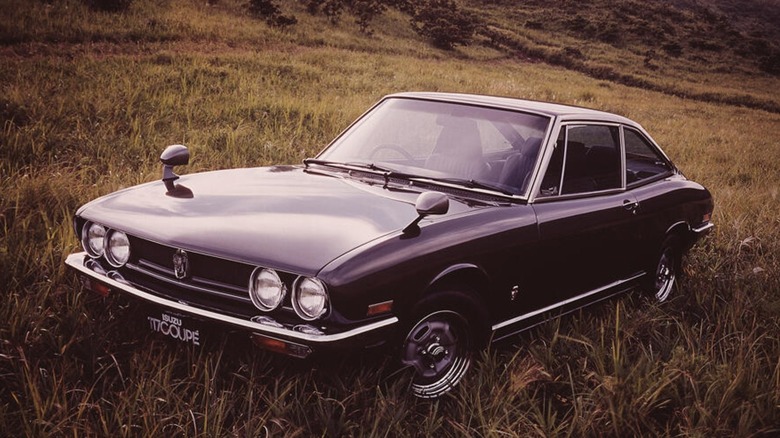
An Isuzu sports car that's also beautiful? Don't be surprised when you also hear that Giorgetto Giugiaro's hand penned the timeless. Yes, it's reminiscent of the Fiat Dino, one of our favorite Fiat cars ever made, but that isn't by accident. Giugiaro was working at Bertone at the time of the Dino's conception — and Bertone was the company that designed Fiat's stunning Ferrari-powered classic.
Unfortunately, Isuzu didn't have the luxury of collaborating with a supercar manufacturer, so it instead equipped the 117 Coupé with a 1.6-liter four-cylinder. Still, it had twin cams and two carbs, resulting in solid 120 horsepower and a top speed of 118 mph. Later, Isuzu upgraded the 117 Coupé to a 1.8-liter engine with 138 horsepower, which offered very respectable performance for its time, like a 0-60 time of 8.6 seconds. Still, the most peculiar engine option was the 2.2-liter naturally aspirated diesel from GM. It produced just 72 horsepower and leisurely accelerated to 60 mph in 19.8 seconds. Yikes!
Isuzu's move wasn't too surprising; the 117 Coupé was an affordable mass-produced car, after all. This also means corners were cut in some places, and the biggest one was a live rear axle with leaf springs. But most classic cars are flawed. The difference is that the 117 Coupé looks like a million dollars, and, with the right engine, can put a smile on anyone's face. Just make sure you snatch one soon, as prices have been climbing lately. Currently, even the cheapest 117 Coupé examples are priced at around $21,000.
Nissan March/Micra Super Turbo (1989)
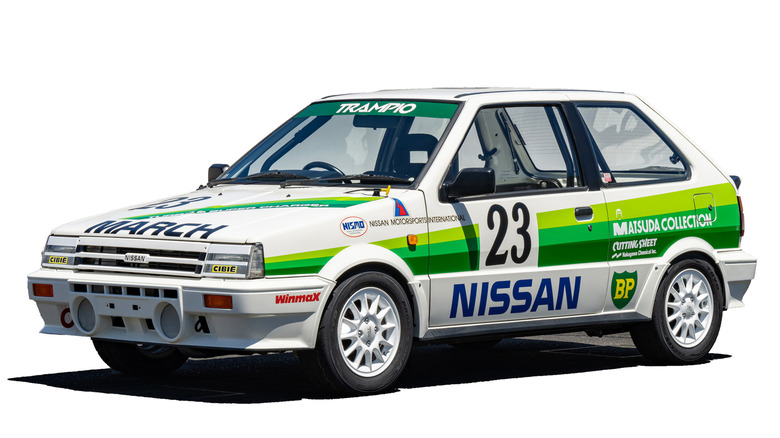
The 1980s were the turbo era for F1 cars, supercars, hot hatches, and even family cars. But there was also so much turbo lag, so drivers would be waiting for seconds before anything actually happened on these machines. So, by the end of the decade, Nissan punched the throttle on a novel idea — putting a supercharger and turbocharger on one tiny engine to kill turbo lag. Yes, Volkswagen later popularized the layout, but Nissan beat it to the punch by almost two decades! And the result was, frankly, astonishing. The 930 cc four-cylinder engine produced 110 horsepower, which doubled the standard engine's 52 horsepower output. That allowed the Nissan Micra Super Turbo accelerated to 62 mph in just 7.7 seconds, allowing it to rival the Renault 5 GT Turbo.
Oh, but it gets better. The March Super Turbo was a homologation special that borrowed the twin charger tech from race cars in Nissan's 1987 March Little Dynamite Cup Race. Nissan built 10,000 units to homologate the car for its rally endeavors, equipping each one with a limited-slip differential on the front wheels and front disc brakes. A five-speed manual was also standard, and many luxury amenities were optional. Since it's rare, finding one is challenging, though one was offered for $18k at Bring a Trailer auction in 2023.
Suzuki Alto Works (1987 to 2000)
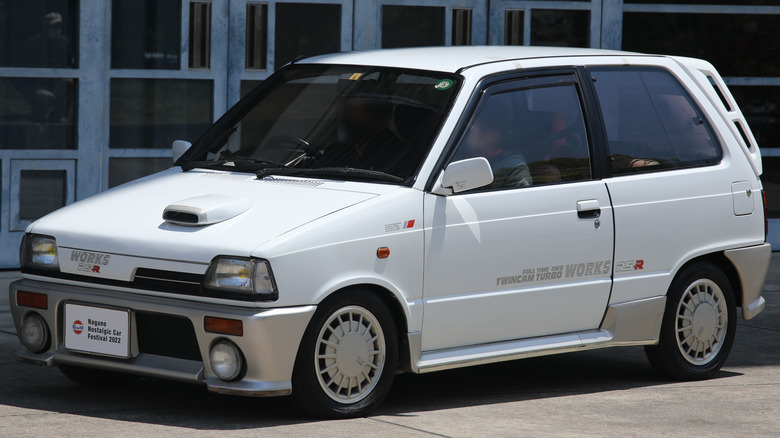
A go-kart with a rally twist sounds impossible until you have a closer look at the 1987 Suzuki Alto Works RS-R. It's just 125.8 inches long and packs a tiny 543 cc turbocharged three-cylinder — and it even comes standard with AWD. Yes, it has only 63 horsepower, but that's only because of the Japanese kei car limitations; manufacturers refused to go above 64. The second-gen model, introduced in 1990, was also limited to 63 horsepower, although it had a larger 657 cc turbocharged three-cylinder engine.
Still, because Suzuki opted for an iron block and a dual overhead design, the newer engine could be easily tuned to 120 horsepower, turning the Alto Works into a true pocket rocket. And despite being a turbocharged engine, Suzuki's popular F6A can rev as high as 9,500 rpm. From 1994, Suzuki equipped the three-cylinder with an aluminum block, so it's not as tunable, but still a blast to drive.
Oh, and you don't have to go with the heavy 1,565-pound weight rating of the AWD models. Most versions (like this Suzuki Alto Works RS-Z hot kei hatch) were front-wheel drive, which kept the weight to just 1,433 pounds. As a result, it's quicker to 60 than the AWD model (9.9 seconds vs 10.4 seconds). Still, both came standard with a five-speed manual, adding to their appeal. To top it all off, well-maintained Alto Works models start at around $6,000 in Japan.
Honda City Turbo II Bulldog (1983 to 1986)
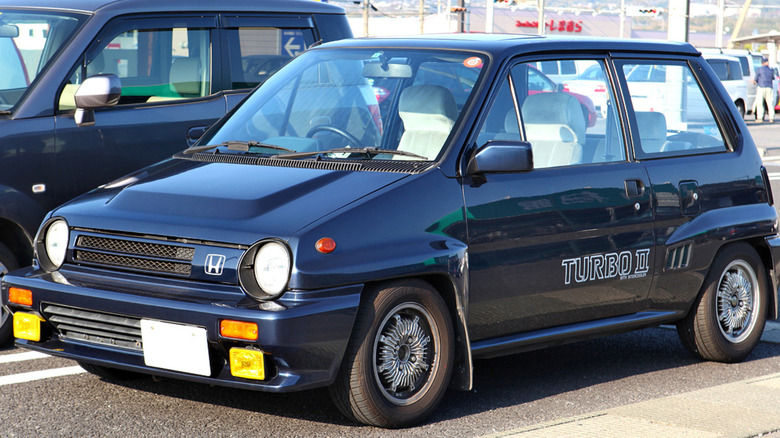
Next on this list is another 1980s Japanese hot hatch. Don't call it a kei car, though, because it's bigger and houses a significantly more powerful engine than what was used for that category. The 1.2-liter turbocharged and intercooled four-cylinder produced 108 horsepower and was paired exclusively with a five-speed manual. Those specs helped it accelerate to 60 mph in 8.3 seconds, which was an outstanding figure for its time.
What makes the Turbo II special, though, is the aggressive design. The first-gen model was already potent, producing 99 horsepower from the same engine, but apart from some stickers, it looked like the regular City. The Turbo II, however, boasts a wide-body makeover with side vents in the rear. And because it's only 134.6 inches long, the wider fenders give it a decidedly chunky appearance. That's where its "Bulldog" nickname actually comes from.
The wider track, along with the all-independent suspension, gave the City Turbo II good handling characteristics. Although it was designed as a performance-oriented model, Honda didn't skimp on equipment; you could find models with air-conditioning and even an in-dash beverage cooler. The City Turbo II is also affordable, as a showroom-fresh 1983 Honda City Turbo II was sold for $21,000 at a Cars & Bids auction together with a Honda Motocompacto scooter.
Peugeot 106 GTi/Citroën Saxo VTS (1997 to 2003)
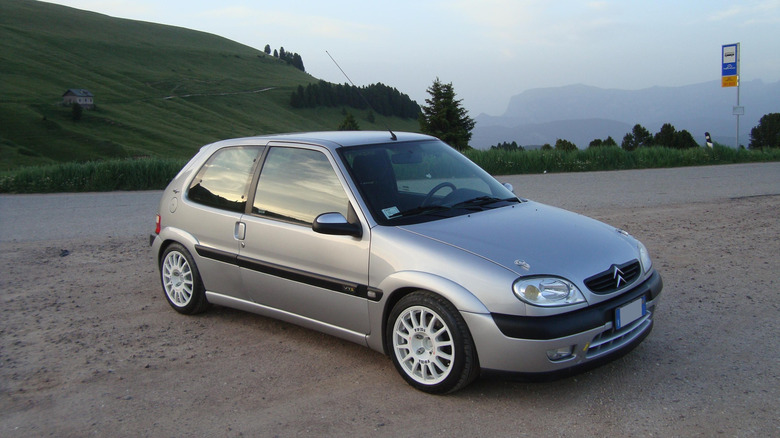
Europe had its fair share of tiny hot hatches, too. While many became mythical, some were unrightfully forgotten — such as the Peugeot 106 GTi and Citroën Saxo VTS twins. They're front-wheel drive cars, yes, but they're still infinitely adjustable under throttle. Just remember that you should do the opposite of what you'd do in a RWD carand you'll be rotating these models like go-karts on any road.
The fact that the 106 GTi and Saxo VTS were both equipped with a naturally aspirated 1.6-liter engine only enhances the experience; it was rated to produce 118 horsepower. Yes, that's not much by today's standards, but the French pair weighed around 2,000 pounds, so 0-62 mph took just 8.7 seconds — and top speed went as high as 127 mph.
What's easy to love the most about these twins is that they were based on the entry-level offerings from both companies, and that helped make them cheap to buy new. You could really dream of owning one as a kid, making them that more special. The same holds true today, with some examples of these models only going for around $6,500 today.
Holden Monaro GTS 350 (1968 to 1974)
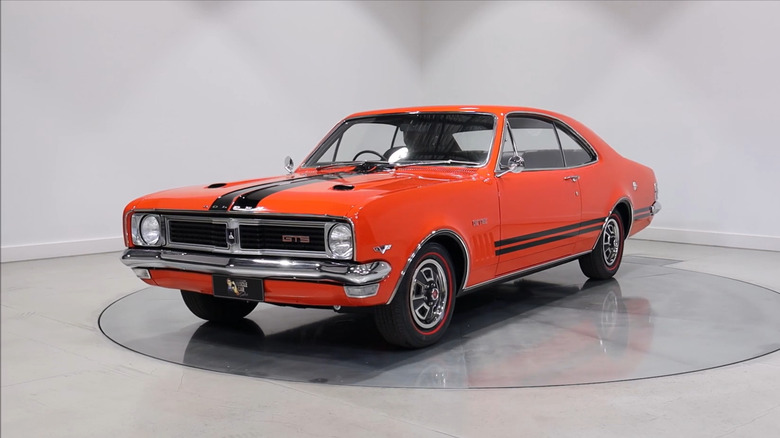
Unsurprisingly, with so many classic American muscle cars flooding the market, the Holden Monaro GTS 350 from Australia isn't a known quantity in the U.S. But it should be, because it offers a different flair of the traditional formula — a potent V8 engine and rear-wheel drive. The engine in question is Chevy's 5.7-liter V8 that produced 300 horsepower and 380 pound-feet of torque. The eagle-eyed among you will notice that these numbers are similar to the 1969 Chevrolet Camaro SS-350, but the Monaro GTS 350 was about 200 pounds lighter than its American cousin. So, when equipped with the standard four-speed manual, it sprinted to 62 mph in just six seconds compared to Camaro's 6.5-second time.
But the Aussie muscle car was also a homologation special for Bathurst, so it also had a more sophisticated suspension than the Camaro. To handle the engine's torque, Holden opted for a Salisbury 10-bolt rear axle with a limited-slip differential, and it even included cooling for the brakes. As a result, it handled significantly better over bumpy roads. Unlike most cars on this list, the Monaro GTS 350 is a genuine blue-chip collectible that's priced accordingly. Pristine samples cost more than $160,000, but models equipped with Holden's smaller 308 cubic-inch V8 can come significantly cheaper with prices closer to $70,000.