

New Car Sales Are Booming For The Rich, Falling For Everyone Else
Good morning! It's Tuesday, January 6, 2025, and this is The Morning Shift, your daily roundup of the top automotive headlines from around the world, in one place. This is where you'll find the most important stories that are shaping the way Americans drive and get around.
In this morning's edition, the middle class can no longer afford new cars, Volkswagen and Audi had a brutal fourth quarter, Lucid is showcasing the robotaxi it built with Nuro and Uber, and Mercedes-Benz is set to offer an advanced driver-assistance system on U.S. city streets.
1st Gear: New cars are no longer for the middle class
I know that because of politics, the phrase "middle-class" has been reduced to a nearly meaningless buzzword, but stick with me, because things are bleak when it comes to new car buying. Because of ever-increasing car prices, middle-class consumers are more likely than not to shy away from new vehicle purchases in 2026.
New car sales are projected to decline to 15.8 million vehicles in 2026, and that represents the first annual drop since 2022. Hell, they were even slowing down toward the end of 2025. It's largely due to soaring prices, so as you may have imagined, the rich aren't really impacted. New car sales have soared 45% among high-income households since 2019, but they've dropped 30% for folks earning less than $75,000 per year. From the Los Angeles Times:
The main culprit [for this decline] is nervousness among consumers making less than $150,000 a year who've pulled back because prices have simply gotten too high, underscoring broad consumer angst around the cost of living that persisted throughout 2025. Cox expects the trend to continue this year, forecasting auto sales of 15.8 million vehicles, which would mark the auto industry's first annual drop since 2022.
The outlook reflects how growing economic inequality is changing the auto industry. New-car sales have soared 45% among households with annual incomes of $150,000 or more since 2019, according to Cox. Yet they've plunged 30% in the same period for those earning $75,000 or less, while sales dropped 7% among families with incomes between $75,000 and $150,000.
[...]
Fears that duties would drive prices even higher fueled a sales surge early last year before the levies took effect. Yet the import taxes haven't yet pushed up stickers, in part because automakers are largely absorbing the higher costs and due to moves by the government that have provided carmakers with some relief.
Tariff-driven price hikes would only add to the industry's affordability challenge. S&P Global Mobility forecasts sales will decline to about 15.9 million vehicles this year, citing cautious consumers and the potential that carmakers will adjust pricing as the main culprits.
Outside of tariffs, there are a few factors driving up prices, such as a lack of smaller, entry-level offerings (which many of us sorely miss). These companies are also, very simply, producing fewer cars. Since there are now fewer cars on dealer lots, they're less inclined to offer rebates or negotiate on prices.
Of course, none of this matters if you make a lot of money, but some of us were born handsome, not rich, and that's our cross to bear.
2nd Gear: VW, Audi are going through it
Man, Volkswagen and Audi cannot catch a break. VW's sales in America just plunged 20% in the fourth quarter — the final indignity in a brutal year for the German automaker. Every single VW model other than the ID Buzz (which has been put on hiatus for the 2026 model year) posted a sales decline in Q4. Jetta sales collapsed 44%, Atlas was down 21%, Taos dropped 9.5% and the Tiguan fell 2.6%. Overall, just 82,798 VWs found new homes in the quarter.
Things were even worse at Audi, where sales slumped 36% to 36,233 units during the fourth quarter. It was the third consecutive quarterly decline for VW and the first yearly decline since 2022. In 2023, Audi set a U.S. sales record, but its volume dropped 14% in 2024. All in all, Audi's 2025 sales dropped 16%. From Automotive News:
VW raised starting prices on most 2026 models as the import-reliant brand grappled with President Donald Trump's tariffs. Audi also implemented hefty price increases across its portfolio.
[...]
The Audi decline followed a flat third quarter that was buoyed by electric vehicle sales prior to the expiration of federal tax credits.
All of Audi's EVs posted double-digit declines in the fourth quarter except for the new A6 E-tron and Q6 Sportback E-tron.
The redesigned Q5 crossover led Audi volume in the fourth quarter but sales were still down 23 percent.
[...]
[Audi's] fourth-quarter sales volume was the lowest since the first quarter of 2022, at 35,505, according to the Automotive News Research & Data Center. Audi's annual total was the lowest in over a decade.
I'm not sure how VW — or especially Audi — pulls itself out of this. As we just discussed, the rich aren't having any trouble buying new cars, so it would seem Audi just really needs to step up its game when it comes to what it's offering. When you look at the electric iX3 and GLC EV coming from BMW and Mercedes-Benz in a few months, it's hard to argue Audi has anything that can compete.
3rd Gear: Lucid, Nuro, Uber unveil Gravity-based robotaxi at CES
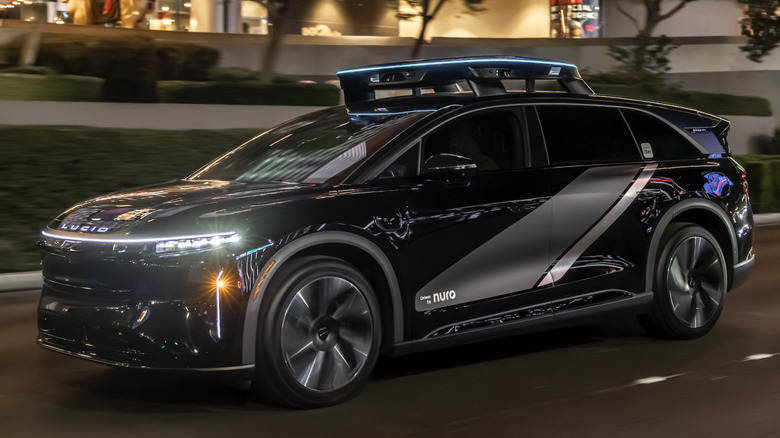
Lucid, Nuro and Uber are one step closer to making their jointly developed robotaxi a reality by unveiling the Gravity-based vehicle at CES in Las Vegas. The big crossover with a roof-mounted sensor "halo" of integrated cameras, lidar and radar is aimed squarely at Alphabet's Waymo and Elon Musk's Tesla robotaxis.
It uses Nuro's Level 4 autonomous system, which is capable of operating without human intervention under defined conditions, and it runs on Nvidia's Drive AGX Thor computing platform. Uber designed the in-cabin experience, which uses screens to allow riders to control the air conditioning, seating, entertainment and contact support if something goes haywire. From Reuters:
The testing program combines real-world driving, closed-course testing and simulation to validate safety before commercial deployment. Production of the robotaxi is expected to begin later this year at Lucid's Arizona factory, pending final validation.
Uber, which sold its self-driving unit to Aurora Innovation in 2020, has since repositioned itself as a platform partner for a slew of developers of self-driving technology. It has signed multiple deals to bring robotaxis onto its app rather than owning the technology outright.
For Lucid, the project represents a bid to diversify beyond consumer electric vehicles, as the luxury EV maker grapples with slowing demand in the U.S. EV market, heavy cash burn and intensifying competition. The company earlier in the day reported 2025 deliveries slightly above estimates, with production far outpacing sales.
The companies say on-road testing began in December of 2025, and the effort was led by Nuro, using engineering prototypers supervised by safety operators. The plan is to move toward a robotaxi launch in the San Francisco Bay Area later this year.
Listen, I can't say how well the autonomous aspects of this system will work, but I can tell you for sure that a Lucid Gravity will make for a far more pleasant robotaxi than a Tesla Model Y or Jaguar F-Pace.
4th Gear: Mercedes readies advanced driver assist system for U.S. city streets
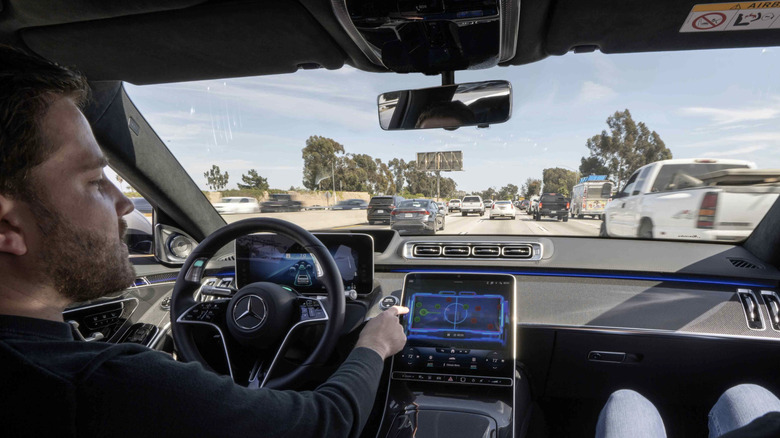
Mercedes-Benz says it's getting ready to launch a new advanced driver-assist system in the U.S. later this year that is meant to allow cars to operate autonomously on city streets with driver supervision. The system — called MB.DRIVE ASSIST PRO — will enable the vehicle to be driven from a parking lot to a destination, navigating city intersections, making turns and obeying traffic lights, all while not killing anyone. It sure sounds like it's meant to compete directly with Tesla's Full Self-Driving software, but, because it's Mercedes and not Tesla, I've got a lot more faith in it. From Reuters:
The system will cost $3,950 for three years in the United States. Customer can also choose on a monthly or yearly subscriptions, but the pricing for those will be disclosed later.
Tesla's Full Self-Driving package costs about $8,000 as a one-time purchase or $99 per month as a subscription.
Most automakers limit self-driving features in personal vehicles to highways, where traffic patterns are more predictable. Cities pose tougher challenges, including pedestrians, cyclists and unexpected situations.
Tesla is the only automaker that, with its Full Self-Driving system, allows self-driving on city streets.
But like Tesla, Mercedes' system will require drivers to remain alert and ready to intervene at all times.
Mercedes' push into urban driving assistance shows how software advances are moving autonomous technology from limited testing toward commercial rollout. Safety concerns and regulation still constrain full autonomy in personal vehicles.
The system, which has been on sale in China since late last year, uses about 30 sensors, including cameras, radar and ultrasonic sensors. They feed data into a computer that can process up to 508 trillion operations per second.
Reverse: Tour group goes awry
 History.com
Ya know, January 6 was bad, but at least America learned its lesson and everyone involved with this blemish on our history was dealt with properly and is no longer in any sort of position of power. Just kidding. We're at the threshold of Hell. If ya, for whatever reason, want to learn more, head over to History.com.
Neutral: I got engaged!

Okay, I feel like saying I'm "neutral" about this isn't really true. I'm pretty damn excited. Originally, the plan was to do it in Paris on vacation, but a passport SNAFU meant we couldn't go. Still, getting engaged on New Year's Eve in the city where we've built a life together ain't half bad. Just remember, if you're going to be mean to me in the comments, you've now got my fiancée to deal with, and she's far tougher than me.
On the radio: The 1975 - All I Need To Hear
My fiancée and I love The 1975, and The 1975 loves us. This song means a great deal to her and I.