

2026 Will Probably Be Rough For Car Sales
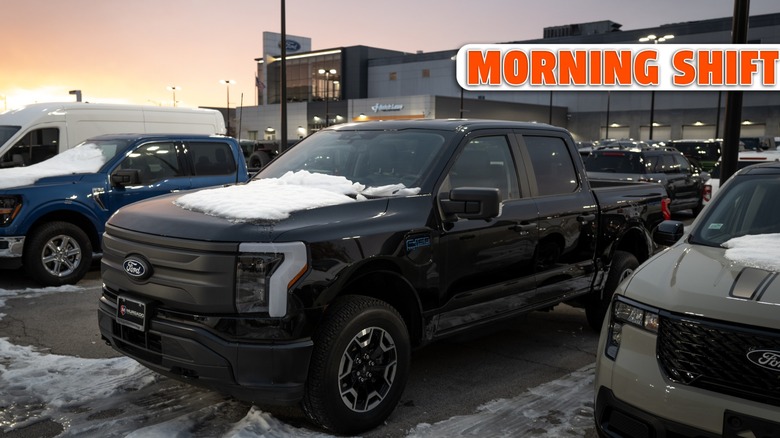
Good morning! It's Monday, December 22, 2025, and this is The Morning Shift, your daily roundup of the top automotive headlines from around the world, in one place. This is where you'll find the most important stories that are shaping the way Americans drive and get around.
In this morning's edition, new car sales are likely to take a dive in 2026 because everything is falling apart, Elon Musk becomes the first person worth $700 billion after getting his 2018 Tesla pay package, the Dodge Durango SRT Hellcat is 50-state legal once again, and tariffs are really hitting the German auto industry.
1st Gear: Don't expect car sales in improve in 2026
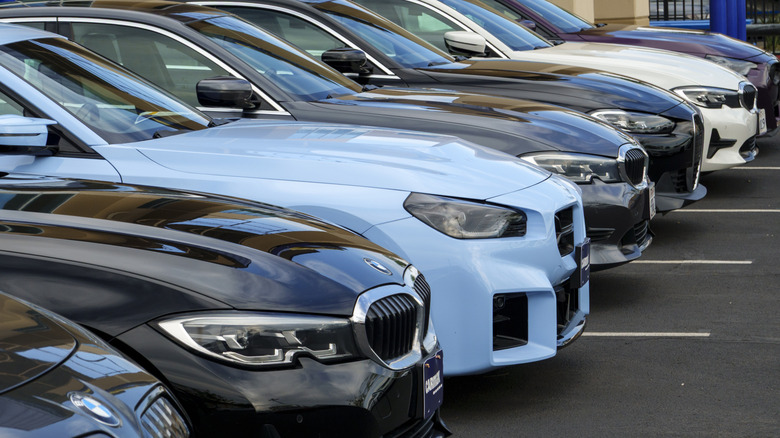
Despite the mess 2025 has been, it's slated to be a six-year high point for new-vehicle sales. Don't expect the same thing in 2026. Analysts expect sales to decline for the first time since 2022 as the industry deals with issues surrounding affordability, import tarrifs and an uncertain future for electric vehicle demand. We also can't forget that there's a lot more potential for automakers to pass more tariff costs onto customers.
Right now, forecasts range from 15.8 million sales at Cox Automotive to 16.1 million at GlobalData, and Edmunds is in the middle at 16 million. No matter how you slice it, those numbers are below the 16.2-16.3 million vehicles that'll end up shipping in the U.S. this year. From Automotive News:
The tariffs that President Donald Trump began imposing last spring and his administration's decision to cancel the federal $7,500 EV tax credit after September have been cited for pushing some consumers to buy a new vehicle sooner than they might have otherwise. That dynamic resulted in weaker sales late in the year.
"All through the third quarter, sales were strong, led by a surge in EV activity," said Charlie Chesbrough, senior economist at Cox Automotive. "But since the tax credits expired at the end of September, the sales pace has slowed, and that trend is expected to continue through the end of the year."
Cox pegged the fourth-quarter sales pace at 15.6 million vehicles, down from 16.4 million in the third quarter.
If sales are indeed down in 2026, the collapse of the electric vehicle market and tariffs will share a lot of the blame, which means a lot of the blame will be at the feet of — you guessed it — President Donald Trump.
Early data shows that about 230,000 EVs were sold in the fourth quarter, down 46 percent from the previous quarter and 37 percent from a year earlier, said Stephanie Valdez Streaty, Cox's director of industry insights. She said Cox projects full-year EV sales to be 2.1 percent lower.
"Despite Q3's record performance, the sharp Q4 pullback resulted in an overall year-over-year decline" in EV sales, she said.
EVs likely will have a tough road in 2026, particularly early in the year, said David Oakley, GlobalData's manager of vehicle sales forecasts for the Americas.
There still will be interest in EVs, including from consumers looking for another one after their lease ends, said Jessica Caldwell, head of insights at Edmunds. But sales are expected to be softer without the tax credit, because EVs will attract fewer casual buyers through attractive lease deals in 2026.
[...]
Analysts say tariffs have not raised vehicle prices as much as once anticipated, though prices remain elevated. The Federal Reserve cut interest rates three times in late 2025, and more lease returns are expected to flow into the used market, giving buyers a larger selection of nearly new vehicles.
But affordability remains a challenge. Some analysts described a "K-shaped" market, with higher-income buyers driving new-vehicle sales while less-affluent shoppers have to stretch their budgets to afford a new car or stay out of the market.
I don't have a crystal ball, so I cannot say for certain how 2026 will turn out, but it's not looking too hot right now. The simple fact is that if people cannot afford new cars, they're not going to buy them.
2nd Gear: Musk whines, makes another $139 billion
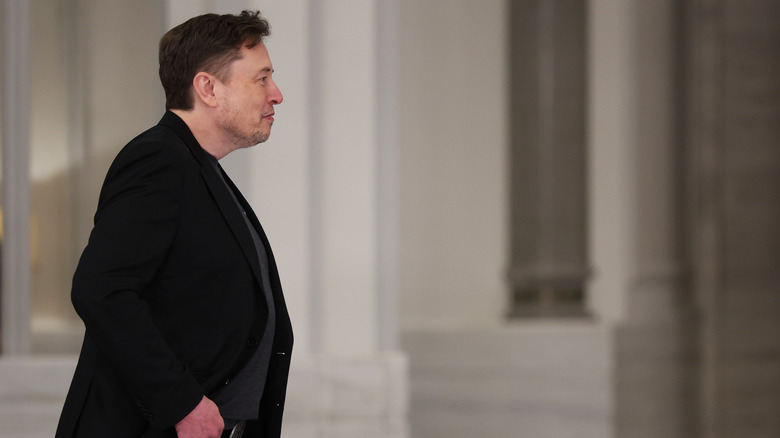
I was starting to get worried that Tesla CEO Elon Musk wouldn't become the first person in the history of the world worth nearly 3/4 of a trillion dollars, but luckily, my fears were quelled. I'd like to personally thank the Delaware Supreme Court for reinstating his $139 billion stock options pay package that was voided last year. From Reuters:
Musk's 2018 pay package, once worth $56 billion, was restored by the Delaware Supreme Court on Friday, two years after a lower court struck down the compensation deal as "unfathomable."
The Supreme Court said that a 2024 ruling that rescinded the pay package had been improper and inequitable to Musk.
Earlier this week, Musk became the first person ever to surpass $600 billion in net worth on the heels of reports that his aerospace startup SpaceX was likely to go public.
[...]
Musk's fortune now exceeds that of Google co-founder Larry Page, the world's second-richest person, by nearly $500 billion, according to Forbes' billionaires list.
Here's to Elon getting even richer in 2026. He deserves every penny, in my opinion. Luckily for me, it's the same opinion Tesla's board has, since they approved his $1 trillion pay package back in November. I'll pray for it, Elon. I really will. You deserve this. You are my hero, and I love you.
3rd Gear: Everyone can get a Durango SRT Hellcat again
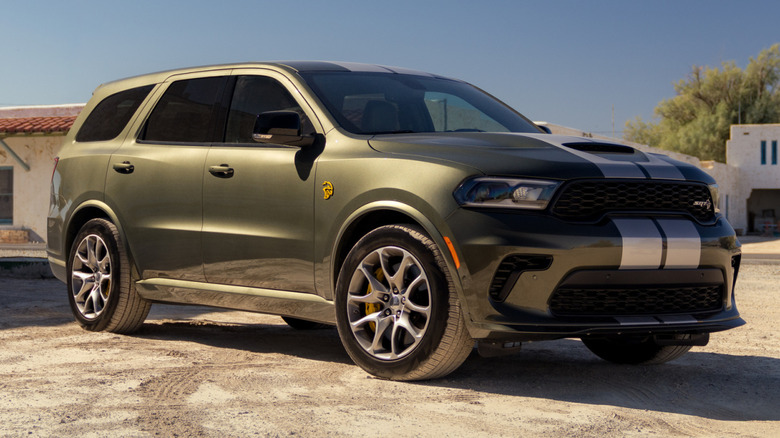
Good news, lunatics! The Dodge Durango SRT Hellcat is 50-state legal once again. Previously, buyers in California and other CARB-aligned states were barred from ordering Durangos with the SUV's high-output 392 V8 or the supercharged Hellcat. That meant 18 states and Washington, D.C. didn't have access to the 392 or Hellcat. There's no word on how Dodge got the Hellcat to meet emissions rules, but we can probably assume there were some under-the-hood tweaks done to get it over the hump. From CarBuzz:
While such a move would have been costly, it makes sense given the size of the population in those states – and the fact that demand for the Durango, despite its age (it debuted in 2011), has been rising. According to Dodge CEO Matt McAlear, Durango sales have been up for 14 months straight, a trend that should get another boost now that the Hellcat is available in more states.
The engine delivers 710 horsepower in the 2026 Durango SRT Hellcat, which starts at $80,590. The lineup also includes a 5.7-liter V8 good for 360 hp, starting at $43,290. Buyers seeking better efficiency can opt for the 295-hp 3.6-liter V6, with a starting price of $38,995. All prices include a $1,995 destination charge.
Dodge said the full 2026 Durango lineup will be legal in all 50 states and that means the 392 V8, too. The engine is found in the Durango R/T, where it makes 475 hp, but that trim won't be available to order until the first quarter of 2026. Dodge has previously said the 2026 Durango R/T will be priced below $50,000.
[...]
Not long ago, Stellantis was gearing up to phase out the V8 in light vehicles, replacing it with hybrid and electric powertrains. Brands like Dodge and Ram even rolled out special-edition models to bid farewell to the V8. Thanks to changes in emissions rules under the Trump administration, however, the automaker has given the V8 a stay of execution. We also know a next-generation Durango is expected around 2029 – and don't be surprised if it packs a V8 as well.

So, if you were hankering for a high-powered V8 Durango, it sure seems like Christmas came early this year. For everyone else, I'm sorry your neighborhood just got louder.
4th Gear: Tariffs slam the German auto industry
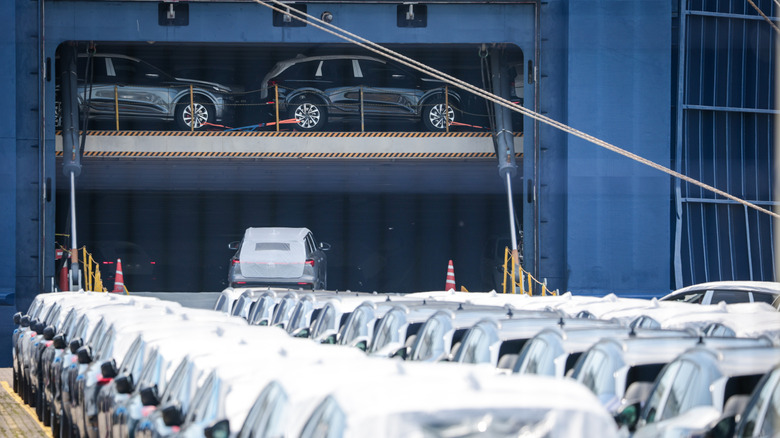
The German auto industry is hurting right now, and a big reason for that is a 14% drop in exports to the U.S. over the first three quarters of 2025. That number makes it the hardest-hit sector of German industry in President Trump's ill-advised trade war. Right now, all German-made cars are hit with a 15% baseline tariff, which is actually lower than the inital 25% tariff Trump proposed on top of an existing 2.5% levy. From Reuters:
German engineering companies have also struggled under the tariff regime, with the study showing exports in that sector to the U.S. declining by 9.5% in the first nine months of 2025.
Machinery exports are subject to a 50% U.S. tariff on steel and aluminium products.
The chemical industry also saw exports to the country's top export market decline by 9.5%, although the report said this could not be blamed solely on tariffs.
"Other factors are likely to have played a role in the case of chemical products, such as lower production in Germany due to higher energy prices," it said.
[...]
"Since it must currently be assumed that U.S. import tariffs will not return to pre-Trump administration levels in the foreseeable future, a significant recovery in German exports to the U.S. is unlikely," study author Samina Sultan said, referring to a "new normal" for German exporters.
Across all manufacturing sectors in Germany, exports to the U.S. were down 7.8% year over year through the first three quarters. That's not great, but it's even more distressing for ze Germans when you consider the fact that it follows an average growth of newaly 5% in comparable periods between 2016 and 2024.
Reverse: This son of a gun
 History.com
My God, this guy really ruined air travel for everyone. I mean, non-precheck air travellers *just* started to go through security without taking their shoes off. I hope Reid is happy, that bastard. Anyway, if you want to learn more about this idiot, head over to History.com.
On the radio: Paul McCartney - Wonderful Christmastime
I know "Wonderful Christmastime" isn't for everybody, but I don't know, man. I like it. It makes me happy, and I think it's the perfect way to kick off the week of Christmas. We're so close, and I hope you were able to waste some key work time today by reading The Morning Shift.