

7 Road Signs That Leave Drivers Confused, Befuddled, Dazed, And Perplexed
Urban design in the United States is incredibly car-centric, whether we like it or not. Just about everything is built around automobiles, and you need one to get just about anywhere. So, the chances are that if you grew up in the States, you've been driving since you were 16 or younger, and you've likely seen hundreds of thousands of road signs in your life — maybe even millions. But do you know what every single one means and how best to respond to each possible sign you could encounter while out driving? Do you know what Adopt-a-Highway signs really mean?
The answer might be yes, but there are some deep-cut signs out there that can leave even experienced drivers reeling. Say nothing of the drivers who are, shall we say, less than confidence-inspiring. From signs where green doesn't quite mean "go" to signs with a lot of words of above-average length, we've gathered a few of the most confusing, befuddling, and perplexing road signs you're likely to encounter while out roaming on American streets. How many of these do you recognize at first blush? And do you know what they really mean, or do you just fake it well enough to make it through your day on good judgment and care behind the wheel?
You're telling me an aircraft enforced this speed limit?
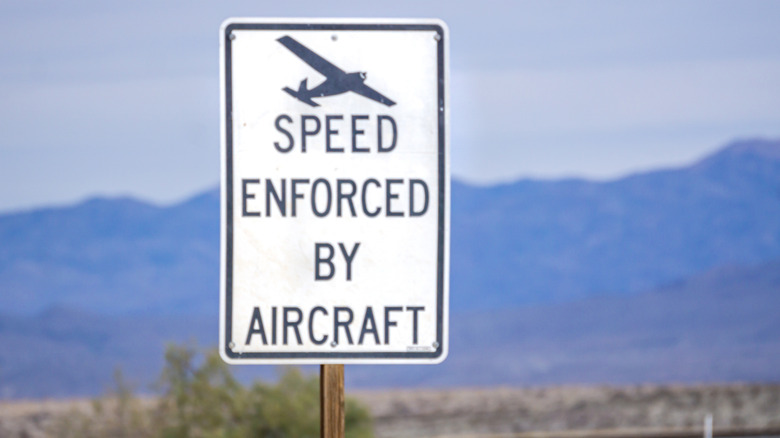
This first sign isn't exactly rare, but that doesn't mean the average driver — or even an experienced one, for that matter — knows precisely what it means. Along many highways, you'll find signs featuring an image of an airplane that read "Speed Limit Enforced By Aircraft." What do you imagine when you pass by one? You could be forgiven for conjuring an image of a fighter pilot tracking your speed down to the tenth of a mile per hour, but the reality is much less dramatic.
Typically, the way police use an aircraft to enforce the speed limit involves two parts. First, there's a spotter plane (or sometimes a helicopter), which does indeed fly in the air over the highway, and a cop in a car some distance away. The spotter plane can time when a car crosses into and out of a given section of road and uses the elapsed time to determine the average speed of the car. If it's over the speed limit, the pilot radios down to the boots on the ground to issue a ticket. Other times, pilots identify potential offenders by eye and verify their speed by flying overhead and matching speed.
This practice isn't necessarily as common as it used to be, though. Speed detection technology has improved in recent decades, making aircraft tracking less economical and high-effort than other methods. With gas prices these days setting new record highs, the cost becomes even harder to justify. That said, if you see a sign, beware that you may still, in fact, be monitored from above, whether you can see the aircraft or not.
When green doesn't exactly mean go
One of the first things new drivers learn — if they somehow haven't learned it already through years of cultural messaging, games, and general education — is that a red light means "stop," and a green light means "go." And yellow? Well, depending on whom you ask, it might mean "slam on your brakes and cause an accident," "speed up and possibly still cause an accident," or maybe even "just pretend it is green; who cares if it turns red before you get there?"
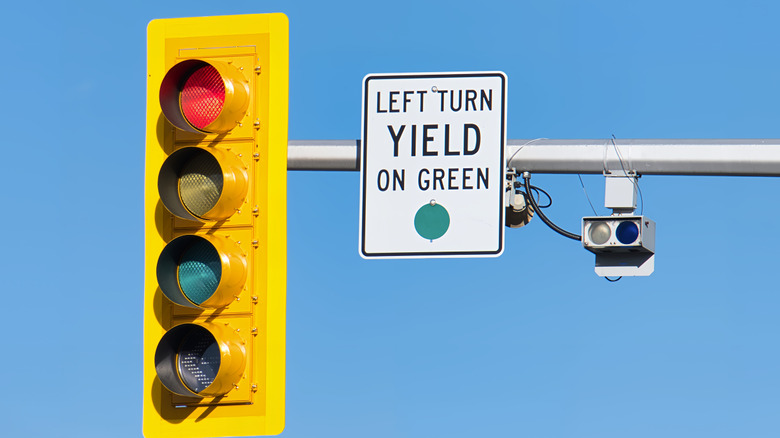
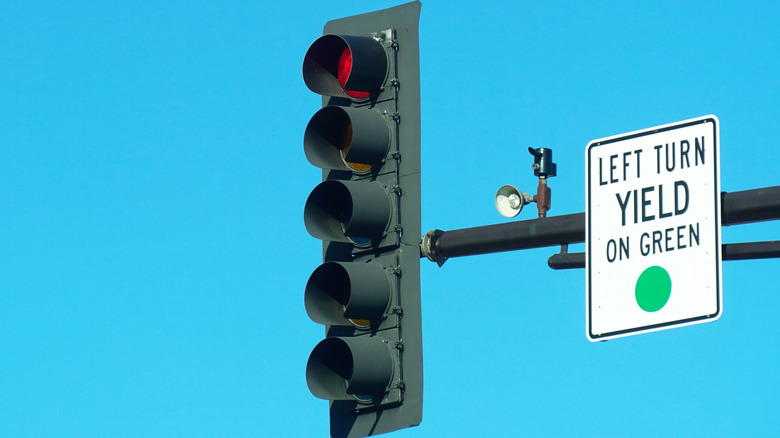
Generally, the color coding of green meaning "go" and red meaning "don't" is pretty universal. It even translates to things like stop signs, railroad crossing lights, and turn arrows. However, "Left Turn Yield On Green" signs are accompanied by a big green circle as a visual indicator, but they distinctly don't mean "go." It's kind of weird.
You'll usually find these signs at intersections with unprotected or partially protected left turns. They're there to indicate that making a left turn is allowed without having to wait for a solid green arrow, as long as the driver watches out and yields to oncoming traffic before turning. Not every green light means that left turns are safe, so these signs aim to clarify that you don't need to wait for a green arrow if one is present on the light post. While the meaning behind this one is pretty straightforward, it can still be confusing to see that green signage and read instructions to yield. As if unprotected left turns weren't already annoying enough.
You need special exercises to combat soft shoulders
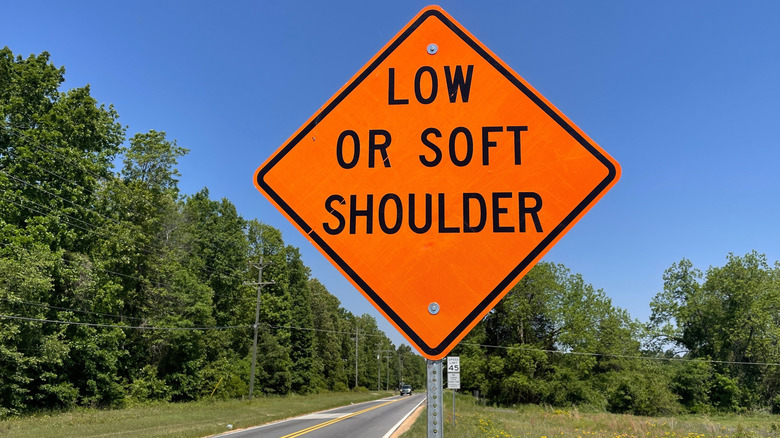
If you're hurtling down the road and see a sign that says "Soft Shoulder," don't worry. It's not necessarily trying to guilt you into going to the gym more often or to make you successfully do a push press. Soft Shoulder signs are actually very important warnings. The shoulder of a road is the edge of the road outside of a lane. Sometimes the shoulder is reserved for buses or emergency vehicles. Typically, it's paved, and it may be fitted with rumble strips to warn drivers that they're drifting off the road. When a shoulder is unpaved, though, it's called a soft shoulder, and it can be dangerous for an unprepared driver. Soft shoulders are usually made of packed dirt, sand, or gravel, and they aren't as even as the road.
If a car's wheel drifts over to a soft shoulder, it can cause the car to veer, swerve, or get pulled off the road. This loss of control is dangerous at all speeds, but the consequences are typically worse the faster you're going. Soft Shoulder signs are there to warn drivers that the terrain might not be as expected. Failing to heed such a sign could result in serious injury, so don't take this one lightly.
Bridges are dangerous, y'all
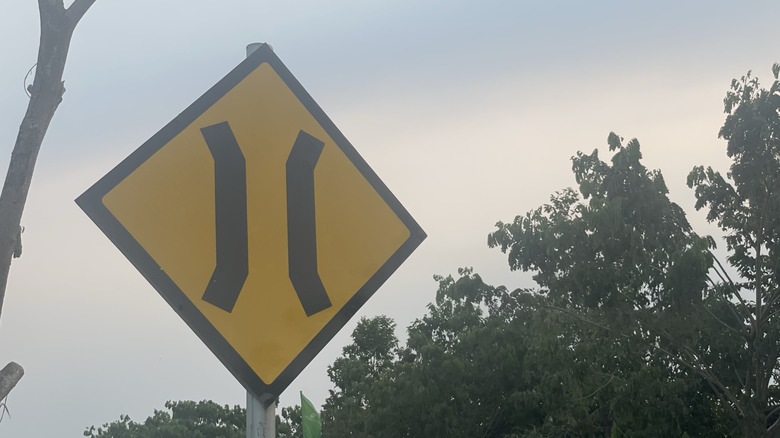
Shoulders aren't the only potentially dangerous parts of a road, of course. Bridges can also cause a headache (or much worse), so it's important to respect the message of a narrow bridge sign. Some of these "Narrow Bridge" signs are obvious, with the words painted right there for the whole world to see, but others are a little more opaque. These pictographic signs usually show thick black lines representing the edges of the road coming closer together, or they may depict the division between lanes in a way that reminds us of the Cool S.
Even if the bridge ahead doesn't look all that narrow, it's important to exercise caution. Sometimes, the roadway won't visibly narrow, but that doesn't mean you're working with the same amount of practical space. For example, the guardrails around bridges can leave less functional space even when the width of the pavement stays the same, giving the road the illusion that the bridge isn't actually narrow. You'll want to play it safe.
Take it from someone who was riding in the passenger seat when their friend tried to pass an oversize load on a narrow bridge on I-80 in Nebraska: Space gets tight fast on bridges, and the threat of being crushed by a semi-truck really does cause your life to flash before your eyes. We made it through unscathed thanks to quick reflexes, but at least I might have had the honor of dying on one of Nebraska's awesome electrically conductive snow-melting bridges, I guess.
Exactly how low are your vehicle's emissions?
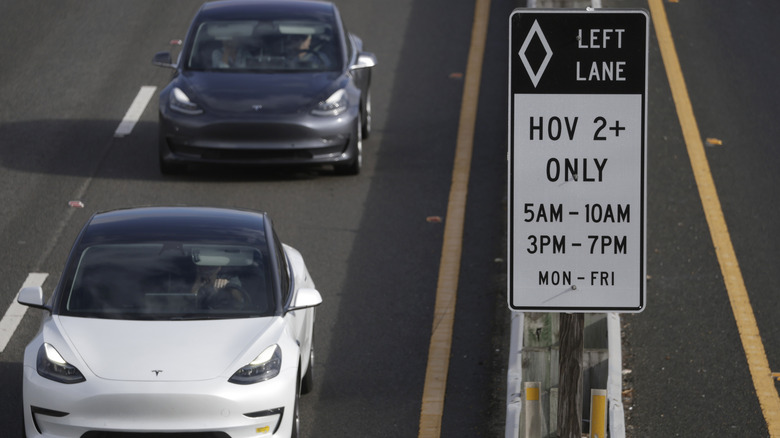
As if high-occupancy vehicle (HOV) lanes weren't already confusing enough with their part-time rules, variable lower limits on the number of passengers, really long signs with instructions, and their weird striping. Now, we poor drivers have another factor to contend with in the form of "Inherently Low Emission Vehicles Allowed" signs. It's only five more words to consider when weighing whether you're allowed in the HOV lane, but it's a bit of a head-scratcher.
First of all, "inherently" is just a weird and unusually long word to see on road signs, which are, you know, meant to be simple for ease and speed of understanding. Second, "low" is an inherently — there's that term again — relative classification. It has to be used in comparison to something else. Since emissions are directly linked to gas mileage, does a Chevy Malibu (R.I.P.) that gets 36 mpg on the highway have inherently low emissions compared to a big rig? Is a Hummer EV that gets 46 MPGe low on emissions when compared to a 142-MPGe Lucid Air?
The definition is pretty intuitive, thankfully. According to federal regulations, inherently low-emission vehicles, a are those that "don't vent fuel vapors to the atmosphere" within some technical limitations. This includes all fully electric vehicles, but can also include plug-in hybrid and battery hybrid vehicles. It also includes cars that use other alternate fuels, such as hydrogen cars like those Jack Nicholson was sporting before it was cool. While these signs are pretty limited for now, we may end up seeing more of them across the country before long. Especially now that Democrats' big win is complicating Trump's disastrous emissions plan, EVs and other alternative-fueled cars may just be back on the menu big time. Let's hope for more fuel-efficient, affordable, zero-emissions cars and fewer flying Teslas.
Some signs just want your attention
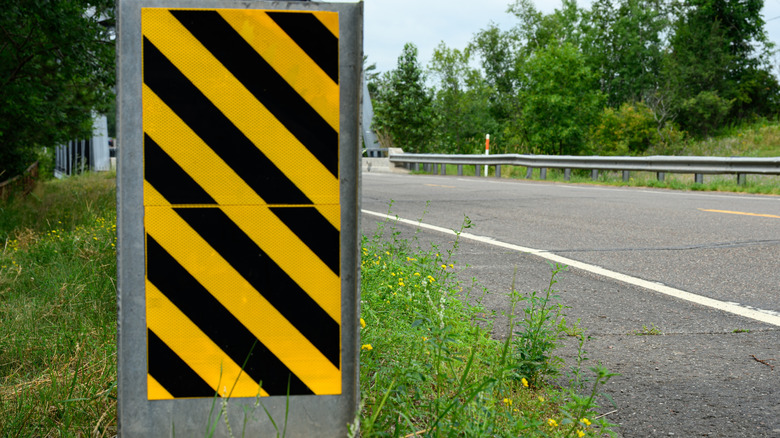
We've all seen them, and they keep us safe, but does anybody actually know what those signs with the yellow and black stripes are actually called? And what are those diagonal stripes in Wiz Khalifa's favorite colors actually telling us? If you didn't already know, these yellow-and-black road signs are known as "object markers," and their purpose in life is pretty straightforward: to mark objects. You'll often find these at the ends of guardrails, near outcroppings of rock, and near columns or support structures. Sometimes they're used to mark conditions instead of objects, despite their name. That means you might find them marking drop-offs, shoulders, and other changes in the road.
There are actually a few different kinds of object markers, not all of which are striped. The striped ones are called Type 3 markers, and they can also come with black-and-yellow chevrons (also Type 3). Other object markers can have several reflective yellow dots with a yellow or black background in the shape of a diamond (Type 1), or three reflective dots on a small rectangle (Type 2). Some Type 1 object markers are just solid reflective yellow.
One interesting note about Type 3 object markers is that the orientation of their stripes is meant to indicate how traffic should flow to avoid the obstacle. According to the U.S. Department of Transportation's manual on Uniform Traffic Control Devices, signs with stripes starting in the upper right corner and flowing downward to the left are called right object markers and indicate drivers should pass the object on the left. Signs with stripes starting in the top left corner and flowing downward and to the right are left object markers and indicate safe passing on the right.
May you never have to deal with reverse lanes
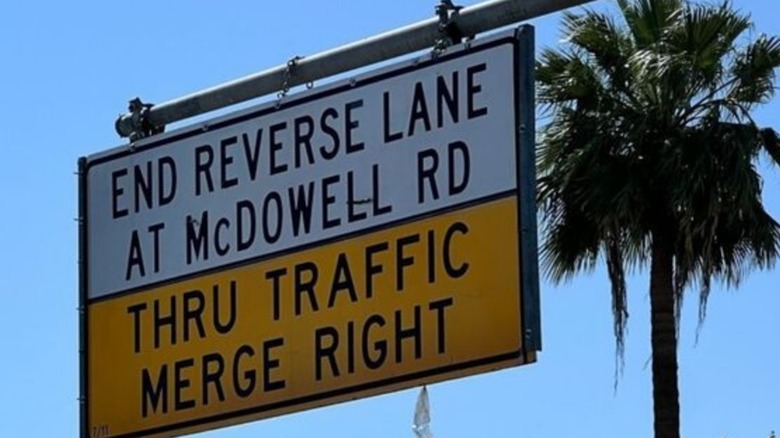
This last one is a real doozy, and I wouldn't wish dealing with it on my worst enemy — unless they cut me off while merging on the highway, in which case they deserve what's coming to them. This is the dreaded "End Reversible Lane" sign, and if you've never had to deal with one, consider yourself blessed. These signs mark the end of reversible lanes — some drivers like to call them "suicide lanes."
These capricious reversible lanes have traffic flowing in multiple directions on them throughout the day, determined by traffic needs. They're usually located near the center of the roadway, and they're kind of like overflow lanes, used to decongest traffic when it's disproportionately busy in one direction. For example, on a five-lane road, you may have two dedicated northbound lanes, two dedicated southbound lanes, and a reversible lane. Depending on the time of day, this lane may be used only for northbound or southbound traffic. Occasionally, these lanes will "end," meaning not that they go away, but that they are no longer reversible.
If you're driving down one and see an "End Reversible Lane" sign, it means you should probably think about getting over, unless you feel really passionate about going the wrong way in traffic, which we at Jalopnik definitely don't recommend.