

Nebraska Has An Electrically Conductive Bridge To Melt Snow, Why Doesn't Everyone Else?

In the spring of 2003, the town of Roca, Nebraska, opened a new bridge that included a section built with electrically conductive concrete. At 117 feet long and 28 feet wide, this section could be "switched on" to run a current through it. Since concrete isn't exactly a great conductor, that generates a lot of resistance, which in turn generates heat. That heat melts snow and ice in the winter, making for a great de-icing method that is cleaner than toxic chemicals and road salts, while also being cheap to operate at a little over $30 a day. A way to get rid of snow without gumming up the road with salts? And Nebraska's had it for 23 years? Why doesn't everybody?
The answer is the same reason we can't have lots of nice things, like biofuels and magnetically levitating trains that are faster than planes: cost. While a conductive concrete heating system is cheap to run, it isn't cheap to make. It's about twice as expensive as regular concrete, which is not conductive (via Eos), making it cost-ineffective to deploy at scale. That's even more expensive than propane-fired boiler-heated bridges, which themselves remain somewhat rare. If that initial price tag can come down, this technology has a real chance to be deployed at scale, saving rivers and groundwater from a lot of chemical contamination from road salts and other chemicals.
How to get electricity to run through concrete
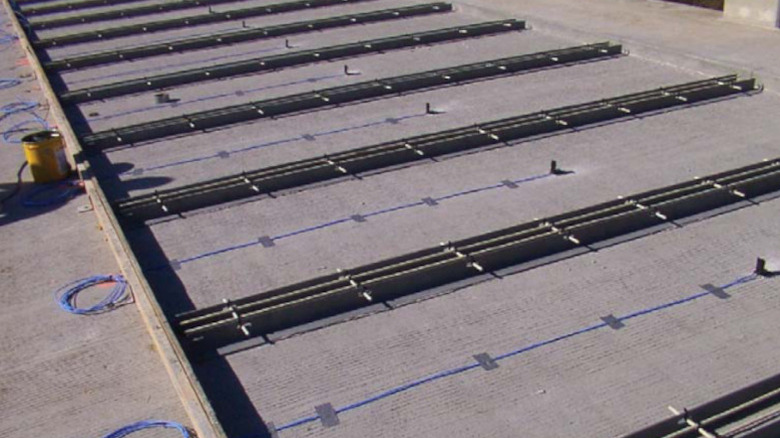
That extra cost comes down to the extra materials that need to be put into traditional concrete to make it conductive, and the difficulty of mixing it correctly. Depending on the method, these include steel and carbon fibers, steel shavings, and graphite, which all work to generate electrical resistance and heat when low-voltage electricity is applied through the concrete. However, to actually form a current, those metals must be in good contact with each other. If you have one steel shaving isolated in the concrete, it can't magically send electricity to another isolated shaving. That means the mixing process needs to be a lot more elaborate than it normally is. All of this adds up in price.
For that reason, the Roca Spur Bridge in Nebraska was only a field test of the conductive concrete heating system, a way to measure its effect and real-world utility. The system works fine, but the real measure of its success — or lack thereof — is how much other infrastructure copied it. The answer is: not much. Globally, there are only six full instances of conductive concrete deployed in the world – four in the U.S. and two in China.
But even beyond price, conductive concrete has a few other issues to get through before it's ready for mass deployment. The lower the temperature is, the more electricity needs to be drawn to heat up the concrete surface. At low levels, electricity is relatively cheap, but if there were an extended cold spell, the cost of using conductive concrete would come a lot closer to the de-icing chemicals it's meant to replace. Research is actively underway to try to make the upfront cost of this technology more affordable, so hopefully there's a breakthrough soon.