

2026 Audi Q3 And Toyota RAV4 PHEV Underperform In IIHS Updated Moderate Overlap Crash Test
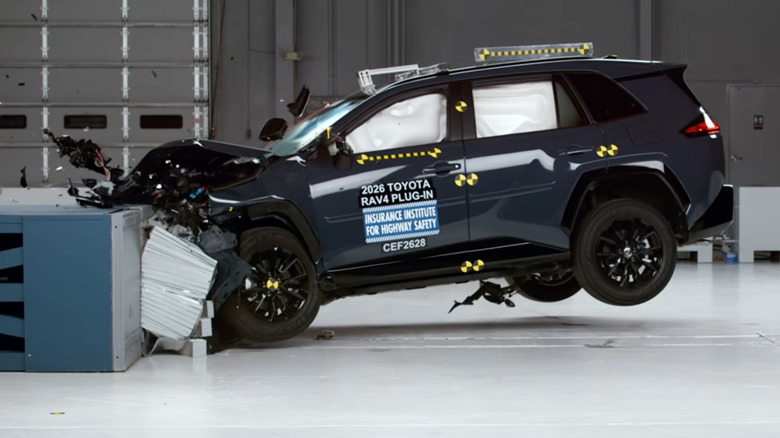
You may think that all modern cars offer unimpeachable protection for their occupants in the event of a crash, but there's more variance and nuance in modern crash safety than you might be aware of. The Insurance Institute for Highway Safety or IIHS, published its first crash test ratings 30-years ago, in the year I was born, 1995. In those early days, its tests were criticized by automakers for being too severe, and yet those same automakers ended up building safer cars that aced the same tests just a few years later.
As the American automotive landscape continues to evolve, the IIHS has evolved its tests, too, with the introduction of updated tests, like the new whiplash prevention test, the updated moderate front overlap test, and the updated side impact crash test that the 2026 Cadillac CT5 recently failed spectacularly. The tests conducted by the IIHS are extremely specific and controlled scenarios, but they establish an objective baseline by which to measure many areas of crash protection. The updates in IIHS tests over the years have uncovered new areas of vulnerability in some cars, and the latest crop of cars tested produced some unexpected results and clear weak points, specifically from cars like the all-new Audi Q3 and Toyota RAV4.
The RAV4's occupants didn't fare terribly
Let's start with the ever-popular Toyota RAV4. The IIHS just released results from the updated moderate overlap crash test for the redesigned 2026 Toyota RAV4 and RAV4 Plug-In Hybrid, and neither one earned the highest rating of Good. The RAV4 Hybrid earned the second-highest score of Acceptable, and the RAV4 PHEV earned the second-lowest score of Marginal in this test. Though these two cars are very similar, their different powertrains affect their performance in a variety of ways, including the PHEV's increased curb weight.
These less-than-perfect ratings are based on the way that the RAV4 protects the rear-seat passenger. In the regular RAV4 Hybrid, which earned the second-highest score of Acceptable, the rear passenger dummy recorded injury values that indicate a moderate risk of injury to the head or neck and chest, because the shoulder belt moved too far up toward the dummy's neck, compromising its effectiveness. It earned Acceptable ratings for rear passenger head and neck injuries, chest injuries, and the performance of its rear restraints.
The Marginal-rated RAV4 PHEV faced similar challenges with the performance of the rear-seat restraint system since its shoulder belt also moved toward the dummy's neck, but the lap belt also moved from its ideal position on the pelvis, up onto the abdomen, which increases the risk of abdominal injuries. The latter issue is a common reason why many new cars don't perform well in the updated moderate overlap crash test. When the lap belt remains in its ideal position on the big bony pelvis, it safely restrains the occupant without risking organ damage, but when the lap belt slips and cuts into the unprotected, organ-filled abdomen, it naturally poses additional injury risk.
The Audi Q3 faced similar challenges, but others did well
The also-new Audi Q3 scored the IIHS lowest rating of Poor in the updated moderate overlap crash test for similar reasons to the RAV4. The Q3's biggest points of concern were a moderate risk of rear-seat occupant chest injury due to the shoulder belt slipping up toward the dummy's neck, and a Poor rating for the rear passenger restraints and dummy kinematics. The rear lap belt also moved from its ideal position securing the dummy's pelvis to the soft and vulnerable abdomen. It received Good ratings for its protection of the dummy's thighs as well as its head and neck, though.
The latest crop of updated moderate overlap test results also includes the 2026 and 2027 Nissan Kicks, 2026 Chevrolet Trailblazer, and the 2027 Volkswagen Jetta. Both the Nissan Kicks and the 2027 Volkswagen Jetta earned the top score of Good in the updated moderate overlap front crash test, but the 2026 Trailblazer earned the lowest rating of Poor.
This test is just one metric
The IIHS subjects cars to a barrage of different evaluations, including the small overlap front crash test, the updated side impact test, and front crash prevention tests with both vehicle-to-vehicle and vehicle-to-pedestrian scenarios. The institute evaluates their headlights, seat belt reminders, and the ease-of-use of their LATCH child seat anchors. There's a lot to cover there, and standards are always getting tougher.
The Audi Q3 and both RAV4s earn the top rating of Good in all other IIHS safety evaluations, so they offer great occupant protection in other metrics, but they solely falter in the updated moderate overlap crash test. The Nissan Kicks scored Good ratings in all tests except a Marginal score in the vehicle-to-vehicle front crash prevention test, while the Chevrolet Trailblazer and Volkswagen Jetta both earned mixed results in all tests.
In the IIHS' updated moderate overlap crash test, the dummy in the driver's seat represents a 50th-percentile adult male, while the rear-seat crash-test dummy is about the size of a fifth-percentile smaller woman, or a 12-year-old child belted in behind the driver. According to NHTSA, the 50th-percentile adult male dummy is 5-foot-9-inches tall and weighs 160 pounds, while the fifth-percentile adult female dummy is 4-foot-11-inches tall and weighs 108 pounds. Visit the IIHS website to learn more about its crash test protocol and results for these cars, or any other vehicle.