

'90s Chevy Blazer SUV Folds Like Paper In Crash Test Against Modern Blazer Crossover
A long time ago, all the way back in the year 2009, the Insurance Institute for Highway Safety released a video to celebrate its 50th anniversary. Just a little educational video showing what would happen if you crashed a 1959 Chevrolet Bel Air into a 2009 Chevrolet Malibu. And even if you've never seen the video, it wouldn't take a psychic to guess how that went — the Malibu drove through the Bel Air so hard, everyone inside would have died. In fact, the Bel Air got destroyed so badly, the IIHS had to go on the record to confirm it hadn't removed the engine before recording the crash.
Thankfully, much like claims that seatbelts are secretly dangerous, you don't hear many people saying that vintage cars were safer anymore. One way or another, those folks seem to have moved on. But claims that older cars are safer in a crash for those inside haven't completely disappeared. These days, though, you're more likely to hear that cars from the 1990s and early 2000s are still new enough to have all the safety features you really need without all the junk you don't.
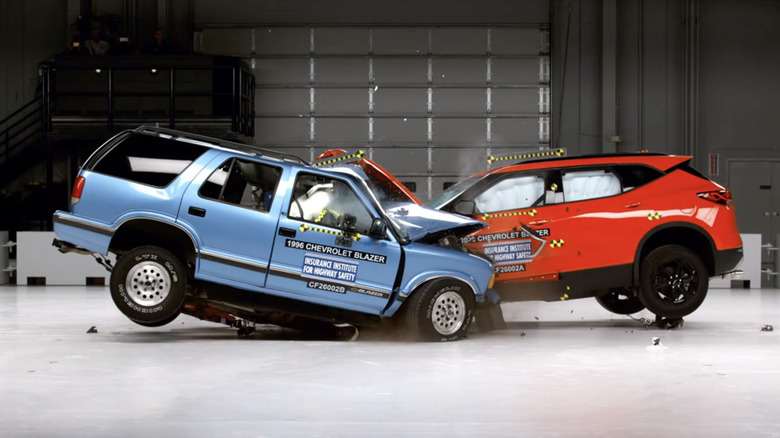
Is that true? Of course not. But if you still have people in your life who insist that's the case, the IIHS has very conveniently decided to celebrate the 30th anniversary of its crash test program with a new video, this time crashing a 1996 Chevrolet Blazer SUV into a 2026 Chevy Blazer crossover.
Driving yourself into the ground
Compared to the '56 Bel Air, the "driver" inside the '96 Blazer at least sort of stood a chance. The Blazer was actually engineered with crumple zones, crash safety standards had gotten increasingly strict over the years, seatbelts came standard, and the driver got an airbag. Oh, and supposedly, it's a big, tough truck, while the 2026 Blazer is an oversized, lifted wagon. Sure, the 30-year-old Blazer probably got the worse end of the deal, but it's still a modern vehicle, and the IIHS only crashes cars at 40 mph.
As you probably already guessed, "everyone" inside the 2026 Blazer fared just fine. Assessments of the crash test dummies inside showed minimal injury risk, except for the "driver," where the injury measurement on its right foot or lower leg were "a little elevated but still in the acceptable range." As for the occupants inside the 1996 Blazer, I'll just let the IIHS take this one:
In contrast, the impact crushed the occupant compartment of the 1996 model, pushing the dashboard and steering column into the dummy's lap. The fully inflated airbag hit the dummy in the chin, snapping its head back and toward the window. This caused the nodding joint of the dummy's upper neck to break, and the head was detached from the body. Although this isn't likely to happen to a human driver, it illustrates the extreme forces the dummy absorbed. The Institute's engineers use specific metrics collected by instruments inside the dummy, rather than visible damage, to estimate injury risk. Those indicators showed that the crash almost certainly would have caused serious injuries to the driver's head or neck and both legs.
So that's good news. If you, a real human, ever crash a 1996 Blazer at 40 mph, your head is unlikely to fully detach from your body. Sadly, this information doesn't really help anyone who'd love to buy a safer car but just doesn't have the money. But if you were still under the illusion that your '90s car would keep you and your passengers perfectly safe in a crash, it's probably time to reconsider that notion.