

Man Creates DIY Flock-Style Cameras That Only Scan Police Plates And For Some Reason The Cops Are Annoyed By This
Flock cameras, and others like them, are giving police the ability to track private citizen movements based on the vast databases of time and location data they create. For some reason, police got very concerned when YouTuber Anthony Sistilli turned the tables and made his own ALPR system that would track the police in the same way. Imagine that.
Sistilli lives in Canada, outside the reach of Flock, Axon, and other U.S. ALPR networks, reports Futurism. Yet even Canada isn't safe from this technology. Brampton, Ontario, where Sistilli lives, is the first city in Canada to adopt ALPR technology, with 360-degree cameras at 50 intersections and in-car cameras inside 415 Peel Regional Police cruisers. While companies like Flock advertise the effectiveness of ALPRs in finding missing persons and recovering stolen cars, Brampton makes no secret that it's also using ALPRs for parking enforcement, which is hardly a violent crime worth creating an all-seeing surveillance dragnet for. That's like using them on garbage trucks to look for code violations.
With this technology coming to his hometown, Sistilli took an interest, and decided to see how hard it would be to build his own version. After all, if a company that makes as many huge mistakes as Flock can still be successful, how hard can it be? As it turns out, not hard at all. All he needed was an off-the-shelf camera, a laptop, and software he built using AI in about 20 minutes. His system has a twist, though. Instead of tracking everyone, as police do, he would only track police cars, turning the system around on the people who use it the most.
Watching the watchers
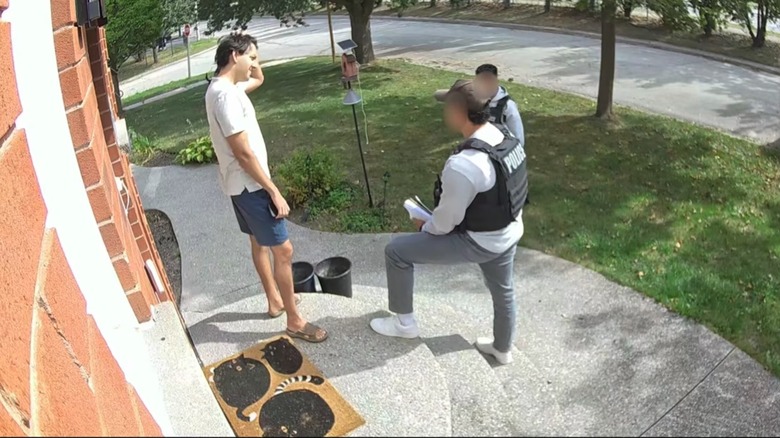
Sistilli released a couple of YouTube videos showing his homemade ALPR to track police cars. It wasn't actually very effective. It only correctly identified two out of seven cruisers that passed his location during the hour he tested it, and it did not capture the license plates of either one, which is about as reliable as a real Flock camera. Still, that was enough for several Peel Regional Police officers to pay Sistilli a visit about his cop-detecting ALPR, even though he'd done nothing wrong.
Only excerpts of his police encounter appear in the video, but Sistilli says that officers were very polite (I'd expect no less of Canadians). They do appear to have a friendly chat, which is rather different than the American approach to policing. They query Sistilli about his intentions with the ALPR system. From Tom's Hardware:
One of them [the officers] took the time to specifically mention how scary it would be for them, because people would be able to find out where they lived, when they got on their shift and what they were doing throughout the day, and that that type of powerful information could put them personally at risk for any bad apples that might want to track them down.
Gee, you don't say. It's funny how the moment the cameras are turned on them, police are suddenly worried about their their own movements being tracked, and how such data could enable "bad apples" to stalk them. You know, just like police have been caught doing to innocent civilians time and time again. From Straight Arrow:
I wanted to see whether it was feasible and use the irony to illustrate a point. Sometimes it's easier to show people what this kind of surveillance means by turning it around than by simply explaining what companies like Flock are doing.
In that, Sistilli has succeeded. Yet when Sistilli pointed out the double standard at play here, the officers still didn't get it. Their failure to see the connection between their fears, and the fears of every innocent person whose license plate ends up in an ALPR database somewhere, is a whole other problem.