

Flock Cameras Aren't The Only License Plate Trackers Stalking Your Car's Every Movement
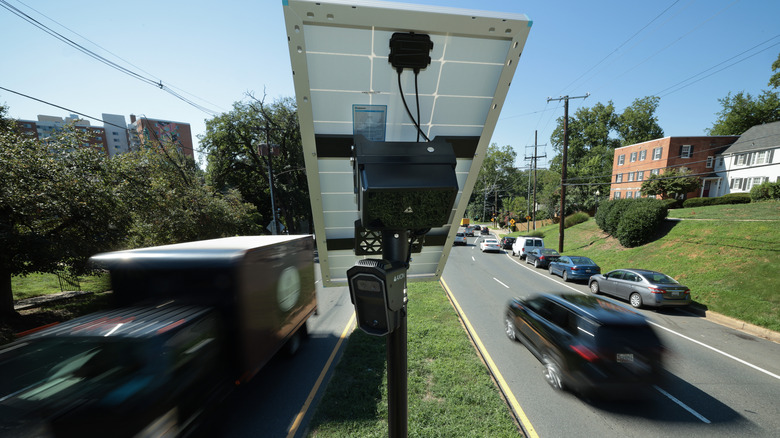
In a development that no one could have possibly seen coming, it turns out that people don't like living under the eye of a dystopian surveillance network that cops abuse constantly. Millions of normal people and even Republicans despise Flock cameras, and the pushback has gotten so bad, that even the state of Florida just announced a ban. Local governments are covering their cameras until they figure out how to get out of their contracts, and residents across the country are finally seeing success in their fight against constant government surveillance. But is it really a win if your town simply swaps one camera company for another?
We've previously reported that the surveillance company Axon is one of the most popular alternatives to Flock. Its tech isn't any less invasive or better for society in any way, and it may actually be even worse than what Flock currently offers. But you don't just have to keep an eye out for your local or state government dropping its Flock cameras for Axon ones. The license-plate tracking and general dystopian surveillance network industry is full of companies looking to muscle in on Flock's turf while their main competitor is all over the news for being evil.
The consulting firm CB Insights maintains a list of Flock alternatives on its website, and sadly, it's a really robust list that isn't limited to just Axon. So far, it includes Verkada, Coram AI, Eagle Eye Networks, Voxel, Dataminr, Hanwha Vision, FacilityOS, Cloudastructure, Citizen, and Rhombus. That doesn't appear to be a complete list, though, as it's missing Motorola's Vigilant system, Rekor, Genetec AutoVu, or PlateSmart. Got all that? Good. It'll be on the test later.
The wonderful world of warrantless surveillance
Many of these Flock alternatives promise superior tech, offering even more invasive features to creeps looking to spy on children's gymnastics classes. As one competitor, Coram, says on its website:
Coram is an AI-native physical security platform that connects to any existing IP camera and unifies video surveillance, access control, LPR, and emergency management in a single cloud-managed system.
The contrast with Flock is direct. Flock identifies vehicles at entry points. Coram tracks vehicles, connects that data to video footage across the site, searches it with natural language, and triggers real-time alerts when something specific happens: a firearm, a fall, a vehicle on a watch list. It does this on the cameras already installed, without new hardware.
For organizations that adopted Flock to answer one question and now need to answer more, that's the core argument. The no-rip-and-replace model means the switch doesn't require a capital investment in new cameras. The subscription includes AI capabilities Flock doesn't offer.
There is some good news available; it's all doom and dystopian-surveillance-state gloom. The American Civil Liberties Union has been sounding the alarm on ALPRs. The civil rights organization has taken aim at Flock because it gets most of the news coverage, but it's also working hard to focus attention on the other companies. The ACLU has also created a convenient toolkit for private citizens who want automatic license plate readers out of their neighborhoods and local communities.
The toolkit includes links to model legislation that the ACLU has proposed for both state and local governments, and it includes a resolution to kick-start the process of ending ALPR contracts. It's an uphill battle if you choose to fight for privacy in a world where companies have a financial stake in tracking you, but without lucrative government contracts, these companies have a much lower chance of survival.