

We're Stuck With Sean Duffy As The Secretary Of Transportation Because It Was The Only Job Left For Trump's Buddies
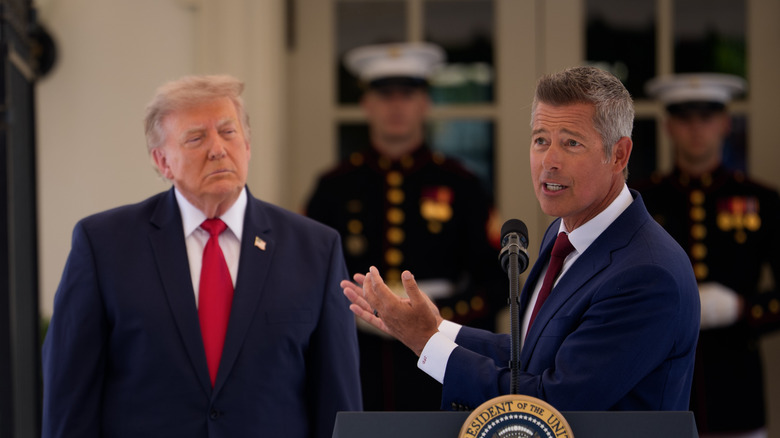
The U.S. Secretary of Transportation, Sean Duffy, has been busy over the last year and a half. He put out a cringe-worthy road trip celebration for America's 250, worked hard to deregulate while also regulating autonomous vehicles, and hunted down immigrants in the trucking industry. Though it's obvious Duffy didn't land the role on merit, he certainly wasn't a first pick either. On a recent episode of The Katie Miller Podcast (hosted by the wife of the White House Deputy Chief of Staff Stephen Miller), it was revealed Duffy got the role because it was the only one left.
The Secretary of Transportation shared with Miller that he didn't know he wanted to be the head of Transportation. Duffy's wife, Rachel Campos-Duffy quickly chimed in, saying outright, "He [Sean] said he wanted to serve the president in any way and ended up in Transportation because that was all that was left."
While taking that in, Duffy added in a half-done impression of Trump, that the president expressly told him, as if he were selling the role, "If I wasn't the president, I would pick the Department of Transportation over any department. It's the best department. And I'm going to give it to you." Duffy went on to say that the president is a builder and loves aviation, and that Trump is the only president who cares about the infrastructure: "Usually, presidents don't give a damn."
Clearly Duffy didn't spend a lot of time studying American history, as one could immediately argue in favor of President Dwight Eisenhower's Interstate Highway System, or Abraham Lincoln's push for the Transcontinental Railroads — two revolutionary projects that helped move people and product across the country in two different centuries. But, I digress.
The journey to cutting red tape and deregulating transportation

Before Duffy got the job, his only real work with infrastructure was helping to get an 80-year-old bridge that spanned between Wisconsin and Minnesota replaced. According to NPR that was an impressive feat mentioned several times, even by Democrats during his confirmation hearing. But otherwise, his experience is limited, further revealed through his latest string of questionable decisions ranging from pushing the incoming Fiat Topolino, with a top speed of 25 mph to help solve affordable transportation, to his latest decision that will remove simple measures (and buttons) that will make cars less efficient.
The podcast went on to discuss some of his other projects, with much of the conversation surrounding airport travel, beginning with Miller asking how often Duffy's wife calls him when she's stuck on a plane. It's apparently often. Campos-Duffy admitted, "...it's never helpful. I'm like, 'this job has no power.'"
But Duffy has played the game otherwise. He went on to talk about how DOT is updating software systems for air traffic control, which anyone can argue is an overdue thing, with the caveat that AI will be more involved. He does promise that he's "not going to turn the skies to AI," or rather, he's not going to allow air traffic to run solely on AI. There will always be a human.
The price of safety
AI was also said to be pivotal in helping flights find alternative routes for bad weather in the future, rather than just shutting down airspace. He explained, "sometimes you have a weather shutdown at an airport and you look out and you're like, 'it's just blue skies. What's going on?'" Common sense and pilots would say there's a massive, dangerous storm between you and your destination, but yes, let AI plan a new route, cause routes planned by AI worked out so well for those hikers that needed to be rescued in the news last week, too.
Duffy also continued to tout his cutting of red tape to get autonomous and eVTOL technology to the American people faster. And sure, one could argue that government might be over-regulated at times, but the majority of regulations exist because there have been years–or decades–of experiences and studies that have shown that some of these regulations are absolutely necessary. Axing some of them will cost Americans in a multitude of ways whether financially, or potentially with their lives (i.e. emissions, safety measures for bikes and vehicles, etc.)
And that's not even taking into the account that any federal infrastructure aid now comes with a caveat that if you're not on board with ICE and federal immigration enforcement, you're not getting funding. There's no getting help as an American if you're not playing by Washington's rules — something Trump's last "pick" is seemingly more than happy to comply with.