

10 Essential Tools Every Motorcycle Owner Should Have

Owning a motorcycle doesn't mean you need to become the sort of person who considers splitting crankcases a relaxing Saturday afternoon. Heck, it doesn't even mean that you understand how motorcycles work. But even riders who happily outsource the serious wrenching still have basic maintenance, inspections, and troubleshooting to deal with, and investing a bit in the essentials can go a long way.
That's where a relatively small collection of tools — including items like a digital multimeter, a socket set, and a battery maintainer — earns its keep. Even if you're just trying to stay on top of your tire pressure and want to do simple mechanical procedures guided by an actual torque wrench and not "yeah that feels about right," we can help you equip yourself with the essentials without turning your garage into a museum of tools you may need someday. This isn't a shopping list for rebuilding a transmission on a milk crate. These are the tools that make ordinary motorcycle ownership easier, safer, and a little less dependent on making a service appointment every time your bike needs attention.
Tire-pressure gauge
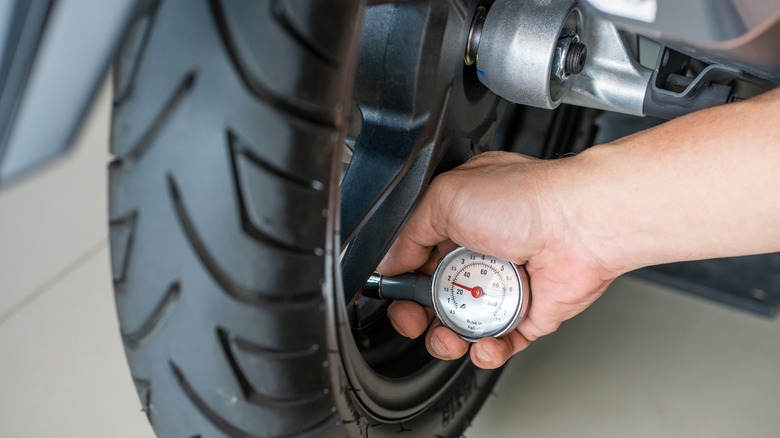
There are plenty of maintenance tasks that can extend the life of your bike, but proper tire inflation is one that can extend the life of the rider. Even if you're just running errands, having correct pressure in your tires can make the difference between having the grip necessary to avoid an accident and ending up crashing your motorcycle. Too soft and you can separate the tire from the rim. Too hard and you can lose traction. And no, neither your steely squinting eyes nor your confidently squeezy thumb and index finger are sufficient for making sure you're in spec.
The good news is that a decent gauge is one of the cheapest tools on this list and also one of the easiest to use. When you're shopping, accuracy should matter more than anything else. Look for a gauge that actually publishes an accuracy specification rather than assuming every gauge is equally trustworthy. For example, some motorcycle-focused 0-to-60 psi gauges are rated to within roughly 0.6 to 0.9 psi, depending on the model.
Usability matters, too. Motorcycle valve stems can be awkward to reach, so a flexible hose and an angled or swiveling chuck can make a gauge much easier to use around spokes, brake hardware, and other wheel furniture. Beyond that, choose whatever format you can read easily. Digital gauges can give readings in tenths of a psi and use a backlit display, while analog gauges are available with large, easy-to-read faces and no batteries to worry about. Either is fine. What you don't want is the mystery-bin special whose contribution to motorcycle safety is making up a number with impressive confidence.
Torque wrench
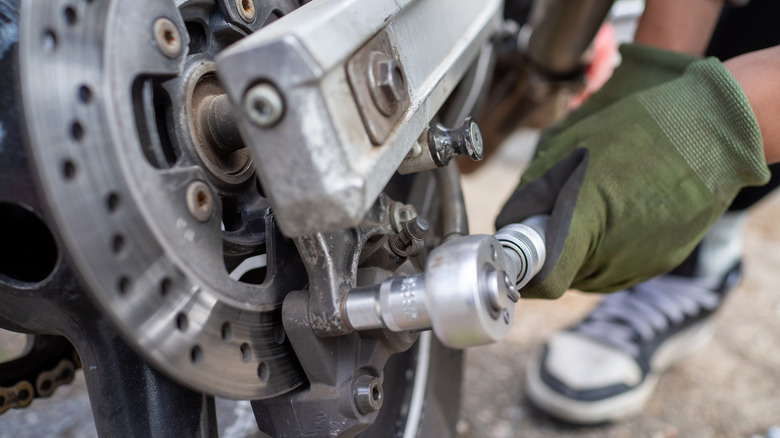
"Yep, that's not going anywhere" is the mandatory final step in strapping furniture to a trailer. However, it's not how you decide when a bolt is tight enough. Plenty of motorcycle fasteners are supposed to be tightened to specific torque values, and a torque wrench exists to make sure you hit those numbers with measured precision and not wrist-based vibes. Too little torque can leave a fastener insufficiently tightened, increasing the chance that the joint can loosen in service. Too much torque creates the opposite problem and can distort the component.
That makes a torque wrench essential once you start doing the sorts of basic jobs that involve removing critical hardware and putting it back correctly. When buying one, start with the torque specifications your motorcycle actually calls for, because wrenches are sold with very different working ranges. A 3/8-inch-drive model may cover 10 to 100 ft-lb, while smaller 1/4-inch-drive tools can be designed for much lower values.
Accuracy is the other specification worth scrutinizing. Look for a wrench with a stated tolerance and, preferably, an individual calibration certificate rather than an anonymous chrome bar that merely promises precision. Quality mechanical models are available with ±3% stated accuracy, while electronic versions can tighten that to ±2% and provide digital feedback. You don't necessarily need the fanciest one, and there's quite a bit of debate about whether owners of expensive torque wrenches actually find them to be more accurate than bargain bin ones. They'll all agree, though, that the correct choice isn't "one more little tug ought to do it."
Metric socket set
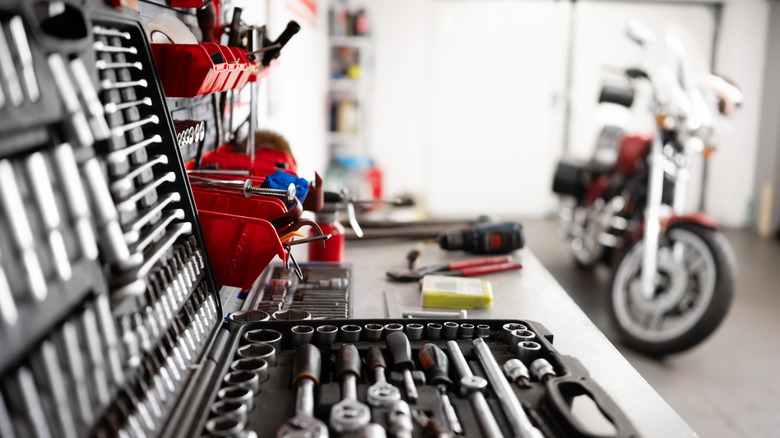
U.S. soldiers (with help from other Allied forces) took Omaha Beach, and Stallone triumphed over Dolph Lundgren in "Rocky IV," but we all ended up turning metric bolts in the U.S. anyway, so you're going to need the right sockets. Motorcycles are covered in nuts and bolts that need to come off for routine maintenance, adjustments, accessory installation, and basic repairs, and a ratchet can reach and turn fasteners in places where swinging a conventional wrench would be awkward or impossible.
Motorcycle-specific tool makers sell metric sets built around common sizes like 8 mm, 10 mm, 12 mm, 13 mm, 14 mm, 17 mm, and 19 mm, while more conventional 3/8-inch-drive sets can cover every metric size from 8 mm through 19 mm without missing any. A 3/8-inch drive is a useful middle ground for general-purpose work, while 1/4-inch-drive sets commonly cover smaller sizes, and 1/2-inch-drive sets step up into larger hardware.
You'll also have to choose between shallow and deep sockets. Both are commonly offered in the same metric ranges, and deep sockets can reach nuts sitting farther down a stud while shallow ones take up less room when clearance is tight. Six-point sockets are widely sold as the standard option for ordinary hex fasteners, and buying a set with clearly marked sizes and no skipped increments can save you from discovering that the one socket you need is apparently the one the manufacturer decided you didn't.
Hex-key set
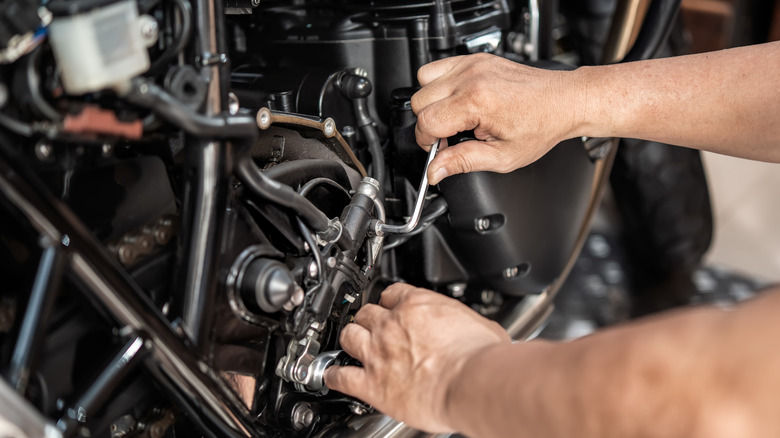
Once you've accepted that your motorcycle is metric, the next issue to address is that not every fastener is solved with a socket. Hex-head hardware shows up all over modern bikes, and even relatively straightforward accessory installation can call for multiple metric hex wrenches alongside ordinary sockets and a ratchet. The bottom line is that a good set of Allen keys is a pretty solid investment, and we don't mean that drawer you have where all the flat-pack Ikea-style hex wrenches ended up.
Start with a metric set that covers the sizes your motorcycle actually uses. Quality sets are readily available from 1.5 mm through 10 mm, which gives you considerably more flexibility than collecting individual keys whenever a new fastener sneaks up on you. Longer arms provide more leverage, shorter ones actually fit where you need them, and such are the compromises of life.
The other buying decision is whether you want straight hex ends, ball ends, or both. A ball-end wrench can engage a fastener at up to a 25-degree angle, which is enormously useful when bodywork, frame tubes, or other motorcycle bits make a perfectly straight approach inconvenient. Straight ends, meanwhile, give you full engagement when you can get directly onto the fastener. This is also one place where paying for decent machining makes sense. Better-designed profiles can increase the contact area inside the screw head and reduce the chance of damaging it, while clear size markings or color coding make it easier to grab the right key without driving yourself nuts.
Battery maintainer
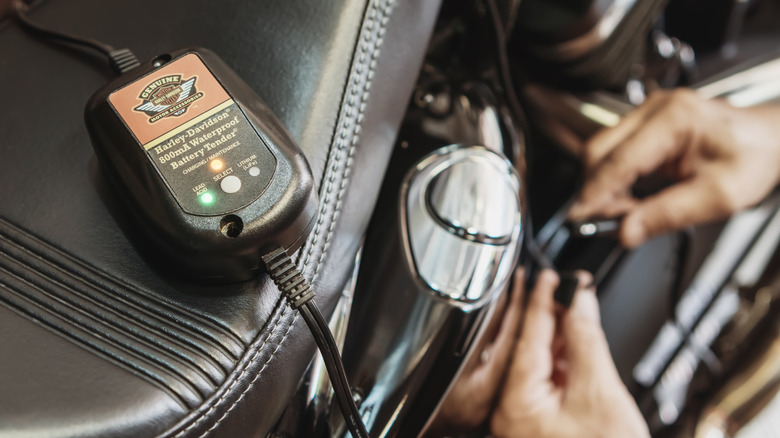
Your motorcycle may get mad at you if you don't ride it for a while, and one of the ways it'll manifest that anger is with a dead battery. And so, a battery maintainer is more than a storage accessory. It's a maintenance tool that monitors battery condition and supplies charge as needed, allowing a bike to stay parked without leaving the battery to slowly discharge itself into oblivion. You may have heard these called "battery tenders," but Battery Tender is actually a brand name of a product built by Deltran – think tissues versus Kleenex.
Anyway, powersports batteries don't enjoy neglect. A battery that hasn't been used for more than two weeks may already need charging, and motorcycle battery guidance specifically recommends using a maintainer during longer periods of inactivity. We double-checked the science on this one, and, before you ask, yes, this applies even if you were totally planning on riding every weekend when you bought the bike.
When choosing a maintainer, compatibility is more important than brute power. Check your battery chemistry first, because some chargers use different charging modes for lead-acid and lithium batteries. Output is a consideration, too. Lower-amperage maintainers around 900mA to 1.2A are intended for smaller-capacity batteries, while 2A units suit most street bikes, and 3A models are aimed at larger batteries. The right maintainer should disappear into the background most of the time, which is exactly what you want from a tool whose entire job is making sure your bike starts when you get a chance to hop on it.
Digital multimeter
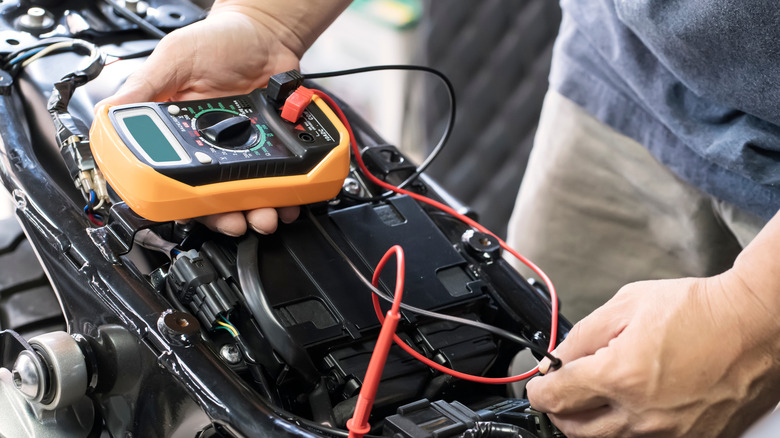
A multimeter is such a simple tool, but it'll change your life. Modern motorcycle troubleshooting has a funny way of leading to you watching a YouTube video, where a guy casually says to "grab your multimeter" and makes you feel mechanically inadequate. A bike that won't start may have a parasitic drain that kills the battery, a charging-system problem, or any number of electrical gremlins that are going to be a whole lot easier to diagnose with this piece of hardware. A digital multimeter lets you stop guessing and start measuring. Even something as basic as testing a motorcycle battery requires checking actual voltage, while deeper charging-system diagnosis can involve measuring DC voltage across the battery and testing components like the stator and regulator-rectifier.
This is one of those tools worth owning before you need it. At minimum, look for a meter that measures DC voltage and resistance, plus a continuity function that can help determine whether an electrical path is intact. Auto-ranging is also useful because it selects the appropriate measurement range automatically, which means one less thing to think about while you're already trying to figure out what the hell is going on with your bike.
You don't need something super specialized. General-purpose digital multimeters commonly measure hundreds or even thousands of volts AC/DC, which is far beyond what you need just to interrogate a 12-volt powersports battery. Usability and trustworthy measurements are much more mission critical. Look for an easy-to-read digital display, decent probes, straightforward controls, and a clearly published accuracy specification. When half the diagnostic flowcharts eventually point toward "check voltage here," owning the thing that checks voltage is table stakes.
Rear paddock stand
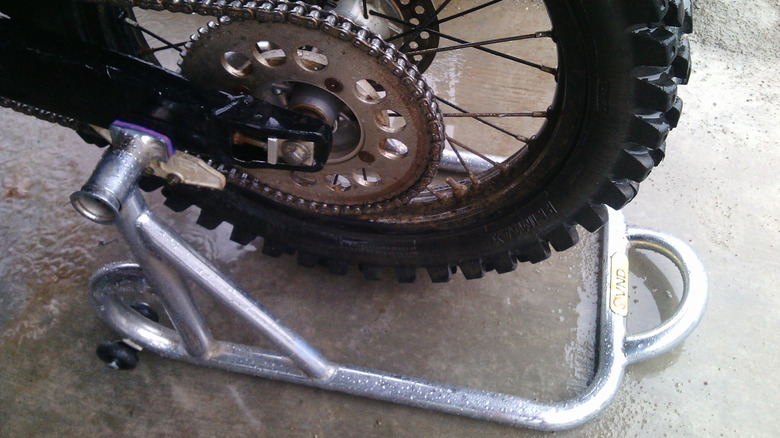
A motorcycle's side stand is great at keeping the bike from falling over in the parking lot, but it's not much help when you need the rear wheel to spin freely. That's where a rear paddock stand earns its keep. By holding the motorcycle upright with the rear wheel off the ground, it turns otherwise awkward maintenance like chain cleaning, lubrication, adjustment, and rear-wheel service into something you can actually do without rolling the bike six inches at a time across the garage. Chain maintenance in particular is substantially easier when the rear wheel can rotate freely.
The buying trick is making sure the stand matches your bike. Some rear stands lift from spools attached to the swingarm, while others use flat or rubberized supports directly under the swingarm. Combination designs can do both, and some are width adjustable to fit a range of motorcycles. Before ordering one, check what your motorcycle actually supports rather than assuming the stand that looked right in a product photo will magically sort itself out.
Because this is one tool whose entire job is supporting the motorcycle while you work around it, quality is a factor. Look for a rigid frame, sturdy casters, and enough adjustability to position the supports correctly. And if your problem isn't the bike but the amount of garage you have to work with, compact alternatives exist. The Tirox SnapJack is a compact rear stand that's compatible with tight quarters, so there are alternatives out there if your working space is actually a corner of your living room or the sidewalk in front of your apartment building.
Chain-cleaning brush
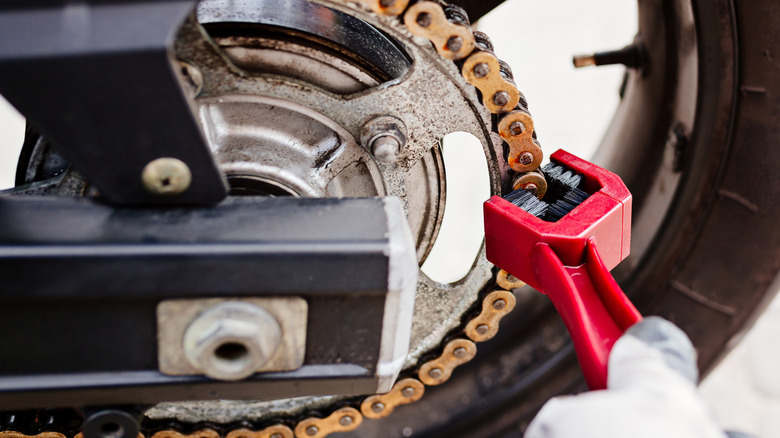
If your motorcycle sends power to the rear wheel with a chain, congratulations: You own a component that regularly collects road grime while also demanding lubrication. That buildup isn't something you want to simply keep embalming beneath fresh chain lube. Cleaning the chain before re-lubricating it removes dirt, grime, and built-up grease, and a dedicated chain brush gives you a way to actually scrub the stubborn stuff loose instead of just spraying cleaner at it and hoping for the best.
A conventional straight brush will work, but motorcycle-specific designs can surround three sides of the chain at once to clean the rollers and side plates. Some also put longer straight bristles on the opposite end for harder-to-reach areas, which means less maneuvering around the rear wheel and swingarm while trying to get at every filthy surface.
Pay attention to the bristles, too. You want something stiff enough to dislodge accumulated crud without reaching for an aggressively abrasive substitute that could do more harm than good. Durable nylon is a common choice on purpose-built motorcycle chain brushes, and a reasonably long handle keeps your hands farther away from the mess. This obviously isn't an essential purchase for belt- or shaft-drive riders, but if your bike has a chain, owning the tool specifically designed to clean that chain seems like a pretty easy call.
Portable tire inflator
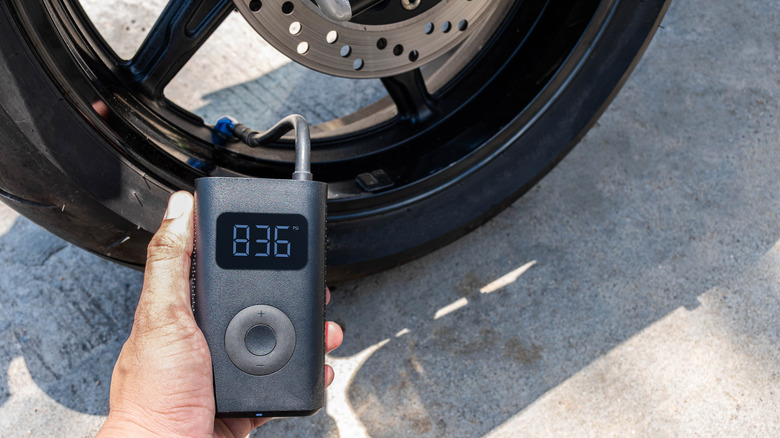
A portable tire inflator can save you in a pinch, but it's remarkably helpful to have back at the garage for more mundane uses, too. It gives you a way to correct low pressure at home without hunting down a gas-station compressor, and it becomes even more valuable on the road if you've lost air somewhere inconvenient. Motorcycle-focused compressors can be genuinely tiny, with one 12-volt model measuring just 4 by 2 by 6 inches, specifically so it can be carried with you when you ride.
A compressor that technically fits in the garage but consumes half your cargo box has missed the sweet spot. Pay attention to the power source, too. Compact motorcycle units are available with 12-volt connections that can run from the bike's electrical system, while cordless rechargeable models eliminate the power cord entirely. If you go wired, make sure the cord and hose are actually long enough to reach both tires from wherever the connection lives.
Pressure capability and an integrated gauge are also worth checking. One motorcycle-specific mini compressor pairs a built-in 0-to-50 psi gauge with a 50-psi maximum output, while compact cordless versions can offer digital displays and considerably higher maximum pressure. You don't need to inflate a tractor tire with the thing. You need something small enough to bring along and competent enough that discovering a low motorcycle tire doesn't turn into a much bigger problem than it needs to be.
Spark-plug socket
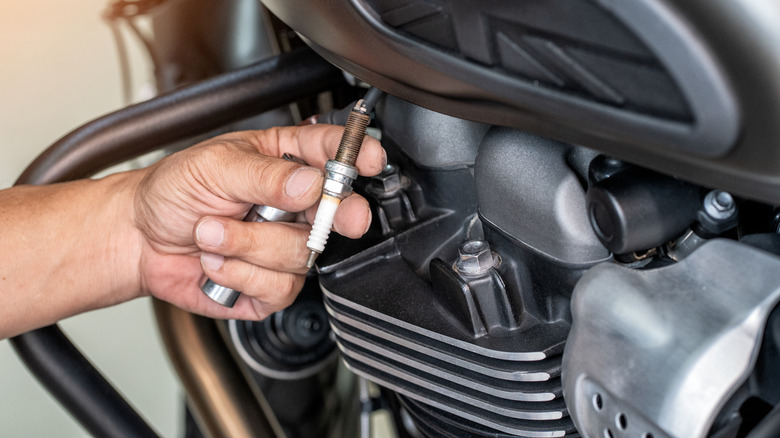
Spark plugs wear out, and they also find more routine ways to make you pay attention to them sometimes. And actually getting one out of a motorcycle can be a little more specialized than the job sounds. They're usually tucked down into the cylinder head, which is why a dedicated spark-plug socket earns its place over a random deep socket from the drawer. The proper tool is typically slimmer and designed to grip the plug once it's loosened, saving you from fishing around in a narrow well after you've already done the hard part.
When buying one, the first job is matching the socket to your plugs. Motorcycle-specific versions are sold in 14-mm, 16-mm, 18-mm, and 21-mm sizes, and the right choice depends on the bike. Thin-wall construction is also worth seeking out because some cylinder heads leave very little clearance around the plug. A proper spark-plug socket is designed to hold onto the plug as you lift it out of the cylinder head, rather than counting on friction and gravity to do anything other than betray you at your most vulnerable.
And that's a pretty fitting place to end this list. None of these tools is exotic, and that's the point. You don't need to turn your garage into a race shop or develop an unhealthy relationship with the Snap-on rep. You just need the right handful of tools for the maintenance and troubleshooting jobs motorcycle ownership predictably throws at you. A spark-plug socket is about as glamorous as that philosophy gets: cheap, specific, easy to overlook, and plenty important when you actually need one.