

4 Things To Know If You Want A Ford Mustang As A Family Car
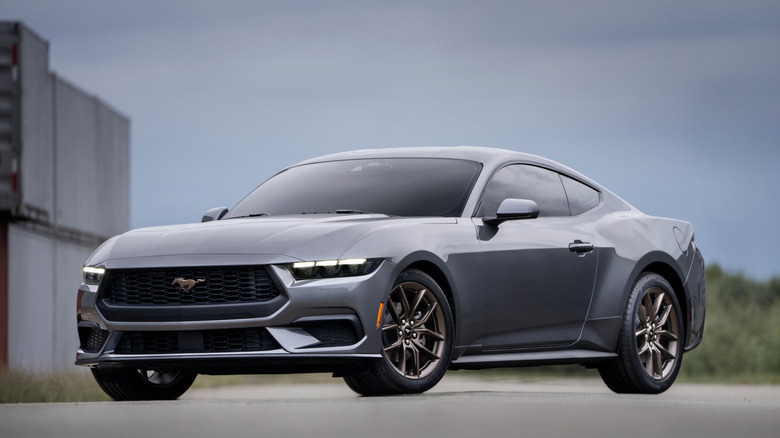
The Ford Mustang is a legendary high performer that — in its sportiest configurations — has been known to lap the Nürburgring in record time. But it also happens to be the very best family car that Ford sells for 2026. Of course, the Mustang is the only actual car the Blue Oval now sells, since everything else is either a crossover, an SUV, or a truck.
Still, the current Mustang may surprise you as a family-friendly choice. Experts from the likes of AAA and Good Housekeeping, among others, tell shoppers to focus on factors such as safety technologies, car-seat compatibility, passenger room, storage space, and fuel economy — and the numbers can be massaged to show the 'Stang does fairly well in some of these areas. On the other hand, Ford's popular pony car can't hang with "real" people movers like minivans or SUVs, especially in key categories involving size and safety. The bottom line is that while the Mustang may be better than you think as a family choice, you should know it comes with some major, potentially deal-breaking compromises.
We'll check all that out and more below, but first a quick note: We're going to focus on the traditional gas-powered two-door Ford Mustang fastback from the current generation, which went on sale for the 2024 model year. We'll leave the Mustang Mach-E four-door EV crossover for another day and take on the four-door Mustang sedan if that ever appears. Rumors continue to fly over that latter possibility despite Ford leaving the sedan segment five years ago.
The Mustang may miss the mark for safety and reliability
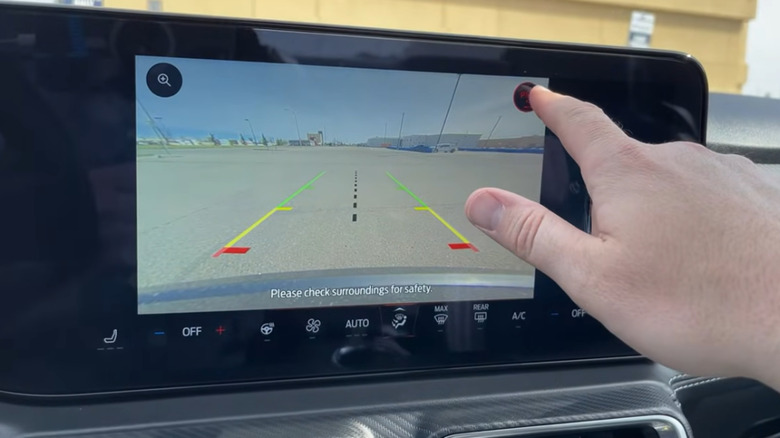
Safety is more important than ever with little ones onboard, so it's good to know that the 2026 Ford Mustang does earn a five-star overall rating in NHTSA crash testing, with the full five stars in frontal and side crash protection plus a five-star score for rollover resistance. The results with IIHS, however, paint a different picture. Not only did it fail to qualify as a Top Safety Pick, but it also received only a marginal rating for car-seat compatibility with its LATCH anchors. To be exact, the lower anchors in both rear-seat positions were found to be located too deep in the seat and were too hard to attach. Remember, too, that the IIHS claims the risk of dying in a crash can be 46% higher for people buckled into the back seats than into the front.
Further, if you're looking for a car you can count on, the Mustang may not be the best solution. It has the second-worst predicted reliability in its segment according to Consumer Reports, and it's been recalled three times — not counting a separately listed recall for unintended acceleration in the supercharged Mustang GTD.
The good news is that the Mustang is pretty well packed with ADAS features. Lane-keeping assistance, a blind-spot system, rear cross-traffic alert, automatic emergency braking, and rear parking sensors all join the federally mandated rearview camera as standard equipment. Adaptive cruise control is among the Mustang's options.
The Mustang is more efficient than some minivans
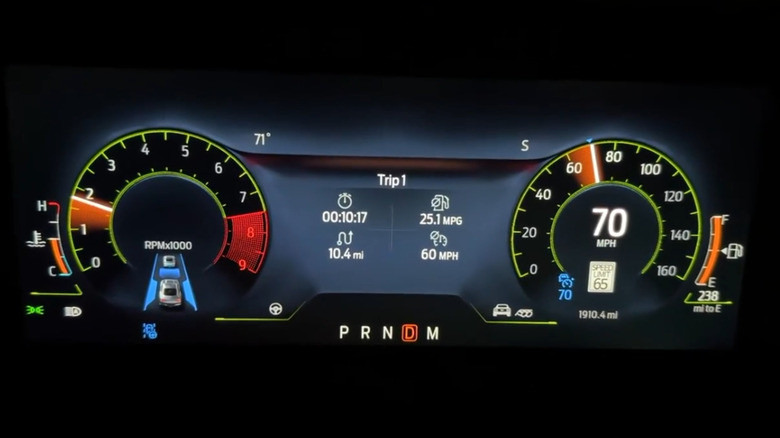
Most people don't stop driving when they have kids. In fact, you may find yourself travelling even more miles than usual if you're adding child-centered rides like visits to the grandparents, trips to the pediatrician, and extra grocery runs to your typical day. With that in mind, it can make sense to choose a family car that's relatively good on gas — like the Ford Mustang.
The 2026 Mustang can earn EPA ratings of 22 mpg city/33 mpg highway/26 mpg combined when equipped with its standard 2.3-liter EcoBoost engine. That makes for advantages of 3 mpg city/5 mpg highway/4 mpg combined over both the 2026 Honda Odyssey and the standard Chrysler Pacifica. Additionally, the Mustang's EPA numbers come along with 315 horsepower and 350 pound-feet of torque. Putting all that output to good use, Car and Driver clocked a 2024 EcoBoost Mustang getting to 60 mph in 4.5 seconds. Just be aware that your gas mileage drops the faster you go, so you won't be able to maximize speed and fuel economy at the same time.
The issue here is that many popular choices for families are actually much more efficient than the Mustang. Among minivans alone, the peculiarly styled 2027 Chrysler Pacifica plug-in can hit 30 mpg combined in gas-hybrid mode and travel 32 miles solely with electricity. The Toyota Sienna, for its part, rocks a conventional hybrid setup good for 36 mpg in all facets of EPA fuel-economy testing.
Size does matter for the Mustang's cabin and trunk
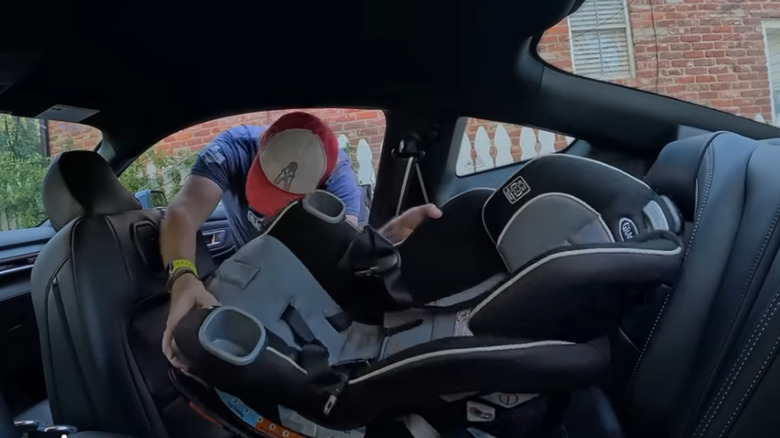
There's also no getting around the fact that the Mustang's rear seats are not very large. So beyond any concerns about reaching those LATCH attachments, it may be tough to even wedge a car seat into the back of the vehicle in the first place. Watching someone try to stuff a forward-facing booster seat into the rear of a Mustang, for instance, shows exactly how real the struggle can be. Moreover, once it's accomplished, your little tyke may not have any legroom leftover. A mere 29 inches is available for back-seat passengers. The fastback also exacerbates the space issue by reducing rear-seat headroom to 34.8 inches.
To put that into context, the compact and hybrid-only 2026 Mitsubishi Outlander can deliver nearly 40 inches of second-row legroom with space left over for a third row — albeit one with fewer than 19 inches of space for lower extremities. Oh, and the Outlander further leads in second-row headroom, with an extra 4.3 inches versus the Mustang. True, the convertible opens up more headroom, but at the price of a 15.6% drop in trunk dimensions.
Speaking of which, the Mustang does have 13.5 cubic feet of room to put junk in the trunk, along with split-folding rear seats that can significantly expand that space. Some reviewers, though, noted that the trunk's shape makes it less practical to use in some cases.
Is the Ford Mustang less expensive than other family cars?
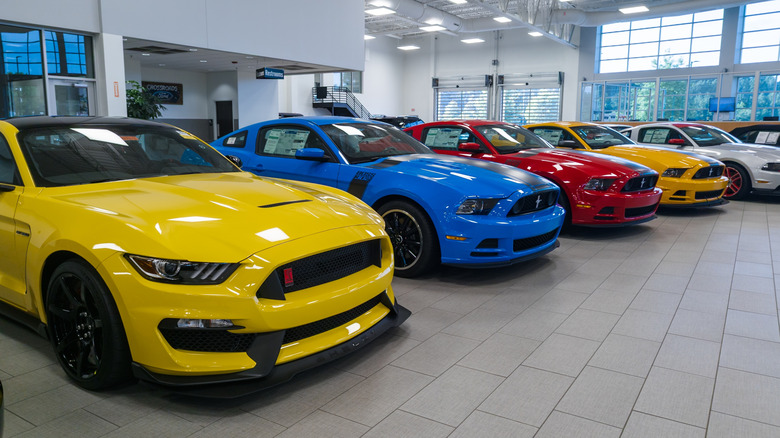
Many people complain about the price of vehicles today, particularly now that rich people rich people killed off America's affordable cars. Yet despite the average marketed price of a new car reaching a new record earlier this year, that cost of $51,974 is a minor purchase compared to the outlay for raising a child. Bringing up baby, from birth to age 18, will set you back more than $303,000 according to Lending Tree.
With that in mind, a new 2026 Mustang, with an MSRP of $32,995 (before destination costs of $1,995), is a veritable bargain. The only minivan priced under $40,000 is the Kia Carnival, which squeaks in at $39,035 — representing an MSRP of $37,490 and a destination fee of $1,545. The flipside here is that even though many people consider minivans to be the Platonic ideal of a family car, many families actually don't need a vehicle that big and pricey. And there are plenty of family-approved rides around that undercut both the Carnival and the Mustang.
For example, when Car and Driver came up with a list of top vehicles for families, it included the Chevrolet Trax, Ford's own Maverick, and the Honda Accord. And all of those have MSRPs below $30,000.