

Gas Mileage Drops The Faster You Go, But Here's Where Your MPG Really Nose Dives

For the foreseeable future, it looks like high gas prices are here to stay. But we still have important places to go, such as work, school, family visits, and medical appointments. We're all trying to save some money at the pump. One oil exec reasons that we should just drive less, which is at once sound and shortsighted, if not outright insulting to the average citizen: conservation is wise, but our job sites and office parks don't suddenly get closer to home when gas prices soar.
So we look for ways to eke out a few more mpg, and stretch each dollar further down the road. Driving slower helps. Obviously, mashing the gas at highway entrance ramps and traffic lights burns more fuel, as a car has to overcome inertia. On the highway, it's a slightly different story. By 75 miles per hour, fuel economy really nosedives. The faster a vehicle goes, the more of its fuel is needed to overcome aerodynamic drag, which accounts for 50% of highway fuel usage, according to the Auto Research Center (ARC). This is why ditching your roof rack helps, but speeding up to save time has diminishing returns.
Diesel, gasoline, hybrid electric — doesn't matter. Limiting time spent idling, keeping your car maintained, and using your air conditioning less, can save gas. But speed's a biggie. After 45 or 55 mph, fuel mileage drops as the amount of energy required to keep up the pace takes a steady, significant toll.
Why mileage drops as speed climbs
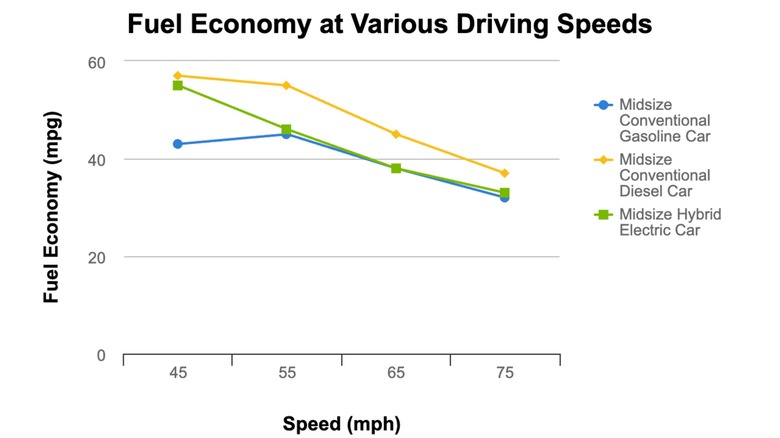
A simplified look at the academic side of things — setting aside variables like the viscosity and density of the air — tells us that when calculating drag, the velocity of an object is squared. In other words, a car going twice as fast as another is dealing with four times the aerodynamic drag, and has to generate more power to overcome it. So, what does that mean in dollars and cents?
The U.S. Department of Energy estimates that, generally, every 5 mph over 50 costs you about $0.27 per gallon, assuming $3.83 per gallon of gas (remember when?). In terms of volume, the DOE chart above shows that a midsized car sipping diesel at 55 mpg, traveling 55 mph, would consume a staggering 31% less fuel than one moving at 75 mph (37 mpg).
Hybrid fuel economy would drop 28% between 55 and 75 mph, from 45 mpg to 33 mpg. Things get a little weirder for conventional gasoline cars, which use 25% less gas at 45 mph than they do at 75 mph — but 28% less at 55 mph than 75 mph.
That supports the national 55 mph speed limit that President Richard Nixon signed into law in 1974 in response to that era's oil crisis. This time around? Who knows? High gas prices could kill the SUV craze. And it might be the perfect time to shop for a used plug-in hybrid.