

Grand Touring Across Spain In The Polestar 5 Was Like Driving A Spaceship Into The Future
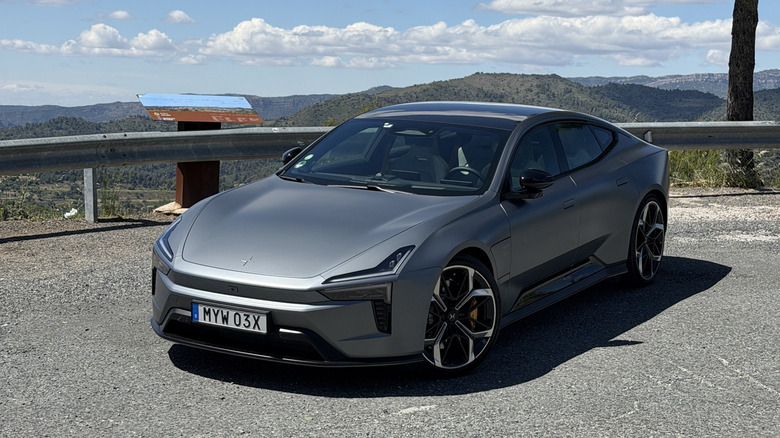
The idea of a "grand touring" car, and the notion of "grand touring" in general, is fairly nebulous. Countless different cars have been designed with fast long-distance driving in mind, with many even using the GT letters in their names. Sometimes a mid-engine supercar or hot hatchback is positioned as a grand tourer, or a fancy EV or plush four-door sedan, though typically the term is applied to large two-door four-seaters that put style above all else. But there's one new car explicitly pitched as a grand tourer that's far from your typical GT: the electric Polestar 5.
Polestar's fifth model is a sleek four-door fastback, built on a special supercar-like platform that its astounding design necessitated. It has a maximum range of up to 421 miles on the European cycle and pretty great fast-charging capabilities, so it's got the GT stuff down on paper. But to really show off just how legitimate the 5 is as a grand tourer, Polestar put together the most ambitious first-drive program I've ever heard about, let alone be a part of.
Instead of inviting lots of journalists to drive the car on the same few-hour route in one place, Polestar came up with a nearly 4,000-mile road trip from its headquarters in Sweden to the Sahara desert in Morocco, giving different groups of us two whole days with the car on different legs throughout the journey. I joined at around the halfway point in Spain, where we drove from Sitges to Valencia on some truly breathtaking roads, and I completely fell in love with the Polestar 5. It feels genuinely special and distinct, without any real analogues in the market, and more importantly it tugged on my heartstrings.
Full disclosure: Polestar put me up in three different hotels and fed me wonderful food over the course of this trip, and then flew me home after. Audi booked my flight from Austria to Barcelona for this trip, as I went directly from the RS5 first drive.
Mind-boggling logistics
Before I get into the car itself, some perspective on just how out of the ordinary this trip was — in the weeks leading up to and since being there, every other person in the industry I talked to about it could not believe Polestar was able to pull it off, even from a pure logistical standpoint. On a typical global first-drive event, the automaker picks one location to base it out of, with different groups of us from around the world being on region-specific waves, usually all doing the exact same program once we get there. Sometimes we'll drive from one location to another, or there will be a few different routes to choose from with a central location we come back to, but for the most part we drive the same roads, stay in the same places, experience probably the same weather, and all capture the same photos and content. And a lot of the time, we might fly halfway around the world just to drive a car for less than four hours.
That's exactly what Polestar wanted to avoid. For this program, no more than two people from any given country were on the same leg of the journey — I was the only American on mine — and we all got randomly paired up with another journalist for the driving. Don't get me wrong, I have many American and Canadian friends in this industry that I love seeing at work events, but it was really refreshing to suddenly be among writers from all over the world. I was paired up with Cameron Officer, a writer from New Zealand who I became fast friends with. And this way, my story is hopefully unique from all your other favorite American auto journalists that got to go on this trip (and from many of your faves from other places), so we'll all really have our own perspectives on the car, photos to share and stories to tell.
 Daniel Golson/Jalopnik
Aside from only a couple people that were doing the entire thing, Polestar also had groups of its staff from various departments (like PR, product planning and design) rotating in and out of different legs, with 109 people in total being involved. Even for some of them, this was the first time they had met in person or traveled with for a program like this. It was like going to sleepaway camp for the first time, where you're forced to be adventurous and make new friends. For some writers and company folk, it was also an opportunity to connect with a friend or colleague they hadn't seen in years.
There were seven media legs, each with different groups of twelve journalists, plus three transit legs in between some of them done by the Polestar team to get the cars to the next starting place or for other logistical reasons, like crossing a body of water. Out of the 3,836 total miles, journalists drove 2,077 of those miles over the course of five weeks. The cars went through Sweden, Denmark, Germany, Switzerland, France, Andorra, Spain, Gibraltar and Morocco. Every route almost entirely consisted of the most dynamic, scenic and historic roads in the regions, with both days of each leg covering pretty different terrain and scenery.
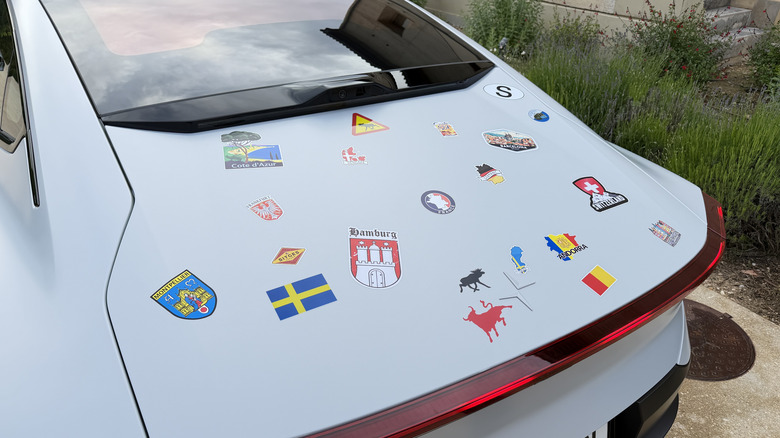
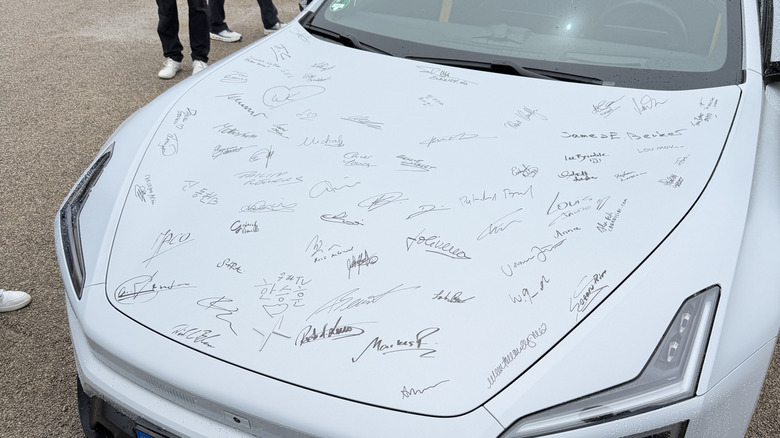
About a month before the media trip started, Polestar did a final run-through of the entire route with many of the same 5s, and then running a week ahead of us was a media team capturing content with two identical cars so it would be ready for us by the time we got there. In addition to the six cars us writers were driving, there was an extra spare of each trim level just in case, as well as two cars being used by us at content capture hubs. There was also a mascot car that accumulated stickers from every place it visited and signatures on the hood from everyone who was on the trip, plus another management car, all Polestar 5s. Oh, and there were also 23 support cars coming along on the journey, mostly Polestar 3s. And a support truck that was a mobile workshop. And also a 5 carrying "flying doctors."
The car justifies its platform
Right, you're here because you want to know about the car. Every one of the routes that Polestar picked for each leg had incredible driving roads and scenery, but the team kept saying how we were on one of the best legs because both days of driving were mainly on "the silent route," spectacular roads snaking through the countryside and carving around mountains called silent because they're essentially never used, not even by tourists people who live in the tiny, ancient towns peppered throughout the area. The roads don't really go anywhere of note, or they're too narrow and twisty to be chosen by tourists. And the route really did feel silent — we only came upon a handful of other drivers in total, with the roads otherwise basically just for us. This was also the longest of the legs, covering 375 miles in total.
Within minutes of leaving our hotel in Sitges the road became so narrow that even when I positioned the Polestar's right wheels over the line on the right shoulder, where there were immediate guardrails or ditches, the car's left tires were fully over the center line. The 5 is a large car, but not especially so — at 200.3 inches long it's about an inch longer than a current Porsche Panamera, and just over an inch wider with the mirrors folded. Even a Miata would struggle to stay between the lines on this road, so I was already taking it pretty slow and cautious, and the road was twisty enough that I wouldn't want to go that fast on it regardless of the width. Then, about fifteen minutes into our drive, the route's silence was broken by a McLaren W1 test car coming towards us around a tight bend. Talk about a "holy s**t" moment. That would be the only other car we came across for an hour.
Luckily the road soon widened up enough to have actual space to drive a car, and I could start having some real fun. For the first day, Cameron and I were in a Performance, the upper of the 5's two trim levels. Its dual motors pump out a total of 884 horsepower and 749 pound-feet of torque, with 603 hp and 487 lb-ft of that being from the in-house-designed rear motor. Polestar says it'll hit 60 mph in 3.1 seconds, but I think that's conservative by at least a few tenths. Flooring it results in a truly invigorating gut-punch of instant acceleration, but the power delivery and throttle mapping is nice and linear, so it's easy to drive the car calmly or zip past a truck without going full hyperspeed.
 Daniel Golson/Jalopnik
Blissfully, Polestar keeps drive modes and adjustability to a minimum. You can toggle between standard or Performance modes for the powertrain, with the latter unlocking more power and increasing the responsiveness; in both cars on both days, we kept it them in the Performance mode basically the whole time, as it doesn't make the car too twitchy or annoying for slower, regular driving.
Polestar could have made a big sedan that looked kind of like the 5 and would probably drive fine if it used one of the Geely brands' existing scalable architectures, but in order to pull off the design and dynamics, it made the pretty wild decision to design an advanced bonded aluminum platform from scratch. Called Polestar Performance Architecture, it's as rigid as a carbon-tubbed two-seat supercar, and lighter and stronger than a typical EV platform. The 5's wheelbase is a massive 120.2 inches, a 4-inch stretch compared to a Panamera, and Polestar says the 5 weighs 5,512 pounds, almost 500 pounds more than a Taycan GTS. But there aren't any active anti-roll bars, air springs, torque vectoring systems or rear-wheel steering to help hide the 5's weight and size — it's just well set up from jump thanks to the PPA architecture, and it felt a lot more agile than I expected going into the drive.
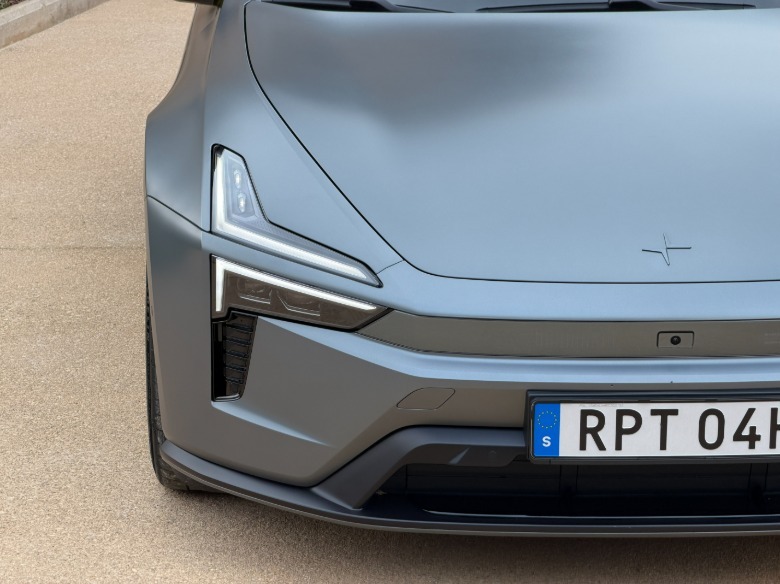
The double-wishbone, front brakes and steering rack are all positioned ahead of the front axle, which not only improved the feedback and handling but also let the designers dramatically lower the hood and set it at an angle that would make a Lamborghini jealous. On both trims you can choose between three different modes for the steering: Light, Standard and Firm. I found Light to be too light for my tastes, with Firm being my favorite, though it will definitely be too heavy for some. While not as sharp as a Taycan, the 5's steering is noticeably more communicative and precise than other Polestars, and the car was a real joy to drive.
 Daniel Golson/Jalopnik
Going for the Performance model gets you coil springs with semi-active MagneRide dampers that read the road up to 1,000 times per second, and three settings for the stiffness (Standard, Nimble and Firm). As we transitioned onto some faster roads with greater elevation changes, the 5 stayed remarkably flat and neutral, even when whipping around uphill hairpins. Though it's clear that the car is heavy, it's far from unwieldy, and the weight balance is a perfect 50:50. Still, I didn't get a great idea of the 5's ride quality because the pavement was essentially perfect on our entire route. It's unclear whether that's because the road is constantly being maintained, or because it's the silent route and no one drives on it, so the surface hasn't needed to be maintained. When we did encounter some rougher areas or drove on cobblestone streets through empty towns, the Performance's ride was always quite smooth.
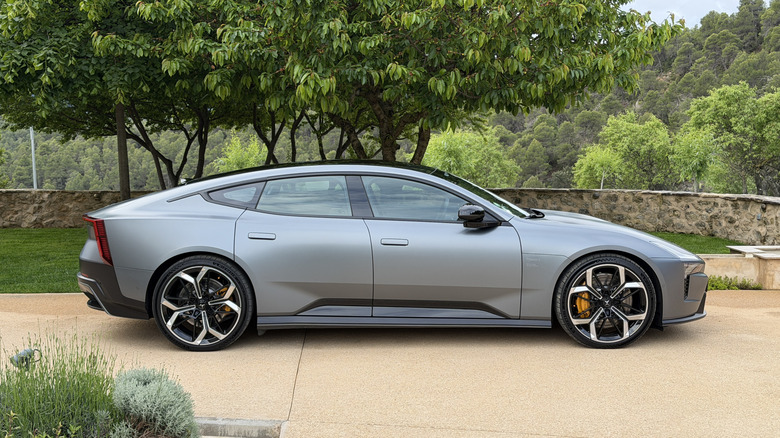
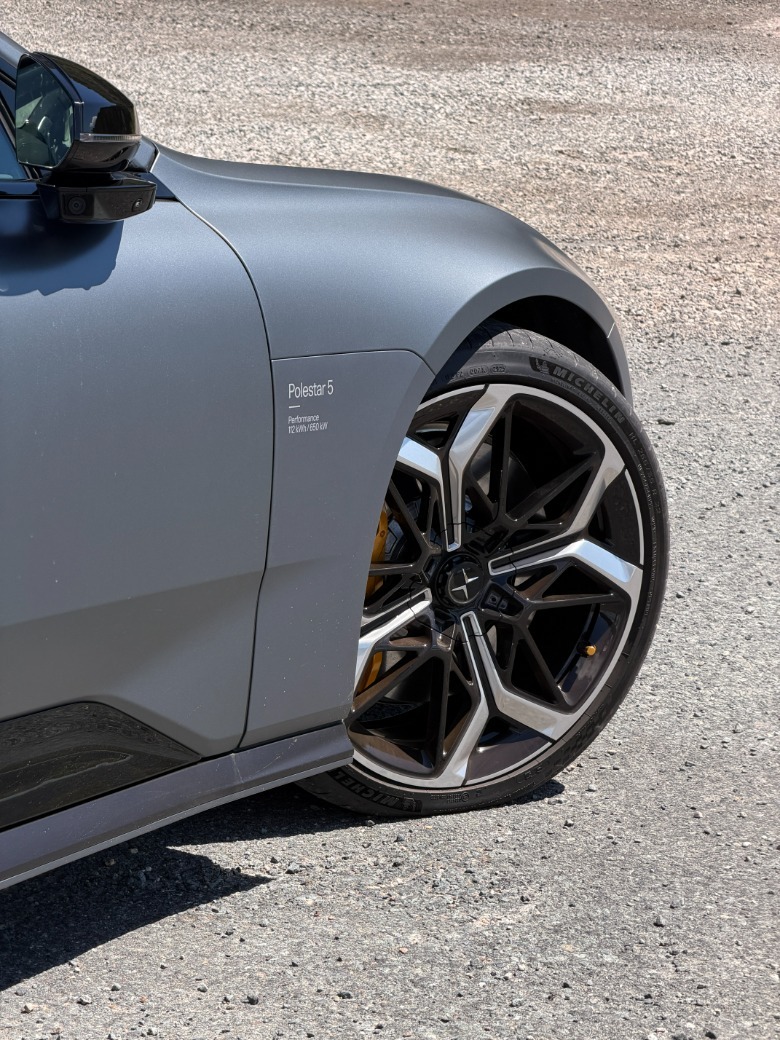
21-inch wheels are standard on the Performance, but these cars were equipped with the optional 22s, wrapped in Michelin Pilot Sport S5 tires with a Polestar-specific compound, sized 255/35 in front and 295/30 in the rear. (The Dual Motor car gets 20-inch aero wheels that are still staggered-width but a size narrower, with all the 21s being the same width as the 22s.) It never felt like I was lacking for grip; if anything I could've pushed the car even harder. The 22s look extremely good, too.
Fitted as standard to both versions of the 5 are Brembo front brakes with four-piston calipers and 15.7-inch two-piece ventilated discs, but it is worth going for the Performance because then you get Swedish Gold calipers that look awesome. The brake pedal felt progressive and firm, but I only had to give it a few light taps even on the fastest sections and sharpest turns. There are three settings for the regenerative braking, with the strongest giving true one-pedal driving that's one of the best-tuned examples I've used. Driving through a town or really hustling in the mountains, the regen was basically telepathic in its behavior.
The monks liked it (probably)
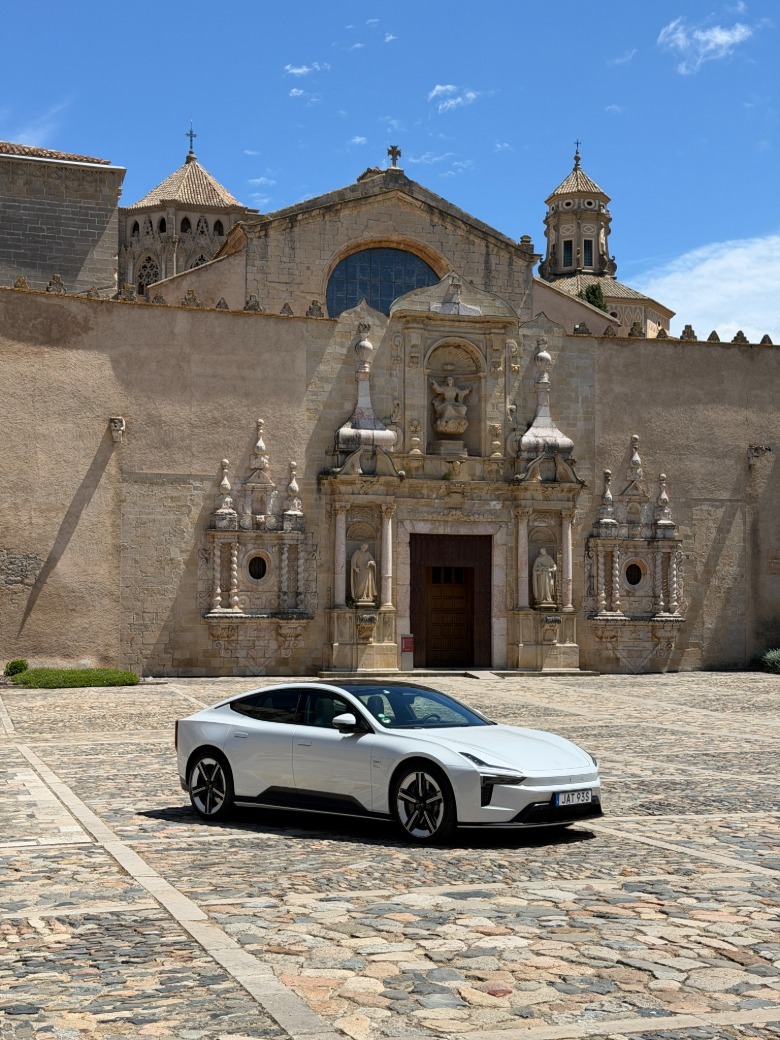
Our lunch stop was at the Santa Maria de Poblet monastery in Tarragona, which was founded by Cistercian monks in 1151. Now a UNESCO world heritage site that has a hotel and restaurant attached, there are still a few dozen monks living there, which is why Polestar had to wait until 1:30 p.m. to stage a car in the courtyard. It was definitely the most interesting backdrop I've seen an automaker use for a content-capture hub, and the contrast between the car and the near-900-year-old architecture made the Polestar look even more out of this world.
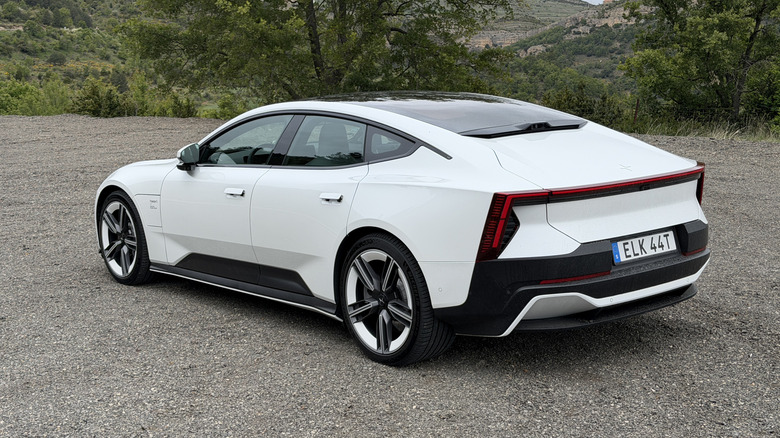
Polestar has been a design-forward brand from the very start, having been led by Thomas Ingenlath from 2017 to 2024, and the 5 is by far its best design yet. In fact, it's one of my favorite new car designs in a long time, and it's impressive that it's stayed so impactful given how not actually new it is — the Precept concept was revealed in early 2020, with the first images of the nearly-identical (and honestly even better-looking) production car being shown a year later. Despite that, the 5 looks more fresh than basically anything else on the road.
 Daniel Golson/Jalopnik
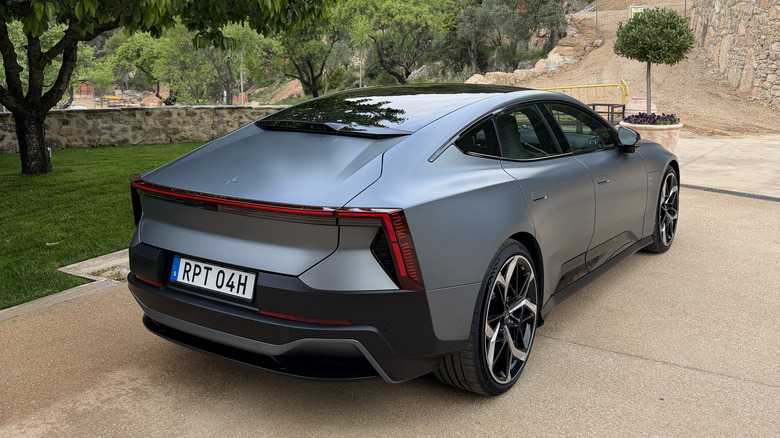
This is one of those cars where the more you look at it, the more you notice. I love the crisp line running from the headlights up along the A-pillar, the kammback tail with its staple-shaped taillights, and the strong rear haunches. Polestar nailed the dramatic proportions, especially when it comes to the overhangs and dash-to-axle ratio, and it doesn't have the thick midsection many EVs are saddled with. Just don't hold your breath for more colors than the current greyscale options, at least not for now.
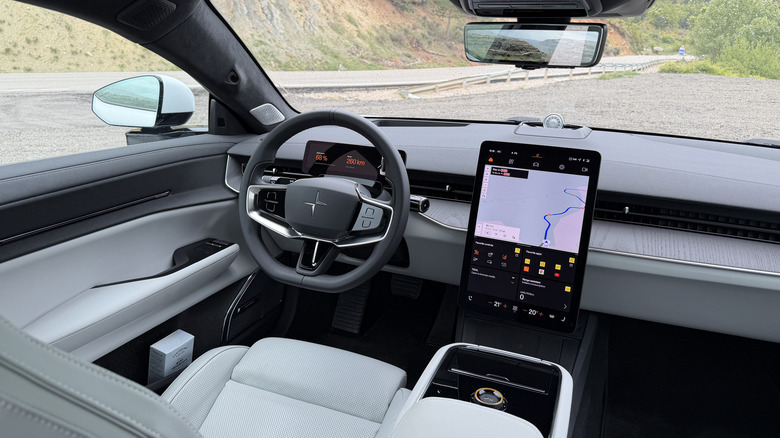
In the afternoon, as a passenger not having to pay attention to the endless twists and turns, I got to fiddling around with the 5's interior in between gawking at the incredible scenery. As with other Polestars, this is minimalism actually done well. Its design will look familiar to anyone who's driven a 3 or a 4, but everything from the dashboard and center console to the door panels are a new design, and the 5's details and material choices really set it apart.
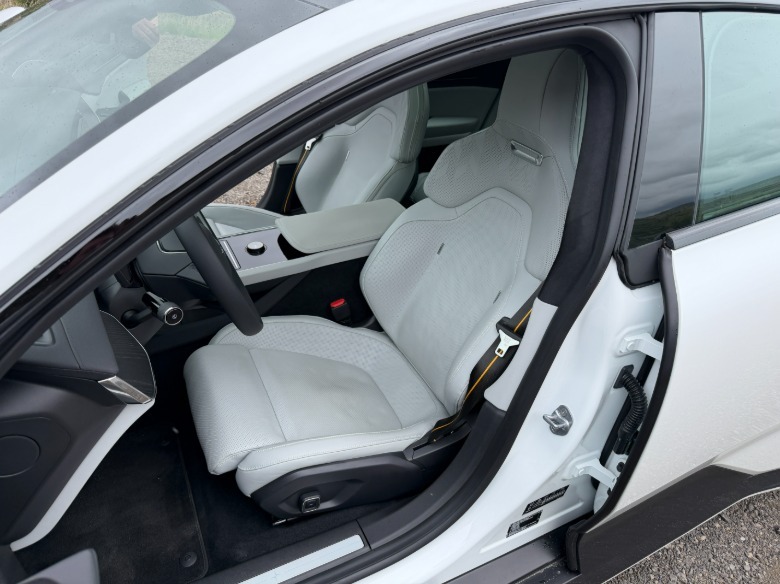
First of all, the seats are f**king fantastic. All Volvos and Polestars have incredible seats, but these ones, designed in partnership with Recaro, are the brand's best yet. All the cars we drove had the Bridge of Weir leather upgrade, which also gets you ventilation and a very good massage function for both rows of seats. Though not as wildly adjustable as Porsche seats, they were extremely comfortable even after hours of driving, and held us tight in the canyons. The slightly relaxed driving position is also great, with the platform allowing a much lower hip-point.
 Daniel Golson/Jalopnik
Competitors might offer "nicer" interiors with more leather and traditional luxury car fittings, but I like the Polestar's mix of interesting recycled materials and leather alternatives. The flax-based natural fiber weave on the seatbacks looks way cooler than carbon fiber, and it's lighter and better for the environment as a bonus. The woven fabric on the upper doors is a nice alternative to just more microsuede, and all the major touchpoints and controls have real metal trim. There's too much piano black on the center console and door armrests, but at least it's kept to a relative minimum.
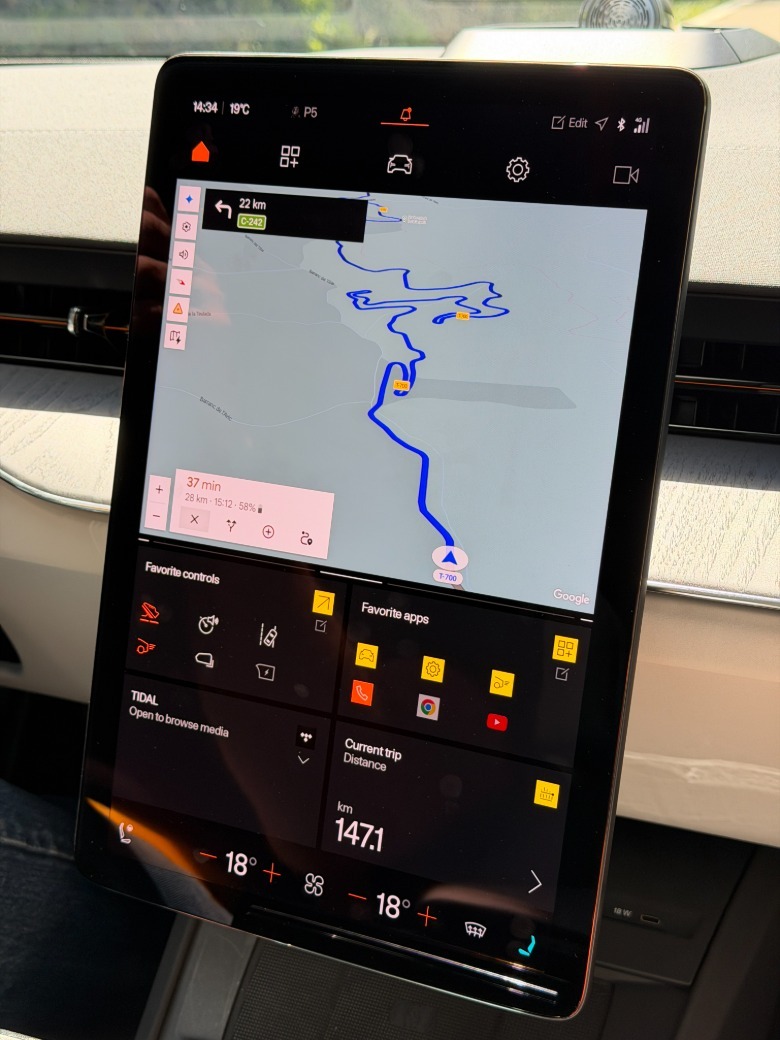
Polestar has really gotten its infotainment system almost perfected, I think. I'm glad there's a digital gauge cluster, with the thin 9-inch screen showing a nice amount of info without it being cluttered, and the ability to display a map. The portrait-oriented 14.5-inch touchscreen has a useful home view with customizable shortcuts to apps and vehicle functions like the dynamic settings, and easy-to-use climate controls. I think the design is super clean, with an excellent font and color scheme, and the Google Maps navigation is fantastic.
What isn't great are the steering wheel controls. They're unmarked, because they do different things depending on the situation. A light brush of your left thumb against the panel brings up the ability to change the regen, drive mode, and speed warning, with instructions in the gauge screen; if you have the adaptive cruise on, then those same buttons control that instead. The right side does a bunch of other stuff, like media controls. You do have to physically press it, so you can't really do it accidentally, but it doesn't feel great and is just too complicated.
The base one is still quick as hell
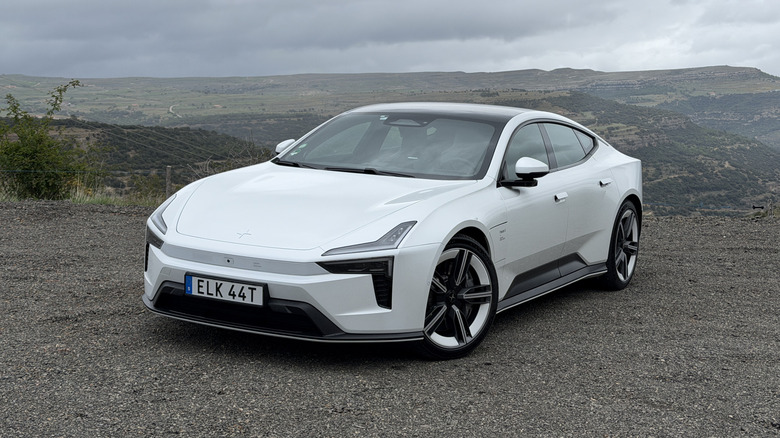
On the second day we switched into one of the white Dual Motor cars. Total output from the motors is down to "just" 748 hp and 599 lb-ft, with 60 mph reached in 3.8 seconds. The Performance definitely felt quicker and more urgent in how it accelerates, but the Dual Motor was still properly fast, even when flooring it at speed. It's got the same 155-mph top speed as the Performance model, too.
While you aren't really losing out on power by going for the Dual Motor instead of the Performance, it does have a lesser suspension setup using passive dampers instead of the MagneRide. There's more body roll and a bit more playfulness in corners versus the planted and precise Performance. The passive setup was still very comfortable, but even with the 22s I preferred how the Performance rode and drove. Either way, the 5's chassis setup is impressive.
It was raining for almost the entire day we drove the Dual Motor, so we weren't really pushing it anyway, and the roads were more long glorious sweepers than the really tight and technical stuff the day before. The Dual Motor car we drove was wearing 21-inch wheels with Michelin Pilot Sport EV all-seasons (also with a Polestar-specific compound) that felt more than grippy enough for the conditions. I like the five-spoke wheel design, though the design team definitely reheated the Taycan's nachos a bit. You can get 22s on the Dual Motor, and I would.
 Daniel Golson/Jalopnik
The Dual Motor car is rated at up to 421 miles of range on the WLTP cycle, but there's no breakdown of ranges for different wheel and tire packages yet. When we left in the morning the car was 95% charged and showed a 200-mile range — chalk that up to the car sitting in the cold overnight, and the previous day's drivers not going slow. 112 miles later, much of which was still driving quite quickly even in the rain, we arrived at lunch with 52% and 124 miles of indicated range left. The Performance is rated at up to 346 miles of range, and it was more than enough for the prior day of driving with a heavy right foot.
Both models' 112-kWh lithium-ion battery pack can be charged at up to 350 kW, which will take you from 10% to 80% in 22 minutes; 200-kW charging at a 400-volt station will do the same in 33 minutes. Though we were given the option to charge if we wanted to, the cars all had enough range for us to reach each lunch stop and overnight location, where Polestar juiced them up using local infrastructure or chargers at the hotels. There aren't exactly charging networks in Morocco, but luckily one entrepreneurial local, the only person in the country to import a Polestar 2, has been installing some of his own charging stations. On the way to Marrakesh the group did stop at the Ouarzazate Solar Power Station, the largest concentrated solar power station in the world, so maybe Morocco will soon be an EV hub.
The elephant not in the room
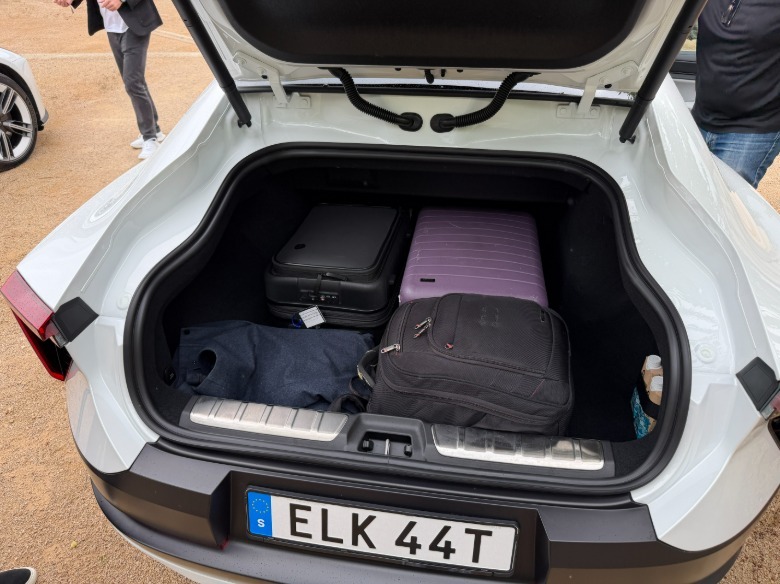
You've probably realized there's one major thing I haven't talked about yet: the 5's lack of a rear window. Partially, that's because I simply never really thought about it while I was driving. The digital rear-view mirror is extremely crisp and clear, with a high resolution and refresh rate that my eyes immediately adjusted to. Its field of view is better than any window and mirror would be on a car like this, and when you turn on your blinker the camera will look in that direction, also dipping down when you go into reverse. It was totally fine in the rain, too. I'll take a camera like this over a window any day.
Visibility was great in general for my 5-foot-9 self, much better than in a Taycan or AMG GT 4-Door Coupe. The side mirrors are big, and even though the 5 has a tall beltline, the side windows are pretty big and there's a sizable quarter window. The A-pillars are a little thick and the windshield is steeply raked, but otherwise the view out the front is great, more akin to something mid-engine than a big sedan.
 Daniel Golson/Jalopnik
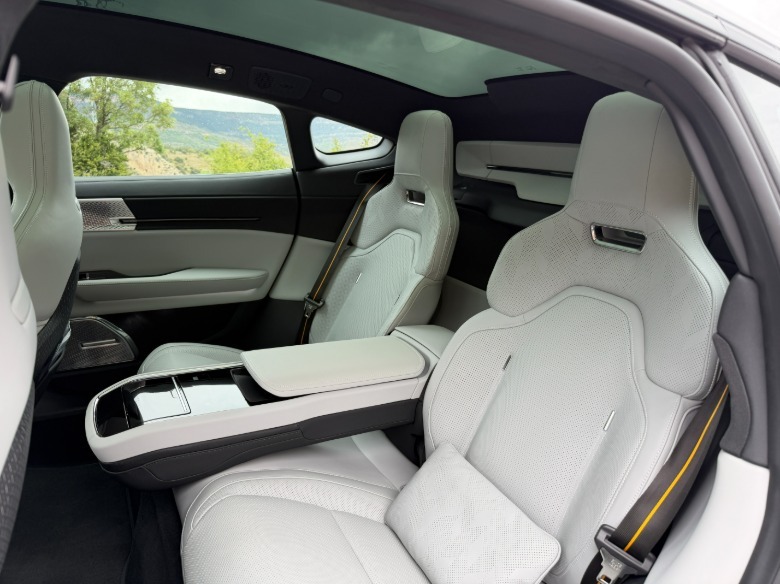
Beyond just styling that's cool and different, getting rid of the rear window allowed Polestar to move the rear header structure well behind the rear occupants' heads, giving the 5 a spectacular back seat. The panoramic glass roof is more than 6 feet long and 4 feet wide, stretching way behind the rear headrests and letting a ton of light into the cabin, and the bulkhead has a nice trim piece with ambient lighting. The rear seats are mounted low and relaxed like the front Recaros, and they're reclinable and available with adjustable lumbar support. Foot garages in the floor help you sit more naturally in the seat, and there is truly a ton of space inside even for people who are over 6-foot-5.
Because of the chunky design of the fold-down center armrest, the car is a 4+1, with the occasional middle passenger sitting a bit far forward of the other rear-seaters, so they aren't bumping elbows. You even get pillows with the leather upgrade. Pillows! Getting the lighter color scheme definitely helps add more visual interest to the interior, but there are lovely design details everywhere, and it absolutely feels Scandinavian. I can't think of any other cars with a back seat like the Polestar 5's, especially not in its segment or price class.
It feels like the future
After lunch it was my turn to be passenger princess again, with even more rain coming at us for most of the afternoon. The Swedes probably make the best seat heaters in the industry, and we made the most of them. At one point we drove through a mountain pass with a lot of construction and logging going on; it seemed like some of it was to prevent trees from falling down onto the road. As someone who watched "Final Destination 2" when I was too young, it definitely wasn't scary at all. Eventually, after passing through yet more ancient towns and beautiful landscapes, we descended back down towards the coast, with the Valencia airport as our goal.
At a more leisurely pace in bad weather, being in the 5 was like being in a relaxation chamber. It's so quiet and comfortable, and there are no fake noises here, just a subtle whirr from the electric motors. Even at highway speeds or while hustling on twistier sections Cameron and I were able to hold a regular conversation with each, and we had been happily chatting away all of both days as we drove through the countryside.
That's what grand touring is really about, and part of why this trip was so special. With me coming from the U.S. and him from New Zealand, we would have almost never been on the same drive program, let alone be partnered up together. We talked about how our countries' media and auto industries compare, things in our lives we've done outside of cars, and of course shared airline travel stories. The previous night we bonded over a love for Tintin with Robbe from the Polestar PR team, who started out in Belgium and now is based in Gothenburg. Tintin was somehow brought up at dinner, and nearly at the same time as I said I had packed a Tintin sweater to wear on the last day, Cameron held up his arm to show a Tintin tattoo, which I somehow hadn't noticed. Our excitement and laughter in that moment will be how I remember this trip.
 Daniel Golson/Jalopnik
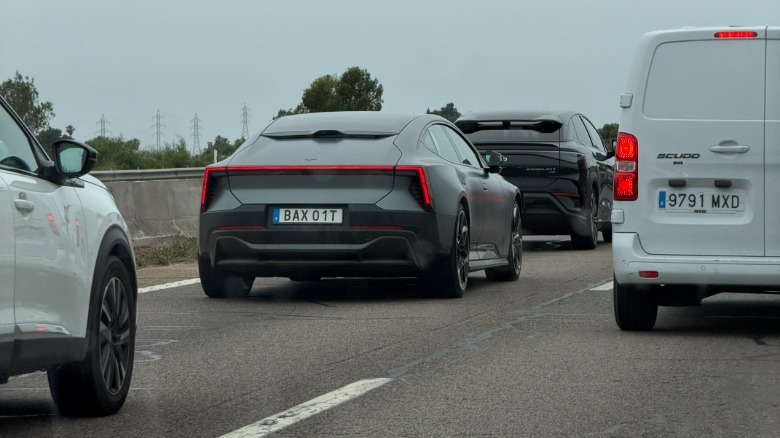
In the last hour of the drive as we approached Valencia we got stuck in stop-and-go traffic, with a couple other 5s peppered along the highway. The car already looked phenomenal on its own and surrounded by other Polestars, but in context of regular hatchbacks and crossovers and vans, the 5 looked completely out of this world. As a kid I obsessively watched the 1986 film "The Flight of the Navigator," in which a young boy discovers a sentient chrome spaceship that takes him forward through time. I would rent that movie from the town library multiple times a week, dreaming that it would happen to me — even though the movie is kinda traumatic for a bit.
Being around the Polestar 5 felt like that ship touched down in our reality, here to transport us eight years into the future where cars can look and feel like that. Whether parked against a screensaver-worthy backdrop or in front of a thousand-year-old castle, the 5 looked like nothing else we encountered in Spain. That it felt equally special to be inside of and to drive, and that it's so well-suited to a legitimate continent-spanning road trip, makes the 5 all the more impressive.
But what about U.S.?
Polestar currently sells cars in 28 markets, and 24 of them are getting the 5 at launch, with full production already underway and the first deliveries set for the second half of 2026, mere weeks from now. Sadly, the United States is one of those four outliers that isn't getting it at first, and you can blame our government for that. The 5 was designed in Sweden and mainly engineered in the United Kingdom, where the chassis was developed, but it's built in China. That means it would currently be subject to an extraordinary tariff making it too expensive — this is already a niche car in a niche segment that is meant to be a halo model more than a volume seller. Tariffs are why the 6 roadster has been delayed, too.
But in Europe, the Polestar 5 is pretty well priced given all of its substance. In Germany, the Dual Motor starts at €100,756 before VAT, or about $117,000. As a Launch Edition car, it comes with nearly everything you want as standard, from comfort and convenience features to active-safety systems. The Performance adds its performance-y stuff, plus some of the Dual Motor's options like a Bowers & Wilkins sound system, with a price of €120,084 in Germany, or about $140,000. In our current world, where a Lucid Air Grand Touring costs around $120,000 and a Taycan GTS is nearly $160,000 (€125k before VAT in Germany), the Polestar 5 isn't an absurd prospect.
Polestar promises the 5 will be coming to the U.S. at some point, we just don't know when yet. If it can stick close to that European pricing here, I think there are a lot of grand touring enthusiasts and aficionados of fantastical design that could easily fall in love with the Polestar 5. It's sure to be a rare sight no matter what, the sort of car where you'll always remember the last time you saw one. Hopefully, for you, that'll be every day, with you behind the wheel.