

The 2026 SUVs With The Most Cargo Space
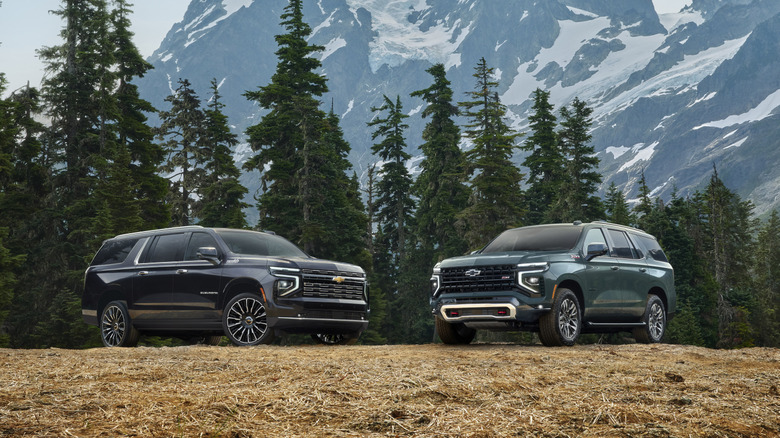
Let's not mince words — modern vehicles aren't just transportation devices, they're also mobile bases of operations. Today, it's no longer just about carrying soccer balls and clothes, but also bikes, electronic gadgets, pop-up tents, and massive beverage coolers. The modern SUV fits the command center theme better than ever before. It offers minivan-like interior volume for passengers and cargo, without carrying the dreaded minivan image.
Now, modern minivans are also cool in our eyes, but buyers still love SUVs more. So, in this piece, we'll give you the 2026 SUVs that are the closest to minivans in terms of interior space. Each of these models has three usable seating rows and ample cargo area, particularly with the third row folded. Some of them even come with highly efficient hybrid powertrains, while others match supercars in a straight line. One thing is certain — every model listed here has enough cargo space to swallow all your belongings without any Tetris gymnastics required. Let's see how they stack up!
2026 Volkswagen Atlas (20.6 cubic feet; 55.5 cubic feet; 96.8 cubic feet)
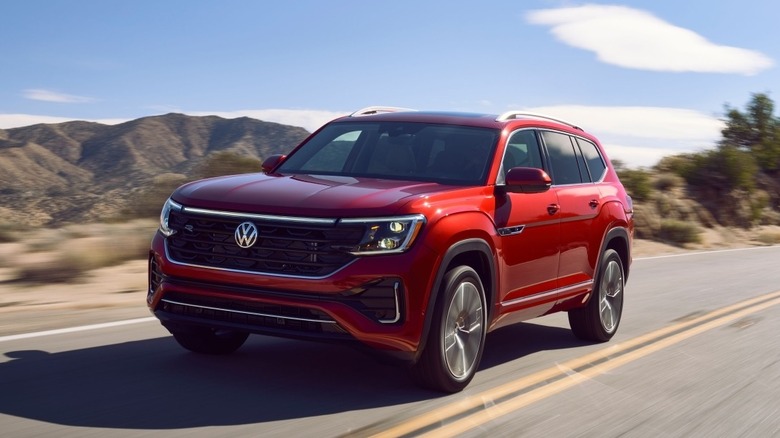
While Volkswagen's three-row SUV has maintained steady sales recently, it still trails behind most of its competitors, like the Toyota Grand Highlander and Honda Pilot. And it's not because it's bad at the practicality game. The Atlas has a sizeable 20.6 cubic feet of trunk space with all three rows in place, which grows to 55.5 cubic feet if you fold the third row. With the second and third row folded, the Atlas provides a van-like 96.8 cubic feet of cargo volume. Additionally, the cabin has numerous useful nooks and crannies. It also offers ample passenger space, even in the third row.
Perhaps a reason why the Atlas remains outpaced in sales is the lack of a fuel-efficient hybrid powertrain. VW offers only one engine in its three-row SUV — a 2.0-liter turbocharged four-cylinder, good for 269 horsepower and 273 pound-feet of torque. It offers good acceleration off the line and comes paired with a smooth eight-speed automatic as standard. Still, with a combined EPA rating of 23 mpg for the FWD variant and 22 mpg for the 4Motion AWD, it's significantly thirstier than its hybrid rivals. The 2026 Atlas starts at $40,785 with destination fees.
Interestingly, the brand-new 2027 Volkswagen Atlas will again be offered the 2.0-liter turbo-four, albeit a slightly updated version with 282 hp. Fortunately, VW promised that the mid-cycle refresh will bring a 48-volt hybrid to the range, which should improve fuel economy.
2026 Infiniti QX80 (20.4 cubic feet; 56.3 cubic feet; 97.1 cubic feet)
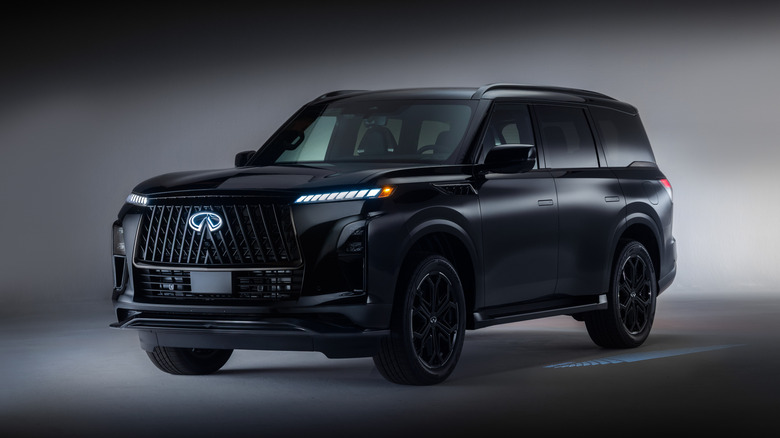
In 2024, Infiniti introduced the brand-new QX80. A huge upgrade over the predecessor, the 2025 Infiniti QX80 brought a twin-turbo V6 and a tech-laden interior to the table. Yes, this means that the predecessor's V8 was gone, but with 450 horsepower (up by 50 hp) and 516 pound-feet of torque (up by 100 pound-feet), the new 3.5-liter engine is no slouch. Furthermore, Infiniti replaced the seven-speed auto with a new nine-speed unit.
Inside, the new QX80 offers dual 14.3-inch screens, Google software, and Biometric Cooling that automatically adjusts airflow if it detects a passenger is hot via an infrared sensor. The cabin is very spacious, too. Each row, including the third, offers ample space for passengers. Behind the third row, there is a useful 20.4 cubic feet of cargo volume, which grows to 56.3 cubic feet with two rows in place. Fold the second row, and you are looking at 97.1 cubic feet of cargo volume.
The new QX80 also has a rugged edge. Every model is equipped with a limited slip differential, while the optional Electronic Air Suspension can raise the SUV by 2.1 inches to increase ground clearance. Additionally, the QX80 can tow up to 8,500 pounds. Infiniti's flagship SUV starts at $89,040 (including destination fees) for the Pure 4WD trim.
2026 Toyota Grand Highlander/Lexus TX (20.6 cubic feet; 57.9 cubic feet; 97.5 cubic feet)
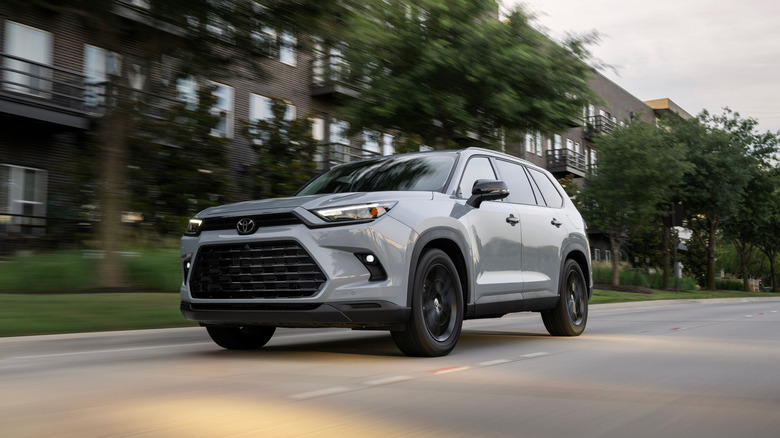
Launched for the 2024 model year, the Grand Highlander finally brought Toyota customers a usable third row. The smaller Highlander is decent in the first two rows, but it has a tight third row and a small 16-cubic-foot trunk. The Grand Highlander is much bigger inside. Not only does it have a usable third row for adults, but it also has a bigger 20.6-cubic-foot trunk. The capacity grows to 57.9 cubic feet with five seats in place and 97.5 cubic feet with the second row folded.
Naturally, Lexus launched its own version of the Grand Highlander, the TX. The luxurious alternative has a similar cargo volume (20.2 cubic feet; 57.4 cubic feet; 97 cubic feet) and the same base 2.4-liter turbo-four with 275 horsepower (the Toyota gets 265 hp). The two also share the electrified Hybrid Max version of this engine, which produces 366 hp in the TX and 362 hp in the Grand Highlander. However, the Grand Highlander is also available with the fuel efficient 2.5-liter four-cylinder hybrid, while the 3.5-liter V6 PHEV with 404 hp is exclusive for the pricey Lexus TX 550h+.
The TX is the more upmarket vehicle, but it's also significantly more expensive. The Grand Highlander starts at $43,455 (with destination fees), with the 2.5-liter hybrid costing $46,805 (including fees). Meanwhile, the TX starts at a whopping $58,920 (with destination fees). If you want the potent TX 500h+, you'll need to shell out $82,160 (including fees)! Alas, you'll get the well-equipped Luxury trim as standard, but that's still a lot of money for an amped-up Toyota.
2026 Chevrolet Traverse/GMC Acadia/Buick Enclave (23 cubic feet; 57.3 cubic feet; 97.5 cubic feet)
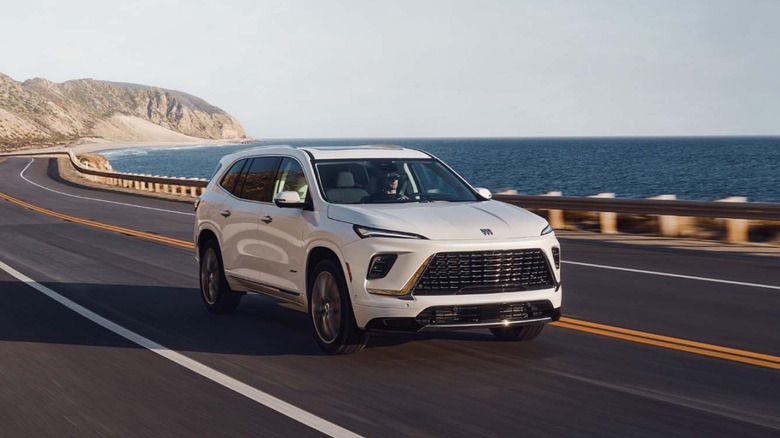
Toyota isn't the only one trying to milk more models from one platform. GM has done the same with the Chevy Traverse, GMC Acadia, and Buick Enclave. Each of these three-row SUVs has competitive cargo space — the Traverse has 22.9 cubic feet behind the third row, 56.6 cubic feet behind the second, and 97.6 cubic feet with only the front two seats in place. The Acadia (23 cubic feet; 57.3 cubic feet; 97.5 cubic feet) and Enclave (22.9 cubic feet; 57.1 cubic feet; 97.5 cubic feet) have similar capacities.
Unlike their rivals from Toyota and Lexus, GM's trio comes with only one powertrain — a 2.5-liter turbocharged four-cylinder paired with an eight-speed auto. With 328 horsepower and 326 pound-feet of torque on tap, it's a potent engine but also a thirsty one. The Traverse is EPA rated at only 22 mpg combined for the FWD model. For comparison, a Grand Highlander Hybrid is good for 36 mpg combined!
The Traverse is the cheapest, starting at $42,975 (with destination charges). That would make Chevy's three-row SUV cheaper than the Grand Highlander, although it has a significantly more powerful engine. The GMC Acadia starts at $45,795 (including fees), while the Enclave enters premium territory with a base price of $48,395 (with fees). Each of GM's three-row SUVs comes as standard with FWD, with AWD being available as an option.
2026 Honda Pilot (22.4 cubic feet; 60.1 cubic feet; 112.4 cubic feet)
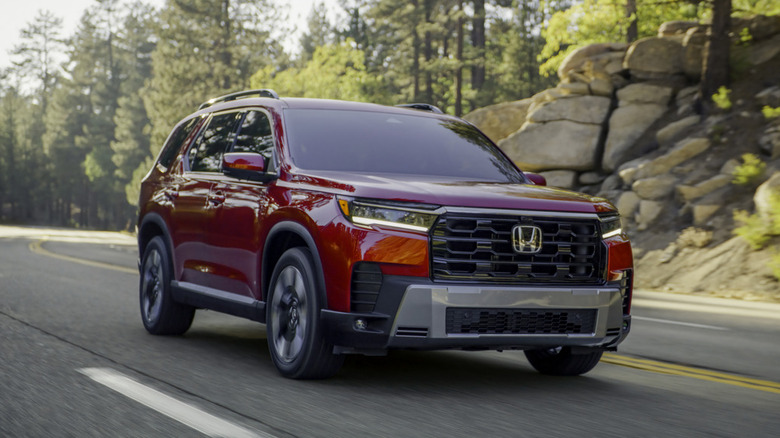
With a base price of $43,890 (including destination charges), the Honda Pilot is a tad more expensive than the Traverse and Grand Highlander, but it also comes with a V6. The 3.5-liter engine produces 285 horsepower and 262 pound-feet of torque, which isn't all that powerful, but at least it sounds better than a four-banger. The V6 is paired exclusively with a 10-speed automatic and comes standard with FWD, though AWD is optional.
Like its closest rivals, the 2026 Pilot can comfortably accommodate adults across all three rows. It also has a competitive cargo volume of up to 22.4 cubic feet (EX-L trim) behind the third row if you account for the hidden storage under the cargo floor. Without it, the capacity falls to 18.6 cubic feet. With two rows in place, the capacity grows to 60.1 cubic feet with the second-row seats fully forward, or up to 113.7 cubic feet (TrailSport trim) with two seats in place. These are some very competitive numbers, but they do require some gymnastics.
That said, the middle second-row seat is removable (Touring and Elite trims) and can be stashed in the hidden storage under the trunk, turning the other two seats into captain chairs. The 2026 Honda Pilot also went big on screens — every trim comes standard with a 12.3-inch infotainment screen and a 10.2-inch instrument cluster. Fortunately, Honda left the physical climate controls intact for the 2026 model.
2026 Cadillac Escalade IQL (24.2 cubic feet; 75.4 cubic feet; 125.2 cubic feet)
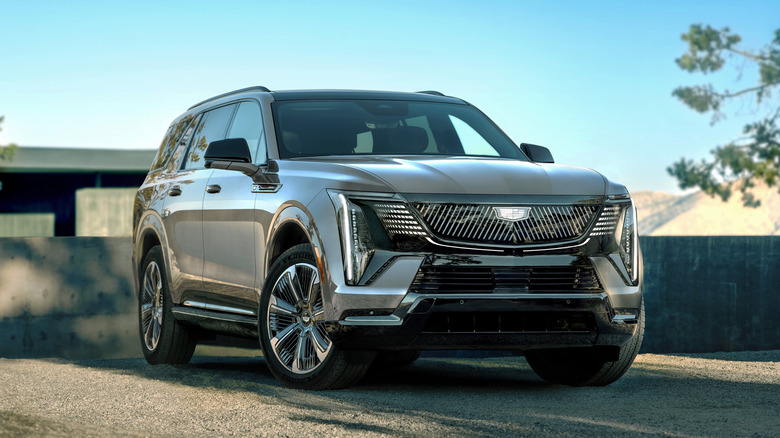
The Cadillac Escalade IQL brings the same brand of maximalist excess as its gas-powered sibling, albeit in EV form. Look no further than its colossal 205-kWh battery pack — a unit massive enough to power nearly three standard electric crossovers, like the excellent Hyundai Ioniq 5. And while its estimated 460-mile range is certainly impressive, it's just the result of brute-force battery scale. The dual-motor powertrain is mega, too, packing 750 horsepower and a whopping 785 pound-feet of torque with Velocity mode enabled. That's enough to bring the 9,000+ pound SUV to 60 in just 4.7 seconds!
The Escalade IQL is massive inside, too. It has 24.2 cubic feet of cargo volume behind the third row, or 75.4 cubic feet behind the second row. With two seats in place, the IQL can swallow a whopping 125.2 cubic feet of cargo. The shorter Escalade IQ isn't far behind, boasting 23.6 cubic feet, 69.1 cubic feet, and 119.1 cubic feet of cargo capacities. Moreover, both models have a 12-cubic-foot front trunk. Still, the Escalade IQL has 4.4 inches more legroom in the second row and more headroom in the third row, thanks to the longer wheelbase.
However, it's the multimedia experience that sets the Escalade IQ/IQL apart from their rivals. They both come with a massive 55-inch display on the dashboard and two 12.6-inch displays for the rear passengers, alongside an optional, AKG-branded 21-speaker audio system. Unfortunately, Cadillac's infotainment doesn't support Apple CarPlay.
2026 Chevrolet Tahoe/GMC Yukon (25.5 cubic feet; 72.5 cubic feet; 122.7 cubic feet)
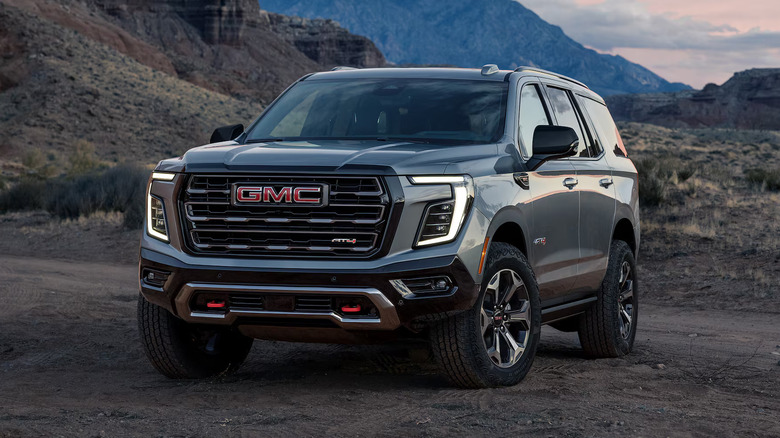
For the largest SUV cargo volumes, you need to enter full-size, body-on-frame territory. The Chevy Tahoe ($63,495 with fees) and its upmarket sibling, the GMC Yukon ($72,395 with destination charges) are some of the most approachable full-size SUVs. They both have the same cargo capacity at 25.5 cubic feet behind the third row and 72.5 cubic feet behind the second row. The overall cargo volumes of 122.7 cubic feet for the Tahoe and 122.8 cubic feet for the Yukon are pretty much equal, too. Both SUVs are very spacious for passengers, providing ample room in all three rows, with many storage areas spread around the cabin.
The Tahoe and Yukon share the same powertrains. The base option is a 5.3-liter V8 with 355 horsepower, or you can upgrade to a 420-hp 6.2-liter V8. They are certainly potent — particularly the larger engine, but also thirsty. The Tahoe and Yukon with the 6.2-liter V8 and 2WD have an abysmal 17 mpg combined EPA rating. Fortunately, they are also available with a 3.0-liter inline-six turbodiesel, which produces 305 hp and returns 23 mpg combined. The diesel is slower than the V8 alternatives, but, thanks to its 495 pound-feet of torque, it can tow 8,200 pounds. That's just 100 pounds short of the 6.2-liter V8 and 200 pounds short of the 5.3-liter V8.
2026 Ford Expedition & Expedition Max (36.1 cubic feet; 75.4 cubic feet; 123.1 cubic feet)
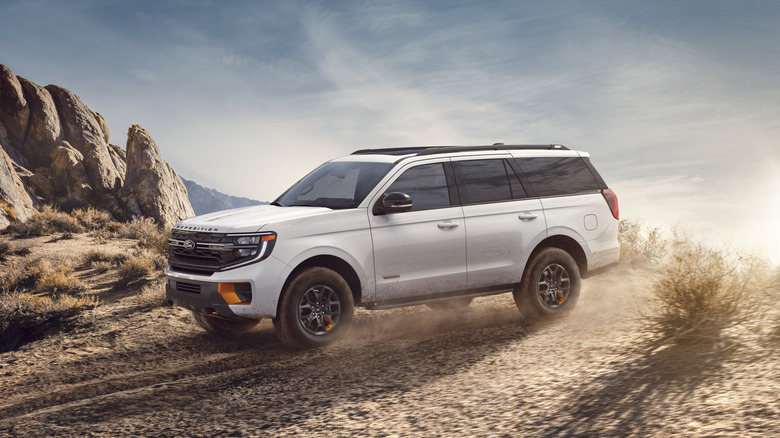
Ford's answer to GM's three-row SUV offerings is also a two-pronged affair. The Expedition acts as the budget-minded model, while the Lincoln Navigator is the premium offering. Both share the same platform and 3.5-liter twin-turbo V6 engine, which is available with 400 horsepower or 440 hp in the Expedition. A 10-speed auto is the only transmission offered. Unfortunately, Ford doesn't offer a fuel-efficient diesel or hybrid alternative in the Expedition, so you'll have to be satisfied with 19-mpg combined in the RWD model.
The Expedition comes in a standard and extended variant, the Expedition Max. The longer model is truly massive inside, with 36.1 cubic feet of cargo volume behind the third row, 75.4 cubic feet behind the second, and 123.1 cubic feet behind the front two seats. Seating is also very comfortable, even in the third row. The regular Expedition offers good interior room in all three rows, with 21.6 cubic feet, 60.8 cubic feet, and 108.5 cubic feet of cargo volume. It also has a class-leading towing capacity of 9,600 pounds, with the Expedition Max topping at 9,000 pounds.
The Expedition's driver seat has a living room feel to it, thanks to the large 24-inch dashboard display and a 13.2-inch center touchscreen. The materials are nice, too, particularly in the higher trims. The Expedition starts at $65,495 (including destination charges), with the Expedition Max costing an additional $3,000, plus $2,795 in destination fees.
2026 Lincoln Navigator & Navigator L (37.4 cubic feet; 84.5 cubic feet; 121.6 cubic feet)
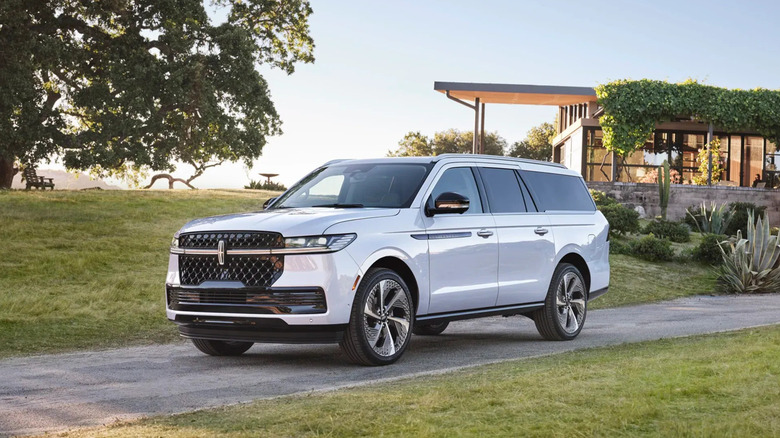
The Navigator is a more luxurious alternative to the Expedition. It comes standard with the more powerful 440-horsepower engine and AWD. As a result, the Navigator is rated at only 17 mpg combined, or just 1 mpg higher than the GMC Yukon with the 6.2-liter V8 and AWD.
Inside, the Lincoln Navigator is a rolling lounge on wheels with a standard 48-inch panoramic screen, alongside an 11.1-inch center touchscreen below. The materials are plusher, too, but that's to be expected, as it starts at a whopping $94,890 for the Premiere trim, with the high-end Black Label trim costing $122,420 (prices include destination fees). Opting for the cavernous Navigator L adds a $3,000 premium. Perhaps a saving grace for customers is the standard BlueCruise highway-driving feature, which is a $2,495 option for the Expedition.
Interior space in both SUVs is similar. Like the Expedition Max, the extended Navigator L variant has a massive cabin, with ample passenger room and a sizeable 37.4-cubic-foot trunk behind the third row. The cargo volume grows to 84.5 cubic feet with the third row folded and up to 121.6 cubic feet with the second row down. The regular Navigator is still competitive with 22.9 cubic feet, 69.9 cubic feet, and 107 cubic feet of cargo space.
2026 Jeep Grand Wagoneer & Grand Wagoneer L (42.6 cubic feet; 88.8 cubic feet; 116.7 cubic feet)
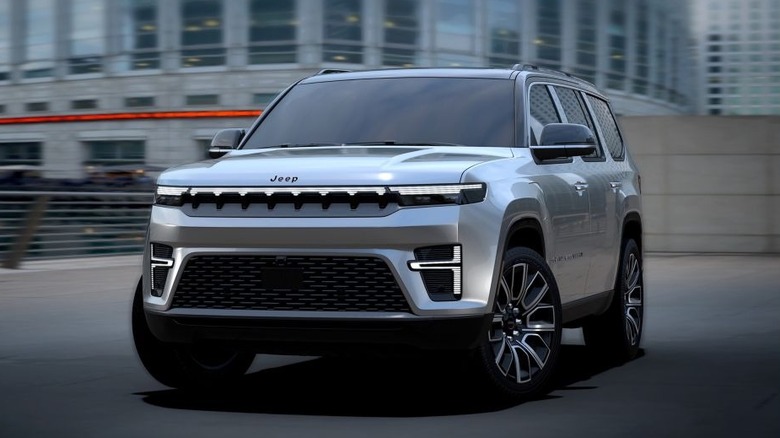
Jeep refreshed the Grand Wagoneer for the 2026 model year, giving it a cleaner look and a range-extended PHEV variant with 647 horsepower and 620 pound-feet of torque. It packs a massive 92-kWh battery that provides ample 150 miles of range. Still, the PHEV is yet to hit dealerships. For now, you have a choice of only one engine — a 3.0-liter twin-turbo Hurricane inline-six with 420 hp.
We still have no idea whether the Grand Wagoneer PHEV will have the same interior volume as the gas Grand Wagoneer. For now, you are looking at a cargo capacity of 27.9 cubic feet, 70.8 cubic feet, and 94.2 cubic feet for the regular model. As expected, the extended Grand Wagoneer L is significantly bigger inside, offering 42.6 cubic feet behind the third row, 88.8 cubic feet behind the second row, and up to 116.7 cubic feet with all rear seats folded.
The Grand Wagoneer is a tech fest inside, packing a center touchscreen of up to 12 inches, alongside an optional 10.3-inch passenger display and two optional rear-seat 10.1-inch touchscreens. The Grand Wagoneer starts at $66,790 (including destination fees), with the extended variant commanding a $3,000 premium.
2026 Cadillac Escalade & Escalade ESV (41.5 cubic feet; 94.1 cubic feet; 142.2 cubic feet)
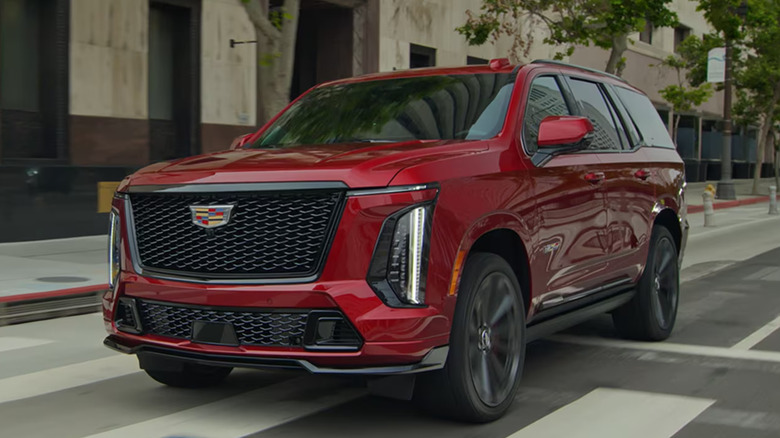
Cadillac's three-row colossus competes directly with the Lincoln Navigator in terms of sheer opulence. Inside, it has an even bigger 55-inch OLED widescreen display that spans the entire dashboard, accompanied by an additional center touchscreen below that controls the climate. The materials inside are luxurious, and there is ample room for adults in all three rows.
Naturally, the extended Escalade ESV is bigger. Behind the third row, it can accommodate 41.5 cubic feet, compared to 25.5 cubic feet for the regular variant. With the third row folded, the Escalade ESV swallows 94.1 cubic feet of cargo, while the regular model sits at 72.9 cubic feet. With only two seats in place, the ESV has a van-like capacity of 142.2 cubic feet, compared to 120.5 cubic feet in the regular Escalade.
The Escalade has one feature that sets it apart from the industry, though — a 6.2-liter supercharged V8. Available in both the regular and extended versions, this high-performing engine produces 682 horsepower and 653 pound-feet of torque, enough for a 0-to-60 sprint of just 4.4 seconds. The regular 6.2-liter V8 with 420 hp is also no slouch and starts at significantly lower $93,995, with destination charges. Meanwhile, the Escalade V costs a cool $170,895 with fees.
2026 Chevrolet Suburban/GMC Yukon XL (41.5 cubic feet; 93.8 cubic feet; 144.7 cubic feet)
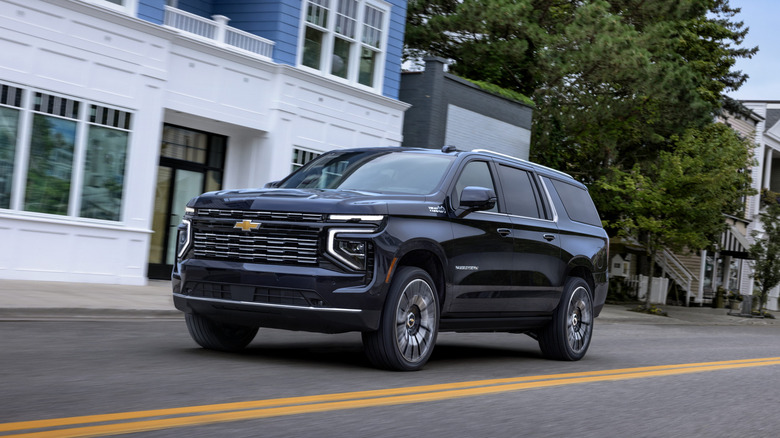
The Chevrolet Suburban, which is essentially the extended variant of the Tahoe, and its cousin, the GMC Yukon XL, offer the highest overall cargo capacity of any SUV at 144.7 cubic feet (Yukon XL) and 144.5 cubic feet (Suburban). With all three rows in place, they both offer a competitive 41.5 cubic feet, while folding the third row reveals a massive 93.8-cubic-foot trunk. Both can also seat up to eight adult passengers in excellent comfort, which means that they are some of the few remaining vehicles that still offer front bench seats.
Unsurprisingly, the Suburban and Yukon XL share the 5.3-liter V8, 6.2-liter V8, and 3.0-liter diesel powertrains with the Tahoe and Yukon. Equipment levels are similar, too, though the added interior space will cost you an additional $2,400 for the Suburban (in comparison to the Tahoe) and $3,000 for the Yukon XL (compared to the regular Yukon). Although the Suburban and Yukon XL share the same platform, they have different tech inside. The Suburban has a landscape-oriented 17.7-inch touchscreen in the middle, while the Yukon XL has a 16.8-inch portrait-oriented touch display. Both have a similar 11-inch driver's information display and can be optioned with the handy SuperCruise hands-free driving feature.