

Consumer Reports' Top USA-Made Cars Could Unlock Some Major Loan Deductions

Sure, the Tax Policy Center — a joint effort of the Urban Institute and the Brookings Institution — says that President Donald Trump's One Big Beautiful Bill will primarily benefit the rich. After all, almost 60% of the tax benefits will go to the top 20% of U.S. taxpayers this year, meaning those who make at least $217,000 annually. Yet in all fairness, there are some aspects of the bill that can be a boon for the rest of us.
The act, for example, features an auto-loan tax break that could be worth up to $10,000 to qualifying buyers — and, importantly, it only covers folks making $100,000 a year or less (or $200,000 for jointly filing married couples). But this tax benefit only applies to purchases of vehicles that undergo their final assembly process in the United States. You can determine this by looking at the car's window sticker, door-jamb label, or vehicle identification number. (The National Highway Traffic Safety Administration helps with the latter by offering a free VIN-decoding tool online.)
Something else nearly as important to keep in mind is that the deduction is expected to expire after 2028. In other words, if you took out a typical car loan today — when average loan lengths are nearly six years — roughly the final three years of interest won't be deductible.
As for which vehicles qualify, we're decoding information from that icon of independent automotive knowledge known as Consumer Reports. According to CR's ranking, only two so-called American brands — compared to four foreign brands — had products among CR's top choices.
CR says the Model Y leads among U.S.-made EVs
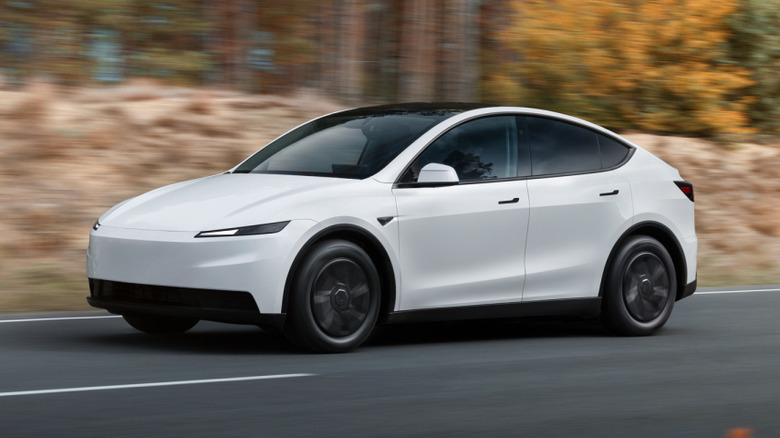
Oddly enough, the top electric vehicle in CR's American-made rankings isn't actually made by an automaker. It's the 2026 Tesla Model Y, from a business that recently doubled down on not being a car company. Nor is this a mercy pick where other, non-American vehicles rated higher in the same segment: The Model Y is the No. 1 choice overall in CR's electric SUV category, ahead of 10 other machines — backed by particularly strong scores for road-test performance, predicted reliability, and customer satisfaction.
Those benefits helped the Model Y slip into the U.S. automotive bestseller list for 2025 in 8th position, with about 317,000 sales. True, it was a steep drop from the year before, when it ranked 4th in the U.S., but not steep enough to knock the Model Y off its throne as the top-selling EV globally.
In terms of how the tax credit would play out with the Model Y, let's use its current starting price of $39,990, plus $1,640 in destination and order fees. Next, we factor in a 10% downpayment (for easier math) and assume a buyer with an average credit score (713), an average-length six-year auto loan, and an average interest rate of 6.27%, with no trade-in. The result is you're on the hook for $7,569 in interest over the length of the loan. However, since the tax deduction we're talking about ends in 2028, you'll only be able to get credit for the first three years' of interest — in this case, about $5,533 in total after amortization.
CR's best made-in-America mainstream cars were the Civic and Camry
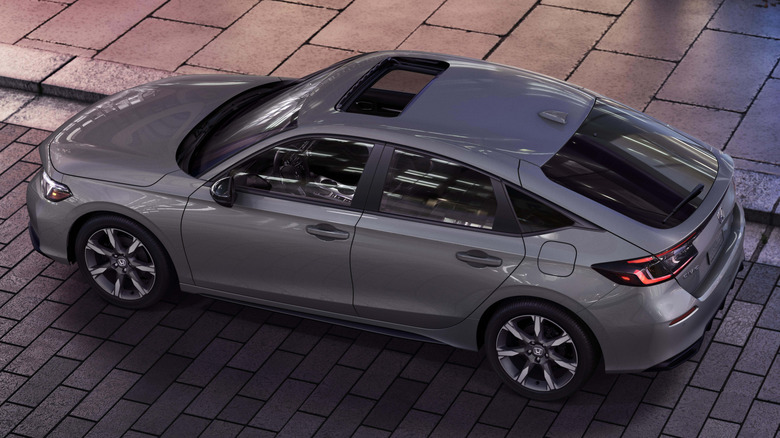
Turning to Consumer Reports' top small and midsized cars, we've two nameplates with long histories of American production. The compact Honda Civic was one of the first cars to come out of the automaker's first U.S. auto plant, which opened in 1982 in to produce the Accord and started building Civics in 1986. The midsize Toyota Camry has been manufactured in Georgetown, Kentucky since 1988.
Frankly, CR didn't seem all that enamored of the 2026 Honda Civic, ranking it 14th overall among 20 small sedans/hatchbacks — despite calling it an "excellent small car." The Civic's handling and fuel economy were highlights, though, with the latter getting a nice boost from the hybrid Civic models. Now, since those were considered the best of the Civics, and only hatchback Civics are made in the U.S. (in Greensburg, Indiana) — the Civic sedans are produced in Canada — we'll plug a hybrid hatch into our savings equation. The outcome? Beginning with a suggested price of $30,595 (plus $1,195 for destination), folks driving the platonic ideal of economy cars will pay $5,792 in interest and can enjoy $4,234 in tax deductions.
The Camry, for its part, is now all-hybrid, and like the Model Y, it checks in as the the No. 1 choice in its category. What's especially notable here is that the Camry hybrid midsize sedan costs (slightly) less than the compact Civic hatchback hybrid. The Camry's starting point of $29,300 (plus $1,195 in destination charges) translates into interest payments of $5,556 over the life of the loan and, therefore, a savings of $4,062 before the end of the tax deduction.
Crosstrek, Forester, Grand Highlander are CR's patriotic picks among the mainstream SUVs
Although it's no longer Consumer Reports' most reliable car brand — Toyota got the nod instead — Subaru remains a popular pick among the website's editors. In fact, two Subaru SUVs were on the CR American-made list for 2026, including the compact Crosstrek. Well, not all Crosstreks, as the hybrid version is built in Japan and doesn't qualify for Trump's tax deduction. The gas-powered Crosstreks, on the other hand, are made in Lafayette, Indiana, so $3,785 out of $5,177 in interest payments can be deducted from your taxes: That's with the Crosstrek opening at $26,995 plus $1,420 in destination charges.
All models of the Subaru Forester, in contrast, are made in Indiana, whether you're shopping for a hybrid edition or the wildly capable 2026 off-road Wilderness trim. Speaking of which, if we mix things up and focus on that edition instead of the base model, we're looking at an opening cost of $36,995, plus $1,450 for destination. That means $7,005 in total interest, and pre-2029 interest deductions of $5,120.
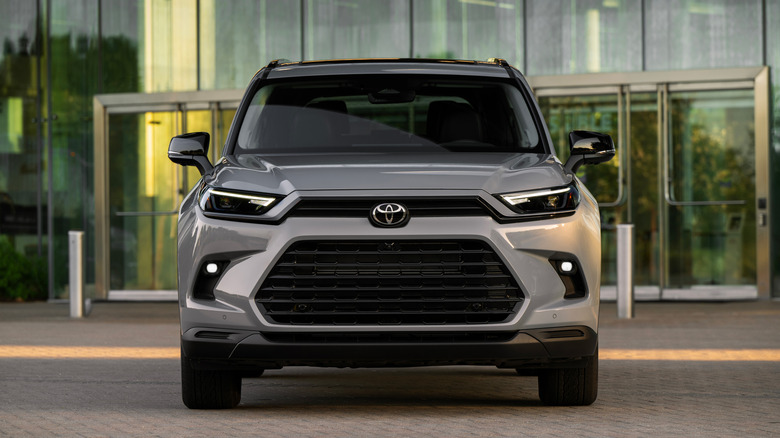
Among bigger SUVs, CR has the 2026 Toyota Grand Highlander going out on a high note. While this Indiana-built three-row entry is going all-electric with 320 miles of range for 2027, the 2026 model, powered by gas engine, got the nod as the top American-made vehicle in the midsize sport-utility segment — complemented by a suggested price of $41,860, $1,495 in fees, $7,899 in total interest, and three years of tax deductions that add up to $5,774.
BMW X3 and X5 bring home honors in the premium SUV segments
BMW is another CR fave, previously tying Subaru for the top overall score for brands that make the best cars and barely edging out Subie for the No. 1 position among the brands with the highest road-test scores. So it's not really a coincidence that BMW tied Subaru by having two vehicles on the CR leaderboard for best American-made brands.
The BMW X3 — built at BMW's facility in Spartanburg, South Carolina, since 2010 — was the selection in the luxury compact SUV category, due in part to its excellent road-test results and predicted customer satisfaction. Speaking of which, that satisfaction may gain a further boost from the $7,012 tax deduction the X3 qualifies for under the Big Beautiful Bill, out of a total $9,593 interest paid. (That's based on running the numbers with the vehicle's base price of $51,300 plus a destination charges of $1,350.) Just be aware that Japanese-built Lexus NX and NX Hybrid did have higher overall scores than the BMW.
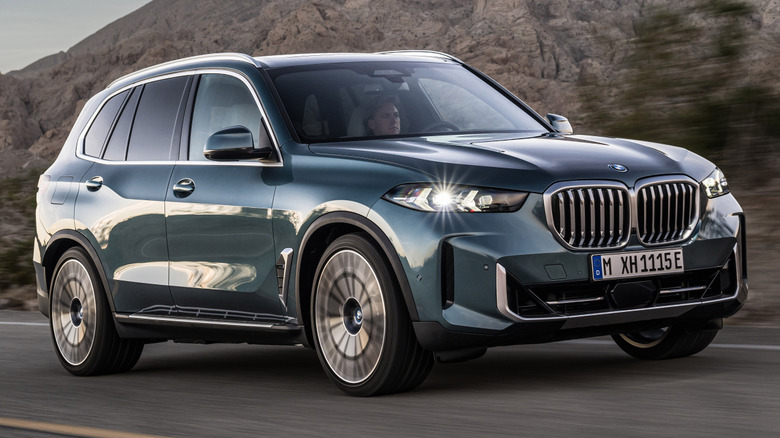
That said, the X3's bigger brother, the BMW X5 that was first manufactured at Spartanburg in 1999, managed a noteworthy double play by earning top honors as the CR's best luxury midsize SUV overall and the best one made in America. Jumping up a size class compared to the X3 naturally means an increase in pricing as well, but that also means a higher tax deduction. The X5 sDrive40i — motivated solely by the rear wheels — is the entry point to the X5 lineup at $68,300, plus destination fee of $1,450, so with $12,526 paid over six years, it qualifies for a tax deduction of $9,157.
Ridgeline, F-150 finish first among CR's made-in-America trucks
The best made-in-America midsize truck isn't from a traditional domestic brand — nor is it a traditional midsize pickup. We're talking, of course, about the unibody Honda Ridgeline. The Ridgeline, made in Lincoln, Alabama, was another choice that garnered the highest scores both in its segment and specifically among American-made alternatives. For our purposes, and taking into account a $1,495 destination charge, buyers of the $40,795 2026 Ridgeline entry model can reap a Big Beautiful tax deduction of $5,633 out of $7,705 paid overall. (The cost for the Jets to besmirch this Honda isn't clear.)
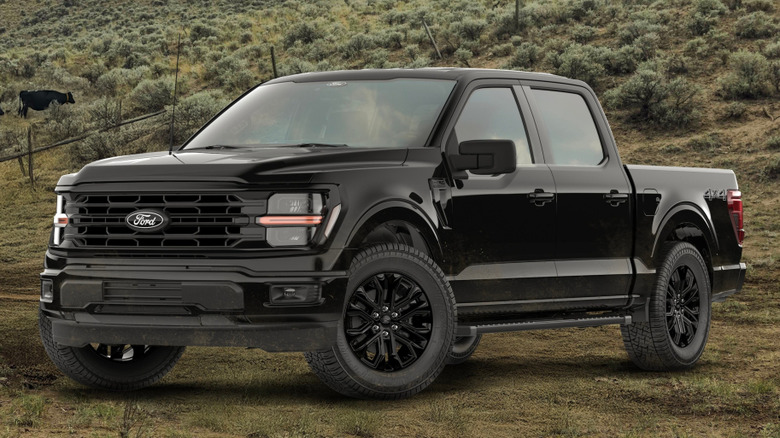
Finally we come to the Ford F-150 — ranked first among all full-size trucks. Sort of. In another quirk of the CR testing regime, Consumer Reports editors consider the F-150 hybrid and the gas-only F-150 as two distinct vehicles, and the hybrid is No. 1 overall with the gas-only model placing second. Both, to be clear, are made in the U.S., whether it's Dearborn, Michigan or Claycomo, Missouri. Getting down to brass tacks, we'll skip over the F-150 XL and STX to look at the next trim higher, the XLT, which is the most popular F-150 trim. The tale of the tape for the XLT includes a suggested price of $45,695, a hefty $2,795 in destination charges, and a potential tax deduction for interest of $6,458 out of $8,35 over the life of the loan.
The bottom line is that the tax deductions can surely help save some money, but getting the full $10,000 won't be cheap or easy. You'll have to take out a six-year loan of over $67,500 to max out savings by paying at least $10,000 in interest before the law is phased out in 2028.