

2027 Mercedes-Benz EQS Drives Farther, Charges Faster And Has Available Steer-By-Wire
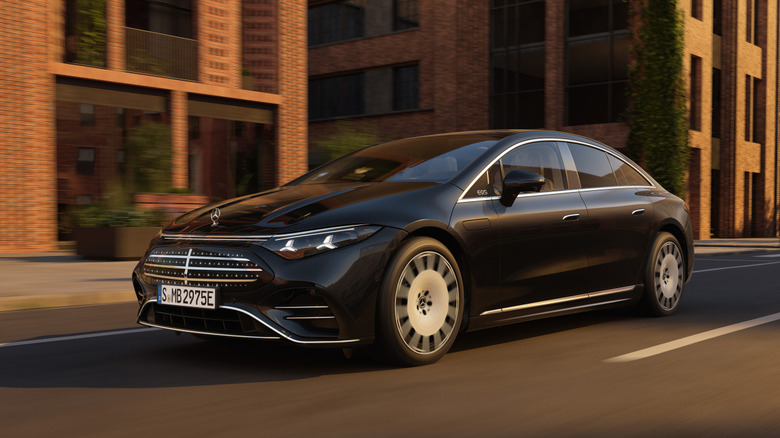
I've always really loved the Mercedes-Benz EQS, but for the most part, the general public hasn't, and that goes for all the entire EQ sub-brand that Mercedes tried to make happen. People didn't vibe with the super aerodynamic, egg-y styling or the screen-filled interiors, and the global EV market has been in flux to say the least. That's why Mercedes is pivoting back to more traditional designs and layouts with its new EVs, like the CLA sedan and GLC crossover, but it isn't giving up on the EQS yet.
For 2027, the EQS sedan gets nearly as big of an overhaul as Mercedes just gave to the face-lifted 2027 S-Class, with the automaker saying more than a quarter of all components are new, versus over 50% being new in the S-Class. The biggest upgrade is that it's now got an 800-volt architecture with a larger battery, letting it charge a lot quicker and go a lot further. Mercedes says the 2027 EQS has a 575-mile range on the European WLTP cycle, almost 100 miles more than the current model.
This all sounds good
The current rear-wheel-drive EQS450+ is rated by the EPA for 390 miles of range, so when the U.S. agency gets its hands on the new EQS later this year, I'd wager it'll have at least 450 miles of range. If that isn't enough for you, Mercedes is working on solid-state batteries, with one EQS prototype going 749 miles in the real world. The EQS' battery is now 122 kWh in size, up from the 118 kWh in the current EQS' 400-volt pack, and there's a bunch of other changes to the battery:
The cells feature anodes in which silicon oxide is blended with graphite. This allows more energy to be stored per kilogram, as the gravimetric energy density has increased compared with the previous generation battery with conventional graphite anodes. At the same time, greater range has been achieved within the same battery dimensions, as the volumetric energy density of the cell chemistry has increased. The proportion of cobalt has also been further reduced.
A big pain point for the existing EQS is its 200-kW DC fast-charging rate, but the new one will be able to charge at up to 350 kW, gaining almost 200 miles of WLTP range in 10 minutes. If you plug the car into a 400-volt charging station, the EQS' computers virtually split the battery into halves that are each charged at 175 kW. Mercedes also upgraded the regenerative braking, increasing the recuperating power from 290 kW to 385 kW, and it sounds like it will have truer one-pedal capabilities than the current EQS.
Mercedes now makes its electric motors in-house, with the new ones being smaller and more efficient. The front motor on all-wheel-drive models has an automatic disconnect feature, while the rear motor has a two-speed transmission, like in the CLA and other new electric Benzes. We don't have full specs or performance figures yet, but expect the face-lifted EQS to be quicker and more powerful.
It's still an egg
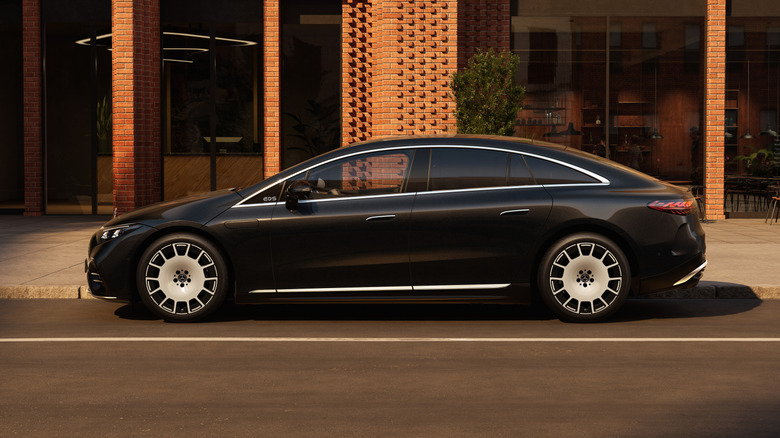
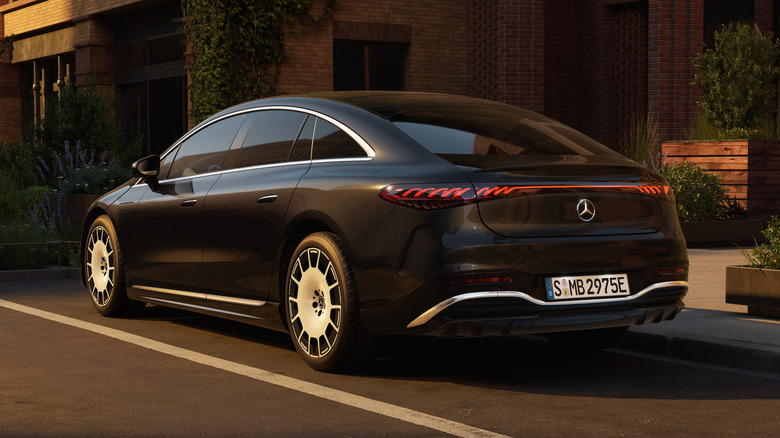
For better or worse, the design of the EQS hasn't changed much. In 2024, Mercedes gave the EQS an optional front-end design with a standing hood ornament and more traditional-looking grille panel, and the facelift takes it a few steps further. Akin to the CLA, the "grille" is now fully separate from the headlights, which are reshaped and now feature a star design. In between the bars of the grille are a bunch of illuminated, animated stars, and the hood ornament is illuminated. If that's too much, you can get the AMG Line, which has a big Mercedes logo in the center, and also a ton of lit-up stars in the black panel.
The hood has a bluffer shape and a pair of powerdomes, and the rear diffuser has been restyled. If you have a real keen eye, you'll notice the extra loops in the helix taillights, but you'll definitely notice the optional monoblock wheels on the car in these photos. Mercedes says the micro-LED headlights have a higher resolution and are 50% more efficient, and the adaptive high beams will be available in the U.S. for the first time.
Inside, things have changed even less. The three-display Hyperscreen is now standard, and the design of the interior looks identical year over year. But the EQS now uses the brand's new MB.OS operating system, powered by a new supercomputer. Many of the tech features have been improved, from the AI voice assistant to the augmented-reality navigation system. You can get new heated seatbelts, and the EQS now comes standard with a rear-seat comfort package that includes power-adjustable seats with cushy headrests. Mercedes is offering a lot more customization options through its Manufaktur division, from fancier colors and leather options to fully one-off specs and details. The company also fitted the car with 10 external cameras, 12 ultrasonic sensors, and up to 5 radar sensors, which work with the MB.OS system to unlock new driver-assist features like proactive automatic lane changes.
You gotta be yoking!
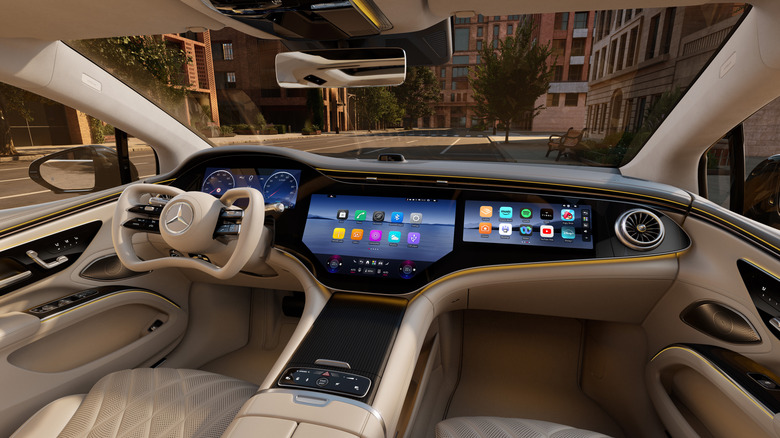
Oh, you may have noticed the yoke-style steering wheel. You get that if you spec the EQS with the new steer-by-wire option, which Mercedes has been teasing us with for years. The EQS already comes standard with rear-wheel steering that turns up to 10 degrees (one of the biggest reasons I like driving them), and that remains the case with the facelift. If you don't get the yoke, you still get a new steering wheel with rocker and roller controls. Here's what the automaker says about the feature:
Steer-by-wire transforms the interaction between the vehicle and driver – with Mercedes-Benz precision and a driving experience that sets new standards. The completely new steering feel provides a unique experience and offers a wide range of advantages in everyday driving situations, benefiting driving dynamics as well as maneuvering and parking. The steering effort required from the driver can be further reduced and the driver no longer needs to adjust their grip on the steering wheel when turning.
Vibrations caused by uneven road surfaces, which were previously transmitted to the driver via the steering wheel, can now be eliminated. Precise and intuitive steering feel is maintained. Steer-by-wire also gives the interior a new look. A flatter steering wheel noticeably opens up the space for the driver, improves the view of the driver display and makes ingress and egress easier. The EQS now combines sportiness and comfort even more effectively, while further enhancing driving stability and lateral agility. The chassis specialists have flexibly adapted the steering ratio to different driving situations. Added to this is the perfect interaction with the standard rear-axle steering. At higher speeds, the rear wheels steer parallel to the front wheels to enhance driving stability.
To ensure steer-by-wire meets the brand's strict safety standards, the design utilizes a redundant system architecture in addition to high-precision sensors and powerful control units. These two signal paths ensure steering capability is always guaranteed. Lateral control is also possible through rear-axle steering and targeted wheel-specific braking interventions via the ESP®.
Mercedes says the 2027 EQS will reach dealers in the U.S. in the second half of this year. A facelift of the EQS SUV should follow soon after. The EQE sedan and EQE SUV will also likely get facelifts soon, but I doubt those smaller models will continue to be sold in America. I wouldn't expect the EQS AMG to stick around, either.