

Want To Spend Less On Gas? Consumer Reports Says These Vehicles Are Your Best Bet
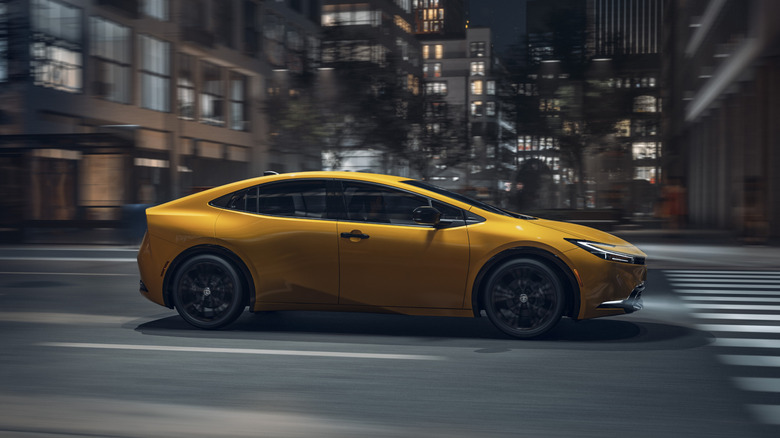
Gas prices are skyrocketing lately, and we might not see them drop in the foreseeable future. So, like with many price hikes in the past, it's only natural to look for a new, more efficient vehicle. Right on time, Consumer Reports (CR) came to the rescue with its latest list of the most fuel-efficient cars, from small compacts to large SUVs.
One thing is very clear from the outset: Today's fuel sippers aren't slow. They aren't rockets, sure, but they're quick enough for most people. Heck, these cars are so easy on fuel that they're also emerging as an excellent EV alternative. Oh, and don't worry — you can still have fun with some of these cars.
To help you navigate CR's list, we extracted the most fuel-efficient vehicle from every popular category on sale in the U.S. right now. We'll give you all the necessary information on every model, including pricing with destination fees included. So, from engaging sports cars to large, three-row family movers, here are the cars that boast the highest miles-per-gallon figures.
Acura Integra A-Spec: Most fuel-efficient upmarket car (31 mpg combined)
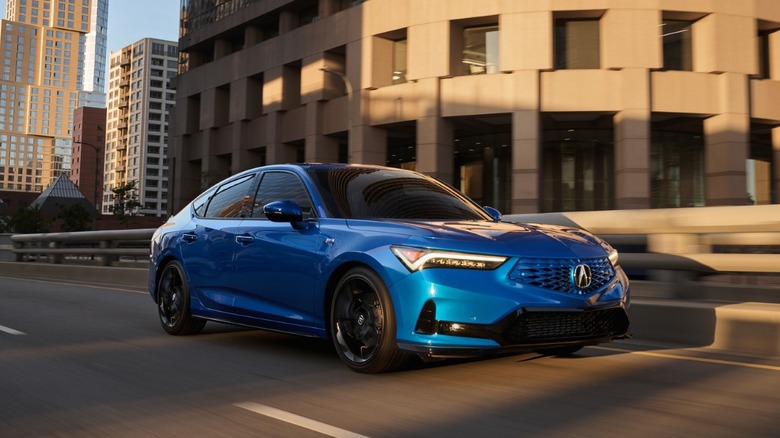
If you want a premium car, but you also want that analog, old-school driving experience, Acura's Integra A-Spec is your best bet. This Civic Si in a tuxedo still comes with a CVT in the base model, but you can get it with a six-speed manual in the driver-focused A-Spec w/Technology Package trim, which starts at $40,495. We tested the manual Integra A-Spec back in 2023 and came out impressed with the driving experience. Acura refreshed the Integra for the 2026 model year, but it mainly received tech and cosmetic upgrades, so it should drive similarly.
Now, sure, it's no Integra Type S, but with a front limited-slip differential, it is still has the ingredients of good driving. The A-Spec also comes with adaptive suspension, so you can choose between a sporty and comfortable ride. You can even put the suspension Comfort mode while keeping the engine in Sport — a combo that works amazingly on public roads.
The 1.5-liter VTEC/turbocharged four-cylinder produces 200 horsepower and 192 pound-feet of torque available from 1,800 to 5,000 rpm. According to Car and Driver, that's enough for a 0-60 mph sprint of seven seconds (with the manual). But the best part is that it's also efficient. Consumer Reports rated it at 21 mpg city, 42 mpg highway, and 31 mpg combined with the CVT. The manual shouldn't be far off, though, with an EPA rating of 32 mpg combined.
Mazda MX-5 Miata Club: Most fuel-efficient sports car (34 mpg combined)
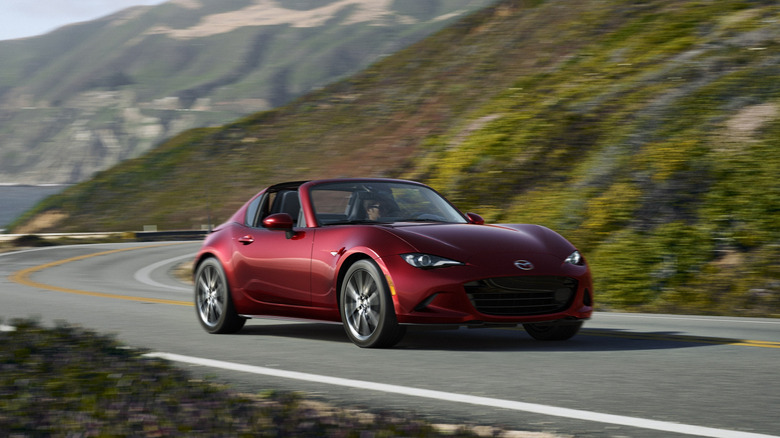
The MX-5 Miata Club is the most fuel-efficient sports car Consumer Reports tested with ratings of 25 mpg city, 42 mpg highway, and 34 mpg combined. These figures would be outstanding for a family car, let alone a driver-focused roadster. And it's not like Mazda's sports car is slow. Its 2.0-liter four-cylinder engine produces 181 horsepower and 151 pound-feet of torque, which is potent enough to bring the sub-2,500-pound RF Club model to 60 mph in 5.5 seconds.
But the numbers never tell the whole Miata story. In this car, it's all about the light, agile chassis, slick-shifting six-speed manual, and responsive naturally aspirated engine. Not to mention, it comes with a droppable top, allowing drivers to enjoy the elements. The taut suspension of the $35,760 Club further intensifies the experience, while the Brembo/BBS/Recaro package takes everything up another notch.
Really, though, any Miata can entertain, including the base Sport trim that costs just $31,665. Granted, the MX-5 Miata isn't without its faults. Its trunk is laughable, and it's not the best long-distance cruiser. But as a budget-friendly (and mileage-friendly) fun car for weekends, it's hard to beat.
Toyota Grand Highlander Hybrid XLE: Most fuel-efficient large SUV (35 mpg combined)
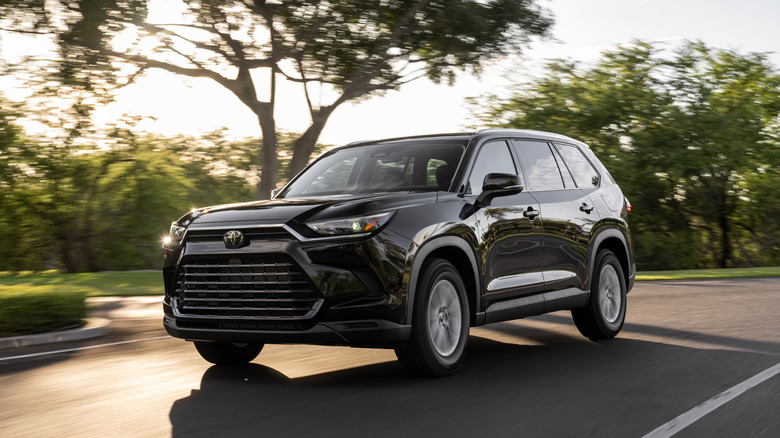
Toyota is killing it with its hybrids lately. Case in point: the 2026 Grand Highlander Hybrid. It's a 201.4-inch-long three-row SUV that can comfortably accommodate adults in all three rows. And yet, the XLE trim — which costs $47,875 – was rated at 27 mpg city, 41 mpg highway, and 35 mpg combined in its CR test. The combined rating is very close to the 36 mpg EPA rating. You can expect similar economy from the entry-level LE trim, which starts at competitive $46,705.
To be fair, the 2.5-liter hybrid system in the Grand Highlander isn't exactly potent. But with 245 horsepower on tap, it's still able to measure a 0-60 time of 7.8 seconds, which is solid. If you find that underwhelming, Toyota also offers the Grand Highlander Hybrid MAX, which produces 362 horsepower and sprints to 60 mph in just 5.6 seconds. It's thirstier on fuel, though, with an EPA rating of 27 mpg combined.
You won't be losing much in terms of capability with the regular hybrid. Yes, the base model is front-wheel drive, but you can get it in AWD form with an electric motor. It also has an e-CVT, which is way better than a regular CVT. It employs a planetary gearset rather than chain and pulleys, so it's very reliable.
Toyota Sienna XLE: Most fuel-efficient minivan (36 mpg combined)
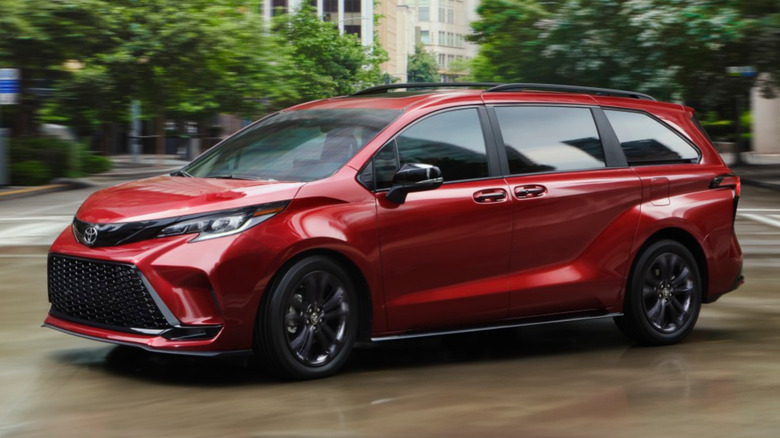
Not surprising anyone, Toyota's decision to use its 2.5-liter hybrid in the latest Sienna also gave us the most fuel-efficient minivan. It's the same power train from the Grand Highlander, which is enough for 245 horsepower and a 0-60 sprint of 7.5 seconds. That's quite good for a minivan that did 36 mpg combined in Consumer Reports tests.
The publication also measured 27 mpg in the city and an excellent 43 mpg on the highway for this model. Those numbers are significantly better than its rivals. The Honda Odyssey, for example, was only rated at 22 mpg combined, while the comparable Kia Carnival Hybrid was good for just 31 mpg combined. It also doesn't hurt that Consumer Reports says the Sienna is a reliable minivan.
Excellent fuel efficiency isn't the only selling point of the latest Sienna. Toyota's minivan is also super comfortable in all three rows, while being able to swallow 34 cubic feet of cargo behind the third row. The cabin is very practical, with cubby places on every corner and 18 cupholders. Heck, you can even get it in AWD form to better cope with snow, or you can take it off-road with the Woodland Edition trim. Just keep in mind that the trim is nearly $11,000 more than the base Sienna LE, which starts at $42,315.
Ford Maverick Hybrid Lariat: Most fuel-efficient pickup (37 mpg combined)
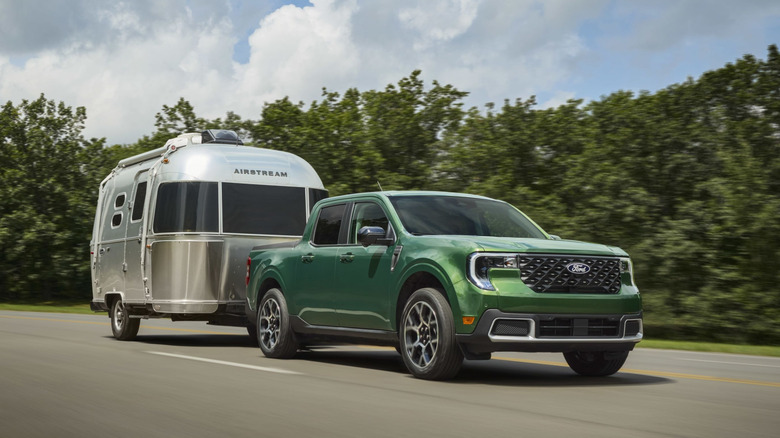
The Maverick Hybrid Lariat took the top spot among pickups in CR's fuel economy tests. It's another 2.5-liter hybrid with an e-CVT that scored a combined rating of 37 mpg, or 33 mpg in the city and 39 mpg on the highway. CR also tested the Maverick XLT with the 2.0-liter turbo-four, though it returned just 23 mpg combined.
Admittedly, the turbocharged four-cylinder is more powerful, producing 250 horsepower compared to 191 for the hybrid. Still, with a 0-60 sprint of 7.4 seconds, the Maverick Hybrid isn't slow. The AWD model was even quicker, hitting 60 mph in just 6.7 seconds. And unlike Toyota's hybrids, it's a real AWD system with a driveshaft and rear differential, which should be useful when off-roading.
The Maverick Hybrid can do truck things, too — but don't expect miracles. Ford's smallest pickup has a 4.5-foot bed and a 1,500-pound payload rating. It can also tow up to 4,000 pounds with the 4K Tow Package. The Maverick is fairly comfortable inside, too, and its standard 13.2-inch infotainment can embarrass bigger pickup trucks. At $29,990 for the base model, it's also quite a bargain.
Toyota Crown Signia Limited: Most fuel-efficient mid-size SUV (37 mpg combined)
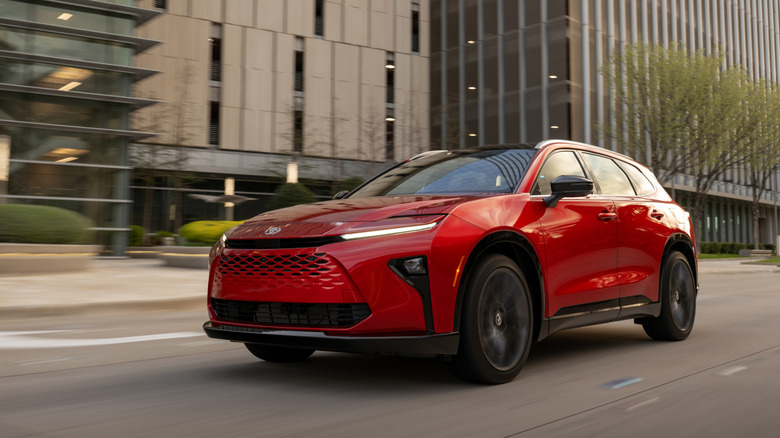
Is it a station wagon or a crossover? Does it really matter if its Limited trim delivers 37 mpg combined (along with 30 mpg city and 42 mpg highway) and treats its passengers with premium, luxury comfort? True, the Crown Signia has no idea what it wants to be, but that doesn't make it a bad car. In fact, it's as close to a Lexus as you'd get from Toyota.
The Crown Signia again shows the superiority of Toyota's 2.5-liter hybrid. In this iteration, it produces 240 horsepower, which Toyota says is enough for a 0-60 sprint of 7.1 seconds. It unfortunately doesn't include the brand's Hybrid MAX power train even as an option, which could've given it more power while still being relatively efficient. Most buyers will be looking at the Crown Signia for the interior, though. There is ample space in both seating rows, and the 25-cubic-foot cargo area is decently sized, too. Moreover, every Crown Signia — even the base XLE trim that costs $45,985 – has leather trim inside, which lifts the ambiance.
Lexus NX 350h: Most fuel-efficient compact SUV (38 mpg combined)
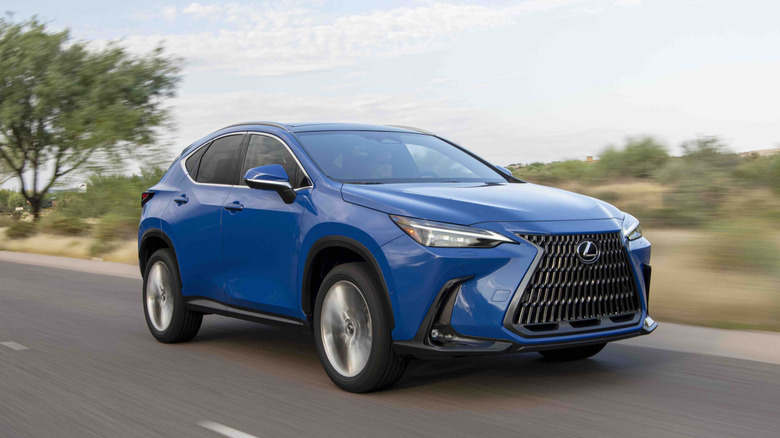
Toyota's 2.5-liter hybrid engine shows its supremacy again, this time in the brand's compact luxury crossover: the Lexus NX 350h. Like in every other implementation, the electrified power train is offered in FWD or AWD form, with the latter featuring an electric motor on the rear axle. It's rated at 240 horsepower combined, enough for a 7.2-second sprint to 60 mph according to Lexus. Not bad, considering it returned 38 mpg combines on CR's test. The city and highway ratings were great, too, respectively returning 37 and 39 mpg.
Lexus also offers a plug-in hybrid variant, called the NX 450h+. Thanks to the bigger 18.1-kWh battery pack, the PHEV has a 37-mile EPA-estimated electric-only range. It's more powerful, too, packing 304 horsepower for a 0-60 sprint of just six seconds. Still, at $59,405, the NX 450h+ Premium is significantly more expensive than the $47,995 NX 350h Premium, so the regular hybrid might be a better option for most people.
Still, both are great at transporting you in premium comfort. The Lexus NX is quiet at speed and irons out road imperfections while also boasting excellent materials inside. Thus, it has been named among the best SUVs you can buy in 2026.
Toyota Corolla Cross: Most fuel-efficient small SUV (41 mpg combined)
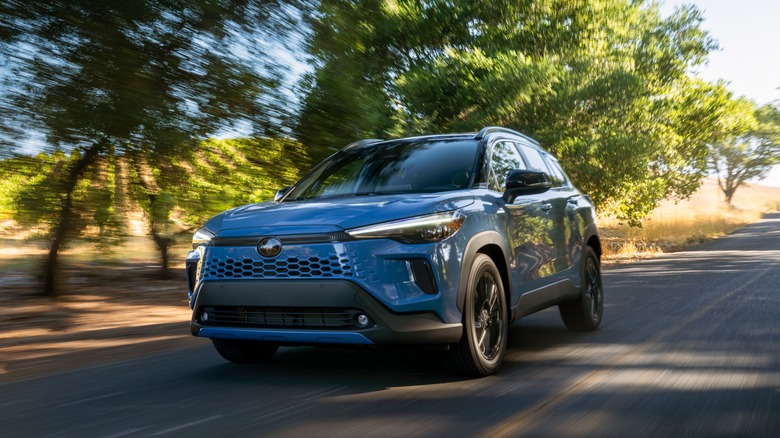
Since it's a small SUV based on the Corolla platform, the Corolla Cross Hybrid features Toyota's smaller 2.0-liter engine. It's similar in technology, with an e-CVT transmission and three electric motors, and it comes standard with AWD. That's a big selling point considering the cool base price of $31,045.
With 196 horsepower, it's decently quick, too. That lets the car reach 60 mph in 7.3 seconds, almost two seconds quicker than the base gas model with 169 horsepower. Its 41 mpg combined figure on CR's test is even more impressive, as it beats any other SUV sold in the U.S. In the city, CR extracted 34 mpg from the Corolla Cross Hybrid, while on the highway, it achieved an impressive 47 mpg.
For the 2026 model year, Toyota gave the Corolla Cross its mid-life refresh. It still fades into the background, but at least it brings an improved interior with an optional 10.5-inch center touchscreen and a 12.3-inch digital gauge cluster. The hybrid and gas models were also further differentiated on the outside, with the former gaining a sleeker look thanks to its colored front grille.
Toyota Crown: Most fuel-efficient large car (42 mpg combined)
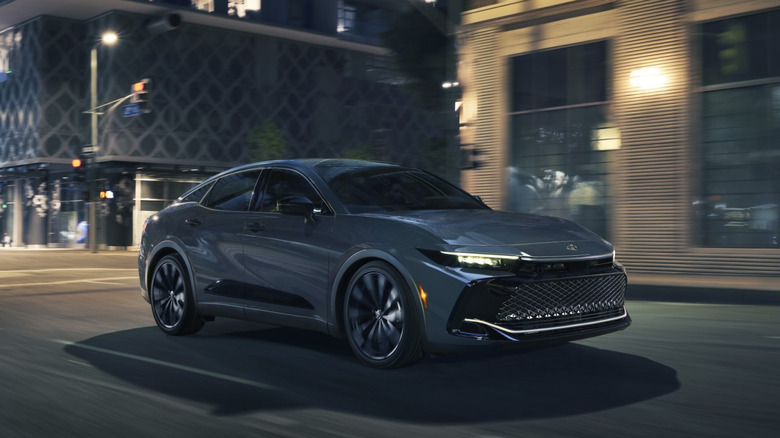
Much like the Crown Signia wagon, the regular Crown also has an identity crisis. It's a mishmash of a sedan, coupe, and crossover, with looks that will certainly divide people. Fortunately, it has the premium cabin of its station wagon sibling, with near-Lexus quality, 12.3-inch infotainment, and a 12.3-inch digital instrument panel.
As standard, the Crown is equipped with Toyota's venerable 2.5-liter hybrid with 236 horsepower, which reportedly hits 60 mph in 7.6 seconds. However, the Crown is also available with the Hybrid MAX power train, which packs 340 horsepower and 400 pound-feet of torque, reaching 60 mph in 5.7 seconds. The MAX employs a more powerful 2.4-liter turbo-four and a six-speed automatic, and it felt impressively quick when we tested the 2023 Crown.
Still, it's the base hybrid engine that gets the better fuel economy. In CR's tests, the Crown returned ratings of 33 mpg city, 49 mpg highway, and 42 mpg combined. It also has an EPA-estimated rating of about 41 mpg, while the Hybrid MAX is EPA rated for 30 mpg combined. With a starting price of $42,635 for the XLE trim, the regular hybrid is also significantly less expensive than the $56,185 Crown Premium equipped with the MAX.
Kia Niro EX: Most fuel-efficient small hatchback/crossover (45 mpg combined)
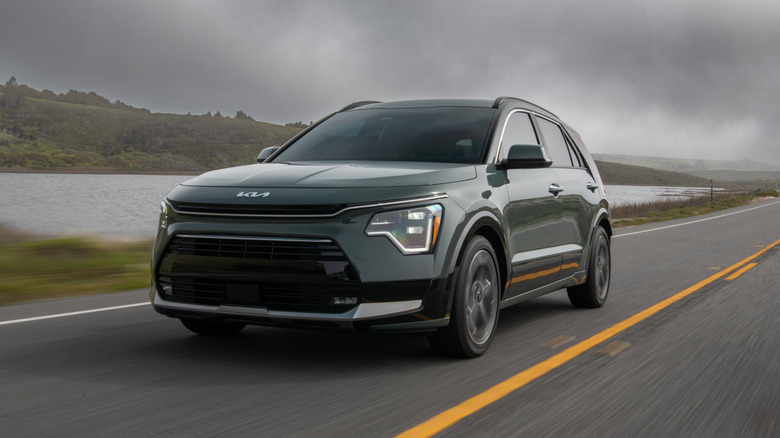
The Kia Niro is a very close competitor the Corolla Cross. Still, because the Niro is only available with FWD, it's closer to a hatchback rather than an SUV, so we ended up giving both a spot on this list. Besides, both are similarly economical; the Niro EX returned 41 mpg city, 48 mpg highway, and 45 mpg combined in CR's tests.
Those some are impressive figures, but it's important to note that the Niro has a 1.6-liter hybrid engine with only 139 horsepower, which was only enough to give it a 0-60 time of 8.9 seconds. Admittedly, the 2026 Kia Niro is one of the cheapest hybrids on sale, with a starting price of $28,885 for the base LX variant. It's also available as an EV with a 253-mile EPA range that starts at $41,195. Back in 2023, we found that both the EV and hybrid power trains suit the Niro, but the latter makes more sense for most people.
Every Niro is decently practical, with good space for adults in both rows. The dashboard looks surprisingly modern, which is partially thanks to the twin-screen interface consisting of a 10.3-inch center infotainment screen. Even so, the unrefined and loud ride leaves a lot to be desired.
Toyota Camry SE: Most fuel-efficient mid-size sedan (48 mpg combined)
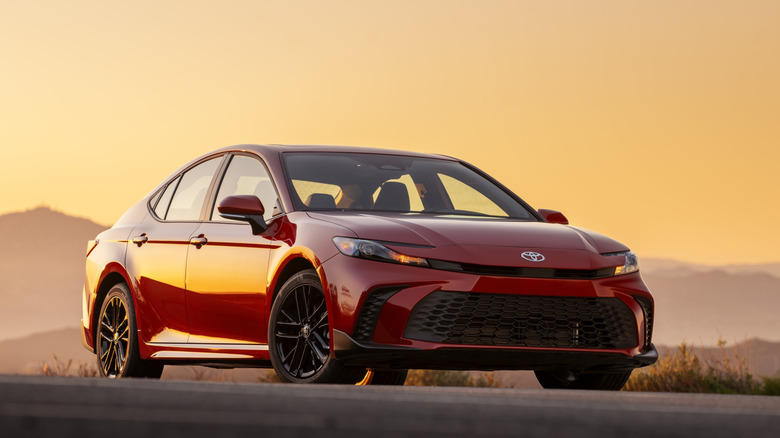
The Camry was one of the last Toyota vehicles with a V6 engine. Today, it's hybrid-only, equipped with Toyota's fifth-gen 2.5-liter hybrid system. In the 2026 Camry, the hybrid power train produces 225 horsepower in FWD and 232 horsepower in AWD form. The latter employs an electric motor on the rear axle, similar to most other Toyota hybrids.
For its fuel efficiency test, CR used the SE trim, which costs $32,995 and sits above the base LE trim ($30,495). The Camry returned 48 mpg combined, which is frankly ridiculous for the car's size and power on offer. The 40 mpg city and 54 mpg highway ratings are amazing, too, putting Toyota's mid-size offering in a category of its own. Notably, the Hyundai Sonata Hybrid SEL returned a close rating of 44 mpg combined, despite being significantly less potent (192 horsepower). Also, the Accord Hybrid Sport was good for only 40 mpg in CR's test while also being down on power (204 horsepower).
Have we mentioned that the latest Camry also has sporty aspirations? It might not be as powerful as its V6 predecessor, but it's a genuinely enjoyable car to drive. And with a 0-60 sprint of just 6.8 seconds, the all-wheel-drive Camry is reasonably quick, too.
Hyundai Elantra Hybrid Blue: Most fuel-efficient compact sedan (48 mpg combined)
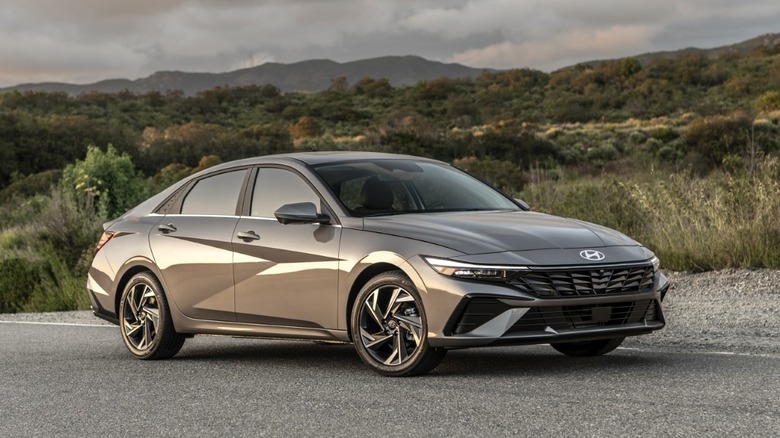
The Elantra Hybrid Blue narrowly edged its closest competitor — the Corolla LE Hybrid — in CR's test. Both returned 48 mpg combined, but Hyundai's compact sedan had better fuel efficiency in the city with 40 mpg vs 37 mpg. The Corolla Hybrid was more efficient on the highway, though, returning 59 mpg, with the Elantra Hybrid good for 55 mpg. Despite this, the Elantra still ranked just a bit higher, so that's the winner we're going with in this slide.
Both sedans are also close in the performance department. The Elantra Hybrid packs the same 1.6-liter hybrid engine from the Niro, producing 139 horsepower, paired with a six-speed dual-clutch transmission. The Corolla Hybrid has a 1.8-liter hybrid engine with an e-CVT and 138 horsepower. They're priced similarly, too. The Elantra Hybrid Blue costs $26,695, while the Corolla LE Hybrid will set you back $26,170.
These parallels extend to the cabin. The Elantra Hybrid Blue comes with an 8.0-inch infotainment touchscreen, with a larger 10.25-inch unit available in the upper SEL Sport trim. The Corolla LE is the same, though a larger 10.5-inch display is available in the XLE trim. Additionally, o the Corolla Hybrid is available with AWD. As for practicality, both sedans can accommodate adults comfortably, but the Elantra Hybrid's 14-cubic-foot trunk edges Corolla Hybrid's 13 cubic feet.
Toyota Prius XLE AWD: Most fuel-efficient car overall (51 mpg combined)
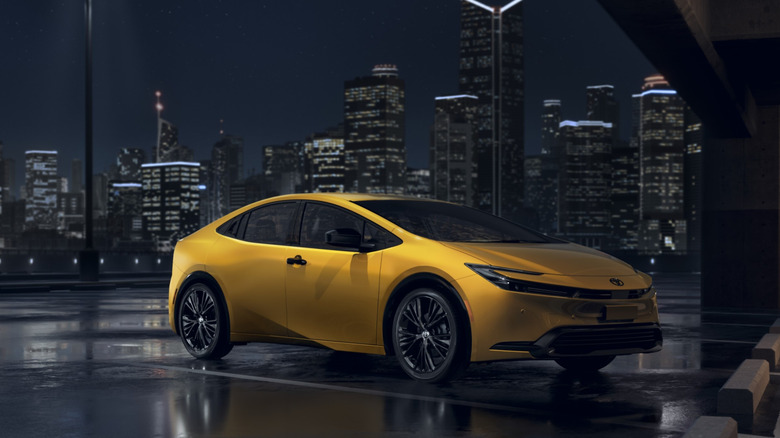
The latest Prius has finally erased its image as a dull transportation device. It's still the most fuel-efficient car according to Consumer Reports, with an astonishing 51 mpg combined rating (and city/highway ratings of 40 and 59 mpg, respectively). But it's also one of the most attractive four-wheel vehicles out there. The pointed nose and coupe-like rear look modern and unique in a Prius kind of way.
The fact that CR tested the XLE AWD model makes the efficiency rating even more impressive. With 196 horsepower on tap, the AWD Prius is decently quick, hitting 60 mph in 7.1 seconds according to MotorTrend. Toyota also sells a PHEV variant with 220 horses, which can reach 60 mph in 6.4 seconds. Depending on the model, the Prius PHEV also has an EPA-estimated EV range of up to 44 miles.
We tested the new Prius back in 2022 and liked the improved, modern interior. Of course, the sloping roofline makes the rear bench useful only for kids, but it has additional practicality with the 23.8-cubic-foot trunk (on the LE trim) and rear hatch. The 2026 Prius LE starts at $29,745, while upgrading to the XLE trim will set you back $33,190.