

Trump's Tariff Schemes Have Cost Automakers Over $35 Billion So Far

Good morning! It's Monday, March 16, 2026, and this is The Morning Shift, your daily roundup of the top automotive headlines from around the world, in one place. This is where you'll find the most important stories that are shaping the way Americans drive and get around.
In this morning's edition, President Trump's ill-advised tariffs have cost the automotive industry over $35 billion so far (and if you don't think that cost is getting passed onto you, I've got a bridge to sell you), VinFast is spinning up construction of its North Carolina factory once again, there's a far-right labor group making in-roads at Audi and VW in Germany and Toyota is recalling over half-a-million Highlanders for a rear seat issue.
1st Gear: Trump's tariff costs are adding up
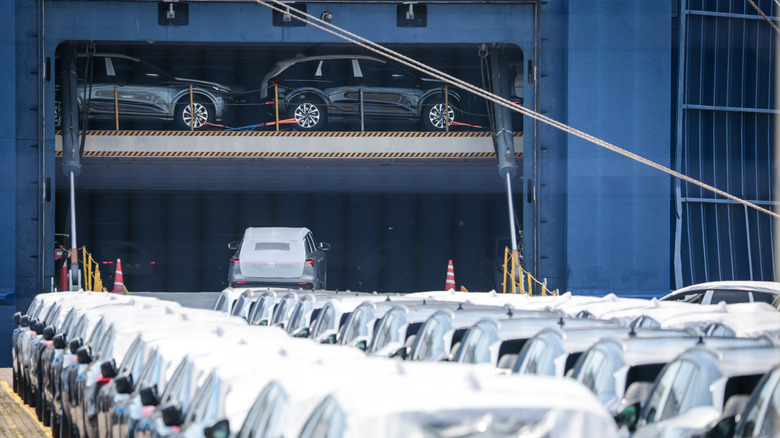
I know it'll come as a major shock, but President Trump's tariffs may not be working out the way he and his buddies had originally hoped. It seems that they have cost automakers at least $35.4 billion since they were introduced. Of course, tariff costs varied greatly by automaker depending on how much of its lineup was shipped into the U.S. from overseas and where key parts were sourced from.
From the looks of it, Toyota had the biggest tariff bill of any automaker. It seems that the Japanese company will take a $9.1 billion hit in its 2026 fiscal year (which ends March 31). The Big Three automakers fared much better, as you may have expected. They were hit with a combined $6.5 billion in tariff expenses in 2025.
Automotive News looked at automaker financial reports that were available through mid-March, including full-year tariff costs for 2025, as well as projections through March of this year, when they were available. Here's what else AutoNews found and how these bills got so high so quickly:
BMW, Honda, Hyundai-Kia, Mazda, Mercedes-Benz, Nissan, Subaru and Volkswagen each either reported or expect tariff bills north of $1 billion.
The costly tariff tabs come as automakers restructure their businesses to account for weaker-than-expected electric vehicle sales and the cancellation of the $7,500 federal tax credit that subsidized EV purchases. The cost of EV restructuring is approaching $70 billion, Automotive News reported.
[...]
Automakers pay tariffs on vehicles they import to the U.S., though the rate varies by country of origin based on multiple deals the Trump administration reached with trading partners in 2025. Vehicles from the European Union, Japan and South Korea carry a 15 percent tariff, while vehicles made in Canada or Mexico that comply with North American free-trade rules are subject to a 25 percent duty on the value of their non-U.S. content.
Many auto parts also have tariffs. The import tax on steel and aluminum imports is 50 percent. A Biden administration 100 percent tariff on Chinese EVs remains in place.
As they awaited more clarity, automakers largely opted to absorb their tariff costs, believing many to be temporary, said Sam Fiorani, vice president of global vehicle forecasting at AutoForecast Solutions. That prevented widespread price increases some analysts expected when tariffs were announced, but created large hits to companies' bottom lines.
It seems that automaker have had enough when it comes to absorbing prices, and that's why we're starting to see more and more price hikes get implemented. Porsche, for example, has already raised U.S. prices several times, and it's even considering moving some production to the U.S. to bring down tariff costs. It's not just Porsche, though. From the third quarter of 2025 through February of 2026, prices rose faster for vehicles built in Canada, Japan, Germany and Mexico than they did for U.S.-made vehicles.
Tariffs are also changing automakers' math on which models get imported to the U.S. Dodge discontinued the Hornet. Volkswagen is skipping the ID Buzz minivan's 2026 model year (at the very least). GM said that it's going to move production of the next-generation Buick Envision from China to Kansas.
All of this led to North American sales dropping at the end of 2025. Automaker sold about 817,720 vehicles imported from outside North America in 2025's Q4. That's down 7.9% from a year earlier. As prices rise and wages don't, I think the downward trend is set to continue.
2nd Gear: VinFast refuses to go quietly
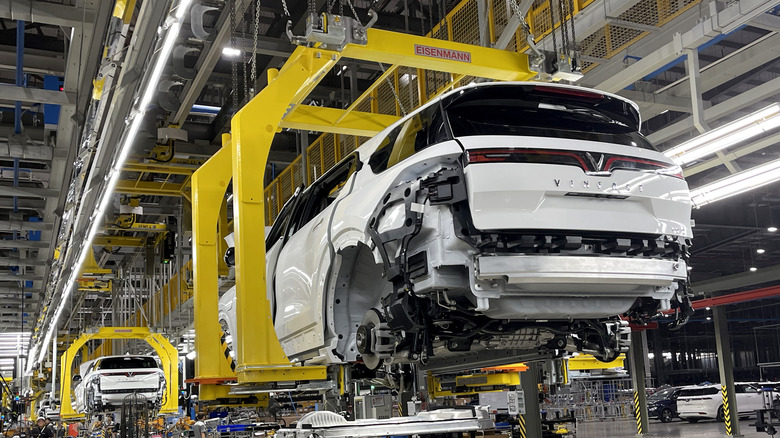
Remember VinFast? Same. Well, it really wants the U.S. to work out, and that's why it's going to resume construction of its factory in North Carolina this year. The plant, which is expected to be operational in 2028, would follow openings in India and Indonesia. In 2024, VinFast announced it was delaying the Tar Heel factory by three years.
The Vietnamese automaker made the announcement while reporting wider losses in the fourth quarter of 2025 as global expansion costs continued to, uh, expand. In Q4 alone, the company reported a net loss of $1.3 billion — an increase of 15% over the same time last year. Still, revenue was up 138.9%, so I guess that's something. The nascent automaker delivered 86,557 vehicles in the fourth quarter — a 127% jump from the third and a 63% year-over-year increase. All in all, VinFast sold 196,919 vehicles in 2025. From Bloomberg:
Scale and cost optimization will be primary drivers of profitability, Thuy said. VinFast founder Pham Nhat Vuong had said he expected the company to break even at the end of this year.
VinFast reported a full-year 2025 net loss of 97.25 trillion dong, an increase of 25.7% from a year ago. Total revenue last year was 90.4 trillion dong, a 105.4% jump from the previous year.
[...]
The company "continues to evaluate opportunities to expand into additional countries and regions across Europe, Asia, the Middle East and Africa," it said in the filing. "This expansion strategy is aligned with Vingroup's broader global development approach, leveraging the Vingroup ecosystem, partnerships and capital resources to support VinFast's international growth."
VinFast looks to focus on Vietnam, Indonesia, India and the Philippines. The EV maker earlier this month signed agreements to provide 20,000 vehicles in Indonesia by 2028.
Luckily for VinFast, cars aren't its only business. It delivered 406,498 e-scooters and e-bikes in 2025 — a 473% year-over-year rise. In 2026, it's hopes are set even higher. The company thinks its motorbike deliveries to be at least 2.5 times the 2025 number, thanks to sales in the Philippines, Indonesia, India, Thailand and Malaysia.
3rd Gear: Far-right labor groups come for VW, Audi
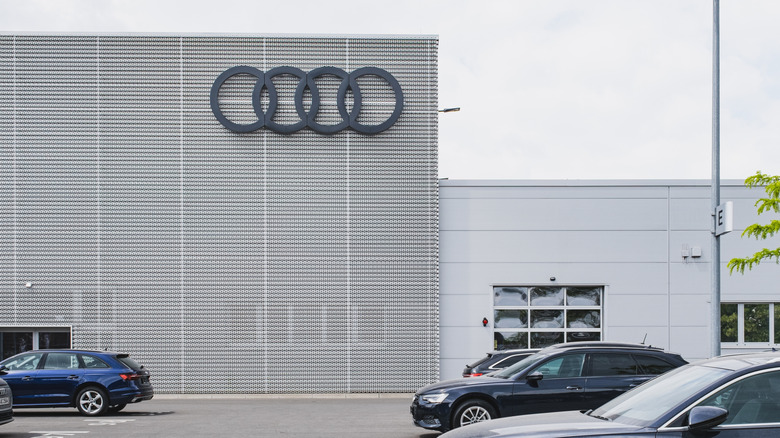
As if there wasn't enough to worry about, there's apparently a fringe far-right labor group making in-roads at Audi and Volkswagen factories across Germany. Luckily, Germany's top industrial union has been able to keep its stronghold on the factories' work councils, but it has certainly lost some ground. If there's one thing you really don't want, it's far right folks in Germany. From Reuters:
Zentrum, a self-styled union affiliated with the Alternative for Germany (AfD) party, said late on Sunday that it had won its first two seats at Volkswagen subsidiary Audi, at the premium carmaker's headquarters in Ingolstadt.
The IG Metall union retained a comfortable majority on the 55-seat works council there, a works council spokesperson said in an emailed statement to Reuters on Monday.
[...]
This year, far-right campaigners sought to build support among auto workers frustrated by tens of thousands of job cuts and the difficult shift to EV production.
Zentrum also took two out of 35 seats on the Volkswagen works council in Braunschweig on Friday, a symbolic win at the carmaker's oldest plant and its first seats at the Volkswagen Group.
However, this was a small proportion of the roughly 360 seats at the group's German factories overall, a works council spokesperson said.
In a statement emailed to Reuters, Zentrum said the results were a nod to its work challenging IG Metall, which it blames for not preventing job cuts, and said it aimed to build its influence at other companies in the future.
[...]
Staff at Audi, Volkswagen and Mercedes-Benz in recent days elected representatives to their works councils, which negotiate with management on issues like working conditions and pay.
These bodies, elected every four years, are traditionally dominated by IG Metall.
Not that it's right, but you can sort of see what is leading to these inroads. Just last week, Volkswagen said it was cutting 50,000 jobs by 2030 as profits continue to drop due to stiff competition out of China. Hopefully, IG Metall can work to stop Zentrum before it picks up too much more momentum, but I'll admit, it does have me worried.
4th Gear: Over 550,000 Highlanders recalled for non-locking rear seatback
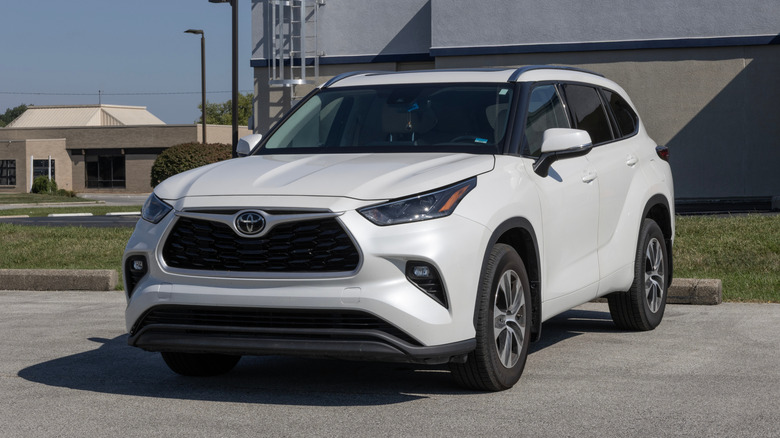
Toyotas is recalling 550,007 2021-2024 Highlander and Highlander Hybrids because of a major issue with the second row seats. Apparently, the recliner in the seat backs might not lock correctly, and that's could lead to a big problem in a crash, according to the National Highway Traffic Safety Administration. A design change by a parts supplier apparently failed to account for the weight balance between the locking spring and the return spring, which keeps the recliner's ratchet teeth fully engaged. From Car and Driver:
As stated in the NHTSA paperwork, a seatback that has not been locked into position may fail to safely restrain passengers in the event of a crash.
At the time of filing the recall, Toyota stated that it was aware of 10 field reports and 18 warranty claims on vehicles related to the recall population.
[...]
While seemingly not a particularly dangerous defect, the fact that this is a hardware issue, rather than a software problem, means it will require a visit to the dealership to be remedied. To that end, Toyota plans to notify owners of the issue in April and urge them to bring the affected vehicles to a dealership for service. Dealers will inspect and replace the return springs with an improved version for free. Owners worried that their vehicle may be included in this or any other recall can check on the NHTSA recalls site.
The recall impacts 420,771 Highlanders and 129,236 Highlander Hybrids, and there's no word on if there have been an injuries or fatalities related to this issue.
Reverse: Blast off
 History.com
Even today, rockets are sick, so imagine what they were like 100 years ago. Sure, Robert Goddard's first liquid-fueled rocket only got up to about 60 mph and lasted for just 2.5 seconds, but there was nothing else like that on earth at the time. It would have been total lunacy in 1926. Anyway, if you want to learn more about Goddard and the first liquid-fueled rocket, head over to
.
The Fuel Up
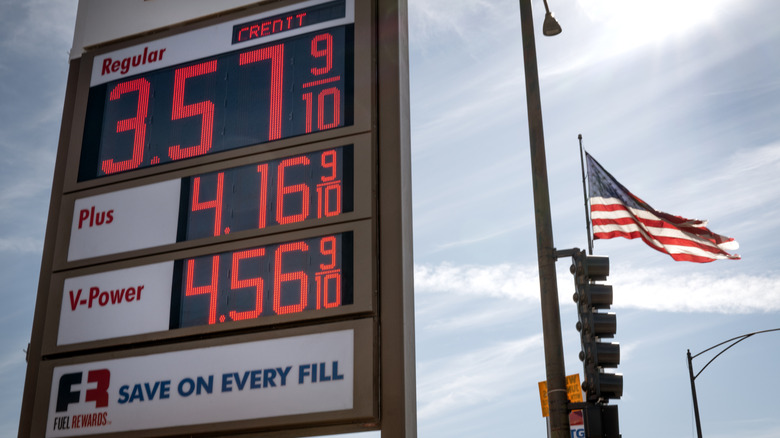
Oil prices are getting perilously to the $100 per barrel mark once again following a brief retreat a week ago, and it means gas prices are still climbing upwards as the U.S.-Israeli war with Iran drags on. We've now entered our third week of this war, and there don't seem to be many off-ramps ahead of us to get out. There are even fewer for reopening the Strait of Hormuz, where about 20% of the world's oil is supposed to flow daily.
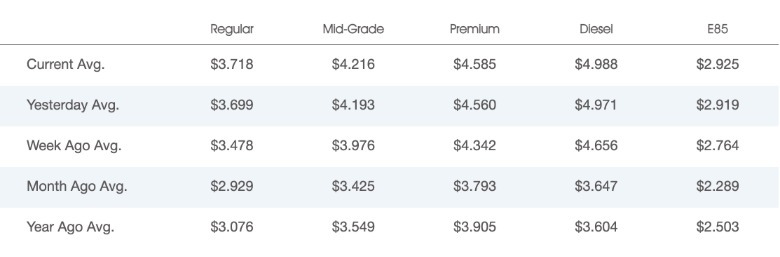
Overnight, the average price of a gallon of regular gas rose about 2 cents across the country to $3.72, according to AAA. The last time gas was over $3.72 for a gallon of regular was back in May of 2024. In any case, the average price of a gallon of gas is now up 74 cents — or about 22.1% — since the day before the war broke out, when it was $2.98.
Here's where national average prices stand right now, according to AAA:
 AAA
AAA
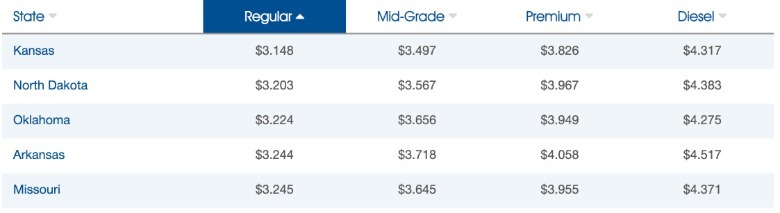
These five states have the cheapest gas in the country:
 AAA
AAA
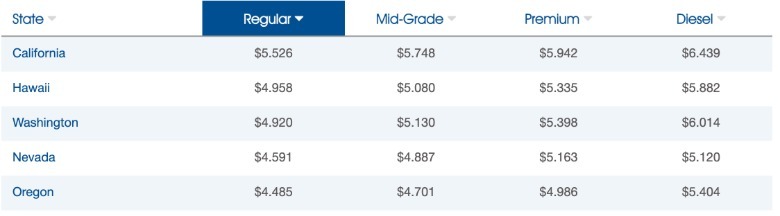
These five states have the most expensive gas in the country:
 AAA
AAA
On the radio: Steely Dan - Dirty Work
"One Battle After Another" — my favorite movie of 2025 — just won the Academy Award for Best Picture, and when it did, the orchestra at the Oscars did their rendition of "Dirty Work." I cannot explain how excited that made me. We're going to look back on this movie for years to come, and it's only going to get better. Also, Leo not getting a single award for his performance in it is criminal.