

U.S.-Israeli War With Iran Is Going To Cost You At The Gas Pump

Good morning! It's Monday, March 2, 2026, and this is The Morning Shift, your daily roundup of the top automotive headlines from around the world, in one place. This is where you'll find the most important stories that are shaping the way Americans drive and get around.
In this morning's edition, the U.S. and Israel's war with Iran is already raising gas prices across the globe, Honda is bringing Acura to Japan with reverse-imported cars, Canada has begun issuing import permits for Chinese EVs and Toyota (the automaker) bumps its offer for Toyota (the supplier) to $30 billion.
1st Gear: Gas prices on the rise thanks to U.S.-Israeli war with Iran
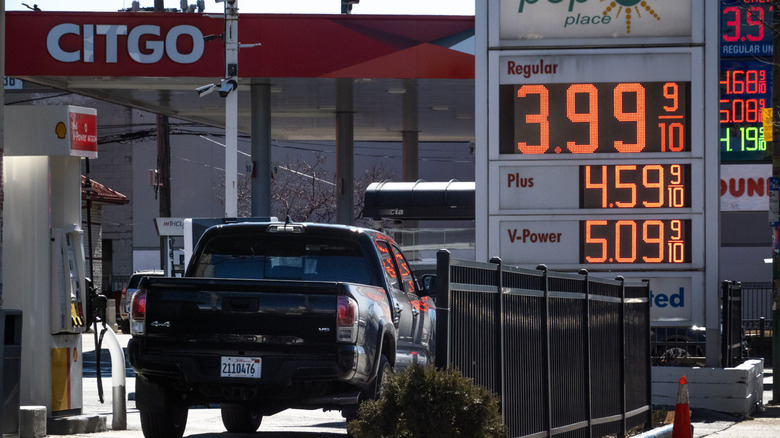
The price of oil is up massively following the U.S. and Israel's strikes on Iran, which have left its supreme leader, at least four U.S. service members and over 200 Iranian civilians (including at least 153 children and people at an all-girls school that was struck by three missiles) dead. As of 9:30 a.m., U.S. crude oil was up more than 8.5% in the past week, while Brent — the international benchmark, was up more than 10.5% in the same timeframe.
Even before Trump's and Bibi's decision to strike Iran, oil prices had already risen 17% this year as the President ramped up rhetoric against the regime. He also ratcheted up sanctions on Iran in recent months.
Sure, Iran's oil production accounts for less than 5% of global output. The issues arise when you consider the fact (which the Trump administration clearly didn't) that it has a major influence over the Strait of Hormuz — a critical waterway for over 20% of the world's daily oil demand. From NBC News:
A closure or restriction there can quickly rock the global oil market, and it would be among the worst-case scenarios for the oil market, longtime industry analyst Andy Lipow said Sunday.
On Saturday and Sunday, at least six of the leading cargo shipping companies said they were halting or diverting ships that were originally set to sail through the key waterway.
"Historically, geopolitical oil shocks fade quickly, but if this episode lasts longer, markets may see extended volatility," Luis Costa, Citigroup's global head of emerging markets strategy, wrote in a note on Sunday night.
[...]
Retail gas prices move about 2.5 cents for every $1 move in the price of crude oil, so already a nearly [$15] cent-per-gallon increase could be on the horizon for consumers. Price hikes at the gas pump could start as soon as Monday, GasBuddy analyst Patrick De Haan said.
[...]
"I fully expect that by Monday night, you could credibly say that gas prices are being impacted by oil prices having gone up," he said.
"It won't be a spike," De Haan said, but still warned that gas stations will likely start passing along price hikes this week.
From just a week ago, gas prices are already up quite sizably. Here's a look at AAA's current average prices related to where they were just one week ago:
Regular: $3.00 (+$.06) | Mid-Grade: $3.49 (+$.05) | Premium: $3.86 (+$.05) | Diesel: $3.770 (+$.09)
It's clearly not just the U.S., either. European gas prices are up more than 50% since Qatar shut down its liquified natural gas production at the world's largest export facility, according to Bloomberg. It follows targeted attacks by Iranian drones.
I'm not sure how or when this ends, but I know it's going to cost everyone a lot of money, and somehow, that's the least of our worries. I will say this, though: we warned you.
2nd Gear: Acura is coming to Japan with U.S.-made cars
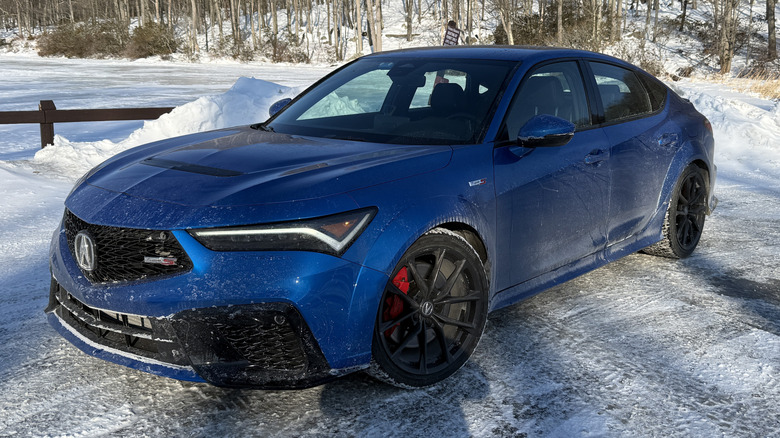
Acura is coming to Japan for the first time in nearly four decades, and its bringing two fantastic U.S.-built products with it: the Integra Type S and Honda Passport TrailSport. The move revives a strategy from the brand's early days of American manufacturing, and it makes the first time an Acura has ever been sold in Japan.
Exports of the ITS and Passport TrailSport Elite will begin in the second half of this year. Both cars will maintain their U.S. specifications, which include a left-hand drive setup. A spokesperson for the automaker said the choice to sell these two vehicles in Japan was made because of "anticipated customer demand," but they're not expected to be massive sellers by any means. From Automotive News:
Honda is expected to build about 21,000 Integras and 60,000 Passports this year at U.S. plants, according to production estimates from AutoForecast Solutions.
Left-hand drive will limit the vehicles' appeal in Japan, said AutoForecast Solutions Vice President Sam Fiorani, who projects combined sales there of no more than 5,000 to 6,000 annually.
[...]
The initiative revives Honda's pioneering 1988 reverse-import effort, when it became the first Japanese automaker to ship U.S.-built vehicles to its home market, starting with Accord coupes and Gold Wing motorcycles from Ohio.
Today, trade imbalances and easing of import restrictions are driving Japanese automakers to make similar moves. Toyota is pursuing exports of U.S.-built vehicles, and Nissan is evaluating options.
Japan exported about $34 billion worth of vehicles to the U.S. in 2025 while sending less than $1 billion in the opposite direction, according to United Nations Comtrade data.
On Feb. 16, Japan's transport ministry simplified inspections for U.S. vehicles under a bilateral agreement. Models meeting U.S. safety standards now qualify for fast-track approval, skipping additional emissions, noise and other local testing.
I, for one, am thrilled that a gem like the ITS is being shared with the rest of the world. It's still one of my favorite cars on sale today, and if I had $55,000 to spend on a new vehicle, there's pretty much nothing I'd take ahead of it. The Passport TrailSport Elite is also an excellent little crossover in its own right.
3rd Gear: Chinese EVs will be in Canada very soon
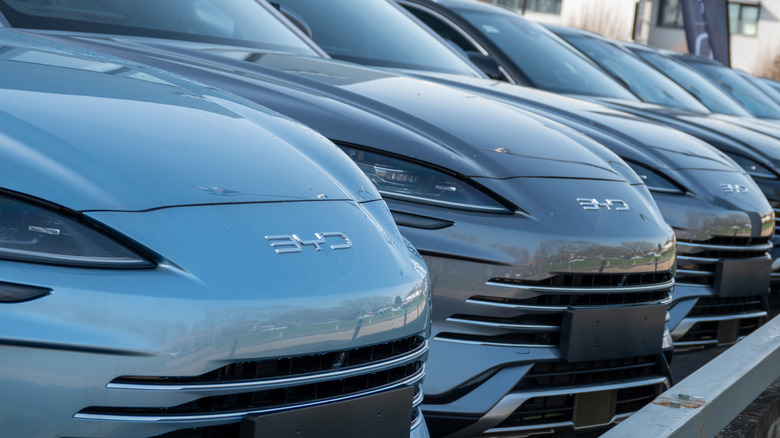
The Canadian government has begun issuing import permits for Chinese-built electric vehicles, which means 49,000 Chinese EVs can start heading over to our neighbors up north over the next 12 months. Those lucky bastards.
An import notice said Global Affairs Canada will award permits for up to 24,500 China-made electric vehicles entering the country from March 1 through August 31 on a "first-come, first-serve" basis. Vehicles given the permits will get slapped with a 6.1% tariff, down from the previous 106.1% duty that was imposed in 2024. From Automotive News:
The updated import rules come six weeks after Ottawa and Beijing reset trade relations after years of tension in a deal that established a quota for China-made EV imports into Canada in exchange for lower Chinese tariffs on a range of Canadian agricultural products, including canola.
The vehicle-import quota will start at 49,000 vehicles and expand to 70,000 vehicles by 2030. It includes battery-electric, hybrid and plug-in hybrid vehicles, according to the import notice.
In any given year, no imports of China-made EVs beyond the quota levels will be permitted, according to Global Affairs spokesperson Samantha Lafleur.
Lafleur also signaled there might be limits to the first-come, first-served basis of the import permit process during the first six months. There is "no predetermined limit" on the number of permits per automaker, she said, but Global Affairs "will monitor the application and issuance of import permits for the purpose of providing equitable access to the quota to eligible applicants."
Global Affairs plans to consult with industry on whether to continue with the first-come, first serve permitting system after the initial six-month quota period or take a different approach. The second quota period runs from Sept. 1, 2026, to Feb. 28, 2027. It will cover up to 24,500 vehicles, plus any unused permits from the first six months.
Along with requiring an import permit, a customs notice published Feb. 26 by the Canada Border Services Agency said vehicle imports must be compliant with all Canadian safety regulations.
While the import regulations cover one side of the equation, it is not clear whether Chinese authorities will manage what vehicles can be exported to Canada. Lafleur said Global Affairs was "not aware of any export-permit mechanism that might be administered by China."
Right now, it's not immediately clear which automakers are positioned to send vehicles to Canada, but it's expected that Tesla, Polestar and Volvo are frontrunners in that regard. Tesla had been the largest importer of China-made EVs to Canada up until 2024.
4th Gear: Toyota really wants Toyota
Toyota — the automaker — has bumped up its offer to buy Toyota — the supplier — to a massive $30 billion bid. The move ends a months-long battle with activist fund Elliott Investment Management, which had pushed for a higher price. From Reuters:
Elliott said it had agreed to tender its shares in the forklift maker, known as TICO, and called the raised offer of 20,600 yen ($132) a share an "improved outcome" for minority shareholders.
The price is nearly 10% above Toyota's previous bid of 18,800 yen.
The automaker originally offered 16,300 yen a share in June before raising it in January. Elliott had rejected both offers as too low.
The fund, and other minority shareholders said those bids undervalued TICO.
The stand-off between Paul Singer's fund – one of the world's most prominent shareholder activists – and Toyota, the world's top-selling automaker, has been closely watched as a test case for Japan's push to improve corporate governance.
Elliott's decision to tender effectively makes the bid a "done deal", said Travis Lundy of Quiddity Advisors, who publishes on the Smartkarma platform, though he called the higher price a "disappointing outcome."
Elliott had previously said the shares were worth more than 26,000 yen each.
As part of the deal, TICO will unwind its holdings in other Toyota companies. That practice of "cross-shareholding" has long been criticised as insulating management from investors.
TICO was founded in 1926 as Toyoda Automatic Loom Works, and it later added an automobile division, which was spun off as Toyota Motor in 1937. In the past, Toyota has said it wants to take TICO private to remove the bruden of short-term profit targets as the group pivots to connected cars and advanced software.
Reverse: Horse power
 History.com
It's wild to think how many Mustangs Ford was producing in its early days. I mean, it took less than two years for the company to crank out a million of them. That's gnarly. When you look at Mustang coupe and convertible sales today (no, I'm not counting the Mach-E), things aren't even close. In 2025, Ford sold 45,333 'Stangs. The world sure has changed. If you want to learn more, head over to History.com.
On the radio: 50 Cent - In Da Club
I know this isn't my normal style of music, but "In Da Club" just so happens to have been the number one song in the U.S. on March 19, 2003. For those who don't know, that's the day the U.S. decided to invade a Middle Eastern country in the name of regime change and stopping them from developing weapons of mass destructions. History may be doing a lot more than rhyming this time around. I'll talk to you guys in 20 years.