

Corvette Skidpad Grip Ranked Best To Worst Across Generations
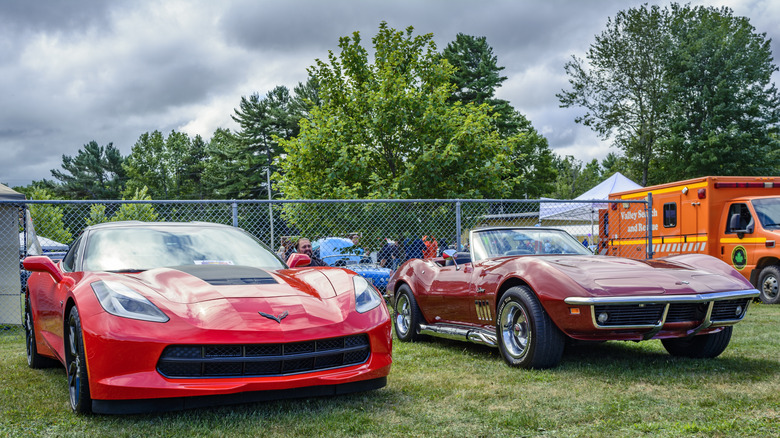
The Chevrolet Corvette has been Detroit's answer to the European sports car for more than seventy years. Since 1953, it has gone through eight distinct generations. The idea behind the Corvette came from Harley Earl, former head of design at General Motors, who envisioned an affordable two-seat roadster that could stand beside the imports returning stateside with World War II veterans. The first Corvette shipped with a six-cylinder engine, and it was Zora Arkus-Duntov (later nicknamed the "Father of the Corvette") who pushed the car towards the V8 power it would become known for.
From there, the Corvette never stopped evolving. The front-engine layout that defined the nameplate for decades was finally abandoned when the eighth generation arrived with its engine behind the driver, a change that purists argued about — and the stopwatch quietly settled. What makes the Corvette so interesting is that it has always been judged by two audiences. One cares about straight-line muscle and badge pride. The other, which is usually more critical, cares about how a car handles when the road bends. And for a car built to take on Porsche, Jaguar, and Ferrari, that second audience matters just as much as the first — if not more.
That is where skidpad grip comes in. Measured in g-force, it shows how hard a car can corner before the tires let go of the road. This measurement largely sidesteps horsepower and driver skill (as you'll see throughout this article), instead mostly being affected by tires, suspension, and chassis balance. To keep the numbers easier to digest, this article leans on Car and Driver's skidpad, which is 300 feet across in its modern tests and 200 feet in older ones. Other testers will be relied on only where necessary.
C7 Corvette (2014-2019)
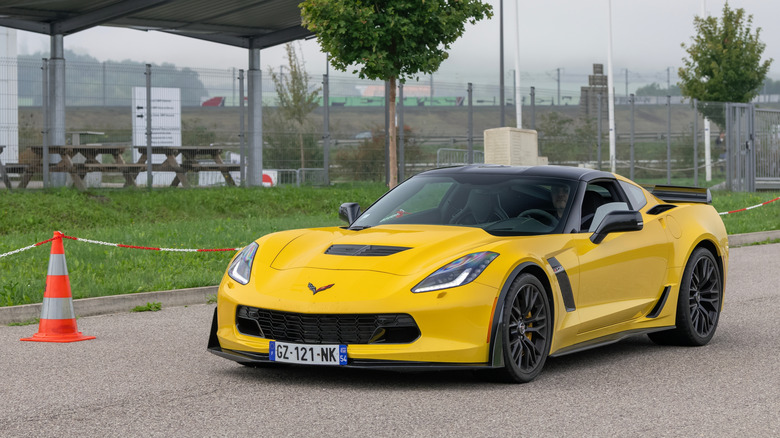
In terms of available and credible test results online, the C7 is where the front-engine Corvette actually peaked. On Car and Driver's 300-foot skidpad, the 2015 Z06 with the Z07 package "scorched the skidpad with 1.19 g." At the time, no production car had logged a higher figure on that pad. The Z06 also managed to stop in 128 feet from 70 mph to 0, cross the quarter mile in just 11 seconds at 126 mph, and do a 0 to 60 mph run in just 2.9 seconds.
Behind that number sat a supercharged 6.2-liter V8 rated at 650 horsepower, as well as Michelin Pilot Sport Cup 2 ZP tires. Weight-wise, the car itself is rated at 3,558 pounds. Car and Driver also posted impressive numbers with the 2017 Corvette Grand Sport, which managed to hold 1.18 g even with 190 fewer horsepower than the Z06, showing how engine strength doesn't matter as much as other factors for grip. Braking from 70 mph took 129 feet, the quarter-mile took 12.2 seconds, and 60 mph arrived in 3.8 seconds. And the Grand Sport is only slightly lighter than the Z06, tipping the scales at 3,452 pounds.
Interestingly, the Z06's 1.19 g is also higher than anything the C8 posted in Car and Driver's tests. Even the 1,064-horsepower 2025 Chevrolet Corvette ZR1 managed a curiously low 1.13 g. In other words, the C7 Z06's 1.19 g is a measurement that no other Corvette generation could match.
C8 Corvette (2020-present)
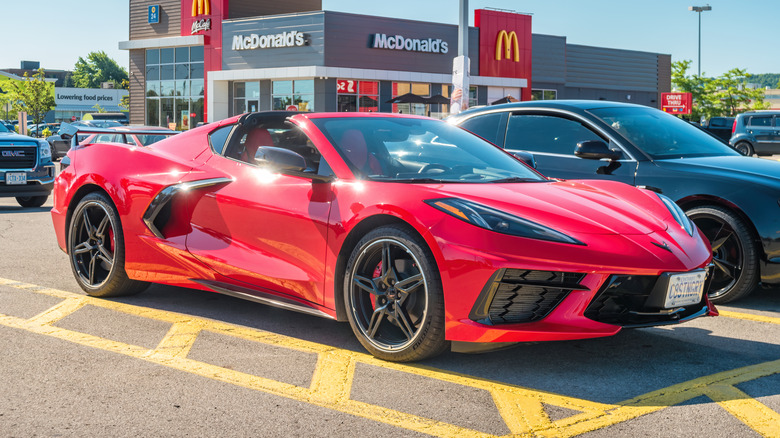
The mid-engine C8 had every reason to beat the C7 here. It is the newer car, it has the newer rubber, and it has more horsepower across the board. The Z06's 5.5-liter flat-plane-crank V8 makes 670 horsepower, and the Z07 package has the car riding on Michelin Pilot Sport Cup 2 R tires. But on Car and Driver's 300-foot skidpad, the Z07-equipped Z06 recorded 1.16 g. Chevrolet's own number for the car was 1.22 g, and Car and Driver noted that this result was "well below the company's estimate." The publication later explained that the Z07's tires had been inflated to the door-placard pressure rather than Chevrolet's lower track recommendation, potentially limiting its measured grip.
Regardless, even if we look at the rest of the lineup, the C8 failed to match the C7 in Car and Driver's tests. The non-Z07 version of the Z06 convertible hit 1.12 g, and the Stingray reached just 1.03 g. Later Car and Driver tests didn't move the number; as mentioned, the ZR1 reached 1.13 g, while the 1,250-horsepower ZR1X came in at 1.15 g. That leaves the C8 0.03 g behind the C7 Z06's result in Car and Driver's testing.
MotorTrend measured nearly the same thing in a different way. Through the 200-foot-diameter turns of its figure-eight course, the Z07 coupe held 1.16 g and the Z06 convertible achieved 1.10 g, against Car and Driver's 1.16 g and 1.12 g on a 300-foot pad. The figure-eight also shows how far apart the trims sit. The Z07 coupe lapped it in 21.9 seconds, while MotorTrend's $78,090 base Stingray needed 24.1 — the same as the Hyundai Ioniq 5 N that beat the Corvette in MotorTrend's comparison test.
C6 Corvette (2005-2013)
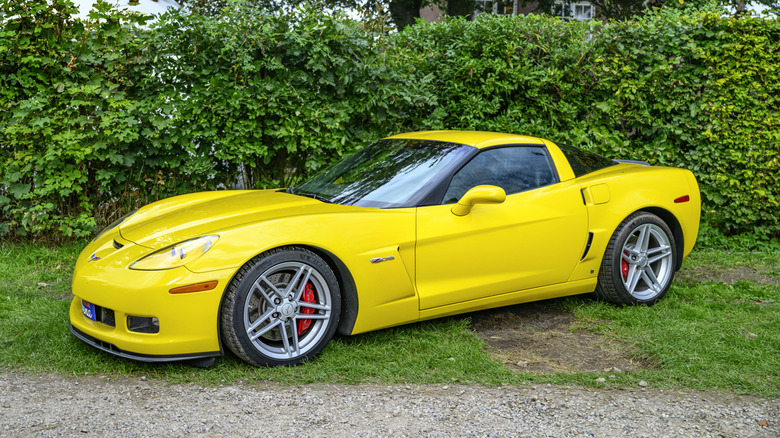
Taking third place is the C6 Corvette, and the C6's best skidpad number belongs to its flagship ZR1. It actually beat the factory's own estimate here; GM put the supercharged ZR1 at 1.05 g, while Car and Driver's skidpad led to a result of 1.07 g on Michelin Pilot Sport PS2 tires. The same 638-horsepower beast stopped from 70 mph in 142 feet, which Car and Driver called "the shortest stopping distance we've ever recorded for a production car" at the time. (As mentioned previously in the article, the C7 Z06 would later stop from 70 mph in 128 feet.)
Car and Driver's write-up also lined the ZR1 up against pricier cars. The Lamborghini Murciélago LP640 managed 1.01 g, the Ferrari 599GTB Fiorano achieved 0.98 g, and the Aston Martin DBS went to 0.97 g. Those three were listed at $325,200, $318,045, and $266,350, while the ZR1 cost just $105,000. Another tester saw the same thing on track. At Roebling Road Raceway in Georgia, MotorWeek's test showed how good the C6 Corvette ZR1 was: the ZR1 lapped faster than any car the publication had tested there, including the Ferrari Enzo. As a result, MotorWeek called it the "ultimate production Corvette."
The rest of the C6 range sat lower in Car and Driver's tests, but they still held respectable numbers for the time. The 2006 Z06 held 0.98 g, and a Z51-equipped 2008 Corvette managed 0.95 g. The 2010 Grand Sport matched the Z06 at 0.98 g in Car and Driver's Buttonwillow comparison, though Chevrolet had claimed 1.0 g for the former. All in all, that leaves the C6 0.12 g behind the C7 Z06.
C5 Corvette (1997-2004)
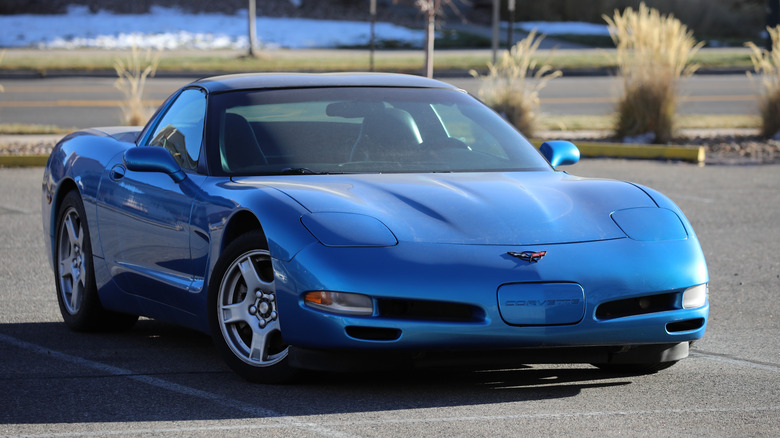
When the C5 Corvette came about in 1997, it got a new LS1 V8, a near-50/50 weight balance, and an ultra-stiff hydroformed steel frame. In terms of skidpad numbers, though, the best result belonged to the 2001 Z06. When Car and Driver tested this model, its 300-foot pad recorded 0.98 g, a figure the magazine called "one of the best we've ever seen for a production car" — a recurring theme thus far with every new generation of the Corvette (except the C8).
The 2001 C5 Z06 used a 385-horsepower LS6 V8 and had a curb weight of 3,126 pounds, with Goodyear Eagle F1 SC tires sized 265/40 in front and 295/35 in back. The rest of the C5 range wasn't too far behind, either. Every non-Z06 C5 that Car and Driver had tested by 2004 topped out at 0.90 g. Car and Driver's 1997 preview listed no skidpad figure among its own test results; the 0.92 g in its write-up was secondhand. Meanwhile, MotorTrend's test of the 2002 car (rated at 405 horsepower), recorded a "stellar" 0.99 g on its own skidpad with stability control off.
In Car and Driver's other tests, the 2005 Z51 also held 0.98 g. The 2006 Z06 matched that measurement despite carrying 120 more horsepower and weighing 21 pounds more than the 2001 C5 Z06 — which isn't surprising when considering how they both used the same Goodyear tires. That leaves the C5 0.09 g behind the C6 ZR1; in other words, a 2005 Z51 matched the 0.98 g that the C5 needed a Z06 to reach.
C4 Corvette (1984-1996)
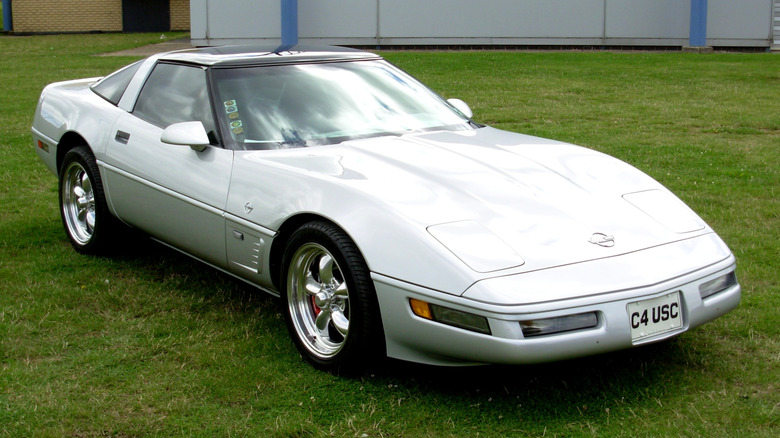
The earliest C4s took criticism for their engines. The Cross-Fire V8 it used was known for being underpowered, which is why enthusiasts nicknamed it "Cease-Fire." But this is another example of how grip is affected by more than just horsepower, as one of the C4's best skidpad numbers came on day one — with a caveat. In the Car and Driver's test of the Z51-equipped 1984 car, the 200-foot skidpad recorded 0.90 g, making for a favorable comparison against 0.82 g for its Porsche 928 rival. The Corvette made 205 horsepower and stopped from 70 mph in 173 feet, and its grip came courtesy of Goodyear Eagle VR50 tires.
Later tests moved to Car and Driver's 300-foot pad, where the numbers ran a tad bit lower. Despite gaining 40 horses, the 1988 Corvette held 0.87 g (with new Goodyear Eagle ZR40 tires), while the 330-horsepower 1996 Grand Sport reached 0.89 g (with Goodyear Eagle GS-C tires). To another magazine, though, the ZR-1 looked to be a bit more impressive. Road & Track measured 0.94 g for the 1990 ZR-1, and also noted the result is "better than any production-built automobile, bar none." On Car and Driver's 300-foot pad, though, none of the C4s mentioned here topped 0.89 g, which leaves the generation 0.09 g behind the C5 Z06.
C3 Corvette (1968-1982)
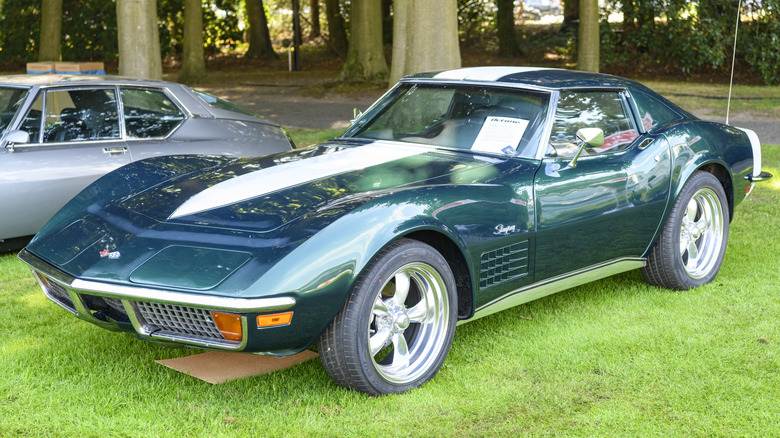
The Corvette C3 was in production for 14 years, and during that time, it managed to set quite a few different skidpad numbers. The first C3 numbers here come from Car and Driver's June 1971 issue, when the publication tested four Corvettes: a 270-horsepower 350, a 330-horsepower LT1, a 365-horsepower LS5, and a 425-horsepower LS6. The LT1 topped the group at 0.80 g, and it was also the lightest of the four. That figure sits in the exact middle of the 0.75 to 0.85 g band that Zora Arkus-Duntov — who was present during the testing — gave for production Corvettes. (That LT1 350 also used the ZR1 package, and as we found when ranking every ZR1 by horsepower, the C3 version sits dead last in that comparison.)
A decade later, in March 1982, Car and Driver put a 1962 roadster and a new 1982 coupe on its 200-foot pad and referred to them as "Old Red" and "New Blue," respectively. The 360-horsepower Old Red held 0.77 g on Sears Road Handler GR78-15 tires. New Blue — with 200 horsepower, a 3,300-pound curb weight, and Goodyear Eagle GT P255/60R-15 tires – held 0.82 g. That's 0.02 g above the 1971 LT1 in separate tests despite the much lower horsepower numbers. Of course, the C4 showed up a year later and blew all versions of this generation out of the water, with its best numbers coming about 0.08 g short of its successor.
C2 Corvette (1963-1967)
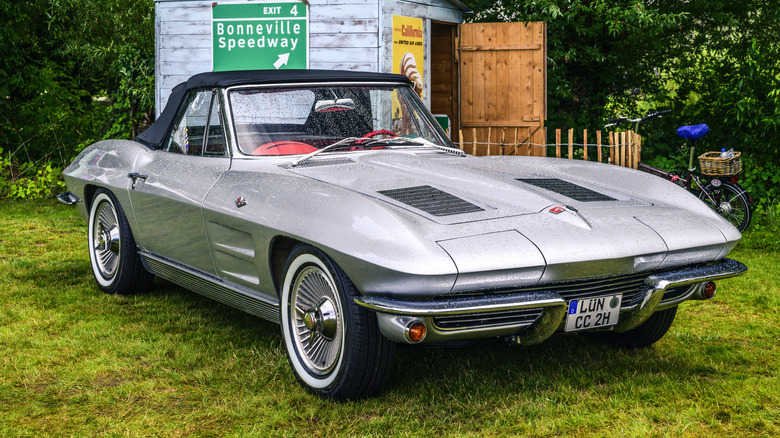
Today, we don't look at a Toyota Camry and immediately think of a sports car. But on a skidpad, a modern one can beat a 1960s Corvette — specifically a 2015 Toyota Camry V6 against a 1966 Corvette Sting Ray. Edmunds tested both on July 7, 2015, recording 0.75 g for the Camry XLE and 0.70 g for the Corvette, a car with a 300 horsepower (gross), a 3,159-pound curb weight, and 7.75-15 Firestone Deluxe Champion bias-ply tires.
The same table lists a 2015 Corvette Stingray without the Z51 package at 0.96 g. Car and Driver can't referee, as you won't find a skidpad figure in its April 1963 test of the Sting Ray, nor its May 1967 test of the 427. The 1963 panel does record a 14.4-second quarter mile at 103 mph, and the text says the independent suspension "completely transformed the Corvette in terms of traction and cornering power." Too bad it didn't include grip numbers to back up this claim.
At least MotorTrend put a number on one. MotorTrend's July 2019 tally has a 1967 427, tested in 1997, at 0.75 g – the lowest skidpad figure of any Corvette in the tally. The highest is 1.17 g from the 2015 Z06 with the Z07 package, which is the same model and package that took the crown at 1.19 g on Car and Driver's pad. The C2 does at least show up in the first two entries of our ten-car list of track-worthy Corvettes: the 1963 Grand Sport and the L88.
C1 Corvette (1953-1962)
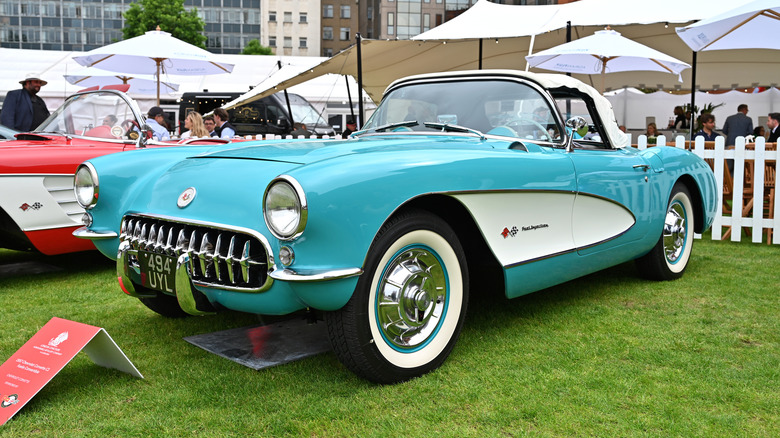
Welcome to 1953, a time when the Corvette actually rocked a six-cylinder engine. Built for the 1953 Corvette, the six pot in question was the 150-horsepower Blue Flame six backed by a two-speed Powerglide transmission. Although skidpad numbers are difficult to find for the 1950s era, MotorTrend at least has acceleration numbers. It timed the 1954 car to 60 mph in 11.5 seconds. The 1962 car — a four-speed with 360 horsepower — reached a figure of 5.9 seconds.
A 1962 roadster is also where the C1's skidpad number comes from, but it has a rather big asterisk attached to it. In Car and Driver's March 1982 comparison, the 200-foot skidpad recorded 0.77 g. That's the same test that gave the C3 its previously-mentioned 0.82 g. The asterisk is the tires, as the C1 used Sears Road Handler GR78-15s, not the 6.70-15 bias-plies it left the factory on. Therefore, it's reasonable to assume the C1's actual skidpad performance was worse than this.
The rest of the car's numbers put it at 3,150 pounds, 6.1 seconds to 60 mph and 238 feet to stop from 70 mph. Car and Driver called it "a nasty beast to drive anywhere near its limit," and a skidpad is nothing but the limit. It's really no surprise that the only C1 number we could find arrived twenty years after the car did. On paper, 0.77 g would edge out the C2's 0.70 g, but this measurement doesn't come from its original tires, so the C1 takes last place on this list by technicality.