

10 Of The Most Track-Worthy Corvettes Ever Made
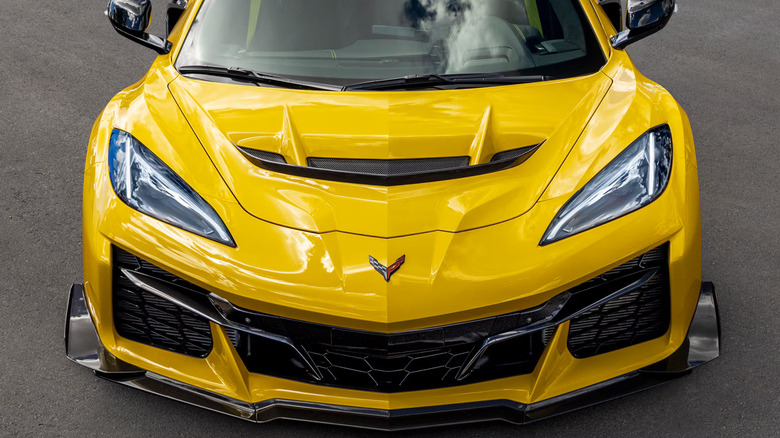
Ever since the Corvette's beginnings as a 1953 concept car, Chevy's flagship car has beaten the odds, slowly gaining market traction to then start dipping its toes into the exotic world of European supercars. What was once an underpowered fiberglass roadster is now a full-blown hypercar killer with stupendous performance and futuristic tech. But the Corvette didn't reach that status by following the norm. General Motors has been improving it continuously for over seven decades, making it faster and better to drive with each new generation.
The Corvettes that pushed the performance envelope the furthest always have been the track-oriented models. These specials have established the Corvette as the exotic sports car it is today, and in this piece, we'll give you some of our favorites. We'll go back to the where it all started for the Corvette as a track car, and how Chevy refined the formula over the years until it reached its pinnacle today. Road-legal or not, these are the most track-worthy Corvettes ever made.
1963 Chevrolet Corvette C2 Grand Sport
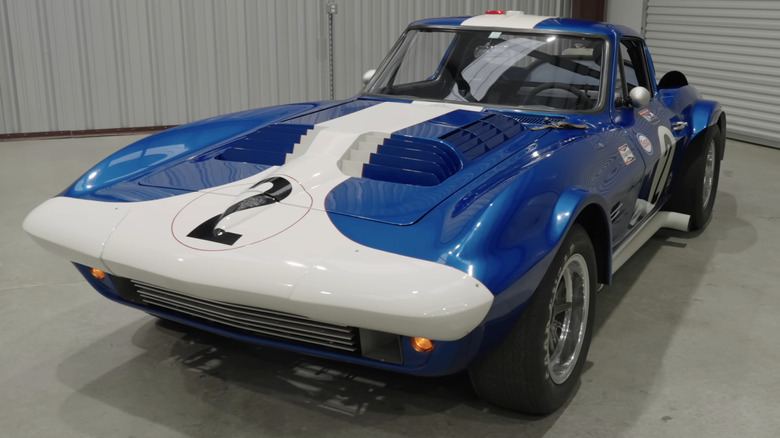
The Corvette C2 Grand Sport signaled a new era for Chevy's V8-powered sports car. The regular Sting Ray was already a great road car and was successful enough in racing, but it wasn't really designed for the track. That became apparent when the Shelby Cobra arrived on the scene in 1962. Carroll Shelby's lighter sports car torched the racing scene, leaving the Corvette in dust.
But star engineer Zora Arkus-Duntov was secretly working out a response. This is the same man who had convinced GM's top brass that the Corvette needed a V8 engine. (Little reminder here — the first Corvette actually had a Blue Flame inline-6 engine.) Initially called the "Lightweight," the Grand Sport, which would've competed in the GT category, followed the Shelby Cobra formula of a light body and a potent V8 engine under the hood.
The result was a racing machine that weighed under a ton, powered by a 377-cubic-inch (6.2-liter) V8 with 550 horsepower. To keep the weight down, Arkus-Duntov replaced the Sting Ray's body panels with thinner ones made from fiberglass and employed an aluminum space frame. Other parts, such as the steering box and differential, were also made from aluminum, while the wheels were made of magnesium. There was also some aero work done on the car, specifically a tapered roofline and vents throughout the body.
Naturally, you'd expect to hear how this car demolished its racing competition, but that glory never came. The Grand Sport's chances to race at Sebring and Le Mans were ruined when GM brass decided to honor a 1957 Automobile Manufacturers Association agreement banning factory-backed motorsports, canceling the project after only five cars were built.
1967 to 1969 Chevrolet Corvette C2/C3 L88
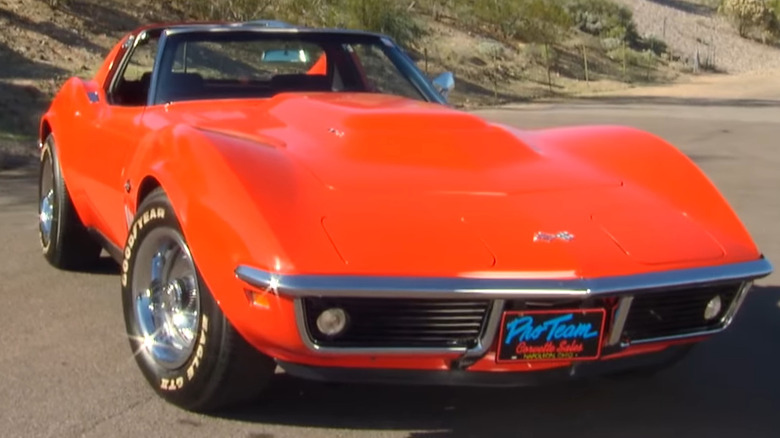
GM's motorsport ban was well into play by the end of the 1960s, but that didn't stop Arkus-Duntov from fiddling with the Corvette. This time, he wanted to build a road car that would compete with the supercars of the era, and the automaker's top brass agreed — with a catch.
This time, Arkus-Duntov's idea was to offer the L88 big-block engine as an option on Corvette's spec sheet. The problem was, the sports car was already offered with 427-cubic-inch big-block V8s, ranging from 390 to 435 hp. And on that spec sheet, the 427-cubic-inch L88 produced only 430 hp at 5,200 rpm. Here's the catch we mentioned: The race-bred engine could rev to 6,200 rpm, where it produced 550 hp. With this marketing trick, GM kept its "We hate motorsport" image in the public's eye, while giving a road-legal, race-bred Corvette to those who knew.
And the L88 was no ordinary engine. It was built for Sports Car Club of America (SCCA) and endurance racing, so it had high-compression pistons, special heads with bigger valves, a stronger crankshaft, and an 850 double-pump carburetor. It also had a cold-air induction cowl, which created a bulge on the hood. And Corvette L88s featured heavy-duty suspension components and brakes to better cope with the potent engine.
The L88 package was offered during the final year of the C2 generation Corvette, and for a few more years on the C3 Corvette. In 1969, GM also offered Corvette L88s with the ZL1 package, featuring a significantly lighter all-aluminum L88 engine block.
1988 to 1989 Chevrolet Corvette C4 Challenge
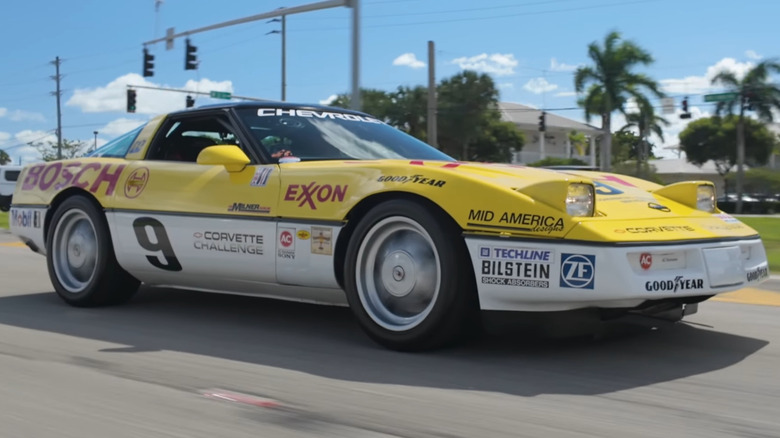
The Corvette C4 story also involves a ban. This time, however, it wasn't GM that prohibited its flagship sports car from competing. Instead, the SCCA booted the C4 Corvette because it made racing boring. See, during a two-year span (1985 to 1987), the C4 Corvette annihilated its biggest SCCA rival, the 944 Turbo, beating it in all 29 races. The SCCA wasn't happy, as the series became too one-dimensional and predictable, so it banned Chevy's sports car for the 1988 season.
Still, Chevy wasn't ready to leave C4's dominance to the history books just yet. So, as proposed by Corvette chief engineer Dave McLellan, the automaker created a "Corvette Challenge" series, consisting only of C4 Corvettes. The SCCA was invited to be the sanctioning body, and sponsors rushed to support it, allowing prizes across the season totaling $1 million.
The series' main draw was that it rewarded driver skill, since all cars were on equal footing. Each car featured a 5.7-liter L98 V8 engine, Doug Nash 4+3 manual transmission, 17-inch Dymag wheels with Goodyear Eagle ZR40 tires, roll cage, Bilstein shocks, and racing brake pads.
Each car started as a Corvette with a B9P option code, which came with things like a six-way power-adjustable driver seat, Delco-Bose stereo, and a blue-tinted removable glass roof panel. Apart from these luxurious features, the stock cars were also equipped with the Z51 handling package. Chevy built 56 B9P cars, but not all of them were converted to C4 Challenge race cars — eight were sold to private customers.
2001 to 2004 Chevrolet Corvette C5 Z06
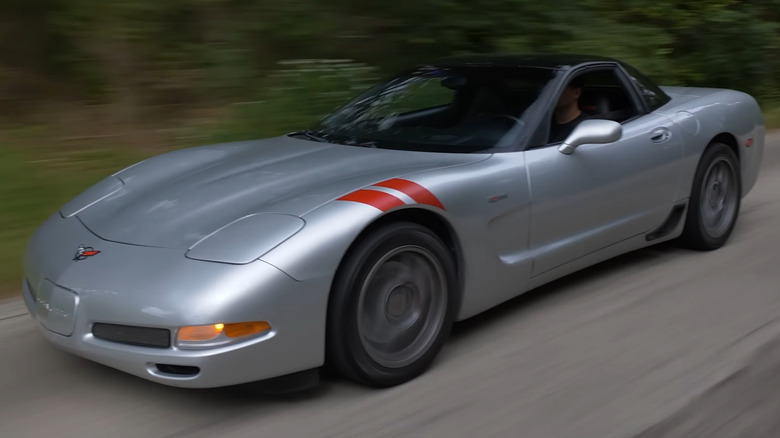
The 2001 Corvette C5 Z06 brought the high-rpm, lightweight formula into the hands of private buyers. Yes, it wasn't the first Z06; that honor would go to the Arkus-Duntov-designed 1963 C2 model, but that's one of the rarest Corvettes, with only 199 ever built. It was the 2001 model that brought the Z06 name into the spotlight.
Chevy did a lot to differentiate the race-bred Z06 from the regular Corvettes. The engine was based on the existing LS1, revised so thoroughly that it deserved a new LS6 designation. Most notably, it featured a restructured cylinder head with a different camshaft configuration for better breathing at higher rpm and higher compression ratio. As a result, it produced 385 hp at 6,000 rpm — 40 hp more than the LS1 — and revved all the way to 6,500 rpm. It was paired with a six-speed manual, and, according to Car and Driver, reached 60 in 4.3 seconds. From the 2002 model year, Chevy bumped the output to 405 hp, cutting the 0-60 time to 3.9 seconds.
But the revised engine was only part of the story. The Z06 also had reduced weight thanks to lighter wheels, tires, and titanium mufflers. Meanwhile, a stiffer FE4 suspension package, wider tires, and higher negative camber ensured tighter handling and higher grip on the track. Finally, to achieve the highest possible torsional rigidity, the Corvette C5 Z06 was only available as a fixed-roof coupe.
2009 to 2013 Chevrolet Corvette C6 ZR1
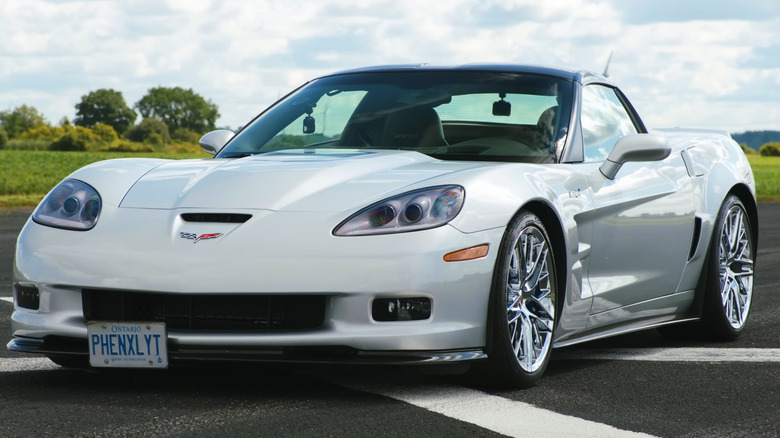
The 2006 Corvette C6 Z06 established Chevy's sports car as a supercar alternative with a 7.0-liter naturally aspirated V8 that produced 505 hp, revved to 7,000 rpm, and enabled a 198-mph top speed. But with the 2009 ZR1, Chevy took things even further by incorporating a 6.2-liter supercharged V8 with 638 hp and a brutal 604 lb-ft of torque. Paired with a six-speed manual, the fire-breathing engine propelled the best-ever C6 Corvette ZR1 to 60 in brisk 3.4 seconds, blitzed to the quarter mile in 11.3 seconds, and reached a top speed of 205 mph (per Car and Driver).
Those numbers are even more impressive when you learn that the ZR1 also had some downforce-enhancing bits that added drag. Built over the Z06 widebody, the C6 ZR1 featured a wraparound splitter on the front, side rocker panels, and a relatively small rear spoiler. Each of these parts was made from carbon fiber to reduce weight and made the C6 Corvette way more aggressive. Heck, the ZR1 even had a Plexiglas panel on the hood that revealed the supercharger — it was that cool.
The performance enhancements didn't stop there. The ZR1 also came with Brembo carbon-ceramic brakes and Magnetic Selective Ride Control dampers for tighter handling, while a stiffer double-plate clutch ensured smoother gear changes. Chevy even improved the steering feel by replacing Z06's aluminum steering column with a steel one and incorporating variable-ratio technology that made it more responsive at slower speeds. All in all, the C6 ZR1 remains a great track car even today. It's still stupendously fast, yet highly analog thanks to the six-speed manual.
2011 Chevrolet Corvette C6 Z06 Carbon Limited Edition
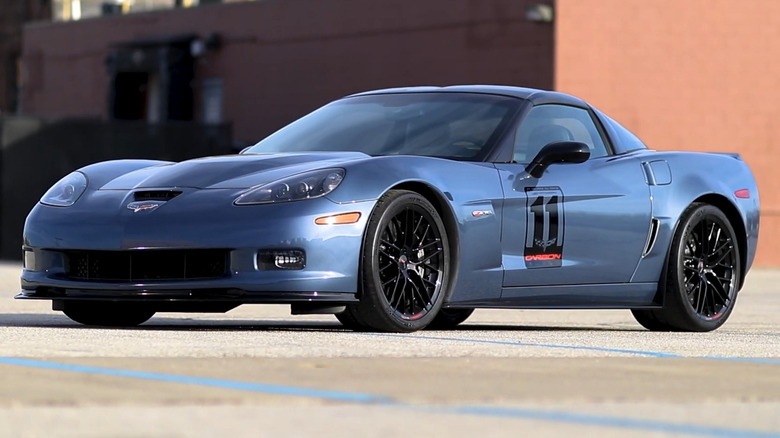
The ZR1 was a capable track machine, but the C6 Z06 Carbon Limited Edition Corvette trumped it in some areas, despite being short on power. With just 252 produced, the Z06 Carbon Edition was built to commemorate the 50th anniversary of the 24 Hours of Le Mans race, so it had all the upgrades necessary for attacking the track. Chevy copied the Magnetic Selective Ride Control suspension, Michelin PS2 tires, and carbon-ceramic brakes from the ZR1, while also incorporating better cooling. The Z06 Carbon also featured prominent aero parts, such as rear spoiler, front splitter, and rocker panels.
However, the Z06 Carbon still used the 7.0-liter naturally aspirated V8 from the regular Z06, good for 505 hp and 470 lb-ft. It was paired with a six-speed manual transaxle for better weight distribution and higher engagement. So, yes, it was short on power compared to the ZR1. Still, thanks to the non-supercharged engine, the Z06 Carbon Edition was also significantly lighter, weighing in at 3,150 pounds, compared to the 3,350-pound ZR1.
And on the track, lightness is more important than horsepower. It not only makes the car more agile and fun to drive, but also enhances grip and is easier on the tires. Besides, who doesn't enjoy a big, naturally aspirated V8 on the track?
2017 to 2019 Chevrolet Corvette C7 Grand Sport with Z07 package
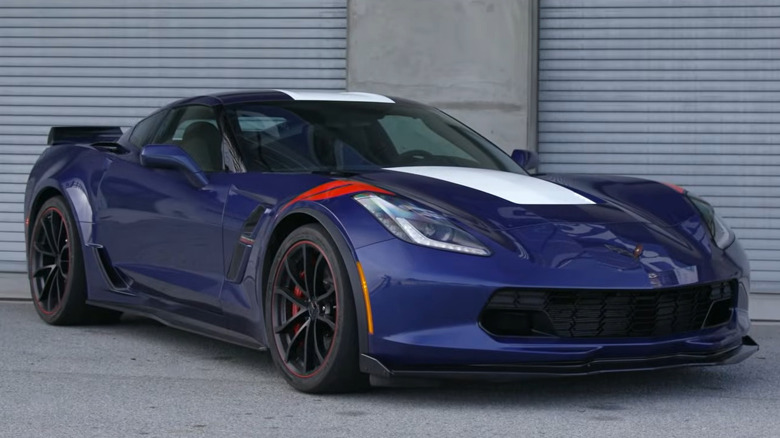
With the 2017 Corvette C7 Grand Sport, Chevy showed us you don't need astronomical horsepower figures to have fun on the track. Underneath, this model borrowed a lot from the regular Stingray, like a a seven-speed manual transmission and a 6.2-liter V8 that produced 460 hp and 465 lb-ft. On the outside, however, the C7 Grand Sport shared much with the Z06. Visually, the most striking thing was the widebody treatment, which let Chevy use large 20x12-inch tires in the rear. Aero bits were added to improve stability at higher speeds, including a front splitter and wickerbill rear spoiler, while an electronic limited-slip rear differential ensured better traction.
By now, you're probably wondering why we didn't include the C7 Z06 here. After all, it came with a 6.2-liter supercharged V8, good for 650 hp and 650 lb-ft. The answer is heat soak. Boosted engines often suffer from heat buildup under the hood, with C7 Z06 owners experiencing power loss after only a few laps on the track. With the C7 Grand Sport, which has upgraded cooling over the Stingray, that issue is all but eliminated, allowing longer track sessions. And the Grand Sport was lighter than the Z06 by about 100 pounds.
Lastly, we need to mention the Grand Sport's Z07 package, which is all but necessary for track sessions. It was an expensive $8,000 upgrade, coming with carbon-ceramic brakes, Michelin Pilot Super Sport Cup 2 tires, Magnetic Selective Ride Control dampers, and aero upgrades.
2019 Chevrolet Corvette C7 ZR1 with ZTK package
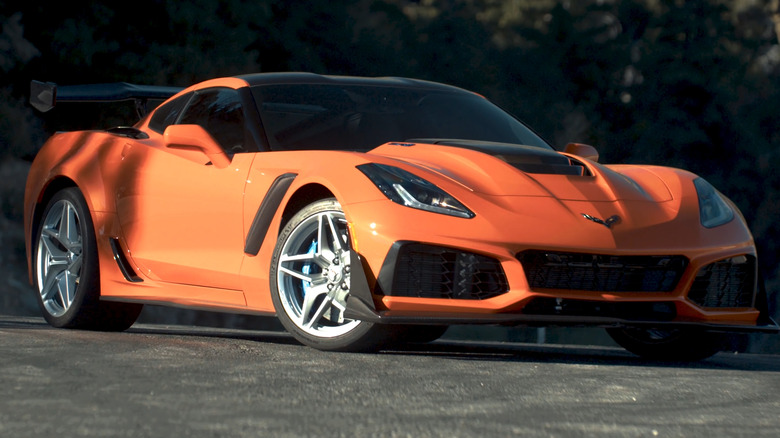
We just argued that due to heat soak, the C7 Grand Sport is better than the Z06 for long track sessions. Then how does the C7 ZR1, with its massive 2.65-liter supercharger that bumps the 6.2-liter V8 output to a whopping 755 hp and 715 lb-ft of torque, fare with heat? Quite well, actually. Chevy equipped this monster with an astonishing 13 heat exchangers to cool anything from the engine oil/coolant to the transmission and differential. The C7 ZR1 also has massive intakes in front, providing 41% more airflow than the Z06.
According to Chevy, this is enough to keep the power train cool on the track even when the ambient temperature reaches 100 degrees Fahrenheit. This means you can enjoy the V8's staggering straight-line performance for longer, beating almost every car you encounter. The C7 ZR1 catapults to 60 in just 2.85 seconds, finishes the quarter mile in unbelievable 10.2 seconds, and reaches a top speed of 212 mph.
Still, it was the optional ZTK package that turned the Corvette C7 ZR1 into a real track weapon. The biggest improvement was even more downforce, up to 950 pounds at 212 mph. To achieve that figure, the ZTK package was equipped with an adjustable rear wing, flat underbody, and front splitter. Meanwhile, track-oriented Michelin Pilot Sport Cup 2 ZP tires and stiffer suspension ensured the ZR1 cornered like it was on rails. Carbon-ceramic brakes were part of the base package, and so was a seven-speed manual, though an eight-speed automatic was available.
2023 to present Chevrolet Corvette C8 Z06 with Z07 package
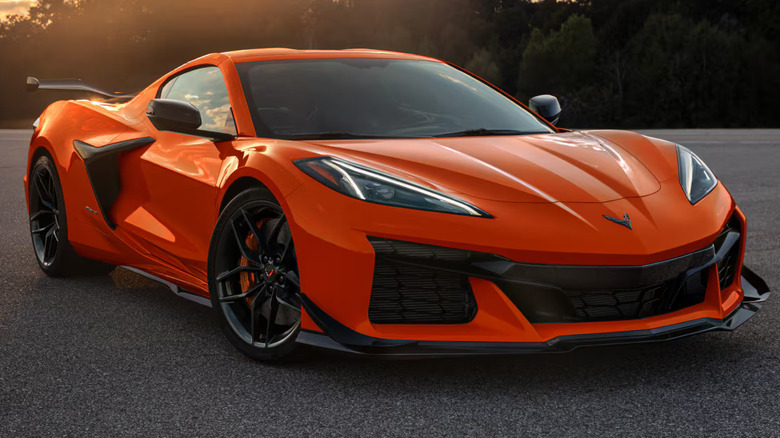
For seven generations, from 1953 to 2019, the Corvette followed the front-engine, rear-wheel-drive formula. The C5 Corvette switched to a transaxle design, with transmission placed over the back axle for better weight distribution, but the engine was still under the front hood. However, for the first time in Corvette history, the 2020 C8 used a mid-engine rear-wheel-drive layout, similar to the supercar crowd.
And that was just the beginning; with the 2023 Corvette Z06, Chevy introduced a racecar-like 5.5-liter V8 with a whopping 670 hp and 460 lb-ft. Crucially, the flat plane crankshaft engine allowed high-revolution shenanigans, with a Ferrari-458-like 8,600 rpm redline and sonic feast that gives you the chills. Ah, yes, the latest Z06 is also equipped with an eight-speed dual-clutch automatic, not a manual. Still, it shifts gears in an instant, allowing a blazing 0-60 sprint of 2.6 seconds. Quarter mile: 10.5 seconds. Top speed: 189 mph.
But the best part about the C8 Z06 is probably the sharp, yet balanced handling. The mid-engine configuration, aided by the Magnetic Selective Ride Control 4.0 suspension, makes the Z06 easy to drive at the limit — great for the track. Still, track day enthusiasts should opt for the Z07 package, which dramatically improves Z06's grip, stability, and stopping power. The package includes carbon-ceramic brakes, grippier Michelin Pilot Sport Cup 2 R tires, and requires the aggressive Carbon Aero package that provides 734 pounds of downforce at 186 mph.
2025 to present Chevrolet Corvette C8 ZR1 with ZTK package
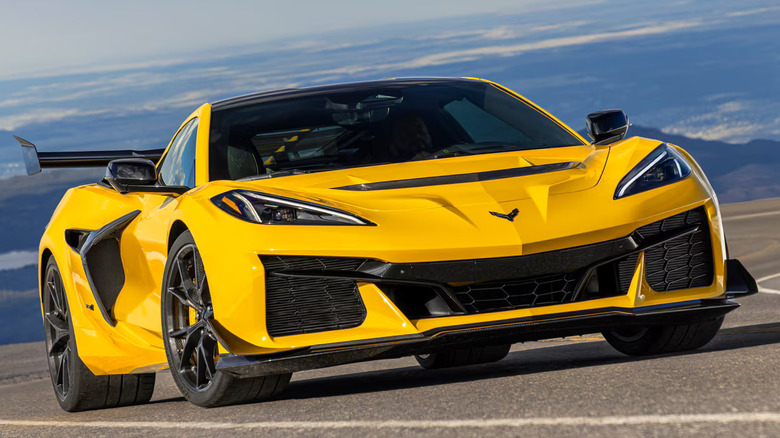
If you drew a line from the C7 Corvette Z06 (650 hp) and ZR1 (755 hp), you'd expect the C8 ZR1 to produce around 850 hp. Yeah, that's not even close. Okay, 900 hp? Nah, that's also too low, because the Corvette ZR1's twin-turbo 5.5-liter V8 is a shock to the supercar system with 1,064 hp and 828 lb-ft of torque. Uncharacteristic of a turbocharged engine, it also revs to 8,000 rpm, and, thanks to an antilag system, has almost no turbo lag.
The bigger shock? All that power is channeled to the rear wheels only. Yeah, there is no all-wheel drive to save you here, but ZR1's Performance Traction System does an incredibly good job of mitigating slippage. As a result, the ZR1 hits 60 in mind-melting 2.3 seconds and sprints to the quarter mile in a staggering 9.6 seconds when equipped with the ZTK Performance Package. Top speed: 233 mph as standard, or 225 mph with the ZTK Performance Package. That, folks, is hypercar territory.
As you'd expect, the ZTK Performance Package must be optioned with the Carbon Aero pack, which adds drag, hence the lower top speed. However, it also adds 1,200 pounds of downforce at the car's top speed, which translates into quicker lap times. The package also comes with stiffer springs, grippy Michelin Pilot Sport Cup 2 R tires, and improved cooling, crucial add-ons for quicker lap times and longer track sessions. Every ZR1 also comes with carbon-ceramic brakes as standard, crucial in a 233-mph car.