

Every Chevrolet Corvette ZR-1 (And ZR1) Ranked By Horsepower
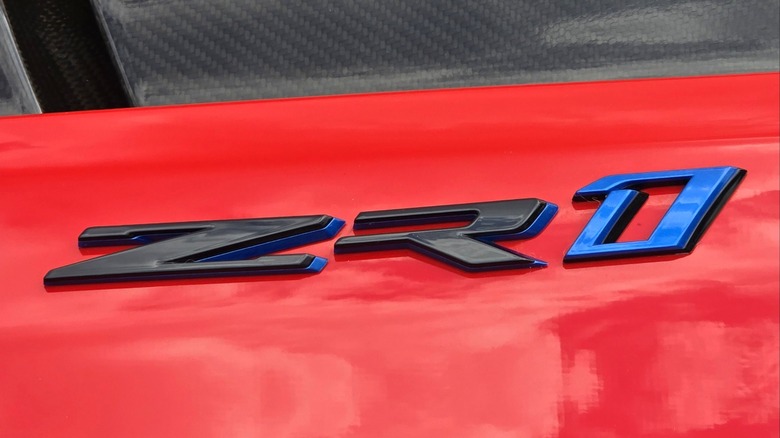
The iconic ZR1 badge has featured across five generations of the Corvette since the early 1970s, and every generation has fascinated its own era of muscle car enthusiasts. Depending on the generation, it's spelled with or without a hyphen, a distinction that matters here because these are technically different configurations across very different eras.
What started as a bare-bones competition package with the third-generation (C3) 'Vette has morphed into an exotic in disguise with the C4 before evolving into a full-on forced-induction supercar with the modern-classic C6 generation onward. With each new Corvette now comes the expectation of a high-powered variant that pushes performance benchmarks into the supercar realm while still donning the signature crossed flags. The C8 Corvette's ZR1's 1,064 horsepower makes that point more plainly than any chapter before it. Let's look at how they all compare when it comes to maximum factory power output and rank every ZR1 and ZR-1 Corvette from least to most powerful.
C3 ZR1: 370 hp (SAE gross); 255 hp (1972, SAE net)
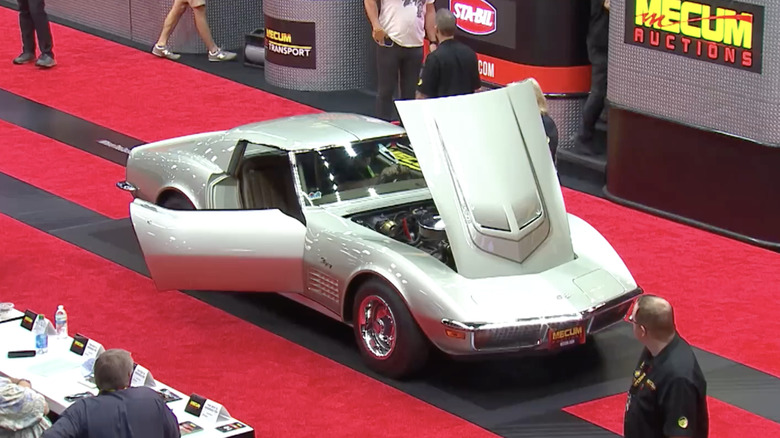
The original Corvette C3 ZR1 was simply a regular production option (RPO) available from 1970 through 1972. Production was scarce across the three years, with just 53 total units being in circulation. All three model years came with the classic 350-cubic-inch (5.7-liter) LT-1 small block with solid lifters and a four-speed manual as the only transmission option. The ZR1 came with no radio, no power steering, and no A/C.
Here's where the numbers need context. In 1970, the LT-1 was rated at 370 hp per SAE gross measurement — a testing method that omitted engine accessories and exhaust restriction, producing optimistic figures. For 1971, the compression ratio dropped from 11.0:1 to 9.0:1, cutting the gross rating to 330 hp. Then, the 1972 C3 ZR1 switched to SAE net measurement — the modern standard — and the same LT-1 was now rated at just 255 horsepower. The real-world performance difference between the '71 and '72 cars was minimal, but the numbers on paper looked catastrophic.
C4 ZR-1: 375 hp (1990–1992), 405 hp (1993–1995)
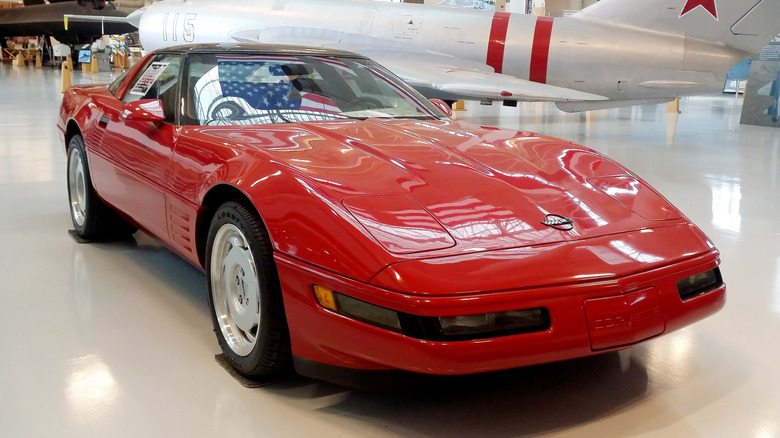
The ZR1 name would disappear for nearly twenty years before returning for the C4 generation starting in 1990. The C4 ZR-1 marked the first and only time the ZR1 carried a hyphen, and it was an entirely different machine compared to the one before it. It was arguably the first supercar Chevy made, and its aggressive body set itself apart from the base C4 — a trend that would continue from here. It was powered by a 5.7-liter dual-cam LT5 V8 designed by Lotus and hand-assembled by Mercury Marine – yes the boat engine company – and paired exclusively to a ZF six-speed manual. The resulting concoction produced 375 horsepower at launch, though early press materials and rumor mills pegged it closer to 380 or 385 horsepower.
The exotic touches proved worthy as the ZR-1 entered sub-five-second 0-60 times and a top speed of close to 180 mph before the American Saleen S7 or even the Dodge Viper. A refresh in 1993 updated the valvetrain, added ported-and-polished cylinder heads, added four-bolt main bearings, and more, all of which brought power to 405 horsepower, where it stayed through its final year in 1995. After that, the ZR1 name would go into another hiatus as the C5 generation notably skipped this high-performance trim altogether — we wouldn't hear this name again until the late 2000s.
C6 ZR1: 638 hp (2009–2013)
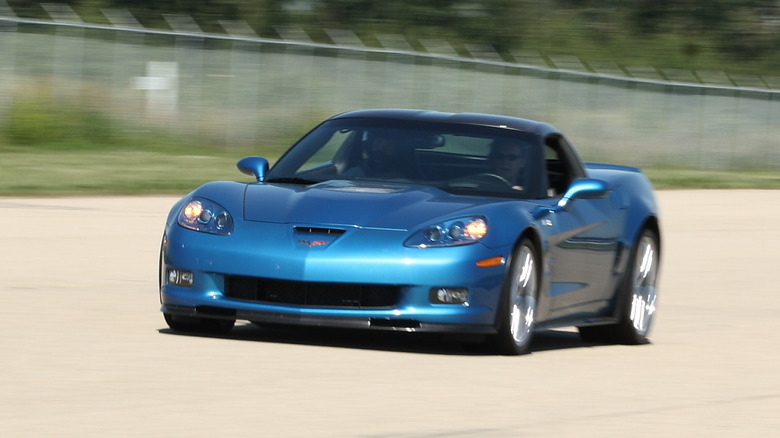
The ZR1 name returned for 2009 — again without the hyphen — and, for the first time in the Corvette's history, introduced forced induction for the all-aluminum-chassis C6. An Eaton supercharger sat on the ZR1's 6.2-liter LS9, helping it produce 638 hp and 604 lb-ft of torque. Famously, a polycarbonate window in the hood displayed the intercooler below.
The newfound power propelled the C6 ZR1 to 60 mph in 3.4 seconds and topped out at over 200 mph in period testing — territory that put the C6 ZR1 in direct conversation with European supercars at a fraction of the price (via Car and Driver). Nicknamed the Blue Devil during development, the car's broader body, widened to accommodate larger wheels and tires, gave it a visual presence the base C6 never had. Across its four-year run through 2013, Chevrolet produced shy of 5,000 units — scarce enough to ensure the C6 ZR1 became one of the most sought-after modern Corvettes on the used market.
C7 ZR1: 755 hp (2019)
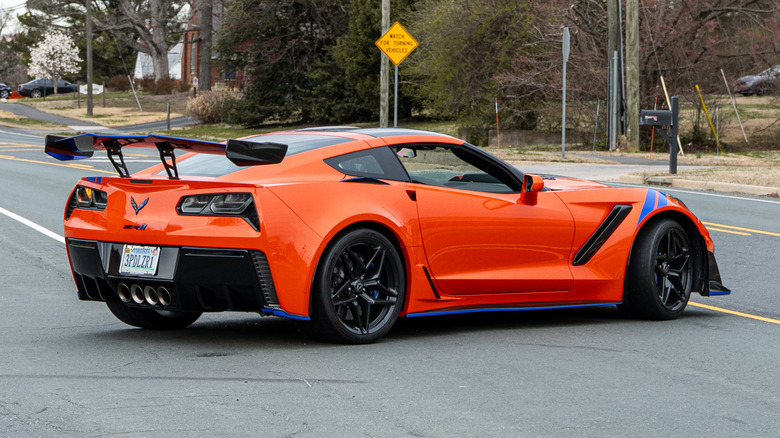
Available exclusively for the 2019 model year, the C7 ZR1 pushed the front-engined Corvette formula to its absolute ceiling. Under the hood sat a supercharged 6.2-liter LT5 V8 fed by a 2.6-liter Eaton blower, producing 755 horsepower and 715 lb-ft of torque. That's 117 horsepower more than the C6 ZR1, which was already considered to be extreme.
The optional ZTK Performance Package pushed the car further still, adding Michelin Pilot Sport Cup 2 tires, specific magnetic ride control calibration, a fixed high rear wing, and carbon fiber front splitter end caps — all of which reportedly combined to generate up to 950 pounds of downforce. As a result, zero to 60 arrived in just 2.85 seconds with an 8-speed automatic in Motor Trend's testing while top speed was claimed at 212 mph. It was the definitive statement on the front-engine Corvette layout, arriving just before GM made that layout obsolete.
C8 ZR1: 1,064 hp (2025–present)
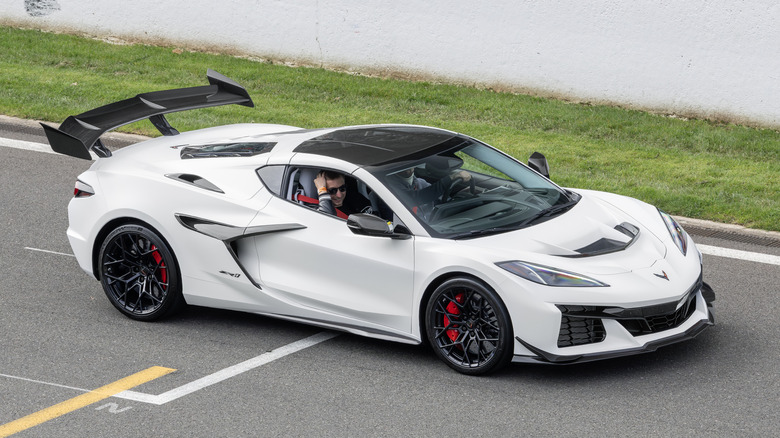
The C8 ZR1 marks the first time the badge has appeared on a mid-engine Corvette, and it arrived with figures that reframe every previous ZR1 in the rearview mirror. A now twin-turbocharged 5.5-liter flat-plane crank V8 — the LT7 — produces 1,064 horsepower and 828 lb-ft of torque, making it the most powerful V8 ever produced by an American automaker. The flat-plane crank architecture, borrowed from motorsport, allows the engine to rev more freely than a traditional cross-plane V8 at the cost of some low-end smoothness — a trade the ZR1 makes without apology. Beyond the numbers, the ZR1 even beat the track-centric McLaren Senna by nearly a second at Car and Driver's annual Lightning Lap competition.
At speed, the car reportedly generates 1,200 pounds of downforce — more than any production Corvette before it. Zero to 60 takes 2.5 seconds, the top speed reaches upwards of 230 mph, and the horsepower gap between a base C8 Stingray and this ZR1 sits at 117 percent, a delta so wide it makes every earlier generation of ZR1 look almost restrained by comparison.