

These Are 10 Of The Most Notable Ford F-150 Changes
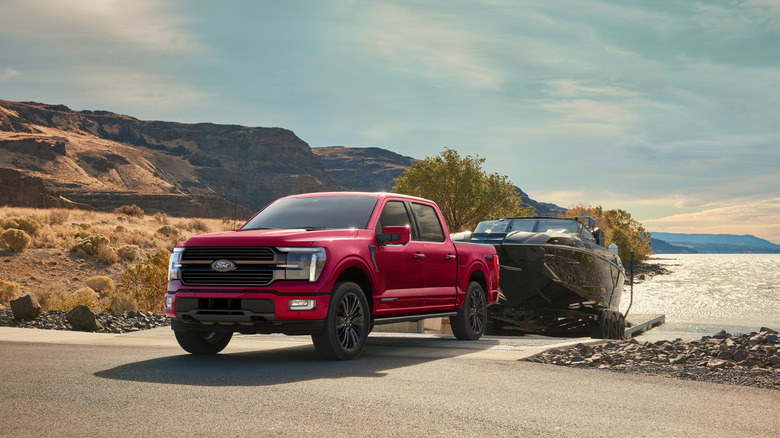
The Ford F-150 just got a mild refresh for 2027, and the changes are quite minimal compared to the current model. This has not always been the case, since the Blue Oval company has not exactly shied away from experimentation with the F-150 in the past. Ford had been making trucks for a long time, but in the period after the Second World War, the company branded its light-duty trucks as the "F-series" from 1948. Initially, the Ford truck lineup was broken down into the F-1, F-2, and F-3, to represent the half-ton, three-quarter-ton, and one-ton units, respectively. Ford also made progressively heavier trucks right up until the F-8 designation. In '53, the naming for the light trucks was changed to the F-100, F-250, and F-350 for the half-ton, three-quarter-ton, and one-ton rigs, respectively. The F-150 name wouldn't arrive till 1975.
Additionally, Ford transitioned the truck line from the legendary flathead engines to the Y-block overhead valve (OHV) V8s between 1953 and 1954, starting with the 239-cubic-inch V8, followed by a 272-cubic-inch V8 from 1956 onward. The trucks were then redesigned in 1957, 1961, 1967, and 1973 – during this time, the F-series lineup gradually began losing its curves and adopting a squarer, flatter design and fascia. As part of these changes, Ford bounced around between chassis redevelopments and styling updates, offered creature comforts, and introduced new engine choices. For one model year (1956), we also got a fully wrap-around windshield. In 1965, a new trim called the "Ranger" was also introduced, and the I-beam suspension was also introduced that year.
1975: The F-150 nameplate arrives
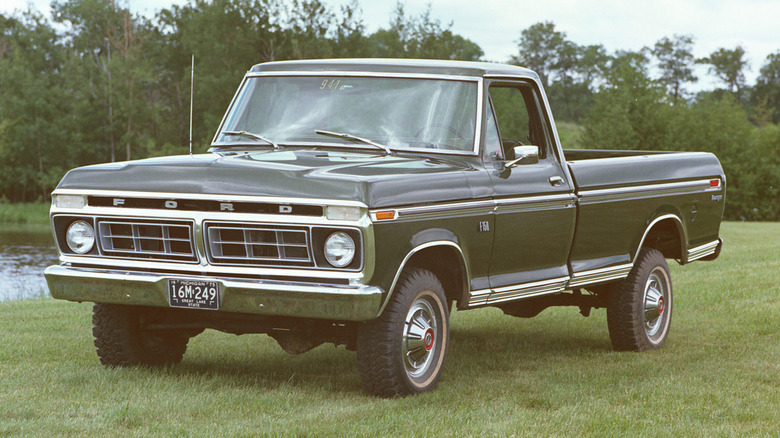
In 1975, Ford came out with the F-150 (1976 model pictured above), which had a heavier gross vehicle weight rating (GVWR) than FoMoCo's other half-ton truck, the F-100. This let the F-150 skirt around emission loopholes, allowing the half-ton truck to be sold without catalytic converters, which the F-100 needed to have. You see, in 1975, the U.S. Environmental Protection Agency (EPA) used to classify vehicles with a GVWR of under 6,000 pounds as being "light-duty" trucks, and in 1975, light duty trucks had to use unleaded fuel and needed cats.
Ford opted to equip the then-new F-150 with beefier components, giving it a GVWR of 6,050 pounds, compared to the F-100's 5,700 maximum, pushing it past the 6,000-pound threshold by a hair. Additionally, it's worth noting that the original 1975 F-150 only came as a 2WD vehicle, though 4WD was added just a year later, in 1976. And yes, the F-100 doggedly remained on as a model all the way until the 1983 year, which meant that for the better part of a decade, Ford was offering two half-ton trucks.
In '83, the Ford Ranger was introduced (as its own model, not as a trim like it was earlier), and thus, the F-150 completely replaced the F-100 – by then, the F-150 had taken on most of that classic square body shape that we all know and love. The rest, as they say, is history, with the Ford F-150 eventually becoming the best-selling new vehicle in 20 states.
1980: New chassis and suspension setup
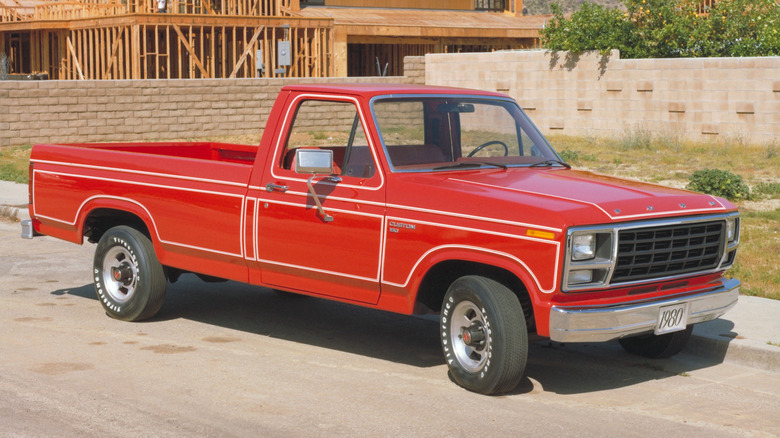
In 1980, the entire lineup got an overhaul. Fun fact: The Ford trucks from 1980 were called "Bullnose" models by some, because of the grille's taper. During the 1980 redesign of the lineup, FoMoCo completely reworked the chassis, making the new trucks lighter. One of the ways in which this was accomplished was by drilling holes into the chassis. However, this "Swiss cheese frame" would later revert to a solid chassis from 1982. Furthermore, the 1980 redesign gave the 4WD models twin traction beam suspension. Essentially, there were two traction beams running inward — one from each wheel (hence, "twin") — while each wheel had a coil for suspension.
The differential was mounted on the driver side traction beam, and not in the middle like on solid axle units. The 2WD models retained the twin I-beam suspensions in the front, and a solid axle at the rear. That twin I-beam setup had roots going all the way back to 1965, which is when the system was first introduced. For the 1980 redesign, the F-150s continued to use Ford's 9-inch rear axle, while the twin traction beam was from Dana. From 1980 to 1982, the 9-incher was standard, but the 8.8 began making its way into the F-150 from '83. To figure out which axle your truck has, look at the differential cover – 9-inch axles have no cover, whereas 8.8s have a 10-bolt one. It's a shame, because the Ford 9-Inch rear end really still is America's favorite axle.
1985 to 1987: Fuel injection is introduced, along with a facelift
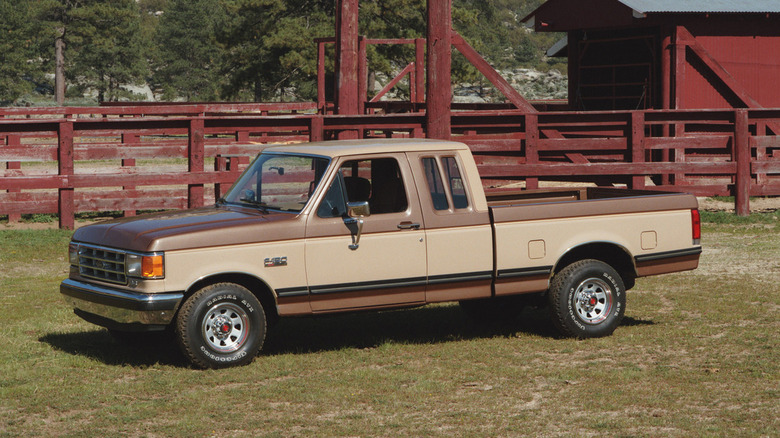
Starting in 1985, Ford began offering electronic fuel injection — EFI, for short — on the F-150. Initially, EFI tech was offered on the 302-cubic-inch (or 5.0 liter) V8, which bumped power to about 225 horsepower on the high-output version of that engine. By around 1987, the F-150 ditched carbs across the lineup. For trucks made during the period, the F-150 received a few aesthetic changes, chief of which included rounding out of the wheel arches — which were formerly square-ish — and the headlights now sitting flush with the grille.
Since we mentioned the grille, the beloved bullnose one was out. The F-150s made after 1987 were known as "bricknose" models, as the grill was no longer as tapered before — an '87 two-tone SuperCab is pictured above. Later, in 1987, the legendary 4.9-liter, inline-6 cylinder engine would also be upgraded with EFI, and the 351-cubic-inch (5.8-liter) Windsor V8 would follow suit the following year, in 1988.
After being EFI-equipped, the 351-cubic-inch Windsor V8 would make about 210 hp, and the 4.9 inline-six would make 145 hp, also after getting EFI. For contrast, the 4.9 would make approximately 122 hp before getting EFI. Lastly, this 1987 eighth-gen redesign also made power steering and power brakes standard across the lineup, and the E4OD four-speed gearbox came in for 1989.
1992 to 1994: New safety upgrades and the SVT Lightning are brought in
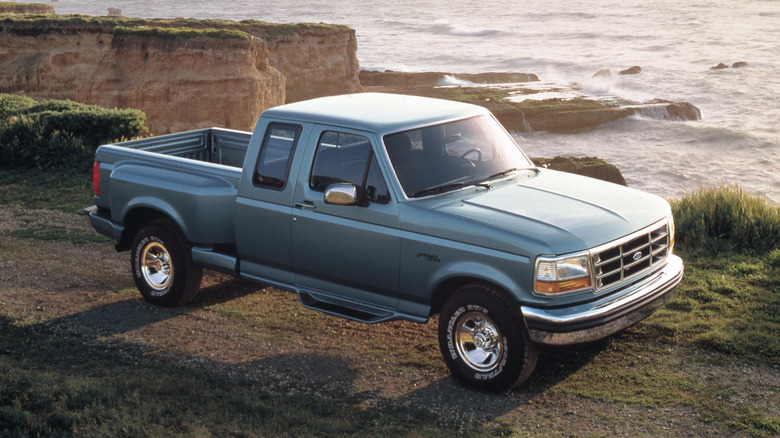
The year 1992 brought more styling updates, though the chassis was largely the same, with aerodynamic curves and a new front end, leading to the trucks being dubbed the "aeronose" Fords. This generation would be the last we'd end up seeing of the square-ish bodies. In 1993, Ford's special vehicles team — or SVT for short – would introduce the F-150 Lightning, which was a performance-oriented version of the F-150. With its tuned 351-cubic-inch (5.8-liter) Windsor V8 engine making 240 horsepower, it was definitely among the coolest special edition Ford trucks of all time.
Earlier in 2026, we also found that younger buyers are snapping up these F-150 Lightning models, which just goes to show what a good job FoMoCo's SVT pulled off. The 1992 facelift, which officially took the F-150 into its ninth generation, increased the creature comforts that the trucks shipped with — though many didn't become available until two years deep. From 1994, F-150 buyers could get keyless entry, power-operated driver seats, and even a CD player on their trucks. The 1994 F-150 (pictured above) also got the center high-mounted third brake light for the first time.
A driver-side airbag became standard equipment from '94 onward. And for those who are looking for the quirky 40/20/40 folding bench seat where the middle could turn into an armrest, that was made available for '94.
1997 to 2001: Complete redesign and a new SVT model
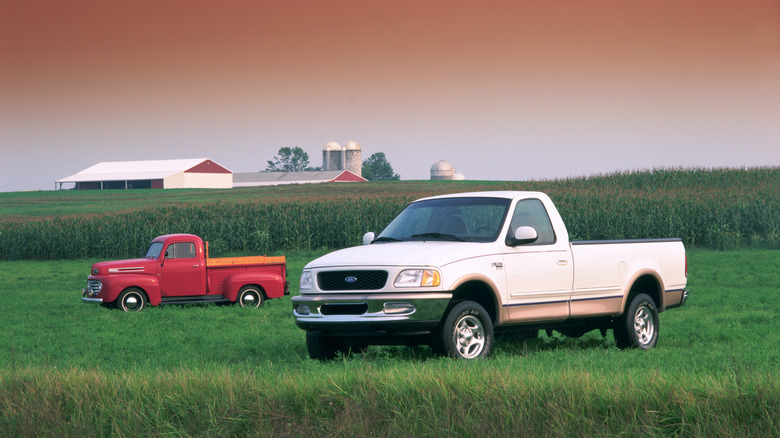
The 1997 F-150 had a new chassis and design and was now extremely aerodynamic, with lots of soft curves. Also, it's worth noting that the beloved 4.9-liter inline-six engine was no longer available for 1997 and onward. For 1997, the front suspension was changed from the TTBs we described earlier to short/long-arm IFS units — 2WD F-150s continued to use coil springs, while 4WDs got torsion bars.
Additionally, a 9.75-inch rear axle was brought in, alongside the existing 8.8-inch one. The engine lineup for 1997 was also completely reworked — buyers now had a 4.2-liter V6 making 205 horsepower and two SOHC V8s. The V8 engines were available in displacements of 4.6 and 5.4 liters, making 210 and 235 hp, respectively. From '97 to '98, the SuperCabs had three doors, while from 1999, these cabs got a fourth door. The model was given a slight fascia update (also in 1999), and the 5.4-liter Triton got a power bump to 260 hp.
Later that year, Ford launched the SVT Lightning II, which, using the same Triton 5.4 V8 that we've been talking about, albeit with a supercharger, made a whopping 360 hp. The 2001 Ford F-150 opened the popularity floodgates for four-door pickups – this was the first year the SuperCrew cab was available, with a foot of space behind the first row of seats.
2004 to 2008: A new platform and some engine changes
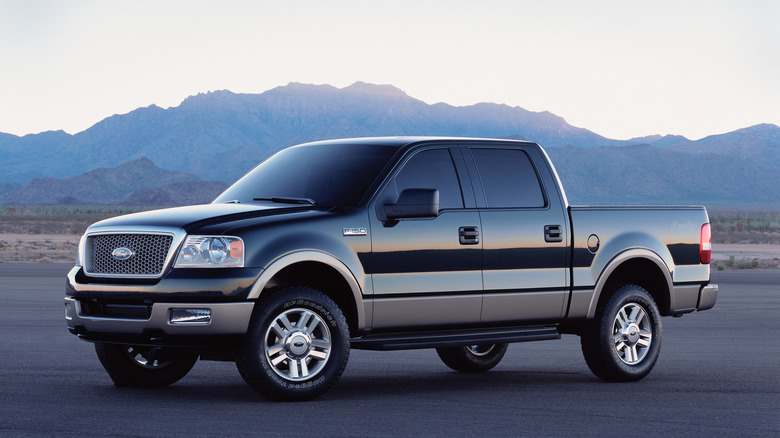
For 2004, the chassis was redesigned once more, moving from C-section rails to what's known as a "fully boxed" design, and the chassis was also partially hydroformed, which meant using high-pressure fluid to shape the frame. At the time, FoMoCo claimed this improved the chassis bending by 50% and that the new chassis was nine times stiffer than the previous generation.
Other changes (to the new, redesigned, non-heritage line) included moving the rear shock units further back, larger 13-inch front and 13.7-inch rear ventilated disc brakes, and the introduction of rack-and-pinion steering on the F-150, which came about in 2004. Overall, this redesign is understood to be a quantum leap forward in terms of things like the ride quality, comfort, and driving dynamics. A common misconception is that Ford didn't offer a V6 in 2004, but this is only partially true.
The new, 11th-generation F-150s originally launched with V8 engines only, but Ford was still selling the 10th-gen F-150s in 2004 (called "Heritage" models), which did come with the 4.2 Essex V6. By 2006, the 4.2 V6 was brought into the 11th-gen F-150 line as well. For 2006, the SuperCrew cabs could be had with a 6.5-foot bed, and from that year, the 5.4-liter V8 became compatible with E85 fuel. In 2008, a factory rearview camera, rear-seat DVD entertainment, and remote start became optional extras.
2009: Frame updates, a size increase, and the Raptor is launched
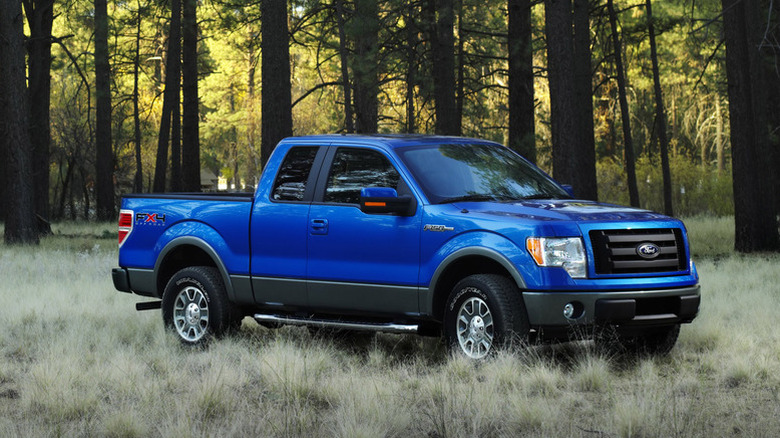
With a chassis overhaul in 2009, it was claimed that the new F-150 chassis was 100 pounds lighter. The rear leaf springs were given a size bump, now being half a foot longer, and the master cylinder was enlarged on cruise-control-equipped models to improve the braking system, too.
The SuperCrew cab was half a foot longer. The SuperCab still had four doors, but the regular cab's rear-hinged rear doors were gone. New introductions for 2009 also included the Platinum trim and the 320-horsepower F-150 Raptor model (introduced as a 2010 model). Additionally, the rear backup cam (still optional) was relocated to below the blue oval on the tailgate, AdvanceTrac stability control (with trailer stability) was now standard, and the interior was reworked, too.
The 2009 redesign came with only V8 engines, which comprised two 4.6-liter V8s, and one 5.4-liter V8. The 4.6-liter two-valve engine made 248 hp, while the newer 4.6-liter three-valve engine made 292 hp, and the 5.4 flex-fuel-compliant Triton made 310 hp. That's right, there was no V6 on the Ford F-150 between 2009 and 2010, and it wouldn't be until 2011 that the six-banger would be brought back to the F-150, which we'll talk about below. The base engine — the 4.6 two-valve V8 — came with the 4R75E four-speed transmission, while the other two got the 6R80 six-speed automatic as standard.
2011: Another engine lineup overhaul
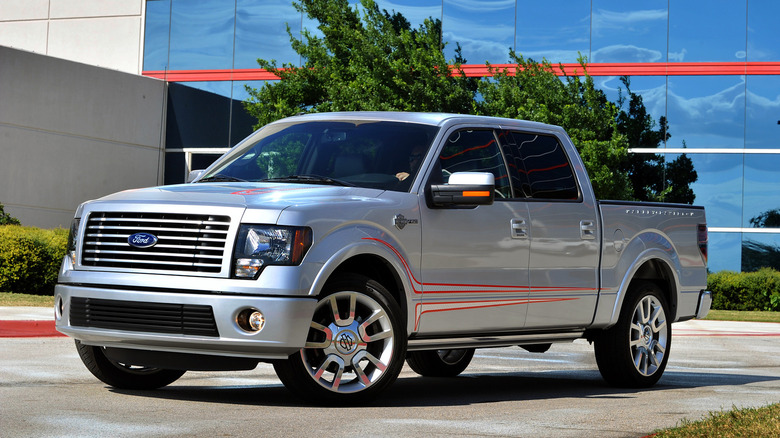
For 2011, the powertrain options changed significantly again. Ford itself said that this update was the "most extensive powertrain overhaul in the 62-year history of Ford F-Series" — and it really was. Gone were the three engines from 2009 to 2010 that we described above, and four new units were introduced. The base engine was a 3.7-liter V6 making 302 hp, and it was a naturally-aspirated unit from the Cyclone family of engines.
The 4.6 and 5.4 V8s were replaced by the new 5.0-liter V8 called the Coyote, which made 360 hp in total. The big news was also the first of the Ford EcoBoost engines, which came about via a 3.5-liter twin-turbo V6 engine that made 365 hp at the top end. The most powerful engine on the F-150 would now be a 6.2-liter V8 unit that made 411 hp, and it was this engine that came standard on the Raptor and Harley-Davidson F-150s of the time.
Additionally, the entire lineup now got a six-speed automatic, with the four-speed being axed in 2011. Electric power-assisted steering (EPAS) also now came standard with most of the engine choices, except the 6.2 V8. Previous versions of the F-150 Raptor used to ship with the 5.4-liter V8. From 2011, the Raptors got the 6.2-liter V8 as standard.
2015: Aluminum body and a new EcoBoost engine
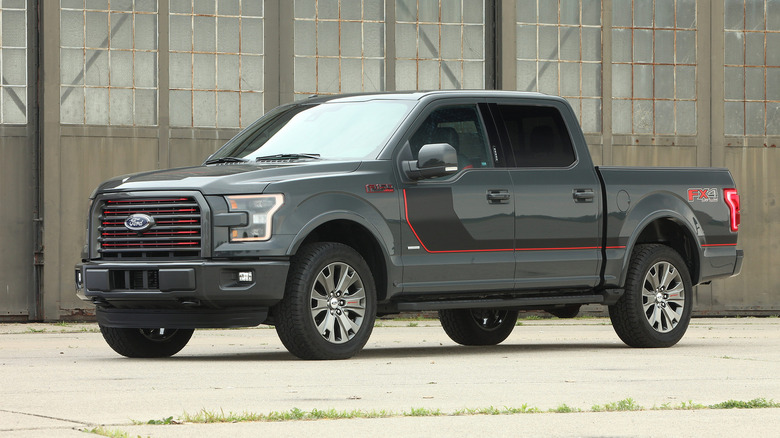
With a new aluminum-alloy body and bed on a steel frame, the F-150 got a substantial bit of weight savings in 2015, with Car And Driver estimating that around 500 pounds of weight was shed from the cab and bed alone. The reduction could be as substantial as 700 pounds, thanks to the new aluminum-alloy construction. The engine lineup was changed once again, with the massive 6.2-liter V8 being given the boot from the lineup.
The new base engine was a 3.5-liter, naturally aspirated V6 making 283 horsepower -– not to be confused with the 3.5-liter EcoBoost twin-turbo V6 making 365 hp that was carried over from before. A new 2.7-liter, twin turbocharged EcoBoost V6 was added, making 325 hp. The 5.0-liter Coyote V8 was also carried over, though it was given a slight power bump to 385 hp, up from 360 the year prior. Note that every engine still used the 6R80 six-speed automatic gearbox for now – it wouldn't be until 2017 that the complaint-riddled Ford 10-speed transmission would show up, paired to the 3.5-liter EcoBoost V6. From 2018, the 10-speed became more broadly available, along with a new 3.0-liter PowerStroke diesel V6 making 250 hp.
Also for 2018, the naturally-aspirated 3.5-liter V6 was replaced by a 3.3-liter V6 making 290 hp as the base engine. New-for-2015 optional extras expanded to include adaptive cruise control, the Ford BoxLink attachment system, LED head and tail lamps, a 400-watt in-cab AC outlet, lane-keep assist, active park assist, and more.
2021 to the present: Electrification and iterative updates
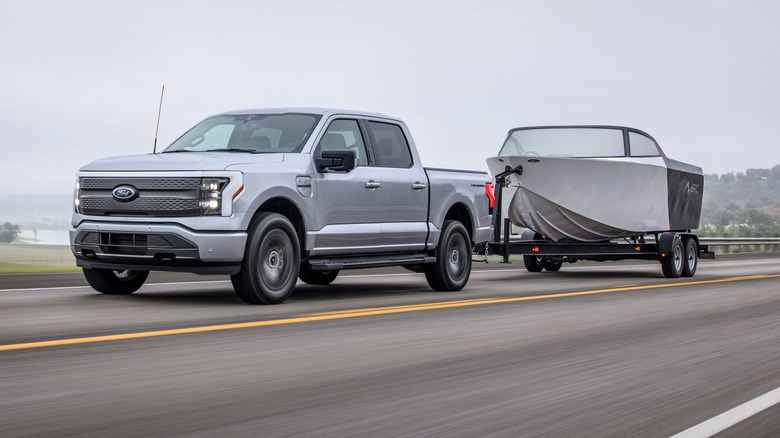
For 2021, the 10R80 10-speed gearbox was now on every engine, and the engine lineup was updated once again. The 3.3-liter V6 and 2.7-liter EcoBoost V6 remained unchanged, but the 5.0-liter Coyote V8 and 3.5-liter EcoBoost V6 now both made exactly 400 hp, and the 3.0-liter PowerStroke V6 diesel (250 hp) would be discontinued at the end of the year. There was also a new PowerBoost F-150 powertrain that mated the 3.5-liter EcoBoost V6 with an electric motor (35 kilowatts) that was mounted before the 10-speed automatic transmission, making a combined 430 hp. PowerBoost buyers could get up to a 7.2-kW Pro Power Onboard system, which could be used to power things like welders and air compressors, for example. In 2022, Ford released the all-electric F-150 Lightning. The most recent 2025 models of this EV could be had with a standard or extended-range battery pack, which were 98 kWh and 131 kWh in size, respectively. There was also a 123-kWh extended-range option.
The standard-range battery pack configuration gave the truck 452 hp and around 240 miles of range on a full charge, while the extended-range battery pack bumped power to 580 hp with 320 miles of range. Though the all-electric F-150 Lightning has since been discontinued as of the date of publication in late 2026, the hybrid PowerBoost version still continues to be on sale for buyers who want an electrified truck. Furthermore, Ford has confirmed that it will be making an extended-range electric vehicle (EREV) version of the F-150.