

Why The Ford 9-Inch Rear End Is Still America's Favorite Axle Decades After Ford Quit Making It
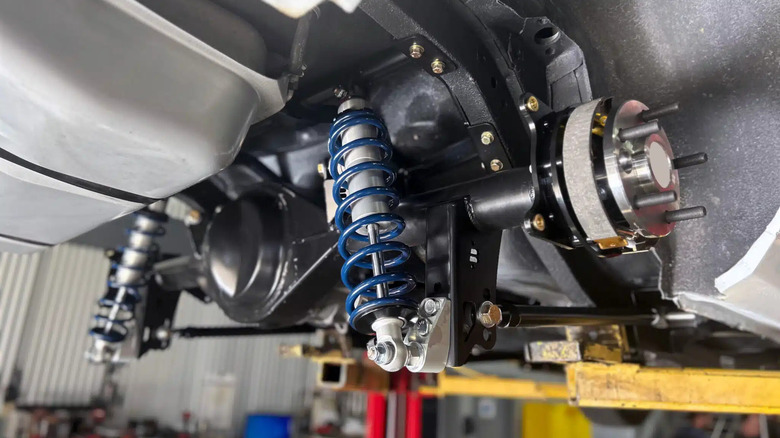
All the horsepower in the world is useless if it can't be transferred to the pavement. Putting the power down is the axle's job, and for a rear-wheel-drive car, the simplest setup is the solid rear, which is essentially a stick with a bump in the middle that houses both a car's differential and axles in one unit. An independent rear, like it sounds, lets the two rear wheels move independently of each other. This is better for ride and handling, but independent rears are more complicated than the old stick axle, and generally not as strong, particularly for drag racing.
In the early days of drag racing, racers adapted heavy-duty truck axles to their hot rods because they were the only ones that could hold up to the abuse from hopped-up engines and drag launches without disintegrating into a mess of metal chunks. The Ford 9-inch was a revelation when it showed up in full-size Ford passenger cars and light-duty trucks in 1957. It was able to take a beating like the big truck axles, but Ford's rear end was lighter, easy to service, and a relative breeze to swap into other cars. Plus, Ford used it in everything from Broncos to Mustangs, so the 9-inch was plentiful in junkyards. Ford stopped making the 9-inch rear end in 1986, but aftermarket companies are still making parts for the axle, and racers are still ripping down tracks with it.
The 9-inch difference
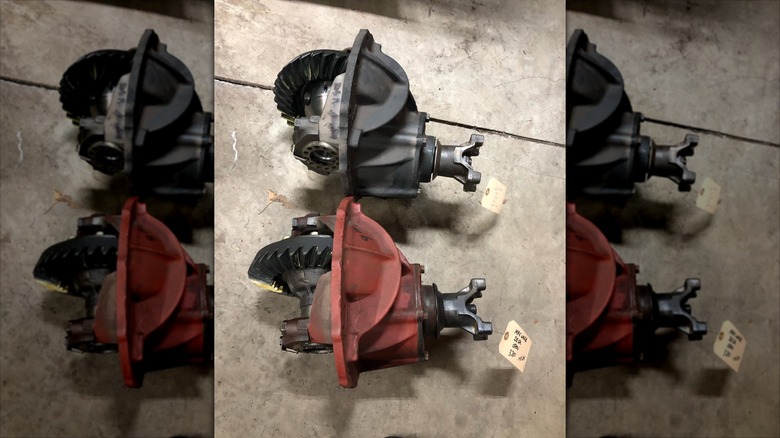
What makes the Ford 9-inch special is its construction. The Blue Oval overbuilt the thing. For example, the pinion, the gear connected to the driveshaft and shaped like a pine tree with the top lopped off, is supported by three bearings. This belt-and-suspenders approach helps to keep everything where it needs to be to prevent breakage.
Also, the ring gear, which translates the pinion's lateral rotation 90 degrees to the rear wheels, is 9 inches in diameter, hence the name. The large diameter of ring gear, as well as how low the pinion sits relative to the centerline of the ring gear, lets the gear teeth make greater contact with each other, which is key for withstanding horsepower. For example, the rear end in a 6-cylinder first-generation Mustang had a 7.25-inch ring gear, while Mustangs with the high-output 289-cubic-inch V8 came with the 9-inch rear.
Another aspect of the 9-inch that racers love is its detachable third member. Unlike a lot of domestic rear ends, the center section that holds the pinion, ring gear, and differential comes out as one unit. This makes gear ratios easily swappable at a race track, as a racer can have multiple center sections set up for different conditions. (The differential is another set of gears that let the wheels move at different speeds without binding. This old-timey video is one of the best explanations of how a differential works.)
Finally, the 9-inch is easy to retrofit into vehicles that weren't originally equipped. The sheet-metal center section housing is easier to weld than cast-iron rear ends — useful for attaching different suspension pickup points. Plus, the axle housings come in a variety of lengths and are relatively easy to shorten, making them easy to fit under most cars.
Why is it still popular?
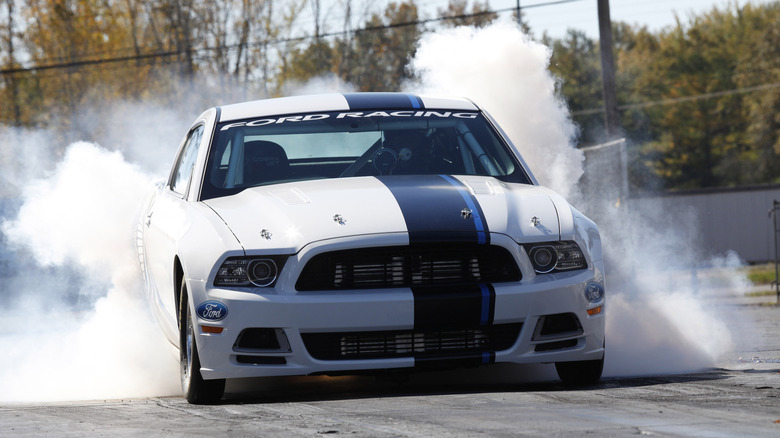
The Ford 9-inch abides because of its adaptability. The aftermarket responded to the needs of drag racers, off-roaders, and circle trackers over the years (NASCAR used it until 2022), and the 9-inch can be configured to excel in just about any application. Every component is available new from the aftermarket, from seals and bearings to strengthened housings and axles. And, although OEM Ford 9-inch rears aren't easy to find at junkyard prices anymore, complete new aftermarket units won't break the bank, costing as little as $1,500.
Contemporary rear ends like Chevy's 12-bolt weren't as strong, with only two bearings supporting the pinion gear and a smaller ring gear. Ford's replacement for the 9-inch, the 8.8-inch axle, was lighter and still strong, but it wasn't quite as sturdy as its predecessor nor did it have a removable third member. Until something comes along that is as versatile as the Ford 9-inch, expect to see it underneath hot rods and drag cars for years to come.