

10 Of The Most Influential Concept Cars Ever Made
What is a concept car? The technical definition describes it as a single model built by an automaker to explore new engineering or design ideas. But with the current state of affairs, most concept cars seem more like PR stunts built to slip into people's algorithms. Take the color-shifting BMW I Vision Dee as an example. Is its E-Ink-covered body cool? Absolutely. Will we ever see this tech in a production car? Probably not.
Some automakers use concepts to preview an upcoming model. The cute and cheerful Citroën 2CV Concept will surely result in an inexpensive production EV. That's great, but there's nothing really revolutionary in these concepts. These concepts don't often become the new gold standard for the company behind them, and other automakers aren't incensed to rush and replicate the design or technology of them. Sometimes, though, a concept car introduces a brand-new idea that then gets widespread, making it truly influential.
Some concepts introduce a new design direction or invent a new vehicle category, while others showcase advanced tech that now we take for granted. In this piece, we'll have a closer look at many of those influential concepts. These cars all had major impacts on the industry, from the Buick Y-Job — the world's first concept car — to the GM Autonomy Concept, which introduced the skateboard chassis used in most modern EVs.
1938 Buick Y-Job — the world's first concept car
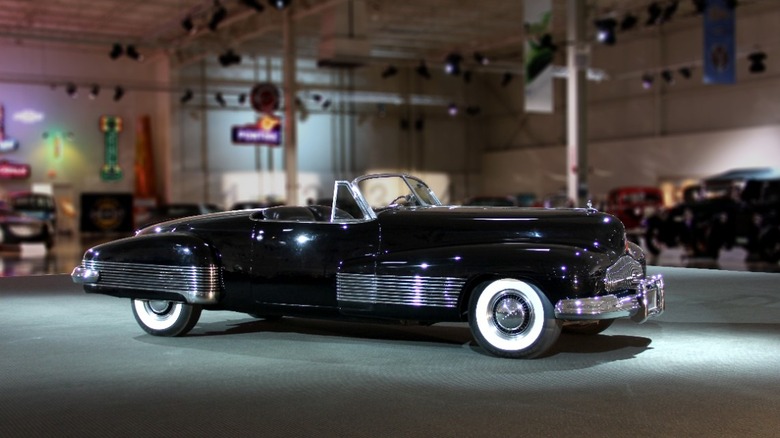
Before Harley Earl (one of the world's most famous designers) showcased the first concept car, automakers mainly worked with coachbuilders to produce one-off cars for wealthy customers. The Y-Job, however, was never listed for sale. Instead, GM notes that Earl used it to demonstrate how a "Car of the Future" might look like.
The result was nothing short of a masterpiece. It might not be immediately obvious from a modern-day standpoint, but the Y-Job looks way sleeker and more elegant than other cars of its era. Earl achieved this thanks to longer and wider proportions to accentuate the car's stance – a design approach that's arguably followed to this day, particularly in coupes and sedans. There were other styling techniques from the Y-Job that other automakers implemented later, like hidden headlights, flush door handles, and integrated taillights.
The standout feature, though, was the intricate retractable roof that stayed hidden under the rear metal deck for a sleek topless look. Once opened, it uncovered a tech-forward interior with a top-mounted radio and electric windows. Adding to the futuristic experience, the Buick Y-Job also features a three-speed automatic transmission, two years before GM took the technology mainstream with the Hydra-Matic. The real kicker is that the Y-Job was a fully-functioning car powered by a 5.2-liter inline-eight engine with 141 horsepower. In fact, Harley Earl drove the Y-Job daily, as he thought the best way to showcase its design and technology was on the street — not in showrooms.
1953 to 1955 Alfa Romeo B.A.T. 5/7/9 — advanced aerodynamics
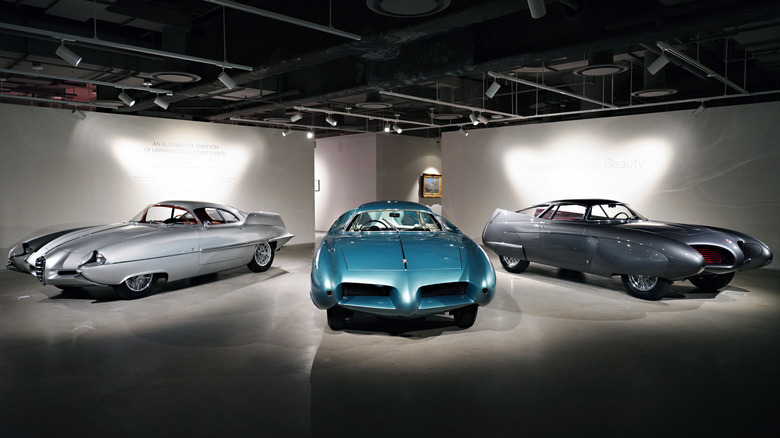
While they could certainly pass as Batmobiles, the B.A.T. designation of Alfa Romeo's 1950 concepts actually means "Berlinetta Aerodinamica Tecnica." Penned by legendary designer and aeronautic engineer Franco Scaglione, the B.A.T. concepts were designed with one idea in mind: cheating the wind. Showcased in 1953 at the Turin Motor Show, the B.A.T. 5 was the first of the trio. Based on the Alfa Romeo 1900 SS sedan, the concept featured a striking body. It had a pointy front end, convex windshield, and streamlined sides with covered front and rear wheels to minimize turbulence, while a big vent behind the front wheels discharged air from under the hood.
Still, it's the three rear fins that catch the most attention. They weren't styling gimmicks; instead, Scaglione used them to smooth out the airflow and allow it to converge at a single trailing point behind the car. By doing this, he has virtually elongated the car's body without using a tapered rear end. As a result, the B.A.T. 5 had a drag coefficient of 0.23 Cd and a top speed of over 124 mph. The B.A.T. 7 brought the former figure down to whopping 0.19 thanks to even more extreme wings, while the B.A.T. 9 was a simpler, more production-ready design.
Many modern cars picked up this trick, and most of them are high-performance machines. Think the Ford GT's and Ferrari 599 GTB Fiorano's flying buttresses, or the BMW i8's floating buttresses over the rear taillights. Similarly, the Mercedes-AMG One uses a central dorsal fin to stabilize airflow, further echoing the design ideas introduced by the B.A.T. concepts.
1968 Alfa Romeo Carabo Bertone — extreme wedge-shaped body with scissor doors
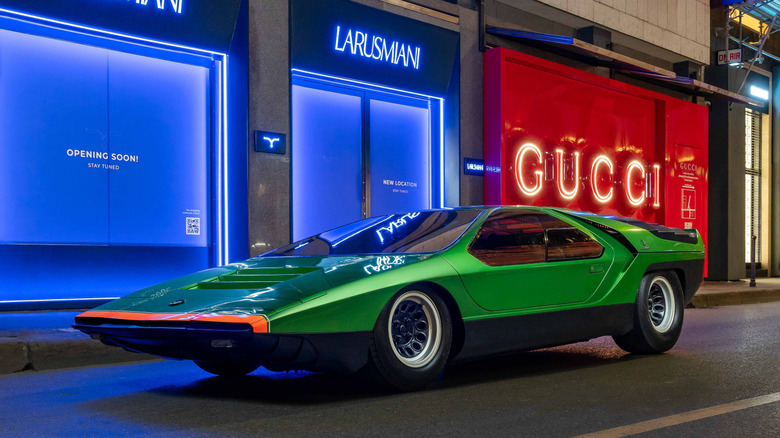
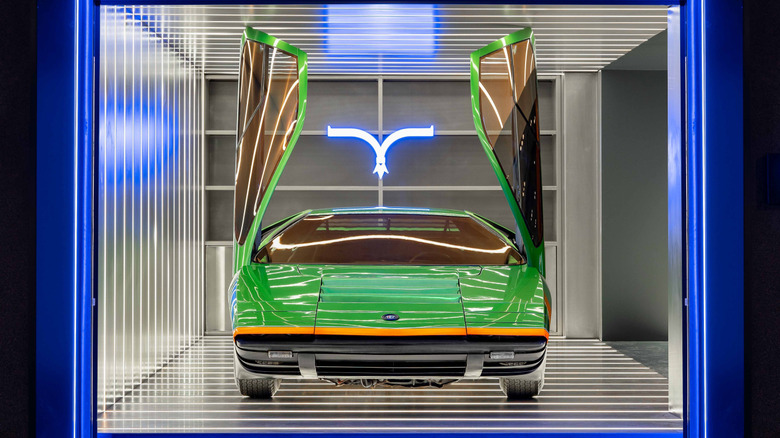
The Lamborghini Countach is arguably the most poster-worthy car ever made. Marcello Gandini's wedge-shaped masterpiece has sharp lines and striking scissor doors, screaming drama and speed even when it stands still. The design was so influential that Lambo's supercars stuck to that formula ever since. There is one missing part of that story, though: the revolution actually started with the Alfa Romeo Carabo, one of your favorite failed concept cars.
Like the Countach, the Carabo was also penned by Marcelo Gandini at Bertone, who was tasked with creating new bodywork for the Alfa Romeo 33 Stradale. That's no small task, considering Scaglione's legend is widely considered as one of the most beautiful cars ever designed. However, Gandini didn't disappoint. Instead of the 33 Stradale's sensual curves, he went with a wedge-shaped, angular body, using low and wide proportions to give the car a better stance. Gandini also hid the headlights behind motorized flaps to make the front end as pointy as possible, and he implemented front and rear gills for a more futuristic look. Still, nothing made jaws drop quite like the scissor doors — pieces of automotive theater that are as visually striking today as they were back in 1968.
Like the Y-Job, the Alfa Romeo Carabo was more than just a styling exercise. Because it was based on the 33 Stradale, it ran the same 2.0-liter V8 that produced 230 horsepower at an astronomical 8,800 rpm, paired to a six-speed manual. It weighed only about 1,543 pounds, too. As a result, the Carabo sprinted to 62 mph in around 5.5 seconds and reached a top speed of over 155 mph.
1969 to 1979 Mercedes-Benz C111 — five-link multi-link rear suspension
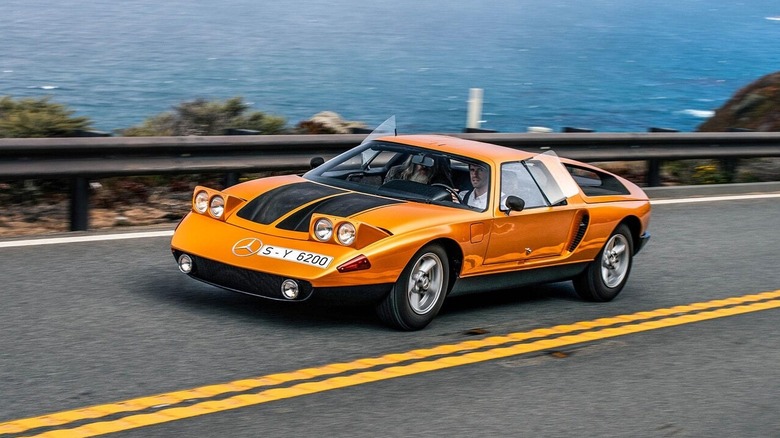
While Italian automakers were busy designing attractive sports cars, Mercedes-Benz used its wedge-shaped C111 concept as a test bed for new technologies. The C111 wasn't as visually striking, but it influenced the auto industry with its internals. Despite its 280-horsepower potency, though, the three-rotor Wankel rotary engine isn't what caused so much influence. The 1963 NSU Wankel Spider beat it to the punch, and those engines aren't so widespread today.
What did stand the test of time is C111's multi-link rear axle. After extensively testing it in the mid-engine sports car, Mercedes brought the design to production for the first time with the 1982 190. Since then, many automakers implemented some type of a multi-link rear suspension in their models. Yes, these aren't carbon copies of the original design, but they all have the same goal of improving comfort and handling at the same time.
The C111 wasn't a one-off, though, with Mercedes building six units of the first iteration. Then, in 1970, it introduced a four-rotor version with 345 horsepower, followed by the 1976 C111-IID and C111-IIID models powered by the legendary OM 617 inline-five turbodiesel. With 230 horsepower on tap, the C111-IIID broke multiple speed records at the Nardo circuit, including an impressive average speed of nearly 200 mph over a 500-mile distance. Since then, turbodiesel engines have been used in many high-performance machines, like the 3.0-liter quad-turbo-diesel BMW M550d xDrive and the Audi Q7 6.0-liter V12 TDI.
1972 BMW E25 Turbo — active safety and driver assistance
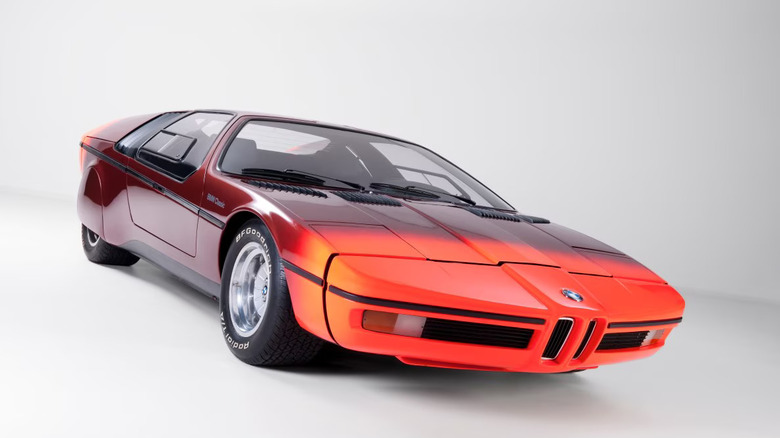
Penned by Pail Bracq for the 1972 Summer Olympics in Munich, the BMW E25 Turbo Concept followed the wedge-shaped craze Gandini made popular a few years ago. However, while it certainly looks attractive with Gullwing doors and pop-up headlights included, it's the safety tech that made this concept significant. The front end has a huge bumper that houses the BMW logo, kidney grilles, and daytime running lights. There's also a hefty gap between the bumper and the body. That's because of the hydraulic shock absorbers, which absorbed impacts and even returned the bumper back after smaller collisions. The E25 Turbo also stopped the driver from starting the engine if the seat belts weren't fastened — an early version of seat belt reminders in all modern cars. Heck, the concept's striking orange paint is phosphorescent, making it easier to see on the road.
Yet, it's the active safety systems that made the biggest splash. The E25 Turbo had a radar-based brake distance monitor that calculated and displayed the braking gap to the vehicle ahead, notifying the driver if they got too close. This concept car was also one of the earliest with anti-lock braking, and it even measured lateral G forces — a feature present in many modern performance cars. The E25 Turbo was practically a rolling laboratory, but that didn't stop it from also being a fully-operational mid-engine sports car. It packed a 2.0-liter turbocharged engine with 280 horsepower and a four-speed manual, which allowed the sports car to reach 62 mph from a standstill in 6.6 seconds.
1978 Italdesign Lancia Megagamma — world's first MPV/monovolume
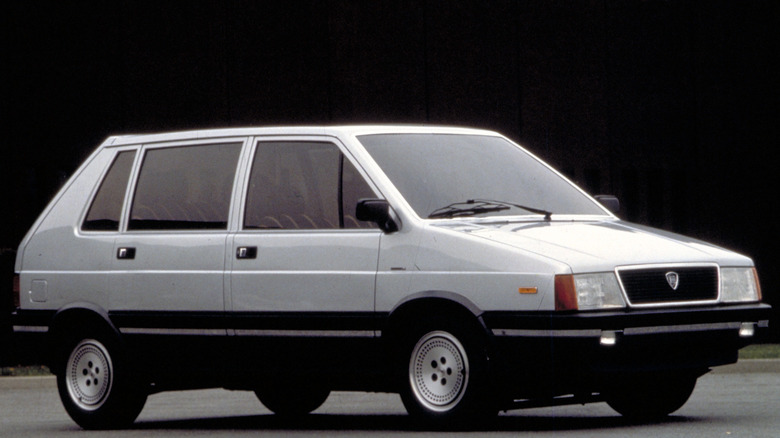
People might be craving SUVs, but minivans are cool, too. They might not look that way visually, but they offer a more spacious and functional interior. And, because of their lower, flat floors, minivans are easier to get in and out of. It's all thanks to the "monovolume" architecture where the cabin and all mechanical components reside into one single, continuous volume. And while it was born much earlier, that architecture reached widespread popularity with the 1978 Italdesign Lancia Megagamma concept.
Now, sure, what you are looking it is a wedge shape. But that shouldn't be surprising, as the Megagamma was penned by Giorgetto Giugiaro. Still, it's the revolutionary interior space that proved more influential. Giugiaro opted for a taller roof and upright seating, which, along with the flat floor, opened up significantly more room for passengers and cargo. In fact, despite being more than 11 inches shorter than the Gamma (Lancia's flagship car), the Megagamma offered about 6.7 inches more interior space.
The real kicker was that the Megagamma used the same front-wheel-drive architecture as the Gamma — including its 2.5-liter engine — meaning it could be easily turned into a production car. However, Lancia left that to other automakers, and they soon turned it into a gold rush. In 1981, Nissan launched the Prairie, which looked like the Megagamma with three seating rows and rear sliding doors. Then, in 1983, Chrysler followed the Megagamma footprint and gave birth to North America's minivan segment with the Dodge Caravan and Plymouth Voyager. The same year, Renault pioneered Europe's MPV segment with the Espace, turning the "monovolume" concept into a global phenomenon.
1981 Ford Probe III — democratized aerodynamics for regular passenger cars
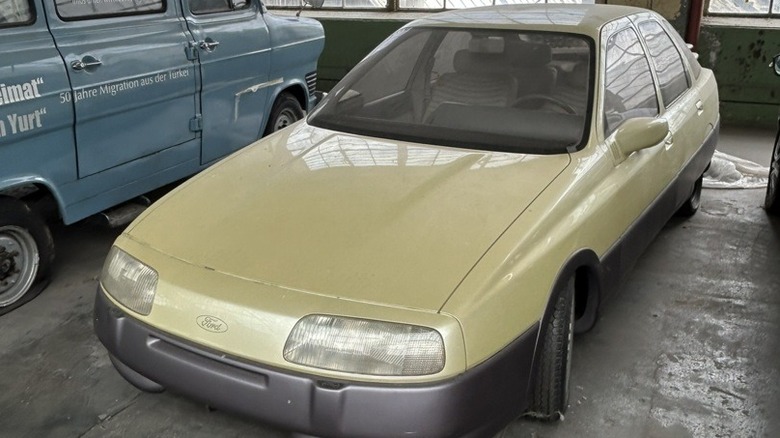
From 1930s streamliners to Alfa Romeo's B.A.T. concepts, car designers toyed with the idea of reducing aerodynamic drag for decades. However, aerodynamics still didn't play a huge role during 1970s car development, particularly for regular passenger vehicles. That all changed in 1981 with the Ford Probe III. This sleek concept previewed the Sierra, but more importantly, it influenced a change to more aerodynamic designs after the 1970s.
With a drag coefficient of 0.22 Cd, the Probe III had 50% lower drag than the best production car in its time. The fluid, rounded body did the heavy lifting, but there were other meaningful improvements that helped Ford achieve that astonishing figure. It featured a twin-deck rear spoiler, semi-covered rear wheels, a raked windshield, and a smooth underbody which minimized lift alongside the active front section. The finer details were just as dialed in, with the concept featuring flush door handles, flush-mounted windows, rear skirts, integrated outer mirrors, and a smooth roof without the usual drainage channels.
The Probe III resulted in the Europe-bound 1983 Ford Sierra, which had a drag coefficient of 0.34 Cd. That wasn't as impressive as the concept, but it was still better than many passenger cars of its time. Ford used similar design principles in the 1983 Taurus "Aero Bird" (0.35 Cd), the 1984 Tempo (0.36 Cd), and the 1986 Taurus (0.32 Cd). Other automakers followed suit, too; in 1982, Audi introduced the third-gen 100, which had smoother body panels, flush windows, and a raked windshield, achieving a drag coefficient of 0.30 Cd.
1989 Toyota RAV-FOUR — blueprint for the modern crossover SUV
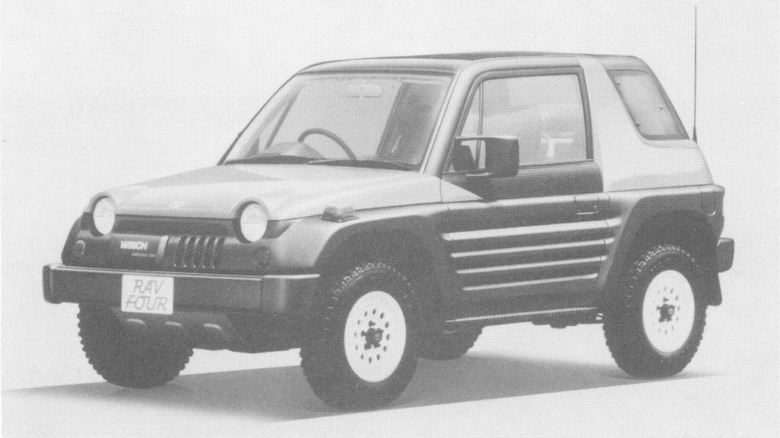
Until the Toyota RAV-FOUR concept arrived at the 1989 Tokyo Motor Show, most SUVs utilized a "body-on-frame" chassis. Yes, automakers already sold small off-roaders, like the Suzuki Samurai and Isuzu Amigo, but each of them had a ladder frame that was similar to larger trucks and SUVs of the era. The RAV-FOUR concept, however, was a car-based SUV; it featured a unibody chassis. To say that this move was influential would be an understatement. Today, each of the top 10 best-selling SUVs in the U.S. — including the current-gen RAV4 — features unibody construction. That's not just the compact models, but also large SUVs like the Jeep Grand Cherokee and Toyota Grand Highlander.
Despite its influence, the RAV-FOUR concept itself wasn't as dull as a modern crossover. Instead, Toyota went with a tried-and-true (at the time) adventure-focused design, reminding the public that the RAV-FOUR could be a capable off-roader regardless of its car-like platform. The concept featured quite a lot of body cladding, a front skid plate, more aggressive tires, high ground clearance, and — of course – four-wheel drive. The design was retro cute, too, featuring circular headlights reminiscent of early Land Cruisers.
Four years later, Toyota introduced the production-bound concept at the 1993 Tokyo Motor Show, which followed many of the same principles. While the retro styling was gone, it still had all the body cladding you could desire, a high ground clearance, and a compact, two-door design. Crucially, it continued to be based on a unibody platform, with independent suspension on all its wheels and a front 2.0-liter gas engine.
1990 GM Impact — proved the viability of battery-electric passenger cars
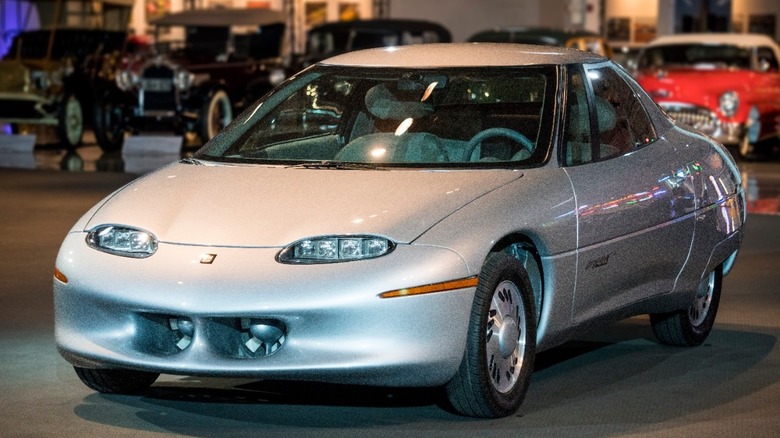
The GM Impact certainly didn't invent the electric car. Battery-powered vehicles have been around since the 1830s, and at the beginning of the 20th century, 600 New York cabs were propelled by electricity. Heck, even Porsche's first car was an EV. However, the internal combustion engine quickly took over and cast EVs aside. From there, it took until 1990 for the GM Impact to arrive and truly reignite the conversation around electric cars. Driven by the recently-discovered global warming caused by fossil fuels and the need for cleaner, emission-free vehicles, the Impact immediately caught attention at the 1990 LA Auto Show.
The sleek, wind-cheating coupe with two seats looked highly futuristic — just as you'd expect from an EV. It had good specs for the time, too. Equipped with 32 Delco lead-acid batteries, the Impact could travel 120 miles on a charge, largely thanks to the aerodynamic body and low-drag tires. Meanwhile, two electric motors on the front two wheels provided enough strength for a 0-60 sprint of only 8 seconds. At the time, this was enough to beat the Mazda Miata and Nissan 300ZX.
GM followed the Impact with a production model, the EV-1. Launched for 1997, the EV-1 had a similar design and novel features like regenerative braking. It also had a much shorter range of up to 90 miles with the base battery. GM later upgraded the EV1 with a Panasonic lead-acid pack that stretched range to 100 miles, alongside an optional NiMH pack good for up to 140 miles. GM sold only 1,117 units, but the concept and production models paved the way for the modern EV.
2002 GM AUTOnomy Concept — skateboard chassis
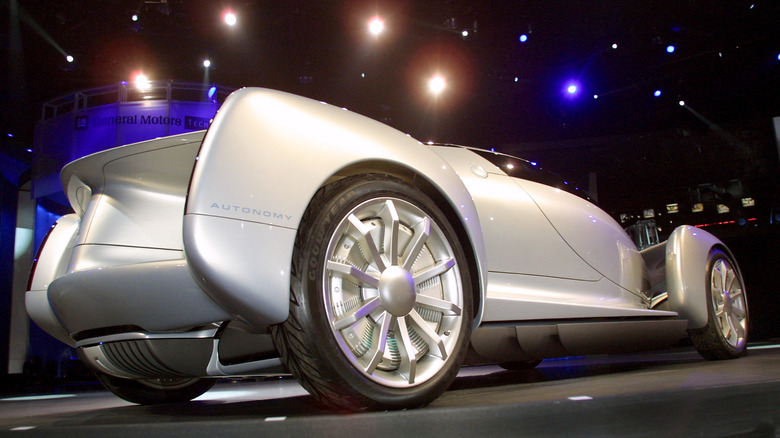
The 2002 GM AUTOnomy is one of those wild concepts where the automaker throws multiple emergent technologies in a striking, hyper-futuristic body. Indeed, the AUTOnomy Concept was equipped with a hydrogen fuel-cell power train, which was still seen as a viable solution at the time. It was also fully drive-by-wire, meaning steering, braking, and throttle were executed by electric actuators rather than direct mechanical linkages to the driver. As a cherry on top, the AUTOnomy was also a fully-autonomous car, which is something so prevalent today that automated driving has different levels of definitions.
The concept's killer feature, however, was the skateboard chassis. Today, most EVs are based on this design, featuring a skateboard-like base that houses the battery and electronics while also providing structural rigidity. It's so prevalent because it's easily scalable across a wide range of vehicles and provides packaging benefits, such as maximizing interior room. Since the skateboard chassis sits at the lowest point of the vehicle, EVs also have a low center of gravity, which aids stability. On top of pioneering the physical design choices, the AUTOnomy Concept's skateboard chassis had all the features of its modern alternatives. It housed GM's existing HydroGen III fuel cell hardware, which fits electronics, cooling, and crush zones in a flat, 6-inch-tall structure.