

Here's What Makes Mercedes' Legendary OM617 One Of The Most Reliable Engines Ever Built
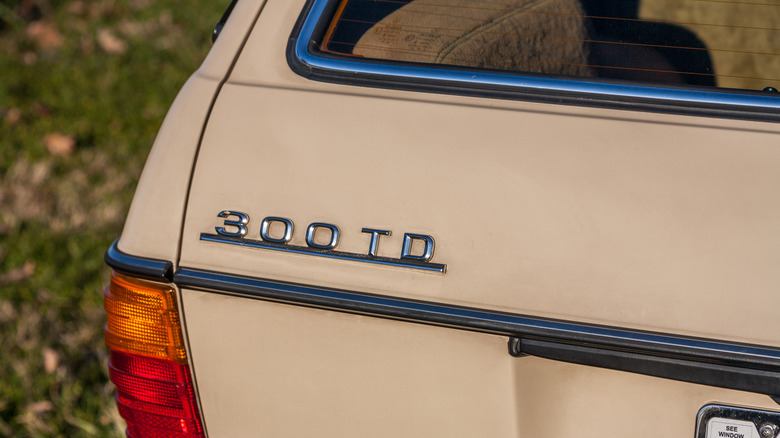
There are a few engines that continually impress with their reliability, and among them is the Mercedes-Benz OM617. It hails from automaker's back-catalog, and it's a great example of a reliable diesel engine that just will not quit. The OM617 is a little unusual in the fact that it's a 3.0-liter inline-five diesel engine, and impressively, it enjoyed a career at Mercedes that stretched from the mid-1970s, right into the 1990s.
The reason why Mercedes opted for a five-cylinder was for more power. Four-cylinder engines weren't cutting it, and six-cylinder lumps would pose fitment issues due to the increase in size, so five cylinders made perfect sense. It's important to note that Mercedes chose another cylinder for more grunt, as opposed to stressing a four-cylinder engine out with performance modifications, as therein lies the secret to its remarkable reliability.
It was over-engineered and under-stressed, which is exactly what attracts fans of durability to the powerplant. Within those two traits come specific engineering practices. For example, modest power relative to displacement, heavy-duty internals designed for longevity, mechanical fuel injection, a robust timing system, and excellent cooling and lubrication systems. It also helps that the engine arrived before complex emissions-slashing devices, such as DPFs, AdBlue, and swirl flaps. No wonder owners have been able to rack up immense mileage in OM617-powered Mercedes models.
Keeping outputs low has been key to the OM617's success
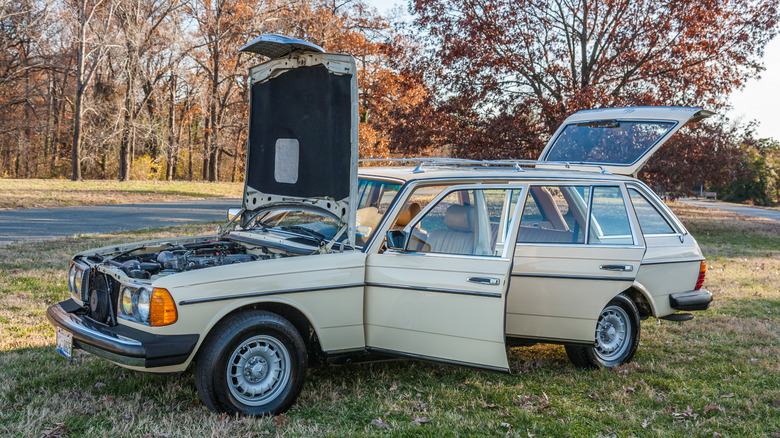
Modern turbo engines with downsized, small capacities are often powerful and efficient, but these high-output engines are generally risky bets when it comes to long-term reliability and durability. By being the very opposite of this, Mercedes created a durability gem in the OM617.
Describing an engine as under-stressed refers to its specific power output; its power-to-displacement ratio. In the case of early OM617 engines, the 3.0-liter lump churned out just 80 horsepower, with the W115-chassis 240D being the first to bring the new diesel inline-five to market. Even the later turbocharged models, like the U.S.-bound 300D of 1977, were never likely to win a 'Top Trumps' game, thanks to a 0 to 60 mph time of around 17 seconds, and a top speed of 103 mph.
Instead of chasing power outputs, Mercedes engineers were more interested in weaving future durability into the OM617's core. They took particular care to ensure the cooling and lubrication systems were up to scratch, as heat can be a real cause of concern when it comes to diesel longevity. Boosted models benefited from oil squirters, a heavier-duty head gasket, and a nitrided crankshaft to help protect against additional heat caused by the stresses involved with turbocharging.
All iterations of the OM617 also benefited from a degree of over-engineering, with a thick cast-iron engine block and forged internals. This was overkill considering the factory outputs, but it gave the OM617 incredibly strong foundations.
Everything within the OM617 points toward simplicity
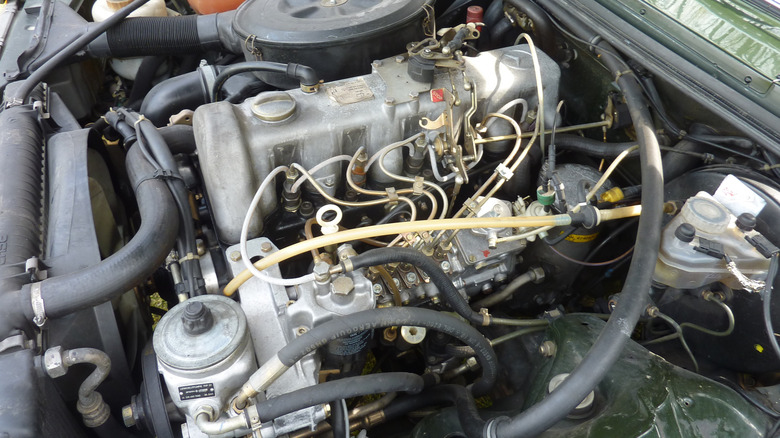
The remarkable longevity and reliability of the OM617 owes much to its mechanical simplicity. It is driven by a single, double-row timing chain — the extra row key to extra durability — and features a simple single overhead-cam design, with no variable valve timing or other complications. In direct contrast to this, modern engines boast far more elaborate timing systems which also drive hydraulic components, variable valve timing systems, and all via multiple chains. While such designs are more technically efficient, they boast more wear points, and the extra complexities simply introduce more opportunities for failure, while also making repairs and replacement considerably more involved. Impressively, OM617-powered cars have been known to achieve 250,000 miles plus.
Furthermore, OM617-powered cars sport a simple engine-driven mechanical fuel injection system. Comparatively, many modern diesel systems use an ECU, high-pressure common rail, and electronic injectors, dramatically increasing the number of complex and failure-prone components within the fuel delivery system. This is how older designs like the OM617 continue to find themselves at the top of the durability food chain, even decades after the auto industry has moved on.