

How Aerodynamics Changed Car Design After The 1970s
Automakers and car designers had been toying with aerodynamics long before the 1970s rolled around. Notable exploits from the earlier days include the slippery teardrop-shaped Tatra and the game-changing Chrysler Airflow from the 1930s, while wings, splitters, and spoilers became more commonplace during the 1960s. Chaparral's 2E is perhaps most memorable with its towering rear wing, but Chevy's innovative chin spoiler on the '66 Corvair was far more subtle.
However, it wasn't until the 1970s and the decades that followed that aerodynamics really began to take hold in the car world. It was at this time that ground effect aerodynamics transformed the sport of Formula One, while smooth body panels, flush-mounted windows, and streamlined Kammback designs became more commonplace on mass-market cars.
Of course, a huge driver for these aerodynamic advances was the soaring costs of motoring during the '70s. Insurance was pricey, the oil crisis turned motorists off of V8-powered muscle cars, and efficiency was all of a sudden more important than outright grunt. As a result, designers paid close attention to aerodynamics, and the developments that came throughout the '70s and '80s changed the industry forever.
Ground effect aerodynamics changed the game

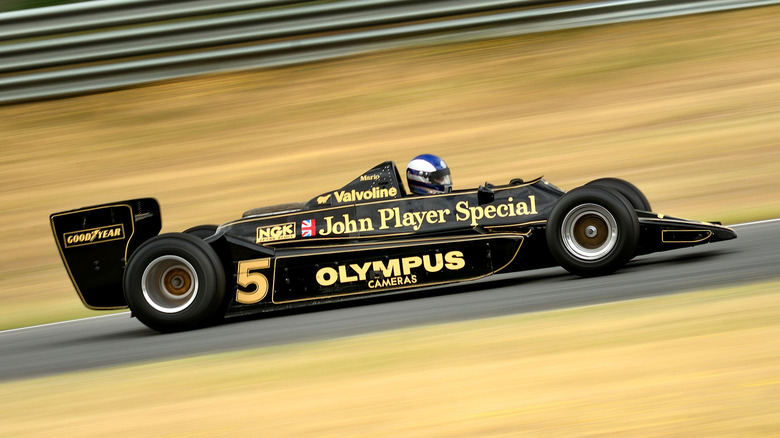
Many innovations in the automotive world stem from the race track, so it makes sense to start there. While the 1960s saw Formula One teams experiment with wings and spoilers, the 1970s were all about ground effects. Simply put, ground effect aerodynamics use the bottom of the car as an aero tool, helping it physically stick to the track.
The Lotus 78 and 79 were real pioneers of this tech in F1, and numerous victories on the track proved the brand's engineers knew what they were doing. A low-pressure zone was created underneath the car, courtesy of venturi tunnels and sliding skirts, enabling higher cornering speeds without the need for a massive wing, which would create unnecessary drag on the straights.
Other innovations soon followed, such as the Brabham BT64B, which achieved this effect using an engine-driven fan beneath the car. The BT64B was quickly banned from competing, but the feature it pioneered is still seen on the highly technical GMA T.50 hypercar today.
Ground effect aerodynamics were soon banned from F1 completely, and the era that followed instead relied on hilarious power outputs. However, the tech had already been proven, and some ground effect aero features have finally made a comeback in F1 in 2022, such as floor tunnels.
The race for lower drag coefficients
While race teams were looking toward aerodynamics to provide the solution for faster lap times in the 1970s and beyond, mass-market automakers instead relied on smart aero to help them produce more fuel-efficient vehicles. It's simple, really — the more easily a car can cut through the air, the less grunt is needed to power it along at speed.
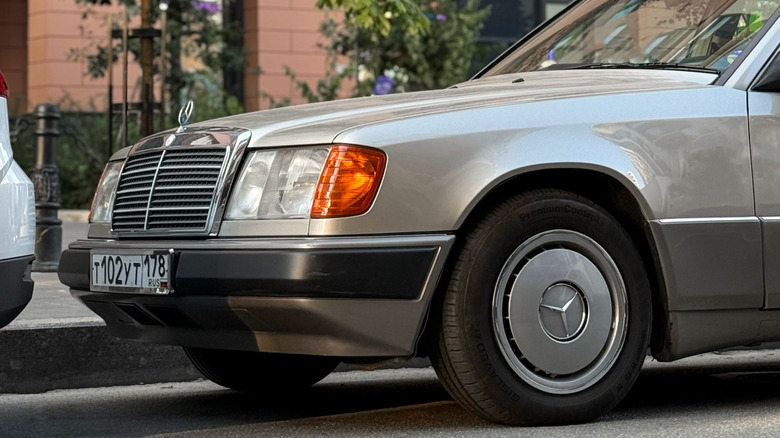
It was in the 1980s that such designs really began to shape the auto industry, with notable models being the Audi 100 (C3), the then-new Ford Sierra, and the W124 of Mercedes-Benz. The slippery Audi 100 impressed with a drag coefficient of just 0.30. By way of contrast, some of the least aerodynamic cars of all time have coefficient scores above 0.8 or higher.
Around the same time, the Sierra shocked with its new "jelly mold" design. Debuting with a drag coefficient of 0.34, it marked a turning point in the industry, with aerodynamic curves becoming the new norm.
The Mercedes-Benz W124 took them both to the cleaners, though, achieving a sub-0.30 drag coefficient. Smooth body panels, a drawn-in rear-end, and a largely covered underfloor all helped it slip through the air. As a result, cars soon wound up being more economical than the boxy designs that had come before, saving consumers valuable pence and dollars at the gas station.
The Kammback revolution
Many of the changes that helped automakers crack low drag coefficients were subtle. Flush windows, concealed wipers, that sort of thing. Some changes were much more notable, though, and perhaps one of the coolest is the Kammback.
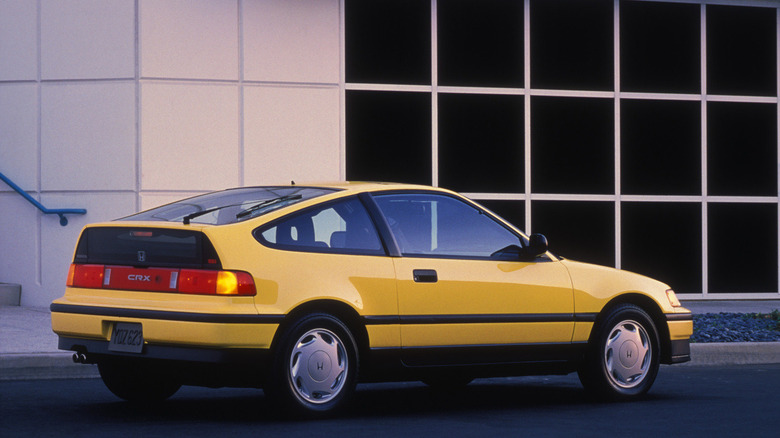
First penned by Wunibald Kamm, a Kammback describes a design in which a car's roofline tapers back toward the rear, only to then finish suddenly, resulting in a slab-like tail end. Kamm designed a 1938 BMW 328 for the 1940 Mille Miglia with such a design, so while it's clearly not an aerodynamic trait of the '80s, the Kammback design did grow in popularity around this decade.
Numerous cars employed Kammback designs in the '80s, like the Honda CR-X and various Citroen models, as well as experimental prototypes like the awesome '85 Trans Am Kammback — one of Pontiac's coolest concepts that sadly never made production. As the years progressed, more Kammback models appeared, most notably a trio of super-economical production cars in the late 1990s and early 2000s: the Toyota Prius, GM EV1, and America's first hybrid car – the original Honda Insight.
Active aero and underbody air management
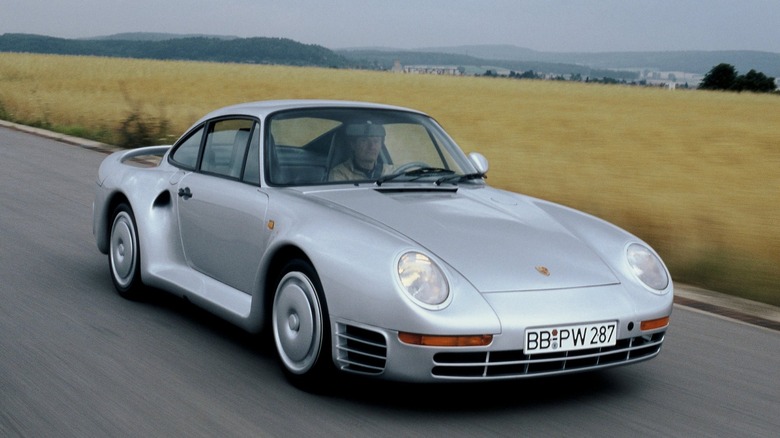
Of course, aerodynamics isn't just about efficiency, and performance-minded aero tweaks aren't exclusively kept for the race tracks, as demonstrated by many 1980s and 1990s performance cars, such as the Porsche 959 — the brand's first supercar. Unlike the raw Ferrari F40, the 959 utilized virtually every slice of the new-fangled tech that was available at the time. It was also all-wheel drive, boasted sequential twin-turbocharging tech, and featured active aero. Specifically, the 959 sported an active rear spoiler plus drag-reducing underfloor panels — both of which helped it achieve zero aerodynamic lift, and a remarkable drag coefficient of 0.31.
It didn't take long for such tech to trickle down to more attainable performance cars. The Mitsubishi 3000GT VR-4 famously offered grip-enhancing active aero, and if that isn't complex enough for an old Japanese sports car, Mitsubishi even made a Spyder version with a power-retractable hardtop. The McLaren F1 of the 1990s also used active aero and keeping the F1's shape sleek and slippery was a flat underbody and a retractable wing, which deployed automatically to create drag and downforce when required. The Bugatti Veyron took active aero to another level when it debuted in 2005, with diffuser flaps controlling air at the front and an adaptive wing and spoiler at the rear.