

7 Of The Most Powerful Engines You Could Order In A Corvette
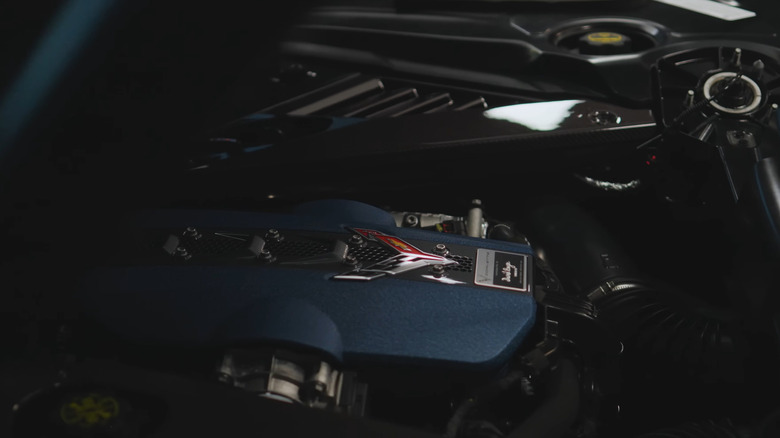
For over seven decades now, the Chevrolet Corvette has been one of the most popular go-to cars in America for those seeking performance. Broadly speaking, the recipe has changed very little over those years, with most examples proudly boasting a V8 engine up front, two driven wheels at the back, and two seats in the middle.
Of course, there have been exceptions, such as the Blue Flame-powered C1 models, and the mid-engine, all-wheel-drive, electrified C8 variants, but for the most part, Corvettes have always followed the aforementioned recipe. It's in the details where one differs from the other, though, with various features and optional extras separating a fairly run-of-the-mill example from something genuinely quite special.
Among the more exciting options offered to Corvette buyers, are some high-output engines, and we've pieced this article together as a means of celebrating some of the most powerful. Importantly, this isn't just a list of the most powerful Corvette engines ever, as that would be mostly restricted to just the latest Z06 and ZR1 offerings. Instead, it hones in on genuinely interesting and historically significant releases, such as the aluminum ZL1 of the C3's era, or supercharged LT5 and LS9 lumps, while also purposefully avoiding any electrified variants. Listed from the least to most powerful, these are our picks.
ZL1 427 V8
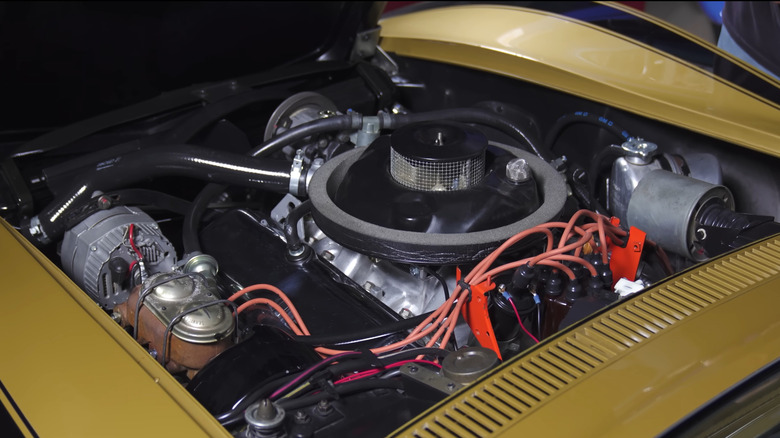
The late 1960s and early '70s is often cited as the golden era of American muscle, with some serious high-output V8 engines finding their way under the hoods of models like the Corvette, Mustang, and Chevelle. From 1970 onward, newly implemented emissions regulations would signify the beginning of the end, but thankfully, Chevrolet managed to get the ZL1 V8 out and into the Corvette's order books just in time.
The ZL1 was a 427 cubic-inch V8, which sported a gross output of 430 horsepower – a significant upgrade from the 300 hp provided in the Corvette's base guise. It was essentially a lightweight L88, itself an engine famed for awesome performance, although its weight was a drawback. Being a sports car, one might assume that the ZL1 was a popular option for the '69 model year, as it provided so much grunt. However, there was a problem — the price tag. At a time when a Corvette Coupe only commanded $4,781, the ZL1 option itself set buyers back $4,718. There was also a number of other mandatory options ZL1 buyers had to fork out for, including uprated suspension (F31), a positraction rear axle (G81), (J56) heavy-duty brakes, and a (K66) transistorized ignition. The total sum of all these options and the base car came to north of $10,000, and buyers couldn't even fit a radio or air-conditioning.
As a result, only two buyers ever purchased a ZL1-equipped Corvette for the 1969 model year, and come 1970, the option was removed. Today, these cars command in excess of $3 million; it's considered by many as one of the marque's true holy grails, and so this high-output V8 is certainly one worthy of recognition.
LT5 5.7-liter V8
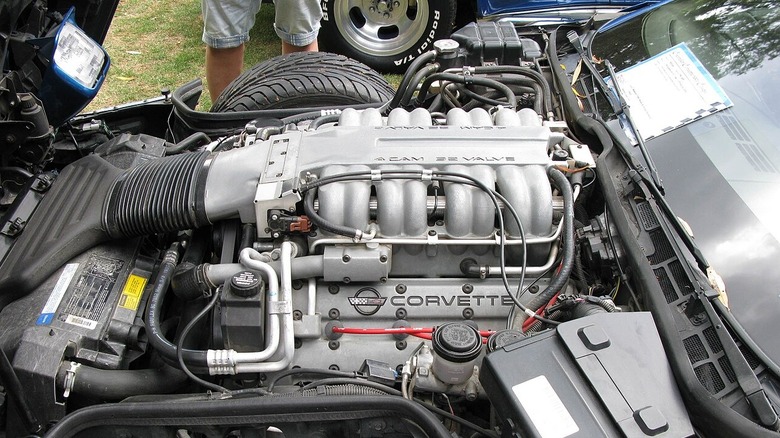
There is more than one LT5 on this list, as GM does have a tendency to reuse engine codes. But this LT5 is the first to have hit the scene, finding its way under the hood of C4 ZR-1 models, from the 1990 to 1995 model years. It boasted a displacement of 5.7 liters, was constructed from aluminum, developed by Lotus, and sported a DOHC, 32-valve design.
When it first debuted for the 1990 model year, the ZR-1's LT5 kicked out a meaningful 375 horsepower and 370 pound-feet of torque, which was really quite impressive for the time. However, Chevy didn't allow the ZR-1 to stay stagnant, bumping outputs to 405 hp and 385 lb-ft for the '93 model year and beyond. To thank for the extra grunt were revised cylinder heads, different cam timing, and new pistons, amidst other tweaks.
In order to make the most of its new-found power, the C4 ZR-1 benefitted from uprated suspension and braking components, plus some grippier Goodyear tires. With these modifications and more than 375` horsepower, the Corvette was finally capable of taking on Europe's finest.
One particularly famous comparison is between the ZR-1 and Testarossa. The latter car's flat-12 produced 385 horsepower, and provided it with a ZR-1-matching 180 mph top speed, although the Corvette could beat it to 60 mph by almost a full second, with a time of just 4.9 seconds to the Ferrari's 5.8.
Callaway B2K twin-turbocharged 5.7-liter V8
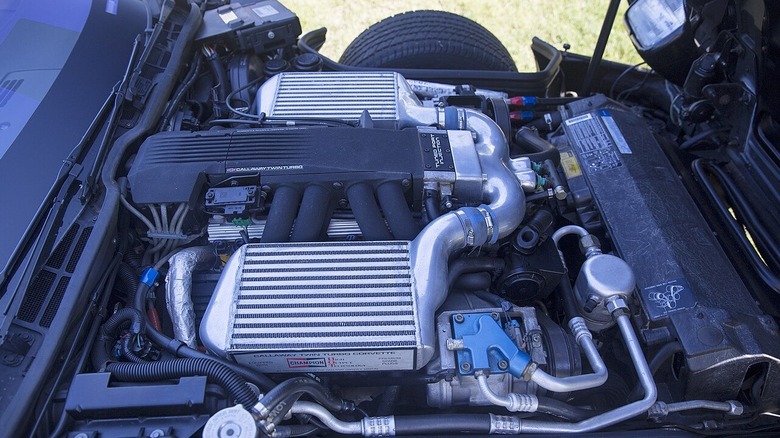
This one is a real oddity, as Callaway's B2K package — available from 1987 through 1991 — was the first external tuning package which was eligible to be ordered through the dealer, with full factory backing. So, despite being produced by an external firm, this twin-turbocharged package — identified by its B2K RPO code — was indeed able to be ordered through Chevrolet itself.
It might seem all that powerful with only 382 horsepower, especially not by today's standards, but two things are worth pointing out here. Firstly, the B2K Corvettes were rated according to net horsepower figures, while the aforementioned ZL1 was rated by its gross horsepower. The switch came in 1972, and since then, we've all had to deal with gross, net, peak, and continuous horsepower ratings.
Secondly, horsepower isn't the only metric worth measuring, there's torque, too. This Callaway-tweaked Corvette managed to squeeze out a truly impressive 560 lb-ft of torque by the end of its production; a figure high enough to see it hold the record as the highest-torque output in a Corvette, right up until the '09 ZR-1 debuted.
Only around 500 of these Callaway Corvettes were ever built, so they are a real rarity today, although that hasn't equated to sky-high prices. Unlike some rare Corvettes which command big money, B2K C4 models still change hands for very reasonable money today.
LS9 supercharged 6.2-liter V8
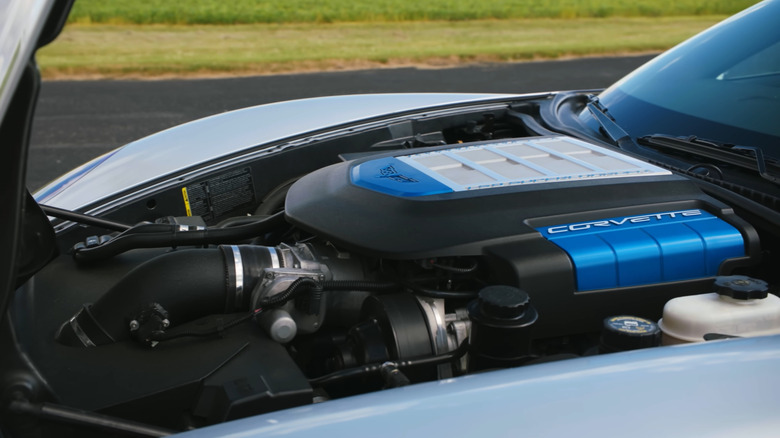
The LS9 was equipped to the C6 Corvette's high-performance ZR1 model, and at the time of its debut — the C6 ZR1 was in production from 2009 through 2013 — it was the most powerful production engine ever made by General Motors. Naturally then, it was also the most powerful production Corvette at the time too, although it's since been bested by quite some margin, as the mills further down your page do reveal.
The LS9 is a 6.2-liter V8, topped with an Eaton R2300 supercharger which operates at 10.5 psi of boost, enabling outputs of 638 hp alongside 604 lb-ft of torque. In other words, an absolute monster. By way of comparison, Ferrari revealed its flagship 458 Italia in 2009 also, and that only boasted 562 hp, so this ZR1 was really pushing the boundaries of what was possible from a factory-standard production car at the time.
Chevrolet opted for forced induction as, at the time, it felt the C6 Z06's naturally aspirated 7.0-liter V8 with its 505-hp output was really about as far as it could take naturally aspirated engines at the time. Eaton had recently developed its latest generation of superchargers, which tackled emission and cooling challenges better than turbocharger kits of the era, and so GM engineers felt this was clearly the path to take. A liquid-to-air intercooler helps to keep temperatures in check, and impressively, the LS9 manages to deliver 90% of peak torque across a huge power band of 2,600 to 6,000 rpm.
LT6 flat-plane crank 5.5-liter V8
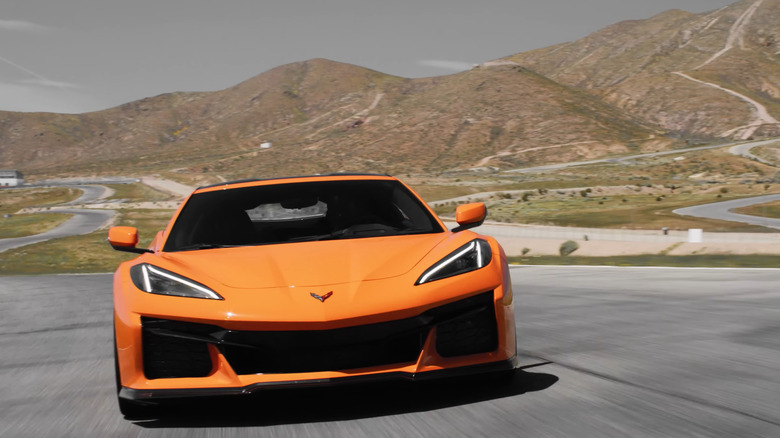
Historic engines from the Chevrolet Corvette's back catalog are always fascinating to revisit, but when in the search of remarkable outputs, it's really the marque's later engines that deliver the most impressive of punches. The LT6 isn't the most powerful on your page, but it is the most powerful naturally aspirated V8 ever to feature in a production car, and it sees the Corvette transcend the sports car category and instead equips it with genuine supercar levels of grunt.
Specifically, the LT6 kicks out 670 hp alongside 460 lb-ft of torque, which is hugely impressive for an engine of 5.5 liters, let alone one that operates without turbos and superchargers. This engine is one of the key differences between the C8 Stingray and Z06 models, with only the latter taking motivation from this remarkably high-revving engine. Key to the LT6's 8,600-rpm redline is its ultra-light rotating assembly, which boasts forged pistons and rods.
It also famously sports a flat-plane crankshaft, which is an unusual choice for a modern performance engine, as larger flat-plane crank designs can be known to vibrate quite violently. Chevrolet countered this as best as it could with extra effort going into silencing any rattles or shakes from heat shields and surrounding ancillaries, but ultimately, any additional noise and vibration that does result from the LT6's design simply adds to its raw, performance-first appeal.
LT5 supercharged 6.2-liter V8
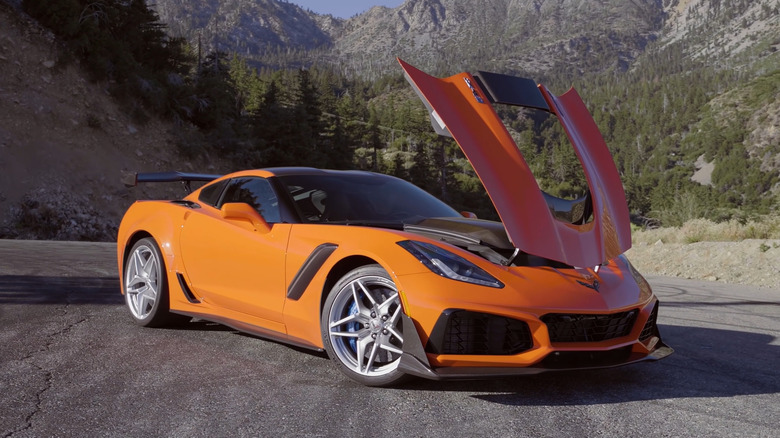
As already covered, the C6-generation ZR1 made a real impact when it arrived for the 2009 model year, thanks to its monstrous supercharged V8 — so Chevrolet had a real task on its hands when looking to out-do itself with the marque's next-generation ZR1.
Once again, a supercharged 6.2-liter V8 engine was called upon, this time dubbed the LT5. Of course, this wasn't the first time Chevrolet had used an LT5 engine to power a ZR1, but this latest effort — which arrived for the 2019 model year — was leaps and bounds ahead of the earlier Lotus-developed effort.
This later LT5 makes use of an Eaton supercharger, and boasts a pushrod design. The culmination of GM's engineering department's efforts are 755 hp and 715 lb-ft of torque, which is more than enough to see this Corvette forever immortalized as the most powerful front-engine production Corvette ever made, for what followed next was the model's switch to a mid-engine platform. Other numbers that demonstrate just how impressive the LT5 is are the C7 ZR1's sub-3-second 0 to 60 mph time, its sub-11-second quarter-mile time, and its 210-mph+ top speed.
Carbon-fiber splitters, a huge rear spoiler, and super-grippy Michelin rubber helps to keep the ZR1 planted when bold drivers attempt to lay that monumental power down onto tarmac.
LT7 twin-turbocharged 5.5-liter V8
It was a controversial move when Chevrolet decided to alter the Corvette's core formula after so many decades of consistency, launching the C8 model as a mid-engine sports car, abandoning the front-engine design it had always boasted. The automaker claimed the front-engine approach had reached a point of stagnation, that all which could be extracted from the design already had been, and so a change was necessary.
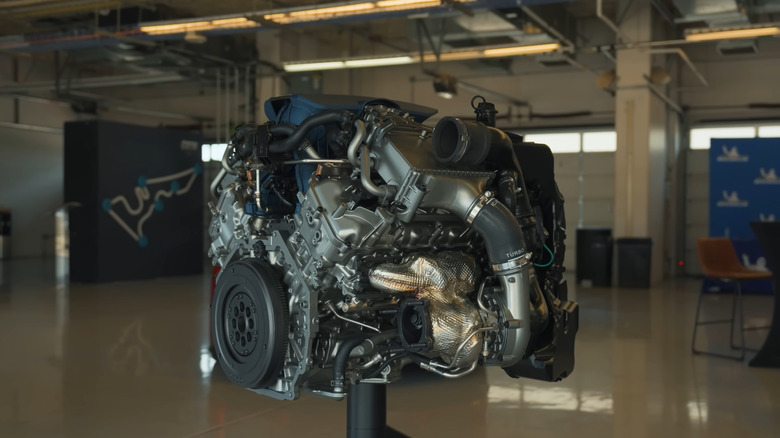
What this inferred, of course, was that later releases would offer levels of performance above and beyond what had come before, and with the C8 ZR1, that extra performance was delivered. Behind the seats sat a twin-turbocharged 5.5-liter flat-plane crank V8, yes, much like the LT6 with turbos, although there are enough differences between the Z06 LT6 and ZR1 LT7 V8.
The headline figures are 1,064 hp alongside 828 lb-ft of torque — figures high enough to see the C8 Corvette ZR1 crack 233 mph, claiming the title as the fastest production car available anywhere for south of $1 million. More power still could be obtained by putting your name down for a ZR1X, which boasts 1,250 horsepower, but that extra grunt comes courtesy of electrification; its LT7 engine is at no higher state of tune.