

New MIT Study Explores Improving Autonomous Driving Tech By Letting The Car Tell You What It's Doing And Why
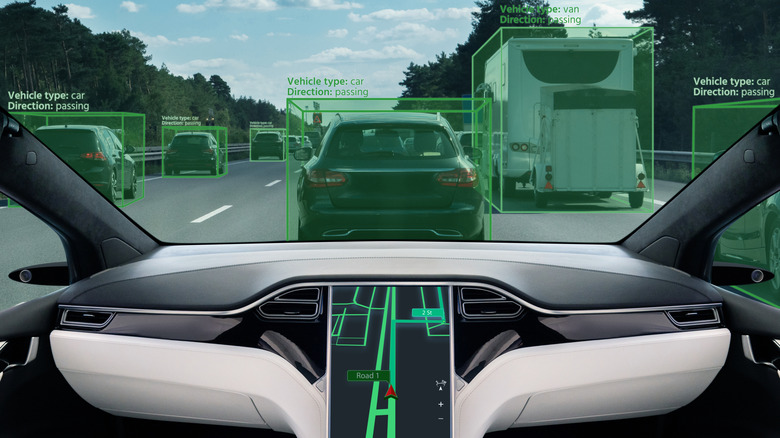
U.S. Secretary of Transportation Sean Duffy's been hard at work deregulating autonomous vehicles so the tech can haphazardly flood American roads faster. Meanwhile, some are trying to improve that tech so it works more harmoniously, and safely, with humans.
Researchers at MIT along with Motional — an autonomous vehicle technology company — recently published their study in Nature. They designed a program that could tell a human what it saw and what it was doing to see if it could help humans better understand how the AI in an autonomous vehicle works. Think about it, in a recent Jalopnik article, we discussed Duffy's AV Framework that went ahead and basically said "hey, autonomous vehicles don't need brake pedals or emergency brake levers." There we contemplated what consequences that could have on just emergency situations that the AI cannot appropriately predict or navigate and the options you have. Autonomous vehicles have demonstrated they are far from perfect through several well-documented failures in real-life emergencies. And that's not counting the "driver support" autonomous driving systems on Teslas which have been engaged while running into buildings, motorcycles, etc.
Now put an algorithm into the framework of the autonomous vehicle technology that allows the AI to tell you why the car is doing what it's doing. The thought is that if a human can get feedback in real-time, the "driver" can be more attentive to help prevent some of the above mentioned issues, but it can also help developers gain valuable feedback as to how the AI system is reacting in environments to better improve its reactions.
Inserting AI into AI to translate AI
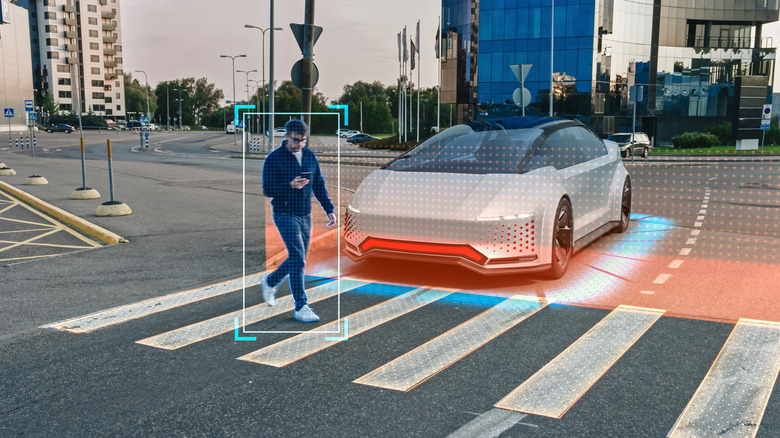
To do this, MIT and Motional created a system called the "Concept-Wrapper Network" or CW-Net. This special-made network is itself an AI algorithm trained on 130 million examples of scenes from self-driving vehicles with multiple labeled concepts in each scene. In other words, they classified concepts for the AI to pick up on like directions (left, right, straight), speed via stop and slow, or teaching it things like an intersection, traffic light, pedestrian, what following is and what it is following. From there, the network is plugged into an AV's machine-learning system to "translate" its actions.
During real-world testing, an AV with the network integrated stopped at a traffic cone. Researchers said that the human driver believed the cone would be the reason for the stop, but the AV stated it was "approaching stopped vehicle." Now there's an adjustment for developers to work on. It also helps riders understand "what the holdup is" which might be infuriating for that particular instance. In another test, researchers looked to see how an AV would interact with cyclists, and had a difficult time detecting them. The driver caught on to this repeated failure and was able to adjust the AV's speed and course to avoid a situation.
A car telling you what it's doing might be a bit much for the occupants who are just along for the ride in today's free range autonomous vehicles. But that kind of feedback can also keep riders informed on oddly-timed stops and bungles. And for nervous adopters like myself, having the machine explain what it's doing in this way might help ease a lot of hesitation surrounding the technology. Or it can make it worse, but we're going to try and stay positive.
The CW-Net could theoretically also benefit users of hands-free driving systems like GM's Super Cruise, Ford's BlueCruise, and Tesla's Autopilot. These systems are there to automate some of your driving, but you (the human driver) still need to be attentive and aware of what's going on. If it's talking to you, you're going to pay attention, which might help keep those drivers who reportedly have trouble staying engaged when these systems are activated, on task.
Further efforts in improving autonomous driving
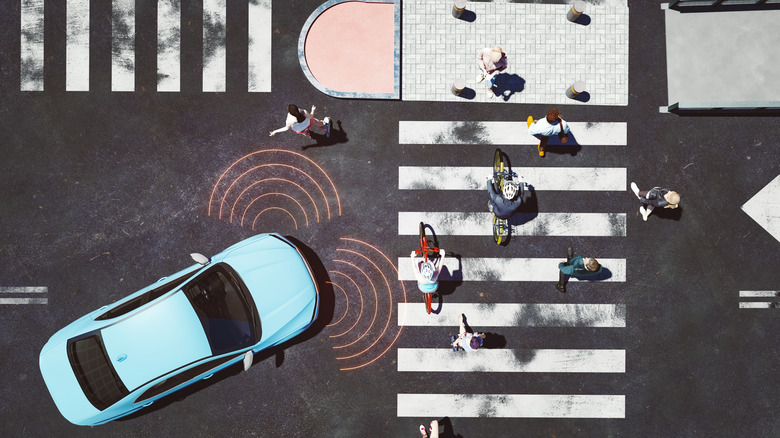
MIT and Motional's work isn't the only effort in attempting to improve autonomous driving. Research at New York University's Tandon School of Engineering as well as at UCLA's Mobility Lab are looking at ways to allow AVs to talk to one another, helping each car to further expand knowledge of its environments. Yong Liu, professor at NYU and supervisor of the project there explained, "A car that has only driven in Manhattan could now learn about road conditions in Brooklyn from other vehicles, even if it never drives there itself. This would make every vehicle smarter and better prepared for situations it hasn't personally encountered."
As for UCLA's work, some of the development is in helping vehicles talk to each other in a way that can help diminish or minimize human-induced blind-spots. An example the program used involves a car approaching an intersection where a tree might conceal a human. Another car approaching that same intersection from another area might be able to tell the initial vehicle there's a human there, so it can be aware of the potential hazard when pulling through.
Regardless, having a way to understand how these AI learning models are interpreting information in real time could be beneficial to both helping drivers be more comfortable with this seemingly "magic" technology and help humans see mistakes in real time that can potentially be fixed in the backend. With that in mind, maybe the deregulating and stripping AVs of essential components like brakes and steering wheels should take a heavy pause until these systems have been verified and proven to be more predictable on the open roads. But that would of course require regulating things, and in this current regime, that's not looking to be on the table any time soon. Hey, at least the scientists are trying to make it better.