

2027 Bentley Supersports Is An Unexpected Delight On Track
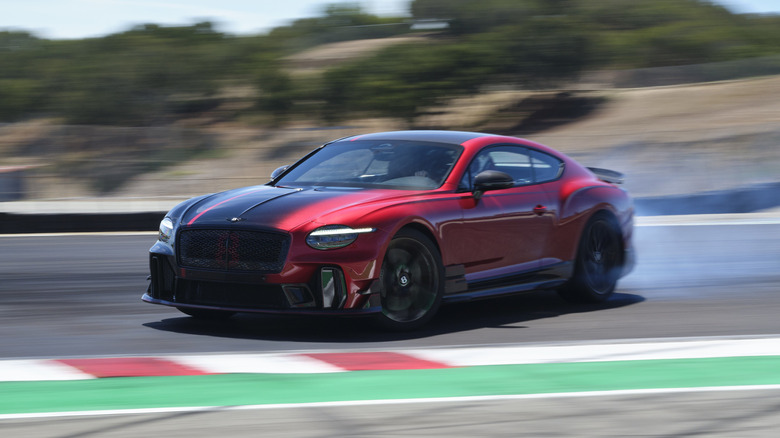
Out of all the locales you might expect Bentley to host a new-car launch, WeatherTech Raceway Laguna Seca is probably the last place you'd guess, even given Bentley's modern history of higher-performance models. And yet here I am, standing in the Laguna Seca pit lane with a helmet on, about to get behind the wheel of a 2027 Bentley Supersports for a few hot laps.
The new Supersports is the latest in Bentley's line of super-sporty Continental GTs, and it's far more extreme than the GT3-R and last-gen Supersports of the late teens. This is the first rear-wheel-drive Continental of the Volkswagen era, and not only is it much lighter than any previous Conti GT, it's the company's lightest car in 85 years. And as you can see from its carbon-fiber bodykit, Bentley made sure it looked overtly sporty, too.
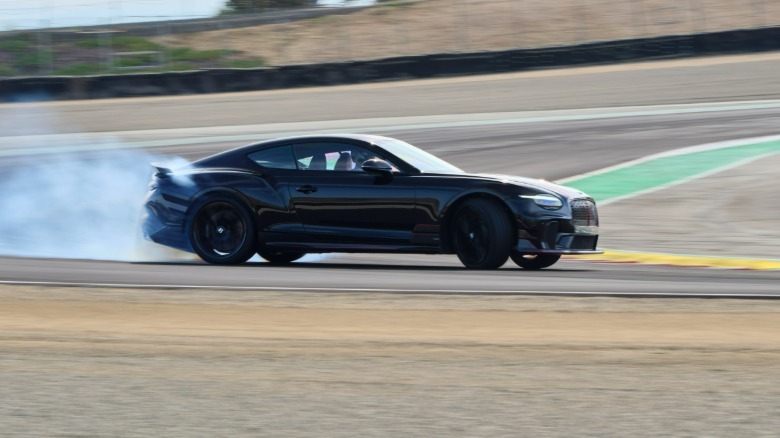
Sadly I don't actually get to drift it — apologies for baiting you with that rad lead photo — but Bentley did let me do half a dozen laps around the track at a rapid pace. You might think that a track-focused Bentley is a ridiculous contradiction, but the new Supersports is the real deal. It's got the actual performance to back up its looks and positioning, and it's downright fun. This is a totally new sort of Bentley, but it's a Bentley through and through.
Full disclosure: Bentley flew me up to Monterey a few days after Car Week and put me up in a hotel for the night so I could ride in the Torcal and drive the Supersports for a few laps around Laguna Seca.
Function over form
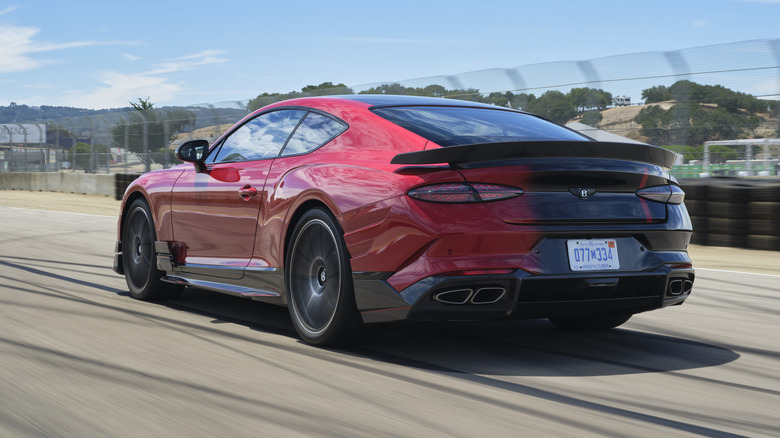
After walking around a couple differently spec'd Supersports and really taking in the car's design, I gotta say I think it looks f**king awesome. While previous Supersports and even the GT3-R were fairly subtle, the new Supersports is more badass, in-your-face, and has a much bigger Need for Speed vibe than any Bentley before it. And before you start talking about how "boy racer" it might look, just know that everything about its carbon-fiber bodykit was developed with aerodynamics and performance in mind first, design second.
 Bentley
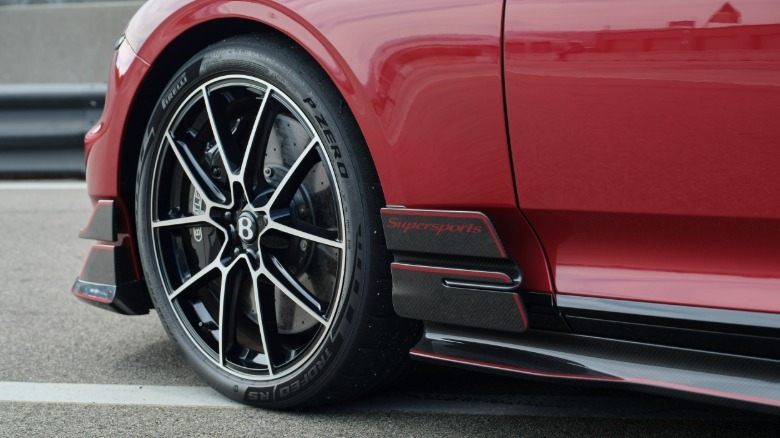
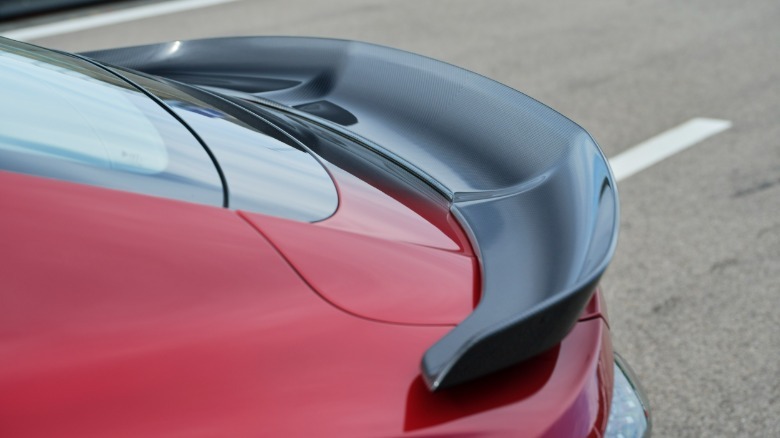
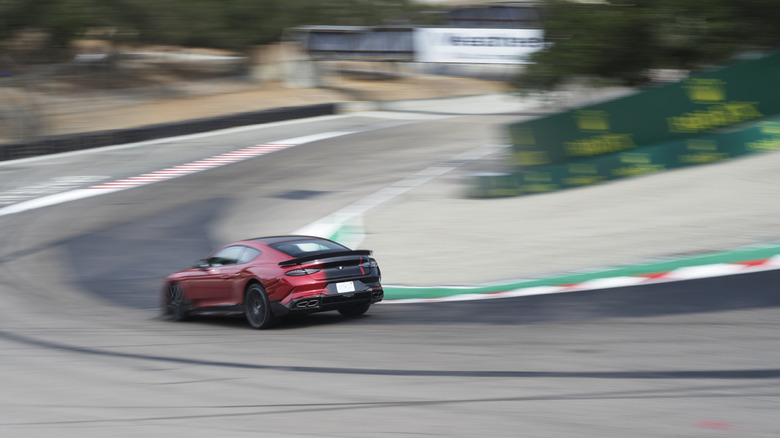
Most noticeable are the mouthy front end with its dive planes and chin splitter, the fender blades just aft of the front wheels, the chunky diffuser and the big rear spoiler. All of those tweaks add up to 661 pounds more downforce than a Continental GT Speed. Other Supersports-specific changes include a laser-cut pattern for the aluminum grille mesh, 22-inch forged wheels developed by Manthey (that are disappointingly boring to look at), carbon-fiber mirror caps and dark-tinted headlights.
 Bentley
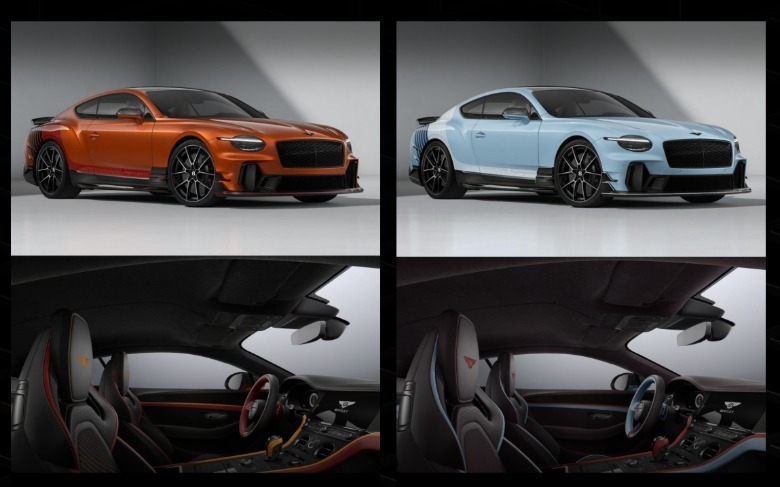
One of the Supersports at the event is the "Nightfall" paint scheme, which pairs gray paint with some subtle gold accents and graphics. It's fine, but the Supersports deserves a really wild spec, like the Mulliner "Dragon" theme of the second car. Bentley recently started offering ombré paint jobs that can go up and down, side to side, or front to back, and with basically any combination of colors. Paired with the off-center stripe and accents, I think it looks really cool, and I can imagine so many great possibilities. Bentley is also offering hand-painted stripe graphics in multiple colors, which I hope a lot of owners go for.
Strictly a two-seater
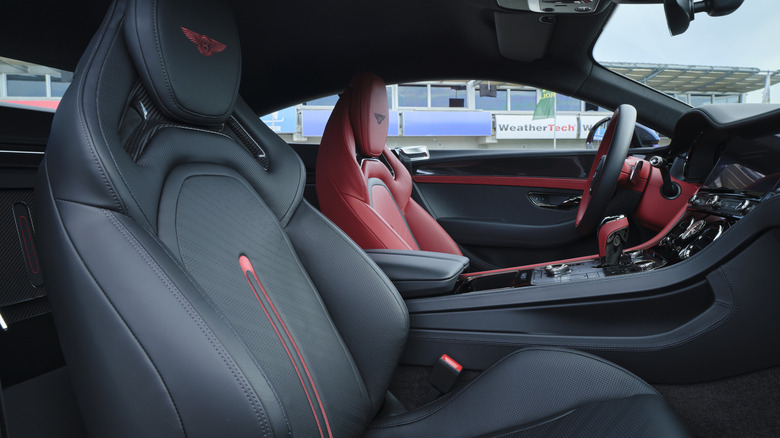
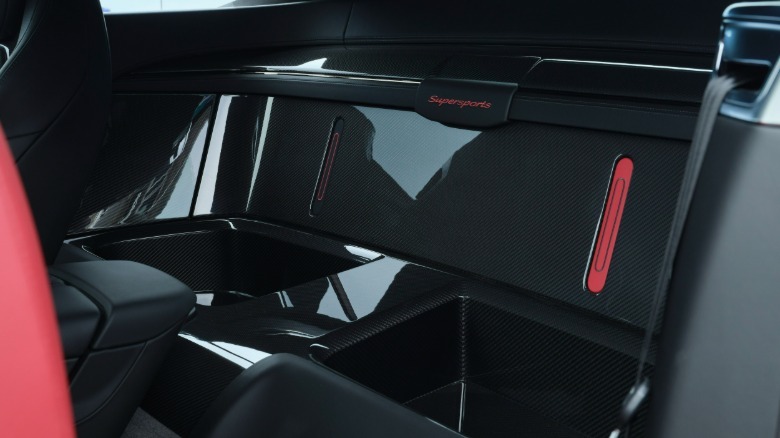
Inside it's largely the same as a regular Continental, but just as on the original Supersports, the rear seat has been removed with a lovely molded carbon parcel shelf in its place, and the massaging front seats are now carbon-fiber-backed buckets with fixed headrests. At least unlike the first-gen Supersports, which shared its manually-adjustable seats with the Bugatti Veyron, these new ones are still heated and power-adjustable. They're really supportive, too, and the seating position is lower than in the regular Conti. Otherwise, changes are limited to some Supersports-specific trim and color scheme options, like the two-way color split of the Dragon car.
 Bentley
Before you see or get in the Supersports, though, anyone within half a mile of the Supersports will experience one of its more visceral qualities: the way it sounds. As I wait for my turn to drive, I watch my colleagues come around the track's final corner and blast past us up the main straight and under the Mission bridge, but I hear the Supersports well before I actually see them coming. The titanium exhaust makes a great bassy rumble as it rips by, and it's all a natural sound. There's just enough fun noises on overrun and upon shifting to make the car sound exciting but not over-done.
Bentley upgraded the twin-turbocharged 4.0-liter V8's crankcase, cylinder heads and turbos, and in the Supersports it makes 657 horsepower and 590 pound-feet of torque. That's more power than a Bentayga Speed has, and it's not far off the base PHEV Continental, which has 671 hp and 685 lb-ft. The best point of comparison is against the pre-facelift Conti's V8, which made do with only 542 hp and 568 lb-ft. Though not quite as rapid as the all-wheel-drive hybrids, Bentley says the Supersports will still hit 60 mph in 3.4 seconds, and acceleration feels really punchy from behind the wheel. I don't even push it that hard, and I still carry a lot more speed on the main straight and heading into and out of some corners than I did in a 911 Carrera S a few months ago.
One of the industry's biggest diets
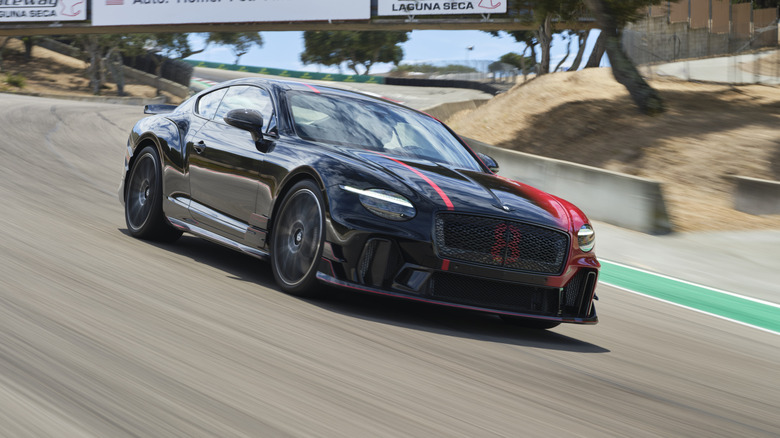
Immediately after setting off the Supersports feels like a totally different animal compared to other new Continental GTs, especially the new plug-in-hybrid ones, and its weight-savings regimen is a huge part of that. In addition to forgoing a hybrid system, making it rear-wheel drive and taking out the back seats, Bentley took out a lot of sound deadening, redesigned the sound system for just two passengers, and fitted a carbon-fiber roof. We don't know the final U.S.-market weight figure yet, but the Supersports will come in a little under 4,400 pounds, over 300 pounds lighter than the old nonhybrid V8 Continental and about 1,100 pounds less than a new PHEV one. Compared to the hybrid, most of that weight has been taken off the rear axle, partly why there's that big rear spoiler.
 Bentley
That diet has been a huge boon for the Supersports' steering. Bentley's current lineup is already wonderful to drive, but without driven front wheels and with all that weight taken out, the Supersports' rack is downright sporty. It's way more communicative and responsive than any other new Bentley, and though it starts out light the steering loads up nicely. Turn-in is particularly sharp and satisfying.
Even if the Continental's existing all-wheel-drive system can have a very rear-heavy bias, it's not the same as a pure rear-drive setup, and that's a lot of power to put down. There's still an electronic limited-slip differential to distribute torque between the rear wheels, which feels pretty natural in its operation, and the company also left in the Conti's rear-wheel steering, and it never feels intrusive or twitchy, which can sometimes be a problem with sports cars that have the feature.
It's fun even with traction control on
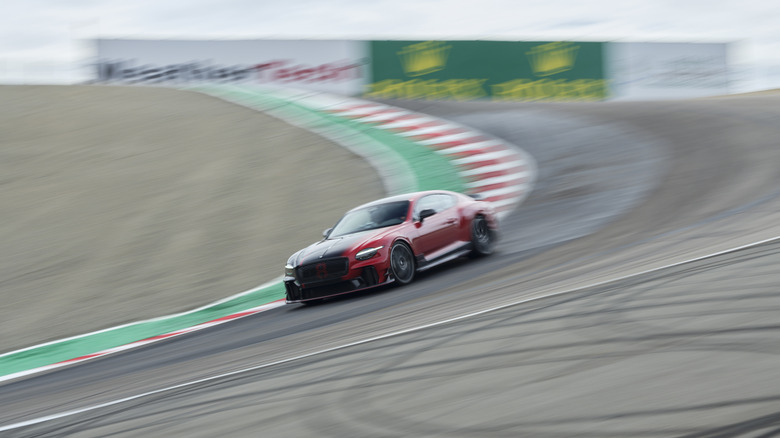
For our laps Bentley keeps all of the traction control and stability systems turned on, and the car definitely feels like it will be more agile and a lot more fun with them off or put in Dynamic Handling mode, but it still allows for some playfulness in the corners and doesn't cut in too badly, only really being noticeable if I try exiting a corner particularly aggressively. It was especially depressing watching people from Bentley's team drift the car around corners for photos, not being able to do it myself... Hopefully next time. My passenger, product communications manager Jonathan Smedley, encourages me to start getting on the throttle just before apexes to get the Supersports to rotate, and once I start nailing that behavior the car really comes alive. It's really easy to get into a good, exciting flow in this car, and it never feels too big or too heavy or too unwieldy.
While Bentley removed a lot of weight, it left in the Continental's air suspension and 48-volt active anti-roll system, which keeps the car remarkably flat even in the more off-camber corners. Tackling the Corkscrew is no problem, either. It still rides pretty well when I hit the rumble strips, and that's in Sport mode; Bentley says its Touring and Bentley drive modes have been tuned to make sure the car is appropriately comfy around town. And despite the removal of some sound deadening, it's still very quiet inside.
 Bentley
The cars we drive have really sticky Pirelli P Zero Trofeo RS, an option for the 22-inch forged wheels that allow the Supersports to pull 1.3 g in the corners, but even the standard P Zero PZ4s should be plenty good. (Bentley says initial prototypes kept firing the seatbelt pre-tensioners, because the Conti's computer systems weren't used to that kind of cornering performance.) Definitely up to the task of reigning in the car from those cornering speeds are the standard carbon-ceramic brakes, which have 10-piston calipers and 17.3-inch discs up front. Pedal feel is excellent, and I frequently find myself braking too hard, too soon, when only a lighter press is necessary to decelerate for a corner. Bentley tells us the cars have been running hard for two days around the track without the brakes needing to be serviced, though I do have to do a few careful cooldown laps at the end of my stint.
They're all spoken for already, sorry
Bentley is only going to make 500 of the new Supersports, and they're all sold out. In fact, during an interview at Monterey Car Week with Dr. Matthias Rabe, member of the board for R&D, he told me that the whole run was sold out within just two months after the car's New York City reveal in November, something the company was not expecting given how big of a departure the car is for the brand. The Supersports starts at $490,350 including the gas-guzzler tax, nearly $150k more than a GT Speed, and I have to imagine most builds will start with the number 6 once options are taken into account.
I don't think those 500 customers will be disappointed by what they've spent their money on. The new Bentley Supersports is a car with a big personality and breadth of ability, one that feels surprisingly at home on one of America's best race tracks. And in terms of Bentley's ambitions to be a more enticing brand to driving enthusiasts, this new Supersports is just the beginning. Overseen by new chairman and CEO Dr. Frank-Steffen Walliser, a small skunkworks team of Bentley engineers developed this car in secret, building a sole prototype that was so convincing it was quickly green-lit. Imagine what the company could do now that it knows there's an appetite for this sort of Bentley.