

Porsche's Track Experience School At Laguna Seca Is More Than Worth The Splurge
For my 16th birthday, my parents signed me up for a day at Skip Barber's new driver school, which I did just a few months after getting my learner's permit. Beyond just being fun as hell, it immediately made me a better and safer driver. I took another, more in-depth course a few years later, which left me even more confident behind the wheel. Professional driving schools are something I recommend to everyone, whether the parent of a teen or an experienced driver, but beyond the road-focused courses there's a whole world of on-track schools too.
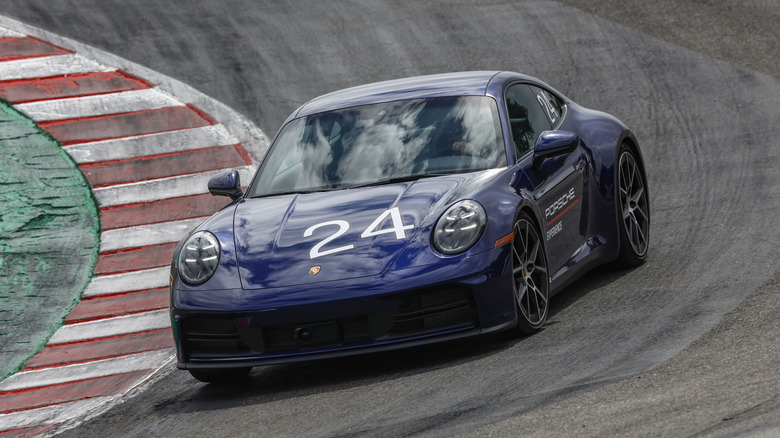
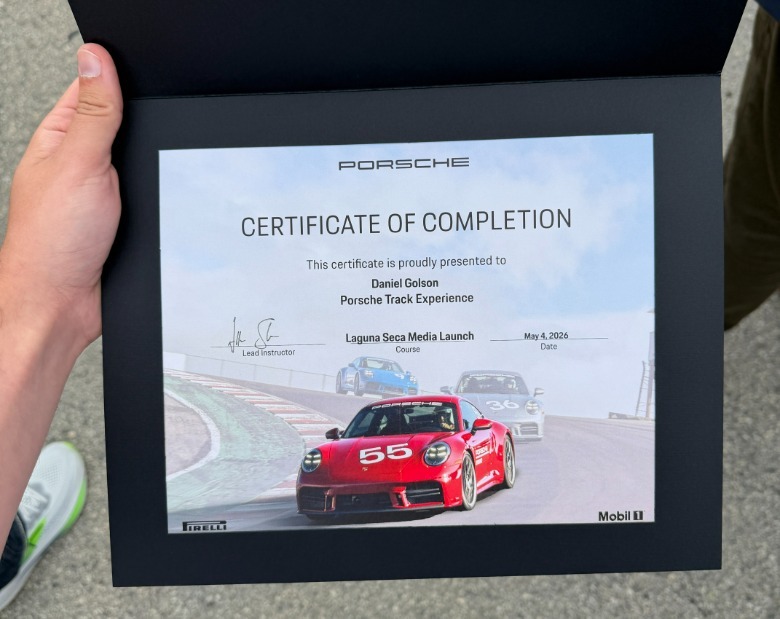
While I've gotten to have a good amount of on-track time through this job, including some events with an instructor in the car, I hadn't gone to a proper track driving school, so I leapt at the opportunity to attend one of Porsche's Track Experience schools at Laguna Seca. Who's gonna say no to spending a day driving a brand new 911 Carrera S around one of the best tracks in the world?
Though it's more expensive than some other schools out there — I mean, we're talking about Porsche after all — the Porsche Track Experience is more than worth the splurge. I came out of the day so much more confident in my abilities, both in terms of Laguna Seca specifically and racetrack driving in general, and it was an absolute blast.
Full disclosure: Porsche gave me a Taycan GTS to drive up to Monterey so I could go to the IMSA race at Laguna Seca and then attend the Track Experience school. It put me up in a hotel, fed me, and bought my plane ticket home.
PTX's 26th year of operation
This is the 26th year of the Porsche Track Experience, which was originally at Road Atlanta and Sebring before relocating to Barber Motorsports Park in Alabama. PTX only just launched at Laguna Seca back in March, becoming the second currently-running location after Barber. It's a partnership that makes sense for both automaker and track to do — Porsche is the winningest manufacturer at Laguna Seca, after all. 55,000 people have taken a PTX course since 2000, about 5,000 people per year, with the school running 230 days out of the year.
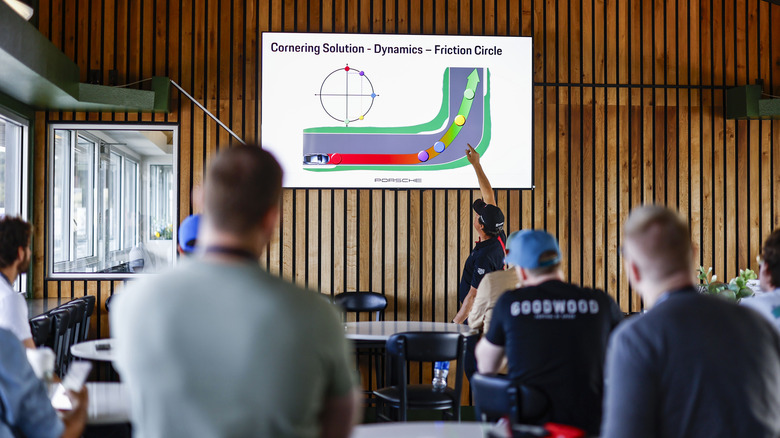
Before hitting the track we had a fairly brief classroom section where an instructor went over some car control and track driving basics, told us about the track, and what we should expect from the day. It was all focused around the 911 specifically, as the car's rear-engine setup makes for unique driving characteristics when it comes to handling, braking, and weight transfer. Actual paying customers get a more in-depth educational session, plus time to drive on the skidpad and do some parking lot exercises like braking drills, but because all of us had at least some experience on track, we skipped all of that in favor of getting right to it.
 Daniel Golson/Jalopnik
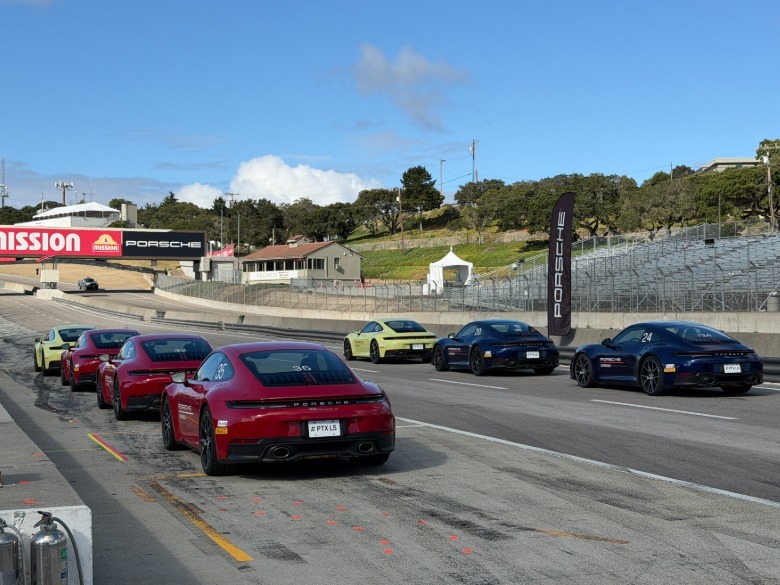
All of our 911s were basically the same when it came to Porsche's performance options, chief among them being the carbon-ceramic brakes, but I was lucky enough to drive one of the few cars that had ventilated seats, a very nice thing to have while driving on track. Some of the more expensive Track Experience schools use more performance-oriented models, but this course uses the 911 Carrera S, both because it's perfectly balanced and because it's the best-selling version of the 911, making up a third of all sales globally. Having never driven the track before, I wasn't too upset that we weren't in the GT3s.
We got split up into four different groups based on level of experience, with one instructor (all professional race car drivers) and two or three of us journalists in each group. All four groups were running at the same time, with the slower ones occasionally waving the faster groups by. Our instructor was running in pole position the whole time, adjusting his pace based on how we were doing. I was continuously impressed with how he was able to keep an eye on all three of us in the rear view and give notes and advice over our in-car radios, all while driving at pace and on the racing line and cracking jokes. Every couple of laps, the car in front just behind the instructor would fall to the back of the group, so we all rotated through for a balanced amount of time in the prime learning spot.
The Corkscrew rules
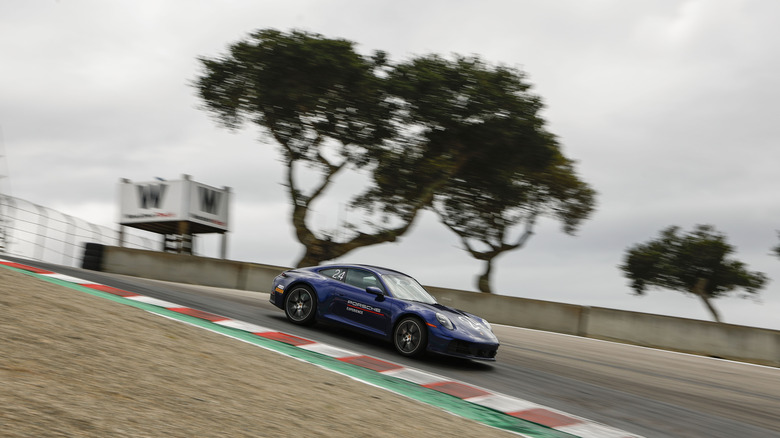
But before we actually started going fast, we spent a few laps taking it slow and learning the track. No one in my group had driven Laguna Seca before, and walking around the track as a spectator or even doing a ridealong really doesn't give you the full idea of what it's like to do it yourself. (That's especially true for me, as my sole on-track experience at Laguna until this was riding shotgun in a 718 GT4 RS with Timo Berhnard at the wheel, and I'm not exactly gonna be able to match his pace.) We learned the proper braking zones and turn-in points, where to focus your eyes in critical sections like the Corkscrew and the main straight, and how intensely to attack certain corners. Porsche set up small cones at the corner entries, exits, and apexes, plus a few markers for braking zones. My thousands of virtual laps raced on Laguna Seca in video games may have cemented a memory of the track layout and turn order in my brain, but actually being behind the wheel, I was tackling it with totally fresh eyes.
Those couple of scouting laps were helpful for sure, especially because once they were done we immediately picked up the pace and put the hammer down. The Carrera S' 473 horsepower were plenty for my first time on a new-to-me track, and even with stability and traction control kept on (that's a Porsche mandate, lest ye go without insurance and risk a hefty bill) the 911 was playful enough to shimmy around in corners. Porsche's PDK 8-speed automatic is perfect enough that I never felt the need to use the paddles myself, either.
 Porsche
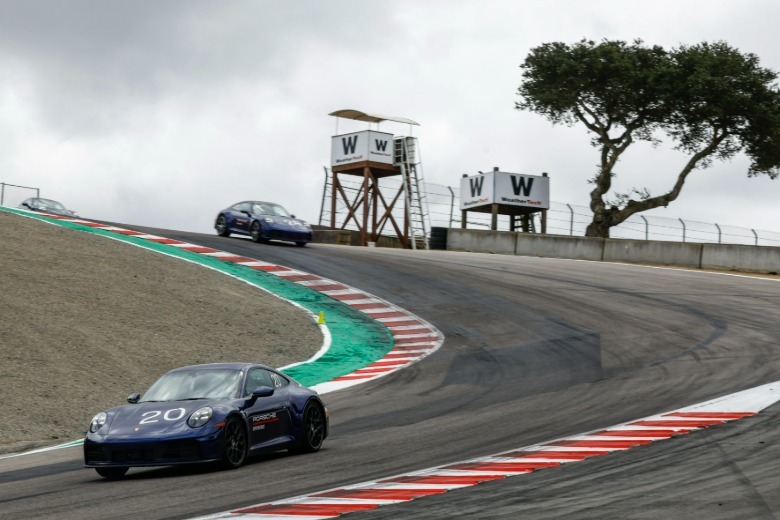
Yes, driving the Corkscrew is a singular experience, and absolutely terrifying at first. Coming to the top of the hill towards turn 8 we hit speeds of over 110 mph even on early laps, and the ideal braking point doesn't come until right as you're cresting the blind hill. It's a sharp left turn down, where you've got to focus your eyes on a tree to properly line up the car, and before you can process that motion it's time for a sharp right to accelerate through the turn. There's a lot to get right, and it's a lot to process in a very brief amount of time. And that 59-foot drop in elevation is no joke.
It's a corner I kept having to force myself to push even harder into, as my brain and body both kept telling me to back off so I wasn't braking late enough or taking the apex tightly enough. But after the first handful of laps, somehow the Corkscrew became pretty easy to deal with, and really damn fun. It's hard not to grin and laugh while going through it — as long as you can stop yourself from concentrating so hard that you make a strange, embarrassing face, the main reason I won't be posting any of my in-car video — and the thrill of feeling my stomach drop and the 911 hunker down never got old.
Other corners are much harder to master
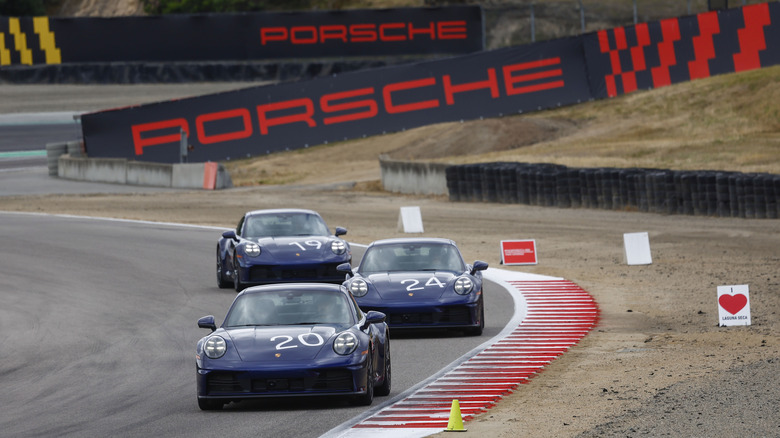
I expected the Corkscrew to be difficult, but other sections were far tougher to consistently get right. If you don't properly exit the Corkscrew, then the car won't be correctly positioned to nail turn 9, and you certainly won't be going fast enough. That one is a lot trickier than it seems at first. And if you don't get turn 9 right, you probably won't nail turn 10 either, and then you're ill-prepared for the final corner. The section I had the hardest time with — and one I always mess up in video games too — was the Andretti hairpin just after the main straight. I really struggled to correctly hit both apexes and set myself up for the next corner, but every time I got it right felt so good.
My favorite part of the track? Turns 5 and 6, then the Rahal Straight toward the Corkscrew. They're both quite tight and kinked, and the suspension really gets compressed in the apexes, but we took them as aggressively and flat-out as possible, which always elicited a cackle from me. Those two corners happen as you're quickly gaining altitude toward the peak of the track, adding to the excitement. The feeling of flooring it down the main straight was also quite thrilling, with the 911's front end getting light and the butterflies in my stomach flapping as the car crested the hill through turn 1 at around 130 mph.
Every dozen or so laps we would pull into the pits to take a breather and get some additional tips and feedback from the instructors before heading back out. It was helpful to talk to my fellow drivers about what sections they were struggling with or feeling extra-confident about, and we'd go back out with goals of where to improve. Climbing back into the car I'd think, "alright Daniel, you've got this," and after each out lap I felt like I had leveled up a bit.
Rubber? I don't even know her
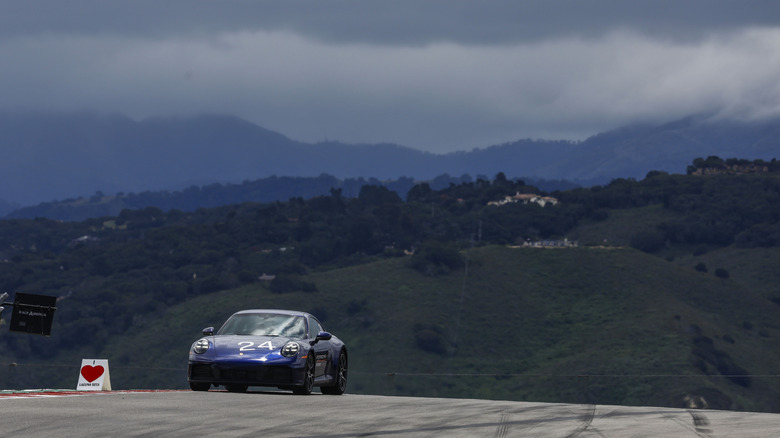
Throughout the whole day but particularly once we had the first couple sessions under our belt and our tires were properly heated up, we dealt with a phenomenon I'd never experienced before: chunks of rubber left on the track from the IMSA race the day before, plus some new bits from us. The instructors warned us about this ahead of time, that it would both feel and sound unsettling, but that undersold it. At some points it was so noisy inside the car that it felt like a helicopter was hovering overhead, and the rubber picked up by the tires made for some really violent vibrations.
This wasn't something to be afraid of, though, and the Porsche team kept talking about how excited they were to have all that rubber on the tarmac. It definitely made for some livelier moments, especially when exiting out of corners — and some "oh, sh*t" moments when a chunk would violently smack into the windshield or front end of the car. We also had to deal with a dead rabbit and then a dead rattlesnake on the track, right at the peak before the Corkscrew. After we raced around the track for a bit longer, the rubber became less of a problem and our tires were really primed for fast lapping.
By the time we began our last stint on track, having racked up dozens of laps, I was feeling really good. I wouldn't call it a "flow state," but almost all of my nerves had turned into courage and determination. Any good race car driver will tell you that consistency and smoothness are key — our instructors told us to imagine there's a string connected to the top of the steering wheel and our feet, as you can't give 100% throttle or braking and increase the steering angle at the same time. That metaphor definitely helped.
Book a class. You know you want to.
Cliché as it sounds, at the end of the day my biggest problem was myself. I wasn't braking late enough, or getting on the gas quickly enough, or turning in sharply enough, or using enough of the curb at the apex and corner exit. Earlier in the day I definitely felt myself holding back too much, because I was perhaps too focused on getting everything right and staying on the ideal line while also not hitting the car ahead of me. You definitely don't want to be the guy going too slow messing up the pace for the people behind you. As the day went on and I got more laps under my belt, all of that melted away. Even better than thinking that I did something well was hearing it from the instructor. There's nothing like a professional race car driver saying, "Daniel, that corner was perfect, good job," over the walkie-talkie.
And the 911 Carrera S really was the perfect car to do this with. It has some of the best steering on the market, paired with one of the best chassis setups on the market, but the 911's inherent handling characteristics made it a bit daunting. We had to really pay attention to weight transfer and grip levels, especially once we started learning more trail-braking techniques later in the day. Even with all the safety systems turned on, the 911 offered just enough tail-happy playfulness to feel super engaging and exciting. The twin-turbo flat-6 and PDK transmission never skipped a beat, and I was able to really wring the powertrain out through most of the track. Having the AC on didn't seem to sap up any power, either. There was zero fade from the brakes, the seats were super supportive, visibility was excellent, it sounded great... Need I go on?
 Daniel Golson/Jalopnik
I took the equivalent of the one-day Introductory high-performance driving course, which starts at $3,500 at Laguna Seca or $2,400 at Barber; for a half-day version it'll cost you two grand, while the two-day course is $6,500. The cars used for that program are the Carrera S, plus the 718 GTS in Boxster and Cayman form, and the electric Taycan GTS. $9,000 will get you two days of the more advanced intermediate Masters class, and beyond that you can spend $14,000 on the three-day Masters RS course, which gets deep into actual racing instruction and includes seat time in 911 GT3s.
No matter which course you pick and what skill level or amount of on-track experience you go in with, any driver will come out of a Porsche Track Experience school a better driver. You get sent home with a USB drive containing in-car and dashcam footage from your sessions, along with Vbox data, so you can pore over all the mistakes you made and everything you got right. More importantly, you'll also come away with a huge smile on your face. I gotta do rally school next.