

7 Pontiac Models That Showed The Brand Still Had The Goods In The 2000s
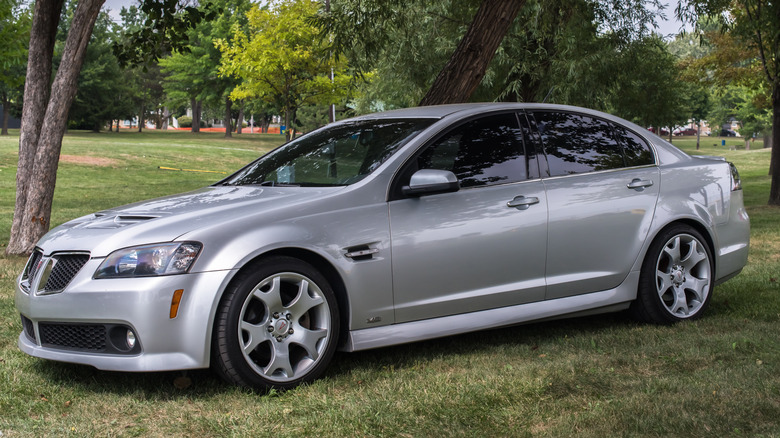
GM has killed many car brands, but the discontinuation of Pontiac in 2010 was perhaps the most heartbreaking. After all, Pontiac was General Motors' enthusiast brand that gave us so many drool-worthy performance machines over the decades, and crucially, at lower prices than the competition. Heck, Pontiacs often were even cheaper than Chevys, without sacrificing performance or driving fun.
Unfortunately, it's precisely those traits that ultimately killed the brand. Pontiac was unprofitable, and how the brand handled its last decade of existence didn't help. Yes, the 2000s gave us some of the wildest enthusiast Pontiacs, but these cars usually don't sell in the millions and are hardly profitable. As much as it stings, if you want to turn a profit, you need SUVs in your lineup. And at the beginning of the 2000s, instead of attracting buyers with a boring, run-of-the-mill SUV, Pontiac was giving them nightmares with the Aztek, one of the ugliest vehicles ever made.
But don't worry, this is the last time we mention Pontiac's infamous SUV. From now on, we'll focus only on cars that showed Pontiac had the goods in the 2000s, which in our dictionary neatly translates to "fun machines." Think Yamaha-tuned utility hatchbacks, front-wheel-drive V8 experiments, gorgeous roadsters, and tire-shredding Australian imports. Tempted? Let's have a closer look!
1996 to 2002 Pontiac Firebird WS6 Trans Am
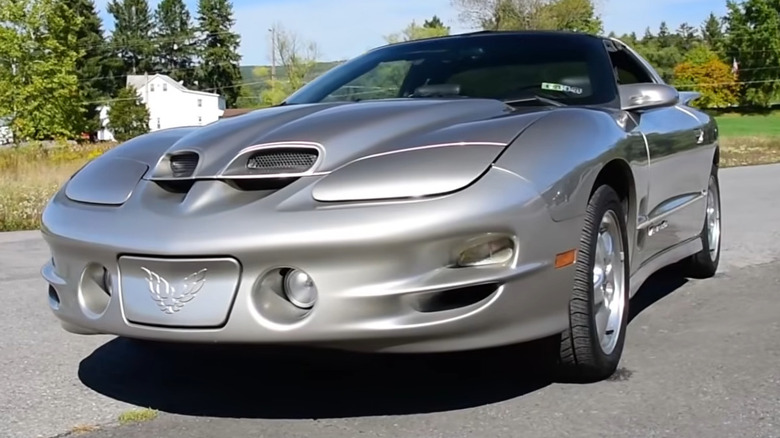
The Pontiac Firebird WS6 Trans Am wasn't introduced in the 2000s — it actually debuted for 1996. However, you could still buy it from 2000 to 2002, and, come on, it's one of the coolest-looking modern Pontiacs. It looks like a Batmobile on steroids, with those front Ram Air nostrils making it look particularly angry.
And those nostrils weren't just for show; the first Firebird Trans Am, introduced for 1996, packed the 5.7-liter LT1 V8 engine from the Corvette, good for 285 horsepower and 325 pound-feet of torque. However, the Ram Air induction system, exclusive for the WS6 package, brought those figures to 305 hp and 335 lb-ft.
Still, the biggest upgrade arrived for 1998, when Pontiac replaced the LT1 with the LS1 V8 from the C5 Corvette. The new engine produced 320 hp and 345 lb-ft with the WS6 package, or up to 325 hp and 350 lb-ft for 2001 and 2002. All Firebird WS6 Trans Ams sprinted to 60 in the 5-second range and had a top speed of 162 mph. A Tremec T56 six-speed manual was standard with all WS6 engines, though buyers could also wrongly opt for a four-speed automatic.
Along with Ram Air induction, the WS6 package brought handling-enhancing upgrades, like larger front and rear sway bars, and stiffer springs, shocks, and bushings. Because F-body GM cars had power steering systems that overheated on track, Pontiac also included power steering cooler with the WS6 package. From 2000 on, though, the cooler became standard on all LS1-powered F-body cars.
2003 to 2006 Pontiac Vibe GT
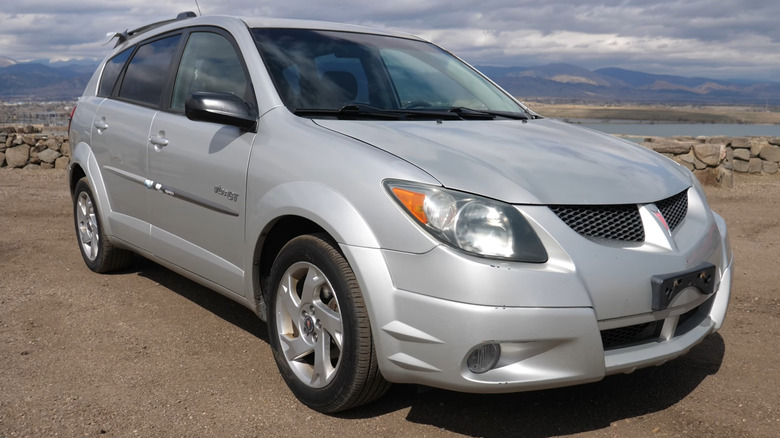
The 2002 Vibe was Pontiac's attempt at creating a practical, efficient, reliable front-wheel-drive urban hatchback. The only catch: it was a Toyota underneath. For many, this signals dullness, and, true, the Vibe's 1.8-liter four-pot lacked oomph, producing only 130 hp. Yes, it came with a five-speed manual option, but you wouldn't call it exciting.
However, for 2023, Pontiac launched the Vibe GT, which packed Toyota's legendary, high-revving 2ZZ-GE engine found in sports cars like the Lotus Elise, bumping up the output to 180 hp. Crucially, the Yamaha-tuned 1.8-liter revved to 8,200 rpm and came exclusively with a close-ratio six-speed manual. As a result, the Vibe GT sprinted to 60 in 8 seconds. Not incredibly fast, we know, but it was largely because of the low 130 lb-ft of torque, which meant you needed to keep the engine at high revolutions constantly to keep the Vibe GT going. Hey, but at least it kept the driver engaged!
The rev-happy engine was only half the equation. The Vibe GT also sat lower to the ground, which made it sharper through the tiwsties, while the good steering accompanied the slick-shifting manual transmission. Inside, the Vibe GT came standard with bucket seats and a sporty three-spoke steering wheel. As a bonus, the Vibe GT was also surprisingly spacious inside. Both seating rows accommodated adults comfortably, while the 24.6-cubic-foot trunk (all seats up) is still impressive today.
2004 to 2005 Pontiac Bonneville GXP
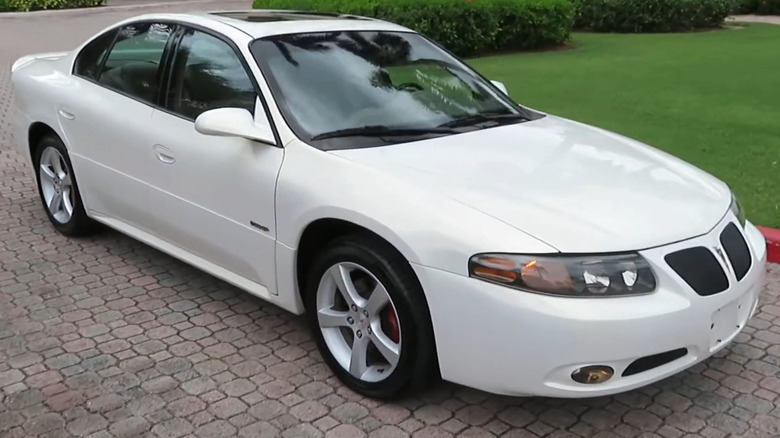
On paper, a front-wheel-drive family sedan shouldn't belong on a list like this. But the 2004-2005 Bonneville GXP isn't your ordinary FWD sedan — it's a performance-oriented, V8-powered enthusiast machine. Heck, it was even Pontiac's first GXP-branded car, which only adds to its significance.
The V8 engine in question was GM's 4.6-liter Northstar, which produced 275 hp and 300 lb-ft in the Bonneville GXP. A four-speed auto was the only transmission on offer, but we'll give that a pass, as this is a full-size sedan, after all. One that accelerated to 60 in less than 8 seconds — solid enough for the era — and handled like it was on rails.
Wait, are we actually suggesting the big Bonneville GXP had legitimate handling chops? Well, that's what reviewers said at the time, which isn't too surprising, as Pontiac reworked the suspension to help the large sedan cope with the V8 power. The Bonneville GXP had firmer suspension, load-leveling De Carbon dampers in the rear, thicker anti-roll bars, and wide 235-section tires on all four corners.
So, keeping in mind that it's large and heavy, the Bonneville GXP was frequently praised for being flat and stable through the bends. Of course, torque steer was also part of the equation, but so were smoky front-wheel burnouts. Maybe this is the reason why it's one of your favorite Pontiacs? Or is it being one of the era's sleekest-looking sedans? Whatever the reason, we would love to see today's automakers be as brave as Pontiac was in the 2000s.
2005 to 2008 Pontiac Grand Prix GXP
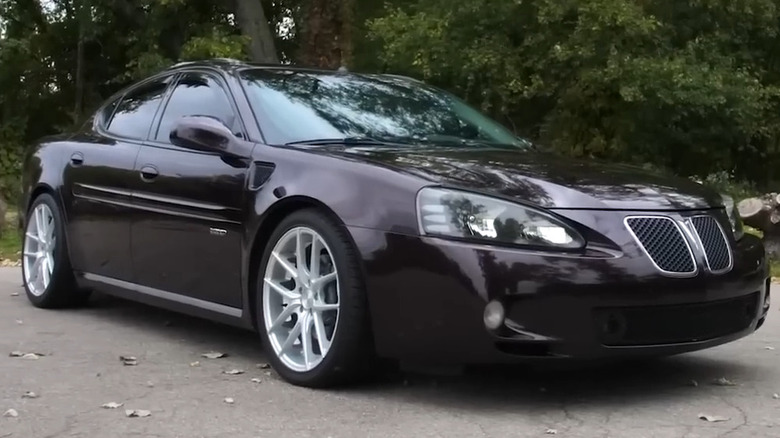
The Bonneville GXP wasn't very successful — just 6,613 sold over two years — but it was a successful proof of concept. So for 2005, Pontiac crammed a V8 in the smaller Grand Prix sedan, which was also exclusively front-wheel-drive. Only this time, instead of the Northstar V8, the automaker used the significantly more potent 5.3-liter V8 with 303 hp and 323 lb-ft, which accelerated the midsize sedan to 60 in a brisk 5.7 seconds (per Car and Driver). And the new LS4 motor was from the popular LS series, known for its toughness and reliability.
Pontiac again mated the V8 with a four-speed automatic, but implemented some new techniques to combat torque steer. Most notably, the Grand Prix GXP used a reverse-staggered tire fitment (245-section front, 225-section rear), running wider rubber on the front axle than the rear. This largely dampened the understeer issue that plagued GXP's predecessor, the Grand Prix GTP. Oh, and that car packed a less potent 3.8-liter supercharged V6 with 260 hp and 280 lb-ft.
The Grand Prix GXP also had front Bilstein monotube dampers to further stabilize the front end and enhance grip. Pontiac was so confident in the car's cornering capabilities that it even equipped it with a g-meter, which measures acceleration/deceleration and lateral grip, challenging the driver to push the chassis even further. Meanwhile, to enhance agility, the Grand Prix GXP featured the highly-responsive GM Magnasteer II steering system, which only required 2.4 turns lock to lock. The result might not have been as balanced or engaging as a German rear-wheel-drive sports sedan like the BMW 325i, but the Grand Prix GXP was also cheaper and significantly more powerful than its Bavarian rival.
2007 to 2009 Pontiac Solstice GXP
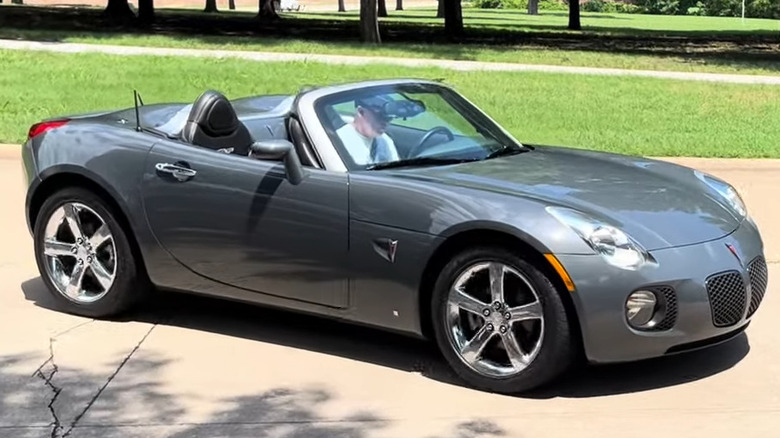
Pontiac had done it all by the 2000s, producing everything from iconic muscle/pony cars to a budget-friendly mid-engine sports car and front-wheel-drive performance sedans. However, Pontiac didn't launch its first lightweight sports car until the 2006 Solstice arrived. A front-engine, rear-wheel-drive coupe/convertible, the Solstice was a car that Bob Lutz, one of the most famous auto executives ever, had dreamt of making for a long time.
Unlike Pontiac's other offerings, this roadster was designed to be agile and direct, if not brutal in a straight line. It arrived with a 2.4-liter naturally aspirated four-pot with measly 177 hp paired to a five-speed manual. The Solstice convertible wasn't fast, but it weighed only 2,860 pounds, which made it fun to throw around corners. Still, for 2007, Pontiac gave the roadster a power train worthy of its chassis in the high-performance GXP. The 2.0-liter turbocharged four-cylinder produced 260 hp and 260 lb-ft, propelling the Solstice GXP to 60 in the mid-5-second range. Heck, Tesla designer Franz von Holzhausen even owns a Solstice powered by a 400-hp LS2 V8, showing how good a platform it was.
Indeed, the Solstice GXP had all the goodies you'd expect from a performance roadster, like a stiffer suspension, optional limited-slip differential, and a standard five-speed manual. While heavier than the regular variant, the GXP convertible still weighed a svelte 2,976 pounds. It certainly didn't hurt that the Solstice GXP was stunning to look at. Its classic sports car proportions and taut, yet elegant body still look seductive to this day.
2004 to 2006 Pontiac GTO
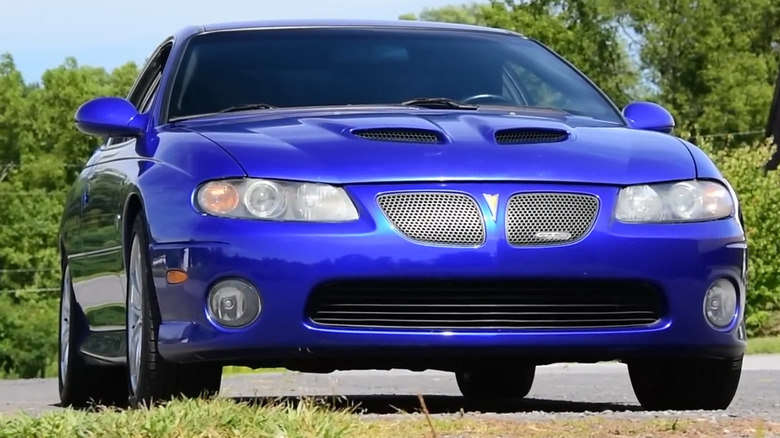
The 1964 Pontiac GTO is often lauded as one of the first true muscle cars, combining a midsize chassis with a massive 389-cubic-inch V8 that produced 348 hp. However, the last GTO wasn't built by Pontiac, but by GM's now-defunct Australian subsidiary Holden. Not that it mattered much, as the 2004-2006 GTO still managed what Pontiac always stood for: supercar-matching performance on a budget.
Powered by Corvette engines, the GTO could embarrass most sports cars at the stoplight, especially because it also looked quite sedate and normal. In that sense, it was the ultimate sleeper in the mid-2000s. The first GTO, introduced for 2004, came with the 5.7-liter LS1 V8 that produced 350 hp and 365 lb-ft, enough for a 0-60 sprint of 5.3 seconds with the standard (via MotorTrend). The 2005 and 2006 GTOs were equipped with the significantly more potent 6.0-liter LS2 V8, which produced 400 hp and 400 lb-ft. 0-60: 5.1 seconds (via MotorWeek). However, both those 0-60 times were achieved with the standard all-season tires, meaning a set of stickier summer performance tires would've probably gotten them under 5 seconds.
Yeah, we know, a muscle car that's fast in a straight line is nothing new. However, the Pontiac GTO was also surprisingly good once the straights ran out. It had a front/rear independent suspension and a responsive, balanced rear-wheel-drive chassis that kept the driver engaged. Yes, the GTO was heavy at around 3,700 pounds, but it masked its weight surprisingly well. To keep purists happy, Pontiac offered an optional six-speed manual, though a four-speed automatic was standard.
2008 to 2009 Pontiac G8 GT/GXP
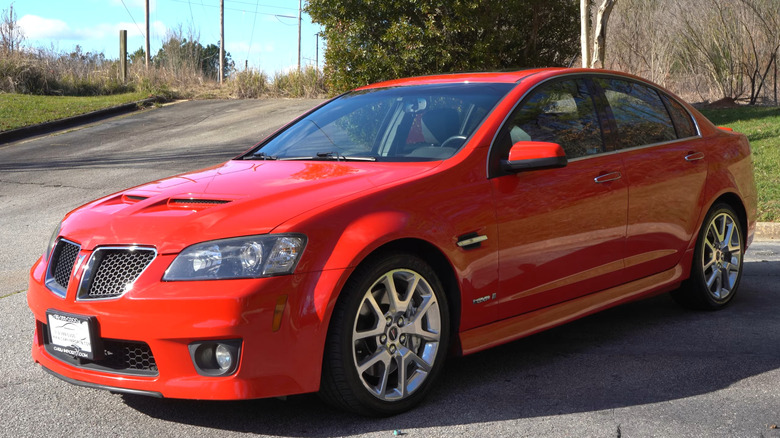
Axing the revived GTO only three years into its production cycle stings, but at least Pontiac gave enthusiasts one last hoorah with the G8 performance sedan. This time based on the Australian Holden Commodore, the G8 brought muscular looks, peppy engines, and a practical sedan body to Pontiac's lineup.
Yes, the base model came with a 3.6-liter V6 with 256 hp, but the GT and GXP versions were proper tire shredders. The G8 GT was equipped with the 6.0-liter LS2 V8 engine, which produced 361 hp and 385 lb-ft, enough for a 0-60 sprint of 5.3 seconds. Unfortunately, the G8 GT was only offered with a six-speed automatic, so it wasn't as engaging as Pontiac enthusiasts would've hoped. The G8 GT was still good at handling twisty backroads, while also offering a smooth ride.
Still, it's the Pontiac G8 GXP model that gets enthusiasts excited, as it came with an optional Tremec TR6060 six-speed manual. It also had the higher-capacity 6.2-liter LS3 V8 that produced 415 hp and 415 lb-ft. This engine turned it into a supercar crusher, allowing a 0-60 time of only 4.5 seconds.
Pontiac also equipped the G8 GXP with an even stiffer suspension and Brembo brakes to make it more drivable and safer at speed. And if that wasn't enough to take on the era's best performance sedans, the automaker developed G8 GXP's handling/ride balance at the Nürburgring circuit.